


DevOps Articles
Claude for IT Help Desks: Reducing Ticket Volume
From Beginner to DevOps Engineer: How HCL GUVI Zen Class Helps You Get There


Get In Touch For Details! Request More Information
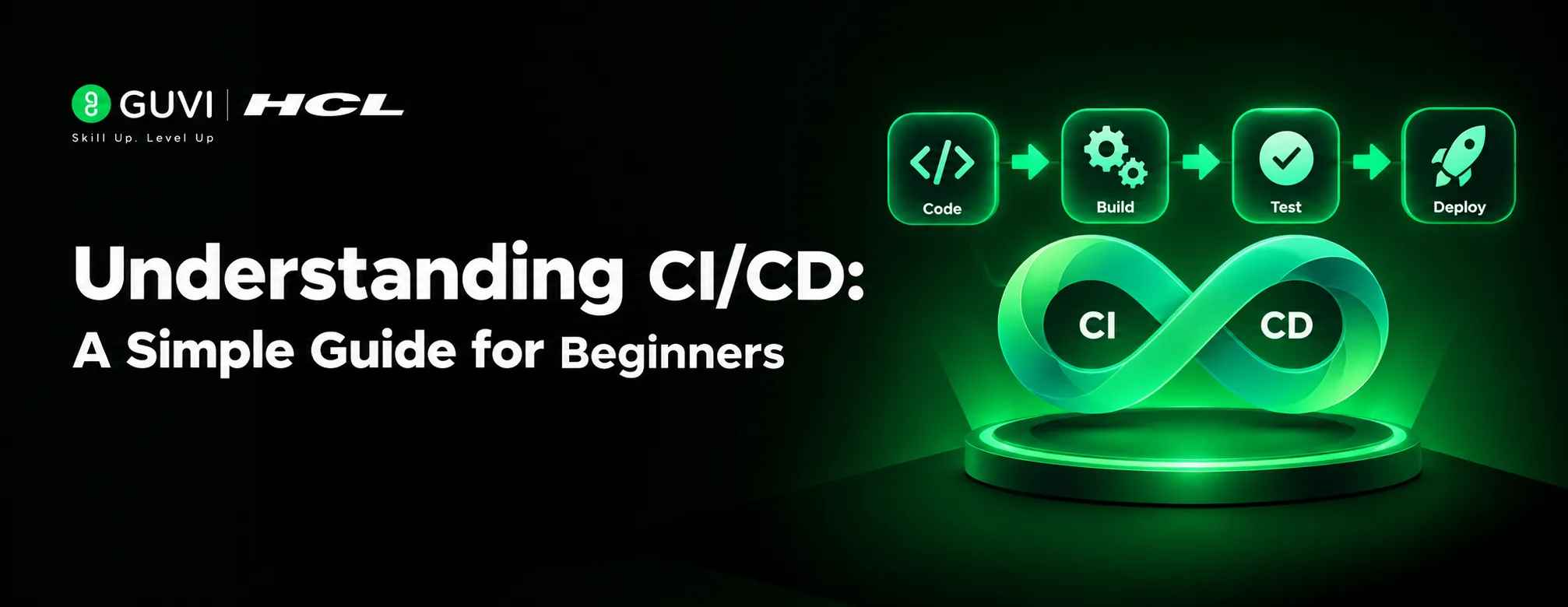
Understanding CI/CD: A Simple Guide for Beginners
Sep 26, 2026 3 Min Read 11338 Views
(Last Updated)
Every new feature or bug fix that reaches an app is usually delivered through CI/CD. It is a development practice in which teams frequently merge small code changes, then test and release them through automated processes.
Before CI/CD, teams often waited weeks to combine their work into a single release. This made errors harder to find and fixes slower to deliver. CI/CD removes that delay by checking every change as soon as it is made.
Quick Answer: CI/CD is a software development practice that automatically builds, tests, and delivers code changes. Continuous Integration (CI) merges and tests code often, while Continuous Delivery or Deployment (CD) releases it to users. Together, they help teams ship updates faster with fewer errors.
The term “Continuous Integration” was first used by Grady Booch in 1991, years before automated pipelines made it an everyday practice.
Table of contents
- What is Continuous Integration (CI)?
- Key Benefits of CI:
- What is Continuous Deployment (CD)?
- Key Benefits of CD:
- How Does CI/CD Work Together?
- Tools for CI/CD
- Conclusion
- FAQs
- What is a CI/CD pipeline?
- Why is CI/CD important in software development?
- Which tools are used for CI/CD?
- Is CI/CD only for large teams?
- Is CI/CD the same as DevOps?
- What is the difference between Continuous Delivery and Continuous Deployment?
What is Continuous Integration (CI)?
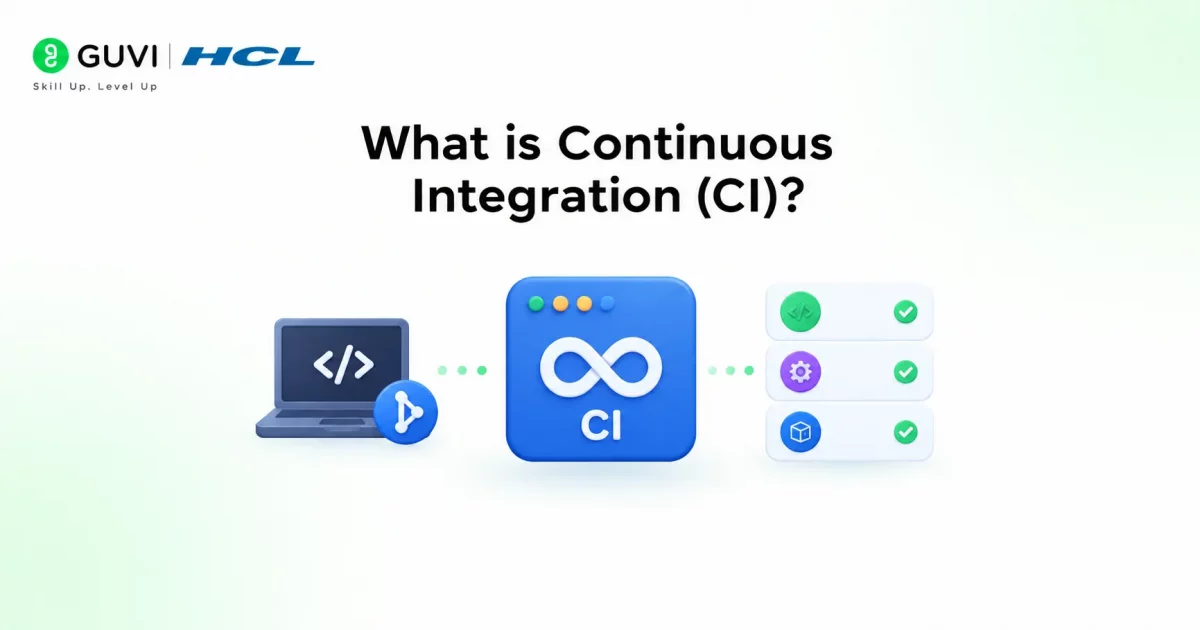
Continuous Integration is a development practice in which developers frequently merge code changes into a shared repository. Each integration is automatically verified by building the project and running tests. The goal of CI is to detect errors quickly and improve software quality.
Key Benefits of CI:
- Early Bug Detection: CI encourages developers to commit code frequently. This makes it easier to identify and fix bugs early in development.
- Reduced Integration Issues: By integrating continuously, teams avoid the dreaded “integration hell,” where merging code from different branches becomes a nightmare.
- Automated Testing: CI pipelines often include automated tests, ensuring that new code doesn’t break existing functionality.
What is Continuous Deployment (CD)?
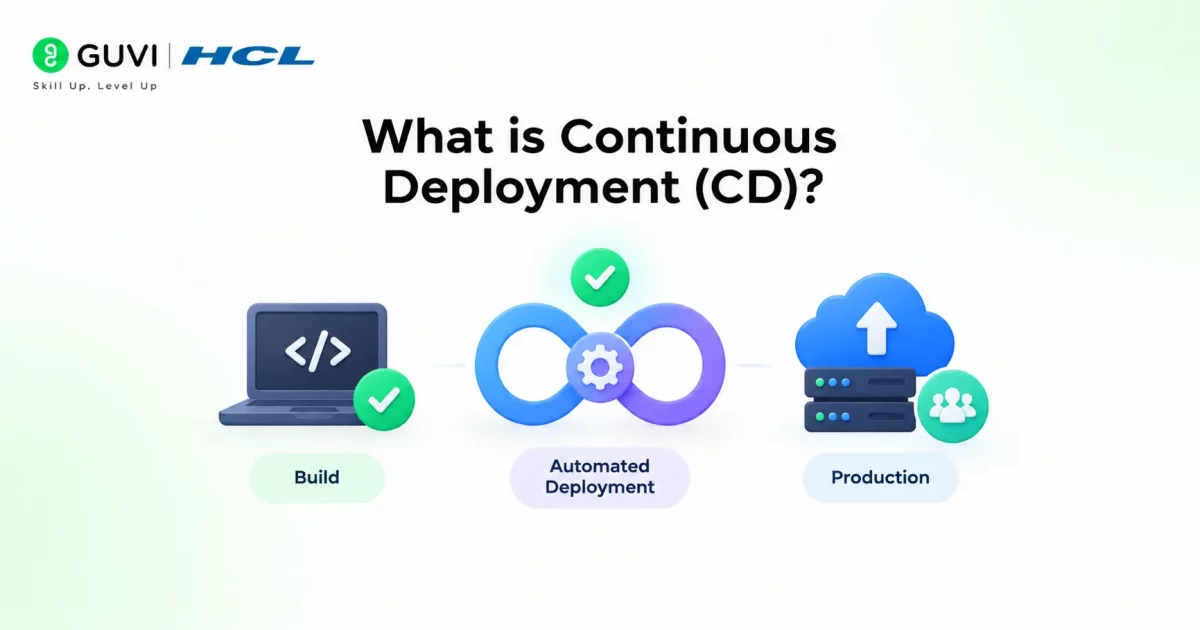
Continuous Deployment takes CI a step further by automating code releases to production. With CD, every change that passes the automated tests is automatically deployed to production. This means new features, bug fixes, and updates reach users faster and more frequently.
Key Benefits of CD:
- Faster Time to Market: Automated deployments mean that new features can reach users faster, giving companies a competitive edge.
- Reduced Manual Effort: CD eliminates manual deployments, reducing the risk of human error.
- Improved Feedback Loop: Frequent deployments let teams get user feedback sooner, enabling faster iterations and improvements.
Also Read: Continuous Integration vs Continuous Deployment in DevOps
Want to build CI/CD pipelines hands-on? HCL GUVI’s Advanced AI Cloud Computing & DevOps Programme covers CI/CD, Docker, Kubernetes, Terraform, and AWS through 140+ hours of live online sessions and real projects. Learn in English or Tamil, earn an NSDC and HCL GUVI certification, and get placement support with access to 1000+ hiring partners. No prior coding experience is needed. Register now and start your DevOps career.
How Does CI/CD Work Together?
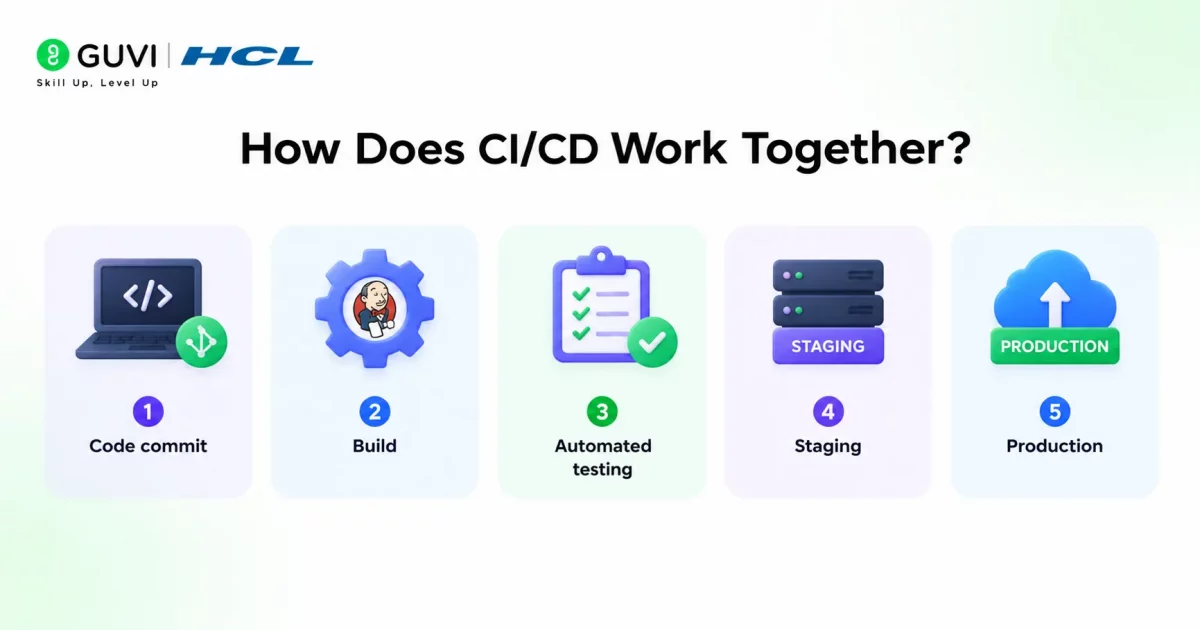
CI and CD are two parts of one automated pipeline. Continuous Integration checks every code change as it is made, and Continuous Delivery or Deployment carries the approved change to users. Here is how a change moves through the pipeline:
- Code commit: A developer saves new code to a version control system such as Git.
- Build: A CI tool like Jenkins or CircleCI detects the change and immediately starts building the application.
- Automated testing: The pipeline runs tests against the build. If any test fails, the process stops and notifies the developer, so they can fix the problem before it spreads.
- Staging: When all tests pass, the code moves to a copy of the live system for final checks.
- Production: The change is released to users. With Continuous Deployment, this happens automatically, while Continuous Delivery waits for a team member to approve it.

Tools for CI/CD
CI/CD tools automate the build, test, and release steps of the pipeline. Some run the whole pipeline, and others focus on one stage such as deployment:
| Tool | What It Does | Best Suited For |
|---|---|---|
| GitHub Actions | Runs pipelines directly from a GitHub repository using workflow files | Teams already hosting code on GitHub |
| GitLab CI/CD | Covers code hosting, testing, and deployment on one platform | Teams that want everything in a single place |
| Jenkins | Open-source automation server with a large plugin library | Teams that want full control over their setup |
| CircleCI | Cloud-based platform with fast builds and simple setup | Teams that want quick setup without managing servers |
| Azure Pipelines | Part of Azure DevOps, supports many languages and both cloud and on-premises systems | Teams working in the Microsoft ecosystem |
| AWS CodePipeline | Managed service that automates release workflows | Applications running on AWS |
| Argo CD | Keeps Kubernetes applications in sync with configuration stored in Git | Teams deploying to Kubernetes |
Conclusion
CI/CD has changed the way software is built and delivered. By replacing slow manual releases with automated checks and steady updates, it lets teams deliver reliable software at a pace that was once difficult to achieve. As applications continue to grow in size and complexity, CI/CD will remain central to modern software development.
FAQs
1. What is a CI/CD pipeline?
An automated workflow that builds, tests, and releases code changes from commit to production.
2. Why is CI/CD important in software development?
It catches errors early and lets updates reach users faster and more reliably.
3. Which tools are used for CI/CD?
Popular options include GitHub Actions, GitLab CI/CD, Jenkins, CircleCI, Azure Pipelines, and Argo CD.
4. Is CI/CD only for large teams?
No, small teams and solo developers use it too, since it saves time at any scale.
5. Is CI/CD the same as DevOps?
No, CI/CD is a set of automated practices, while DevOps is a broader culture that includes it.
6. What is the difference between Continuous Delivery and Continuous Deployment?
Continuous Delivery waits for manual approval before release, while Continuous Deployment automatically releases every passing change.
Success Stories






























Did you enjoy this article?