


Mechanical CAD Articles
Who Is a Mechanical CAD Designer? A Complete Beginner's Guide
How to Prepare for Mechanical Engineering Technical Interview Questions: A Practical Guide
CAD Designer Resume Examples & Tips to Land Your Dream Job
CAD Designer Career in India: Salary, Job Roles & Growth Path

Get In Touch For Details! Request More Information
Mechanical Engineer Salary in India 2026: Fresher to 15 Years (All Sectors)
Aug 16, 2026 4 Min Read 56814 Views
(Last Updated)
Mechanical engineer salary in India is a topic full of half-truths — if you’ve ever sat in a placement seminar and heard “mechanical engineers don’t earn much,” you’ve heard only half the story. The real number depends entirely on which mechanical engineer you’re talking about — a design engineer at an oil rig and a production engineer at a small ancillary unit are not in the same salary universe, even with identical degrees.
This guide breaks down what mechanical engineers actually earn in India in 2026 — by experience level, industry, specific employer, and education path — using current market data rather than generic “engineers earn well” advice.
By the end, you’ll know where your salary should realistically sit, which industries pay a premium, and whether an MTech or a jump to IT is actually worth it for you.
Table of contents
- TL;DR Summary
- Mechanical Engineer Salary in India 2026 by Experience and Industry
- Mechanical Engineer Salary at L&T, Tata Motors, ISRO, and DRDO
- Salary After MTech vs BTech for Mechanical Engineers
- Mechanical Engineer vs Software Engineer Salary: Is Switching Worth It?
- Factors Affecting Mechanical Engineer Salary in India
- Conclusion
- FAQs
- What is the average mechanical engineer salary in India in 2026?
- Which industry pays mechanical engineers the most in India?
- Is an MTech worth it for a higher salary in mechanical engineering?
- Can mechanical engineers earn as much as software engineers in India?
- What is the starting salary at ISRO or DRDO for mechanical engineers?
- Does location affect a mechanical engineer salary in India?
TL;DR Summary
- A fresher mechanical engineer salary in India typically starts between ₹3–6 LPA, with core manufacturing at the lower end and IT-adjacent roles at the higher end.
- Sector matters more than years of experience — an automotive or IT-switched engineer often out-earns a core-sector peer with double the tenure.
- PSUs and top private players (L&T, Tata Motors, ISRO, DRDO) offer stability and strong mid-career pay, but slower early jumps than private-sector core or IT roles.
- An MTech adds real salary lift mainly in R&D, design, and PSU/lateral-entry roles — not uniformly across every job.
- Switching to software isn’t automatically the “better” move — it depends on which core specialization you’re leaving and what skills you’re bringing.
Mechanical Engineer Salary in India 2026 by Experience and Industry
Mechanical engineer salary in India rises steadily with experience, but the rate of that increase varies widely by industry. Core manufacturing grows slowly and linearly. Oil & gas and aerospace grow faster but require niche certifications.
Engineers who move into IT-adjacent roles (automation, embedded systems, digital twin, CAE-to-software transitions) see the steepest jump after 5–8 years.
| Experience | Core Mechanical | Oil & Gas | Automotive | Aerospace | IT (Switched Role) |
| Fresher (0–1 yr) | ₹3.0 – 4.5 LPA | ₹4.5 – 7 LPA | ₹3.5 – 5.5 LPA | ₹4 – 6.5 LPA | ₹5 – 8 LPA |
| Junior (2–4 yrs) | ₹4.5 – 6.5 LPA | ₹7 – 11 LPA | ₹5.5 – 8.5 LPA | ₹6.5 – 10 LPA | ₹8 – 14 LPA |
| Mid (5–8 yrs) | ₹6.5 – 10 LPA | ₹11 – 18 LPA | ₹8.5 – 13 LPA | ₹10 – 16 LPA | ₹14 – 24 LPA |
| Senior (9–14 yrs) | ₹10 – 15 LPA | ₹18 – 28 LPA | ₹13 – 20 LPA | ₹16 – 24 LPA | ₹24 – 38 LPA |
| Lead/Principal (15+ yrs) | ₹15 – 22 LPA | ₹28 – 45 LPA | ₹20 – 32 LPA | ₹24 – 35 LPA | ₹38 – 60+ LPA |
These are industry-observed estimated ranges for 2026, based on job market listings, recruiter input, and placement data trends — not a single-source survey. Actual offers vary by city, company size, and specific role.
If you’re a mechanical engineer looking to strengthen your CAD skills or build a career in automotive design, HCL GUVI’s Advanced CAD & Automotive Design Course, part of the exclusive ZEN Class Programs, offers live mentor-led training, hands-on projects, industry case studies, Autodesk certification, and dedicated career support to help you become job-ready. Enroll today and take the next step toward a successful design engineering career!
Also Read: Mechanical Engineering Careers in 2026
Mechanical Engineer Salary at L&T, Tata Motors, ISRO, and DRDO
Among India’s most-searched mechanical engineering employers, private manufacturing giants like L&T and Tata Motors generally offer faster early-career salary growth, while ISRO and DRDO offer lower starting pay but strong long-term stability, pension-linked benefits, and R&D exposure that’s hard to find elsewhere.
Here’s how the numbers typically compare in 2026:
- L&T (Larsen & Toubro): Freshers (GET/GTP roles) usually start around ₹4–6.5 LPA; mid-career design or project engineers with 5–8 years’ experience often reach ₹9–14 LPA, with project leads going higher depending on the business vertical (construction, heavy engineering, or defence).
- Tata Motors: Entry-level roles for mechanical engineers (production, quality, or R&D) generally fall between ₹4.5–7 LPA; engineers with 5+ years of experience in powertrain or EV-related design frequently earn ₹10–16 LPA, reflecting the company’s EV push.
- ISRO: Scientist/Engineer ‘SC’ entry-level pay follows government pay scales, typically landing around ₹6–8 LPA in-hand equivalent (Level 10 pay matrix) once allowances are included, with structured promotions every few years and strong non-monetary benefits (research exposure, job security, HRA/DA revisions).
- DRDO: Similar government pay-matrix structure to ISRO — entry-level Scientist ‘B’ roles are comparable, with pay growing through defined promotion cycles (Scientist C, D, E) rather than negotiated hikes.
Salary After MTech vs BTech for Mechanical Engineers
An MTech does not automatically guarantee a higher salary than a BTech in mechanical engineering. It helps most in R&D-heavy roles, PSU recruitment (many PSUs give MTech candidates a direct entry or exam-exemption route), teaching/academia, and specialized design roles like thermal or CAE analysis.
For most core manufacturing and production roles, 2–3 years of BTech work experience often outperforms a fresh MTech on paper.
Here’s the practical breakdown:
- BTech fresher: ₹3–6 LPA depending on sector (see table above).
- MTech fresher (direct after BTech, no work gap): Often only marginally higher — ₹4–7 LPA — unless entering a specialized PSU or R&D pipeline.
- BTech + 2 years’ experience vs. MTech fresher: The BTech-experienced candidate frequently earns more, because employers weight hands-on project and tooling experience heavily in core mechanical hiring.
- MTech + PSU/GATE route: This is where MTech pays off clearly — GATE-qualified MTech holders entering PSUs through direct recruitment can start at ₹7–10 LPA (pay matrix + benefits), well above that of a typical BTech fresher.
Important Note:
GATE scores remain one of the strongest ROI levers for mechanical engineers in India — a good GATE score can open PSU and MTech-at-IIT pathways that private-sector BTech hiring simply doesn’t offer at the same pay level.

Mechanical Engineer vs Software Engineer Salary: Is Switching Worth It?
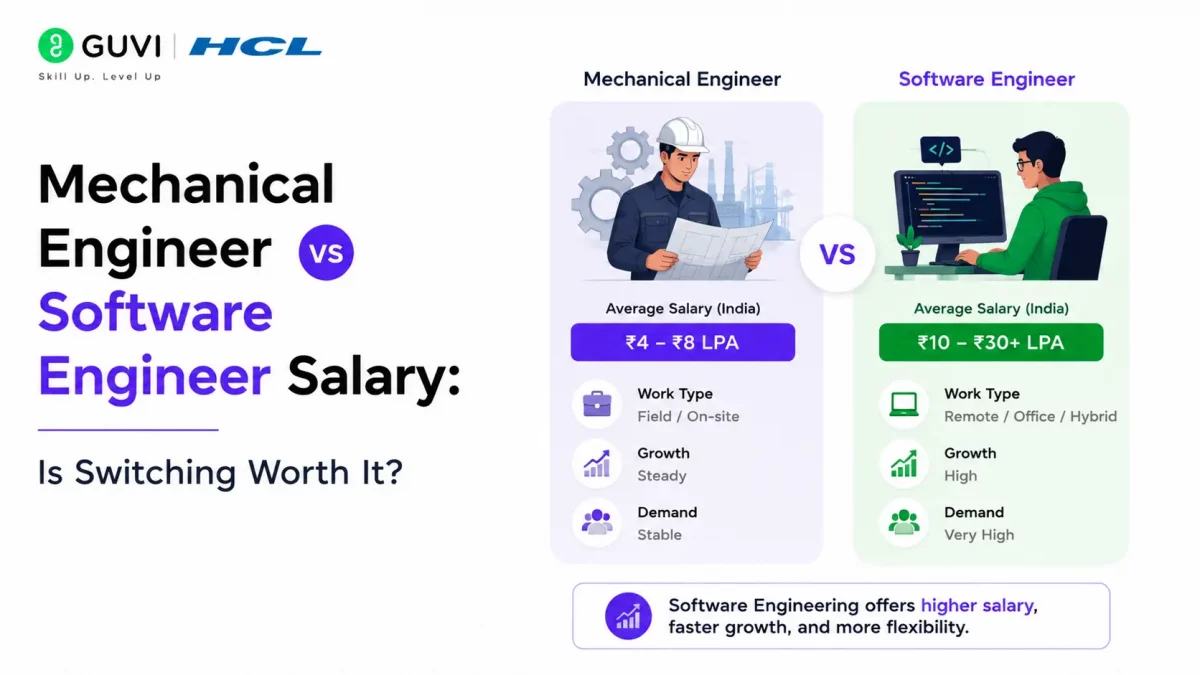
Software engineering roles generally offer higher starting salaries and faster early-career growth than core mechanical roles — but the gap narrows or disappears when comparing software pay to mechanical engineers in high-paying sectors like oil & gas, aerospace, or automotive R&D.
Switching is worth it if you’re stuck in a low-paying core manufacturing role with no growth path; less so if you’re already in a strong mechanical niche.
The comparison, honestly:
- Software engineer fresher (Tier-1/2 IT companies, product roles): ₹5–12 LPA, with product-based companies at the higher end.
- Mechanical engineer fresher (core manufacturing): ₹3–4.5 LPA — a real gap.
- Mechanical engineer fresher (oil & gas/aerospace): ₹4–6.5 LPA — the gap shrinks significantly.
- Mid-career (5–8 yrs): Software engineers in strong product companies often reach ₹18–30 LPA; mechanical engineers in oil & gas or automotive R&D can reach ₹11–18 LPA — software still leads, but not by the 3–4x margin people assume.
The mechanical engineers who successfully “switch” and earn software-level pay usually don’t abandon their core knowledge — they move into CAE/simulation software, embedded systems, robotics, or automation, where mechanical domain knowledge plus coding skills are a rare and well-paid combination.
Also Read: 5 Steps to Go from Mechanical Engineering to Software Engineering Job
Factors Affecting Mechanical Engineer Salary in India
Several factors determine how much a mechanical engineer actually earns, not just the degree itself. Here are the top 5 that actually decide the salary:
1. Industry and Sector Choice
The sector you join matters more than almost anything else. Oil & gas, aerospace, and automotive R&D consistently pay more than core manufacturing or ancillary units, even for the same experience level.
2. Company Type: PSU vs Private vs Startup
PSUs offer lower starting pay but steady, guaranteed hikes and long-term stability. Private majors move faster early on, while startups can pay well but come with higher risk and less predictability.
3. Location and City Tier
Industrial hubs like Pune, Chennai, Bengaluru, and Hyderabad pay noticeably more than Tier-2 or Tier-3 cities. Cost of living, industry concentration, and local demand all drive this gap.
4. Specialization and Skill Set (CAE, Automation, Design, etc.)
Engineers with in-demand skills such as CAE, robotics, or automation earn well above those in generalist production or maintenance roles. Niche technical skills consistently command a salary premium over broad, unspecialized experience.
5. Certifications and Additional Qualifications (GATE, MTech, Six Sigma)
A strong GATE score, a relevant MTech, or certifications like Six Sigma can open higher-paying PSU or specialized roles. On their own they rarely guarantee a raise, but they widen the doors you can walk through.
Conclusion
Mechanical engineering salaries in India aren’t a single number — they’re a range shaped by your sector, employer, and how you position your skills. Core manufacturing will always trail oil & gas, aerospace, and hybrid tech-adjacent roles, but that doesn’t mean core engineers are stuck.
The right specialization, a well-timed MTech, or a strategic skill addition can meaningfully shift where you land on this spectrum.
FAQs
1. What is the average mechanical engineer salary in India in 2026?
The average mechanical engineer salary in India in 2026 ranges from ₹4.5–9 LPA, with fresh graduates starting at ₹3–6 LPA depending on the industry they join.
2. Which industry pays mechanical engineers the most in India?
Oil & gas and aerospace typically pay mechanical engineers the most in India, followed by automotive R&D and IT-adjacent hybrid roles.
3. Is an MTech worth it for a higher salary in mechanical engineering?
An MTech is worth it mainly if you’re targeting PSU recruitment through GATE, R&D roles, or academia — for most private-sector core roles, work experience often adds more salary value than an MTech alone.
4. Can mechanical engineers earn as much as software engineers in India?
Mechanical engineers in high-paying sectors like oil & gas or aerospace can approach software-engineer pay levels, and hybrid roles like CAE or automation engineering can further close the gap, though pure software roles still lead on average.
5. What is the starting salary at ISRO or DRDO for mechanical engineers?
Entry-level Scientist roles at ISRO and DRDO typically offer in-hand pay equivalent to ₹6–8 LPA once allowances are included, following government pay-matrix structures with defined promotion cycles.
6. Does location affect a mechanical engineer salary in India?
Yes, cities with major industrial or aerospace hubs — such as Pune, Chennai, Bengaluru, and Hyderabad — generally offer higher mechanical engineering salaries than smaller industrial towns.
Success Stories









Did you enjoy this article?