


Mechanical CAD Articles
Types of Mechanical Stress with Examples
LinkedIn Profile Tips for Mechanical Engineers: How to Build a Recruiter-Friendly Profile
Stress and Strain in Mechanical Engineering: Types, Formulas and Applications


Get In Touch For Details! Request More Information
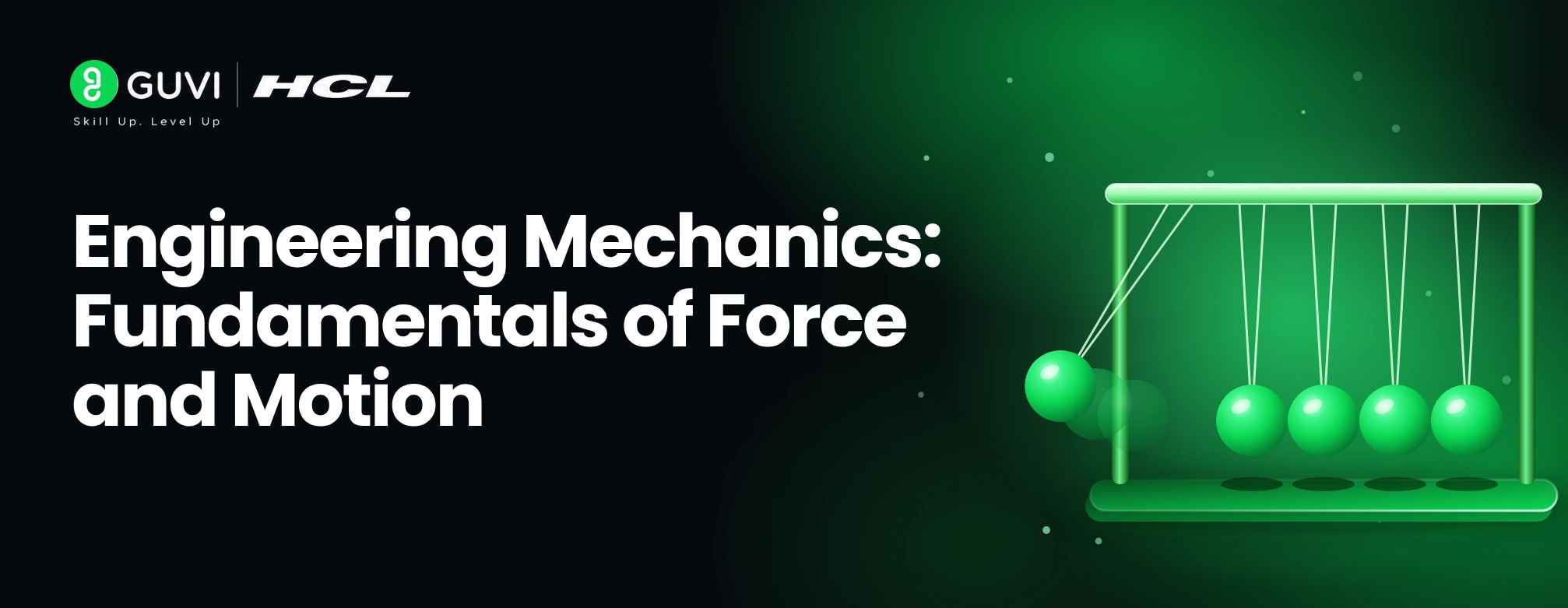
Engineering Mechanics: Fundamentals of Force and Motion
Nov 02, 2026 4 Min Read 96 Views
(Last Updated)
All machines, from a bicycle to a tower crane, work because forces act on them and either get them moving or keep them still. Engineering Mechanics is the subject that explains how. It is one of the first core subjects in mechanical engineering, and it supports almost everything that follows, including machine design, robotics, and vehicle engineering. This blog covers force and motion from scratch, with formulas and examples that need no advanced physics.
Table of contents
- TL;DR
- What Is Engineering Mechanics?
- Understanding the Basics of Force
- What Is Force?
- Characteristics of Force
- Types of Forces
- Newton’s Three Laws of Motion
- Understanding Motion in Engineering Mechanics
- Distance and Displacement
- Speed and Velocity
- Acceleration
- Equations of Motion
- Relationship Between Force and Motion
- Real-World Applications of Engineering Mechanics
- Why Is Engineering Mechanics Important for Mechanical Engineering?
- Conclusion
- Frequently Asked Questions (FAQs)
- What is Engineering Mechanics in simple words?
- What is the difference between statics and dynamics?
- Is force a scalar or a vector quantity?
- Can an object move if the net force on it is zero?
- What topics are covered in an Engineering Mechanics syllabus?
TL;DR
- Engineering Mechanics studies how forces act on bodies that are at rest or in motion.
- It has two branches: Statics (bodies in equilibrium) and Dynamics (bodies that accelerate).
- Newton’s three laws link force, mass, and acceleration.
- Distance, displacement, speed, velocity, and acceleration describe motion.
- Inertia, momentum, and friction connect force to how real machines behave.
What Is Engineering Mechanics?
Engineering Mechanics is the branch of applied science that studies how forces act on physical bodies and how those bodies respond, either by staying at rest or by moving. Engineers use it to predict whether a part will hold, move, or fail before it is built.
It has two branches:
- Statics: deals with bodies at rest or moving at constant velocity, where all forces are balanced. Examples include a bridge girder or a bolt holding a bracket.
- Dynamics: deals with bodies whose motion is changing. It includes kinematics (describing motion) and kinetics (linking motion to the forces causing it). A piston moving inside an engine is a dynamics problem.
Statics asks, “Will this stay in place?” Dynamics asks, “How will this move?”
Understanding the Basics of Force
What Is Force?
A force is a push or pull that can change the motion or shape of a body. Its SI unit is the newton (N). One newton is the force needed to accelerate a 1 kg mass by 1 m/s².
Characteristics of Force
Force is a vector, so it needs more than a number to describe it:
- Magnitude: how strong it is.
- Direction: which way it acts.
- Point of application: where it touches the body.
- Line of action: the straight line along which it acts.
Want to turn your understanding of Engineering Mechanics into practical design skills? Enrol in HCL GUVI’s Mechanical CAD Design Course and learn to create 2D drawings and 3D mechanical models using industry-relevant CAD tools. Gain hands-on experience and build the skills needed to explore career opportunities in mechanical design and engineering.
Start your Mechanical CAD learning journey today!
Types of Forces
Contact forces need physical touch. Examples are applied force, friction, tension in a crane cable, and the normal force, which is the support a surface pushes back with. Non-contact forces act at a distance, such as gravity and magnetic force.
Mass and weight are often confused. Mass is the amount of matter in a body, measured in kilograms, and it does not change. Weight is the gravitational force on that mass:
W = mg
where W is weight (N), m is mass (kg), and g is acceleration due to gravity (about 9.81 m/s²). A 60 kg person weighs about 589 N on Earth. On the Moon the mass stays 60 kg, but the weight drops.
Also checkout: What is Mechanical Engineering 101: Introduction to Principles, Applications and Skills
Newton’s Three Laws of Motion
First law (inertia): A body stays at rest or keeps moving in a straight line at constant speed unless a net external force acts on it. When a bus brakes suddenly, you lurch forward because your body tries to keep moving.
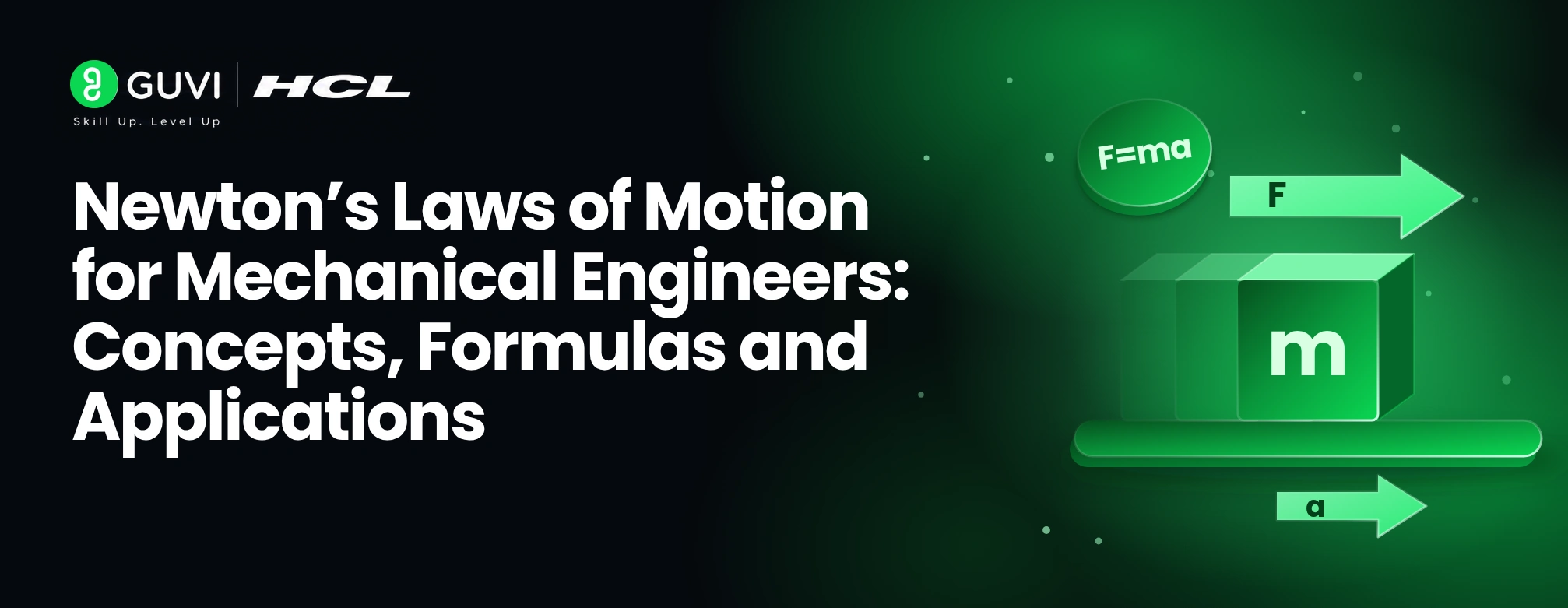
Second law: The net force on a body equals its mass times its acceleration.
F = ma
where F is net force (N), m is mass (kg), and a is acceleration (m/s²). If a 1,200 kg car accelerates at 2 m/s², the net force on it is 1,200 × 2 = 2,400 N.
Third law: For every action there is an equal and opposite reaction, and the two forces act on different bodies. A car’s tyre pushes backward on the road, and the road pushes the car forward. That reaction is what moves the car.
Also checkout: Mechanical Engineering Career Roadmap
Understanding Motion in Engineering Mechanics
Distance and Displacement
Distance is the total length of the path travelled. It is a scalar, meaning it has size but no direction. Displacement is the straight-line change in position from start to finish, and it is a vector. Both are measured in metres (m).
If you run one full lap of a 400 m track, your distance is 400 m, but your displacement is zero because you end where you started.
Speed and Velocity
Speed is distance divided by time. Velocity is displacement divided by time, so it includes direction. Both are measured in m/s.
Speed = distance / time
A car covering 100 m in 5 s has a speed of 20 m/s. A car going around a roundabout can hold a constant speed while its velocity keeps changing, because its direction changes.
Acceleration
Acceleration is the rate at which velocity changes.
a = (v − u) / t
where a is acceleration (m/s²), u is initial velocity (m/s), v is final velocity (m/s), and t is time (s). A car going from rest to 20 m/s in 10 s has an acceleration of 2 m/s². A negative value means the body is slowing down.
Equations of Motion
For constant acceleration in a straight line, three equations cover most beginner problems:

- v = u + at
- s = ut + ½at²
- v² = u² + 2as
Here s is displacement in metres. For the car above, s = 0 + ½ × 2 × 10² = 100 m. It covers 100 m while reaching 20 m/s.
Also checkout: 7 Important Roles and Responsibilities of a Mechanical Engineer
Relationship Between Force and Motion
Force changes motion. When forces on a body are balanced, its velocity stays constant. When they are unbalanced, the body accelerates in the direction of the net force, exactly as F = ma says. Three ideas explain how this plays out in practice.
Inertia is a body’s resistance to any change in its motion. More mass means more inertia, which is why a loaded truck is harder to start and harder to stop than a small car.
Momentum is mass multiplied by velocity.
p = mv
where p is momentum (kg·m/s). A 1,000 kg car at 20 m/s has a momentum of 20,000 kg·m/s. Force and momentum are related but not the same. Force is the push or pull, while momentum is how much motion a body carries. Force equals the rate of change of momentum, so a large momentum needs a large force, or a longer time, to bring it to a stop.
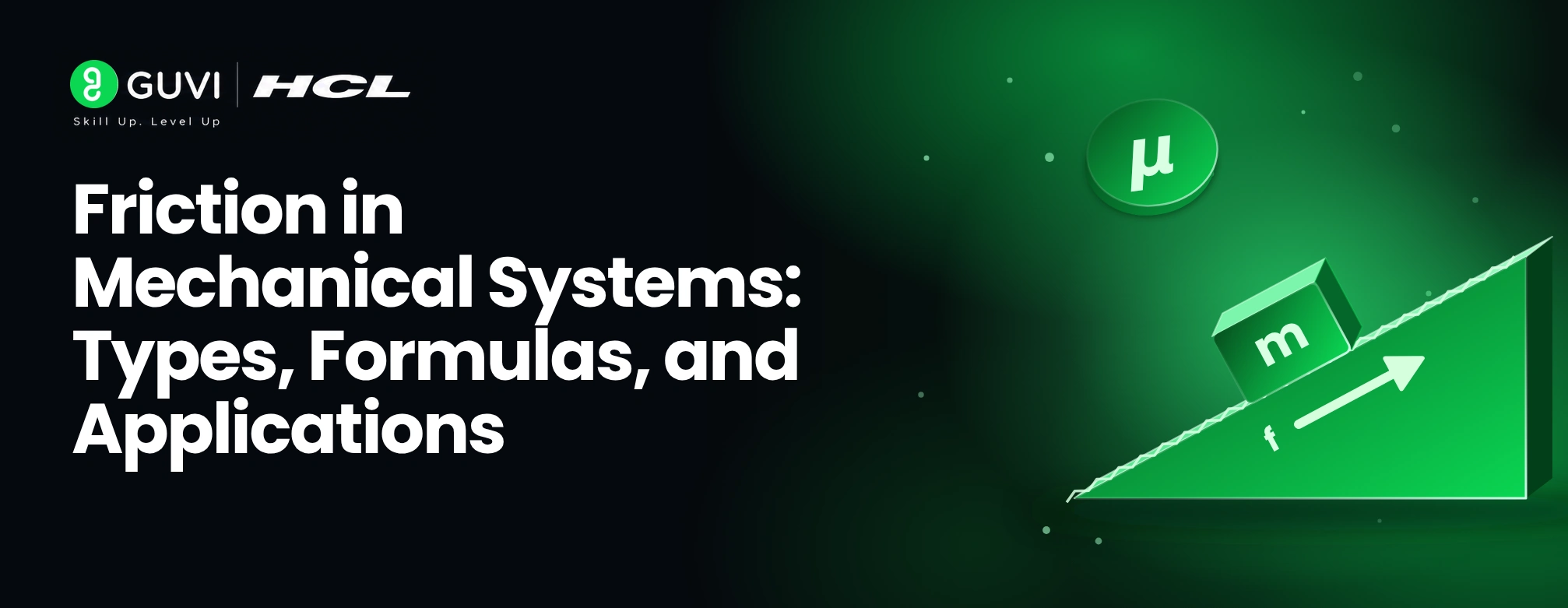
Friction is the force that opposes relative motion between two surfaces in contact.
f = μN
where f is the friction force (N), μ is the coefficient of friction (no unit), and N is the normal force (N). Take a 50 kg crate on a floor with μ = 0.4. The normal force is 50 × 9.81 = 490.5 N, so friction is about 196 N. You must push with more than 196 N to move it, and once it moves, the net force (push minus friction) decides its acceleration.
All three work together here. Inertia resists the crate starting to move, friction opposes it once moving, and the net force produces the acceleration.
Also checkout: Best Websites to Learn Mechanical Engineering
Real-World Applications of Engineering Mechanics
- Mechanical engineering: Engineers calculate the forces on shafts, gears, and bearings so each part carries its load without breaking.
- Automobile engineering: Braking distance, tyre grip, and crash safety all depend on friction, momentum, and acceleration. Crumple zones work by increasing the time over which a car’s momentum drops, which reduces the force on passengers.
- Machines and industrial equipment: Conveyor belts, cranes, and hydraulic presses are designed using force balance and motion analysis.
- Construction and structural design: Statics tells engineers whether a beam, truss, or column stays in equilibrium under the loads of people, wind, and its own weight.
- Product and machine design: Even a simple door hinge or a bicycle frame is sized by analysing the forces it will face in use.
Why Is Engineering Mechanics Important for Mechanical Engineering?
Engineering Mechanics gives mechanical engineers a way to think before they build. With it, an engineer can:
- Analyse the forces acting on a component, such as the load on a bracket or the tension in a cable.
- Understand how machine parts move, from a rotating wheel to a sliding piston.
- Design systems that are safe and efficient, with enough strength and no wasted material.
- Solve practical problems, such as why a machine vibrates or why a joint keeps loosening.
- Build the base for later subjects such as strength of materials, theory of machines, and fluid mechanics.
Conclusion
Engineering Mechanics turns everyday observations, like a pushed crate or a braking car, into precise calculations. Force explains why things move, motion describes how they move, and concepts like inertia, momentum, and friction connect the two. Once these basics are clear, the rest of mechanical engineering becomes much easier to follow.
Frequently Asked Questions (FAQs)
1. What is Engineering Mechanics in simple words?
It is the study of how forces affect objects, whether the objects stay still or move. Engineers use it to design parts, machines, and structures that work safely.
2. What is the difference between statics and dynamics?
Statics deals with bodies in equilibrium, where forces are balanced. Dynamics deals with bodies whose motion changes because of unbalanced forces.
3. Is force a scalar or a vector quantity?
Force is a vector. It has both magnitude and direction, so two forces of equal size can have very different effects if they act in different directions.
4. Can an object move if the net force on it is zero?
Yes. By Newton’s first law, a body with zero net force keeps moving at constant velocity. It just does not accelerate.
5. What topics are covered in an Engineering Mechanics syllabus?
Typical topics include force systems, equilibrium, friction, centre of gravity, moment of inertia, trusses, kinematics, and kinetics of particles and rigid bodies.
Success Stories

About the Author
Vishalini Devarajan
An Aerospace Engineer turned content writer, I focus on making complex concepts easy to understand through well-structured, reader-friendly blogs. Whether it’s a technical topic or a non-technical one, I love creating content that is clear, engaging, and impactful.
View all posts by Vishalini Devarajan
Connect with me @






Did you enjoy this article?