


Web Development Articles
How to Use Firebase Firestore for Real-Time Data in Web Apps
Web Designing Roadmap 2026: Best Guide to Become a Successful Web Designer

Get In Touch For Details! Request More Information

Top Career Opportunities in Web Development [2026 Guide + Skills]
Feb 12, 2026 5 Min Read 8033 Views
(Last Updated)
Web development is booming, with a $65B market in 2023 set to hit $130B by 2032. Discover the top career paths and skills to join this high-demand field. With web developer jobs growing at an 8% annual rate, the demand for skilled professionals is only climbing.
From startups to enterprise tech, companies across sectors are hiring developers to build, scale, and optimize digital platforms. Exploring career opportunities in web development today means stepping into a future-proof role with strong growth, flexible work models, and global relevance.
This blog dives into the most in-demand web development career opportunities, essential skills, and actionable steps to help you start or grow your journey in tech.
Table of contents
- What Is Web Development? A Quick Breakdown & Why You Should Learn It
- Core Areas of Web Development
- Front-End Developer: A Top Career Opportunity in Web Development
- What Does a Front-End Developer Do?
- Tools & Skills Required
- Job roles related to front-end development
- What Does a Back-End Developer Do?
- Tools & Skills Required
- Common Job Titles in Back-End Development
- Full-Stack Development
- What Does a Full Stack Developer Do?
- Common Job Roles in Full Stack Development
- Why Full Stack Developers Are in High Demand
- Web Development Specializations and Industry Scope
- High-Growth Specializations That Developers Are Moving Toward
- Wrapping it all together: Why Choose Web Development as a Career?
- FAQs
- What skills do I need to become a web developer?
- Can I specialize in a certain area of web development?
- Do I need a degree to become a web developer?
What Is Web Development? A Quick Breakdown & Why You Should Learn It
Web development is the process of building websites, web apps, and digital experiences that people use every day, from shopping on Amazon to streaming videos on YouTube. It powers everything you see and interact with on the internet.
Learning web development gives you the skills to create, manage, and improve these experiences. And with companies across industries investing in digital infrastructure, the demand for skilled web developers has never been stronger.
From small startups to global tech giants, everyone needs developers who can build fast, functional, and user-friendly websites and apps. It’s a skill that opens doors to remote jobs, freelance projects, and product building.
Core Areas of Web Development
Here’s how the field breaks down into three main career tracks:
| Role | What It Means | What You Work On | Avg. annual salary |
| Front-End | Focuses on the user interface and experience | Layouts, buttons, animations, mobile responsiveness using HTML, CSS, JavaScript | ₹5.8 Lakhs |
| Back-End | Deals with databases, servers, and application logic | Server code, APIs, authentication, database queries | ₹9.7 Lakhs |
| Full-Stack | Combines both front-end and back-end skills | End-to-end project handling, both UI and server-side logic | ₹9.2 Lakhs |
Front-End Developer: A Top Career Opportunity in Web Development
If you’re exploring web development career opportunities, front-end development is often where most beginners start. It’s the part of web development that users see and interact with. Every button, layout, animation, or transition is brought to life by front-end developers.
They translate UI/UX designs into working code, ensuring the site looks good, loads fast, and works seamlessly across devices and browsers.
What Does a Front-End Developer Do?
Front-end developers use HTML, CSS, and JavaScript to build responsive and accessible user interfaces. Their work directly impacts how users experience a website or web application.
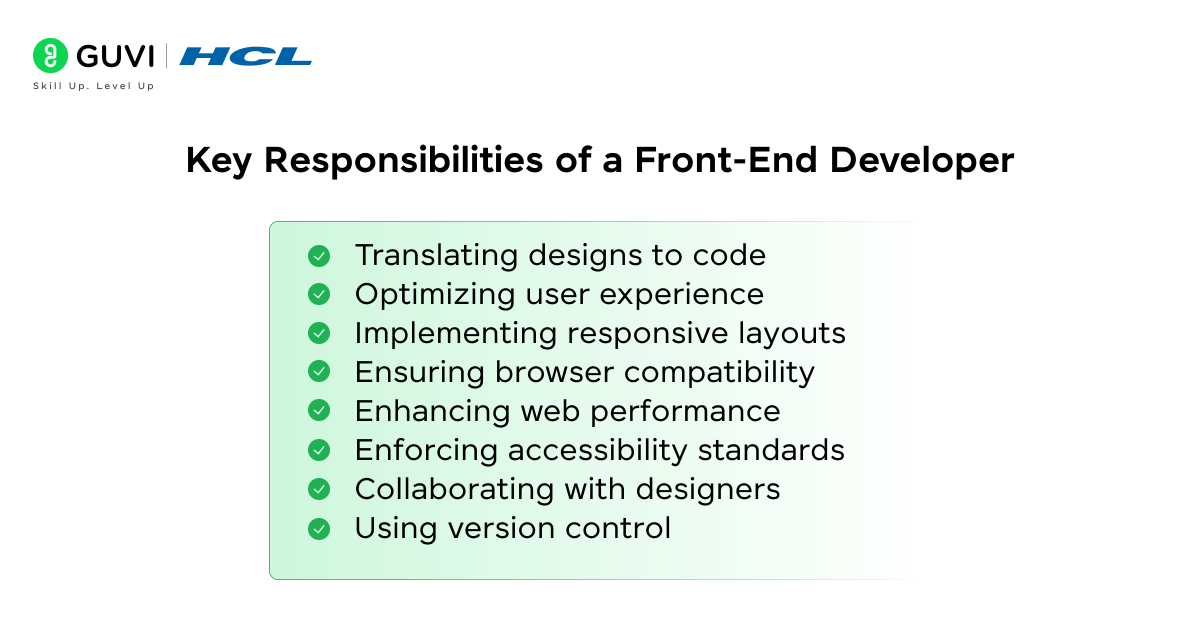
Key responsibilities include:
- Translating Design to Code: Convert UI/UX mockups into structured, styled, and functional layouts using front-end code.
- User Experience (UX) Focus: Optimize navigation, layout, and interactions to ensure intuitive and frictionless user journeys.
- Responsive Design: Build interfaces that adjust smoothly across different screen sizes, from mobile phones to desktops.
- Cross-Browser Compatibility: Test and refine site behavior to ensure consistency across Chrome, Firefox, Safari, and other major browsers.
- Web Performance: Optimize loading speeds through asset minimization, lazy loading, and efficient code practices.
- Accessibility Compliance: Implement semantic HTML, ARIA roles, and alt text to meet accessibility standards (like WCAG).
- Collaboration with Designers: Work closely with UI/UX teams to refine designs, resolve feasibility issues, and maintain brand consistency.
- Version Control: Use Git and GitHub for code tracking, team collaboration, and deployment.
Tools & Skills Required
- Languages: HTML, CSS, JavaScript
- Frameworks/Libraries: React, Vue, Angular (depending on the project)
- Version Control: Git
- Design Collaboration: Figma, Adobe XD (for handoff and interpretation)
Job roles related to front-end development
| Role | Description |
| Front-End Developer | Builds and maintains all client-facing interfaces using web technologies. |
| Responsive Web Dev | Specializes in adaptive layouts for mobile and desktop devices. |
| JavaScript Developer | Focuses on building dynamic and interactive functionality using JS frameworks. |
| UI Developer | Works closely with designers to implement pixel-perfect front-end designs. |
What Does a Back-End Developer Do?
Back-end developers ensure that all behind-the-scenes processes, like user authentication, data processing, and server communication, run efficiently and securely.
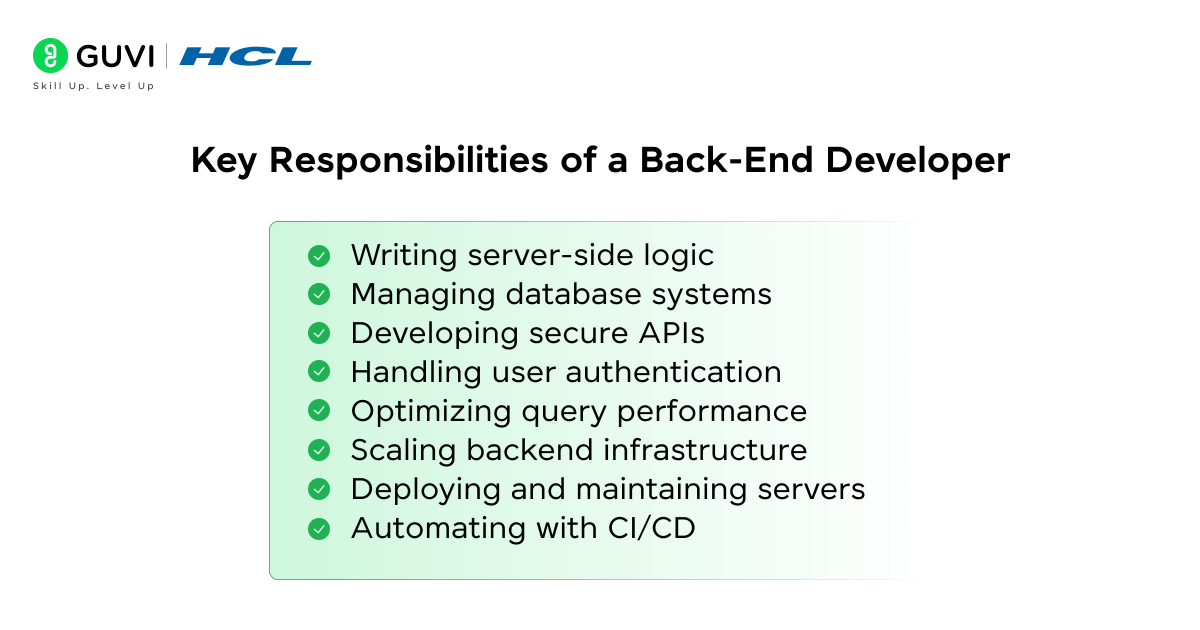
Core responsibilities include:
- Server-Side Logic: Write and manage code that handles client requests, business logic, and server responses.
- Database Management: Design, implement, and query relational or NoSQL databases to store and retrieve user and system data.
- API Development: Build RESTful APIs to connect front-end and back-end components of the application.
- Security & Authentication: Safeguard data with encryption, session management, role-based access, and protection from common vulnerabilities (e.g., SQL injection).
- Performance Optimization: Speed up response times using caching, optimized queries, and load balancing strategies.
- Scalability: Design systems that handle growing traffic using horizontal scaling, cloud platforms, and distributed systems.
- Deployment & Maintenance: Launch and monitor web apps on production servers, fix bugs, and ensure uptime.
Tools & Skills Required
- Languages: Node.js, Python, Java, PHP, Ruby
- Databases: MySQL, PostgreSQL, MongoDB
- Frameworks: Express.js, Django, Spring Boot
- APIs & Tools: REST, GraphQL, Postman, Docker, Git, CI/CD pipelines
Common Job Titles in Back-End Development
| Role | Description |
| Back-End Developer | Builds and maintains server-side logic and APIs. |
| Database Administrator (DBA) | Manages database architecture, performance, and backups. |
| Server-Side Engineer | Specializes in logic-heavy applications with high data volume. |
| DevOps Engineer | Focuses on CI/CD, deployment automation, and server management. |
Back-end roles are a vital part of the growing career opportunities in web development. They ensure that applications are not just functional, but fast, scalable, and secure.
Before diving into the next section, ensure you’re solid on full-stack development essentials like front-end frameworks, back-end technologies, and database management. If you are looking for a detailed Full Stack Development career program, you can join HCL GUVI’s Full Stack Development Course with Placement Assistance.
Full-Stack Development
Full-stack development brings together the best of both worlds: front-end and back-end. As businesses move faster and leaner, they increasingly look for professionals who can manage both client-side and server-side responsibilities. That’s where full-stack developers come in.
Full-stack developers contribute across the entire lifecycle of a web application. They manage user-facing components, handle the behind-the-scenes logic, and ensure everything works together seamlessly in a live environment. This end-to-end involvement makes them indispensable in fast-paced tech teams where flexibility and broad knowledge are essential.
In the growing landscape of web development career opportunities, this role is one of the most in-demand, especially in startups and agile teams where versatility is key.
What Does a Full Stack Developer Do?
A full-stack developer builds complete web applications, working across the front-end (HTML, CSS, JavaScript) and the back-end (Node.js, Python, SQL, etc.) to deliver fully functional digital products.
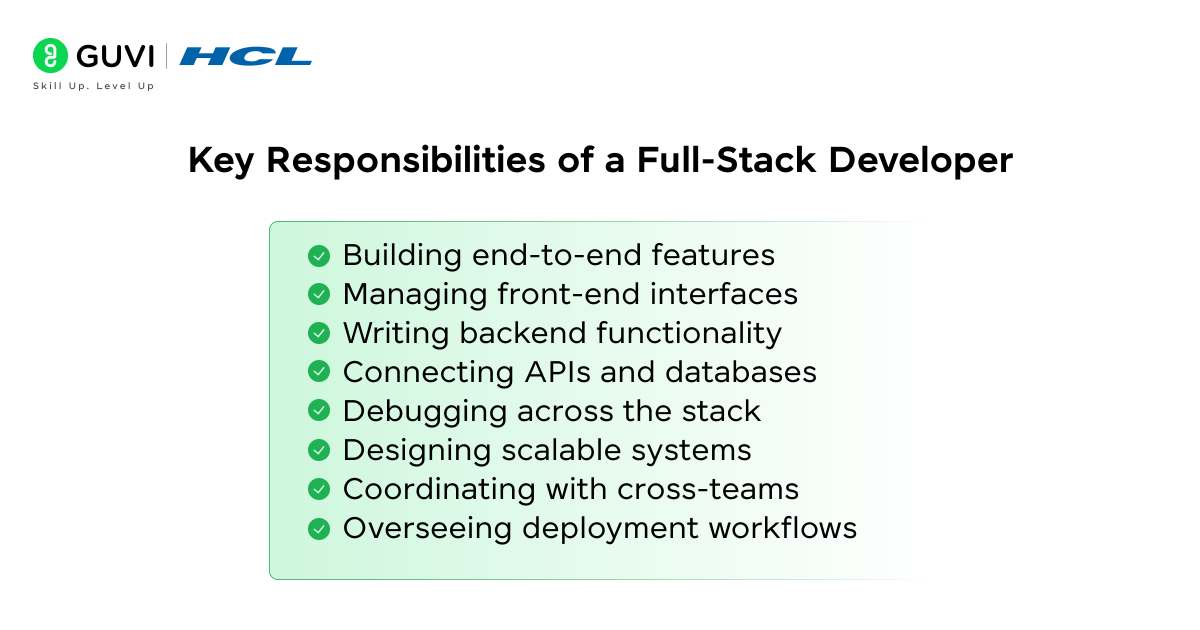
Key strengths include:
- Front-End Proficiency: Builds responsive user interfaces using HTML, CSS, JavaScript, and frameworks like React or Angular.
- Back-End Expertise: Manages server-side logic, APIs, databases, and authentication using tools like Express.js, Django, or Spring Boot.
- Cross-Functional Agility: Switches easily between front-end and back-end tasks as needed, making them valuable in fast-paced environments.
- Architecture Knowledge: Understands how various components interact, from user requests to server responses and data flow.
- Problem Solving: Diagnoses and fixes issues across the stack, often improving communication between front-end and back-end teams.
- DevOps Awareness: Familiar with deployment workflows, Git, version control, and basic cloud infrastructure.

Common Job Roles in Full Stack Development
| Role | Description |
| Full Stack Developer | Builds and manages both front-end and back-end components of web apps. |
| Web Developer | A generalist who often works full-stack, especially in smaller teams. |
| Startup CTO | Leads tech decisions and development in startups, often with full-stack skills. |
| Freelancer | Offers complete web solutions, from idea to launch, for clients. |
| Technical Product Builder | Focuses on building MVPs and scalable products with minimal support. |
Why Full Stack Developers Are in High Demand
Companies value developers who can independently ship features from UI to server logic. In small teams, full-stack developers reduce hiring overhead. In large companies, they bridge the communication gap between front-end and back-end teams, accelerating product development.
If you’re exploring career opportunities in web development, learning full-stack development opens doors to both technical and leadership roles across startups, freelance projects, or even building your products.
Web Development Specializations and Industry Scope
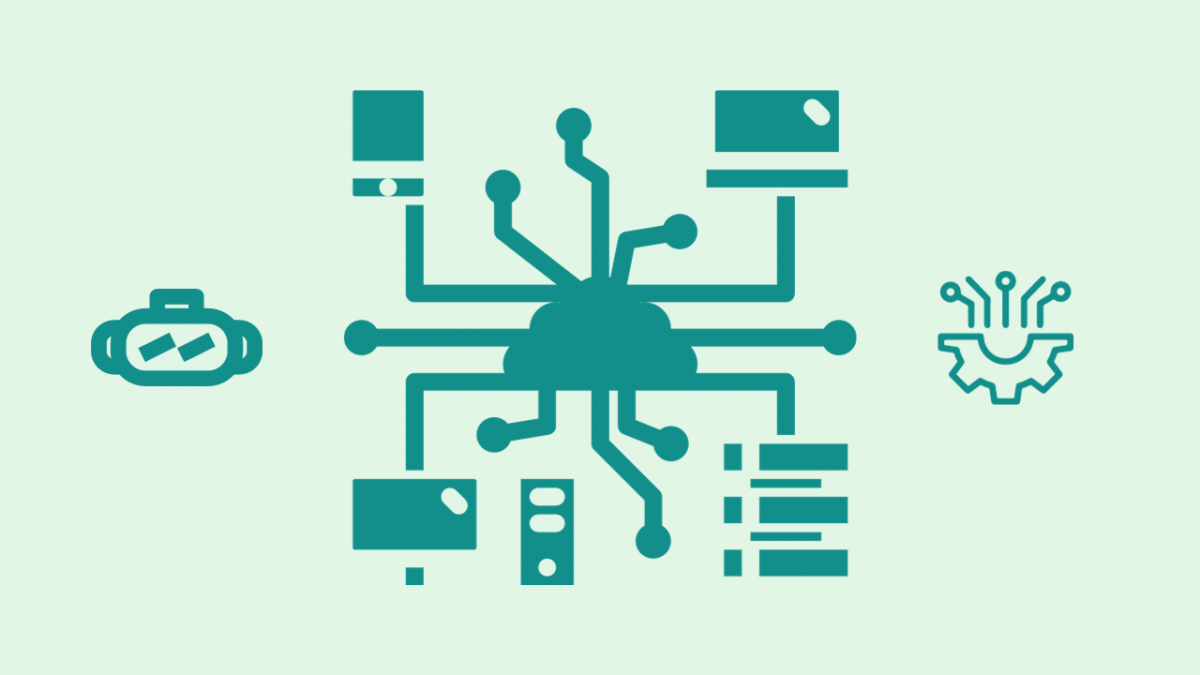
Exploring career opportunities in web development goes far beyond choosing between front-end, back-end, or full-stack. In 2026, India’s digital-first economy is generating rapid demand for niche specialists who can build scalable, efficient, and innovative web solutions across high-growth sectors.
High-Growth Specializations That Developers Are Moving Toward
E-commerce Development
India’s e-commerce market is currently valued at ₹10–13 lakh crore and is expected to reach ₹28–30 lakh crore by 2030. Developers who can build secure platforms, integrate payment systems, and optimize for mobile shoppers (which account for nearly 75% of transactions) are in high demand. Skills in cart architecture, checkout UX, and mobile-first frameworks are essential here.
Mobile App Integration
With over 1 billion smartphone users and 900+ million internet connections, web developers must create apps that sync seamlessly between web and mobile environments.
Building APIs and backend layers that serve both interfaces reliably is now a core expectation for enterprise and consumer products alike.
Progressive Web App (PWA) Development
As tier-II and tier-III cities drive over 56% of India’s online shoppers, and intermittent network access remains a concern, PWAs are gaining momentum. Developers who can build installable, offline-capable, and fast-loading web apps are playing a crucial role in expanding reach to millions of underserved users.
Voice User Interface (VUI)
Voice interfaces are growing in adoption for their accessibility and convenience, especially in multilingual markets. Developers skilled in creating web applications that integrate with voice assistants (e.g., Alexa, Google Assistant) can bring voice-enabled experiences to e-commerce, fintech, and infotainment platforms.
AR/VR for the Web
With Indian e-commerce platforms experimenting with virtual product try-ons and immersive storefronts, AR/VR is no longer limited to gaming. Developers with WebXR or WebGL skills are building interactive experiences directly in browsers, offering high ROI without native app development.
Industries in India Actively Hiring Web Developers
Retail and E-commerce
Quick-commerce (led by Blinkit, Instamart, Zepto) is expected to triple its ₹64,000 Cr turnover by FY28. Whether it’s hyperlocal delivery features or personalized shopping journeys, scalable e-commerce platforms require top-tier web development talent.
Finance and Fintech
UPI is processing over 100 billion annual transactions, accounting for 80% of digital payments. Web developers who understand secure payment gateways, real-time dashboards, and financial API integration are critical to the fintech ecosystem.
Healthcare and Telemedicine
Digital health platforms need robust web infrastructure for appointment scheduling, online consultations, and EHR (Electronic Health Record) access. Developers here must prioritize HIPAA compliance, encryption, and UI simplicity for patients across age groups.
Education and EdTech
As hybrid and remote learning models stabilize, edtech companies are investing in LMS (Learning Management Systems), real-time quizzes, and collaborative whiteboards. Building scalable, mobile-compatible learning tools is a hot skill set in this space.
Media and Streaming
Streaming platforms must deliver high-volume content with low latency and high reliability. Developers who can work with CDNs, media APIs, and real-time engagement layers (e.g., chat, polls) are valued across OTT and media tech startups.
Wrapping it all together: Why Choose Web Development as a Career?
Web development continues to be one of the most future-aligned careers in tech. The global market is expanding rapidly, and companies across every industry are building digital-first operations that rely on fast, scalable web platforms.
Skilled developers are being hired not just for projects, but to lead critical digital transformations. Your work in web development directly shapes how businesses grow and serve users. From improving user experiences to integrating secure payment flows and optimizing backend systems, every line of code contributes to real outcomes.
The field offers steady growth, high earning potential, and a wide variety of paths, from startup teams to enterprise projects to freelance consulting. With every product, update, or feature you build, your value grows along with the web itself.
For anyone looking to build a career that stays in demand and evolves with the market, web development remains one of the most rewarding choices today.
FAQs
What skills do I need to become a web developer?
To become a web developer, you need to be comfortable with coding. You’ll work with languages like HTML (for structure), CSS (for design), and JavaScript (for interactivity). You should also understand how websites and databases work together. Learning how to solve problems and work in a team are also valuable skills.
Can I specialize in a certain area of web development?
Absolutely! There are many areas you can focus on. If you like making things look great, you might become a front-end developer. If you’re interested in databases and making the website’s behind-the-scenes work, you could be a back-end developer. And if you enjoy both, you could be a full-stack developer who does it all!
Do I need a degree to become a web developer?
No, you don’t necessarily need a degree. Many web developers learn through online courses, tutorials, and practice. Having a degree in computer science can help, but what matters is your skills and experience. Employers often look at your portfolio and what you can do.
Success Stories




























Did you enjoy this article?