


DevOps Articles
Claude for IT Help Desks: Reducing Ticket Volume
From Beginner to DevOps Engineer: How HCL GUVI Zen Class Helps You Get There

Get In Touch For Details! Request More Information
11 Best Websites to Learn DevOps For Beginners
Sep 01, 2026 6 Min Read 24249 Views
(Last Updated)
Ever wondered how companies ship new features multiple times a day without breaking production? That’s DevOps at work, and it’s exactly why so many people search for the best websites to learn DevOps every year.
DevOps combines software development, IT operations, and automation into one continuous delivery pipeline, using practices like CI/CD, Infrastructure as Code, and containerization to help teams ship faster and more reliably. This guide covers the 11 best websites to learn DevOps, what makes each one genuinely different, and a step-by-step roadmap for 2026.
Table of contents
- TL;DR Summary
- What is DevOps?
- Why Learn DevOps as a Beginner?
- Best Websites to Learn DevOps at a Glance
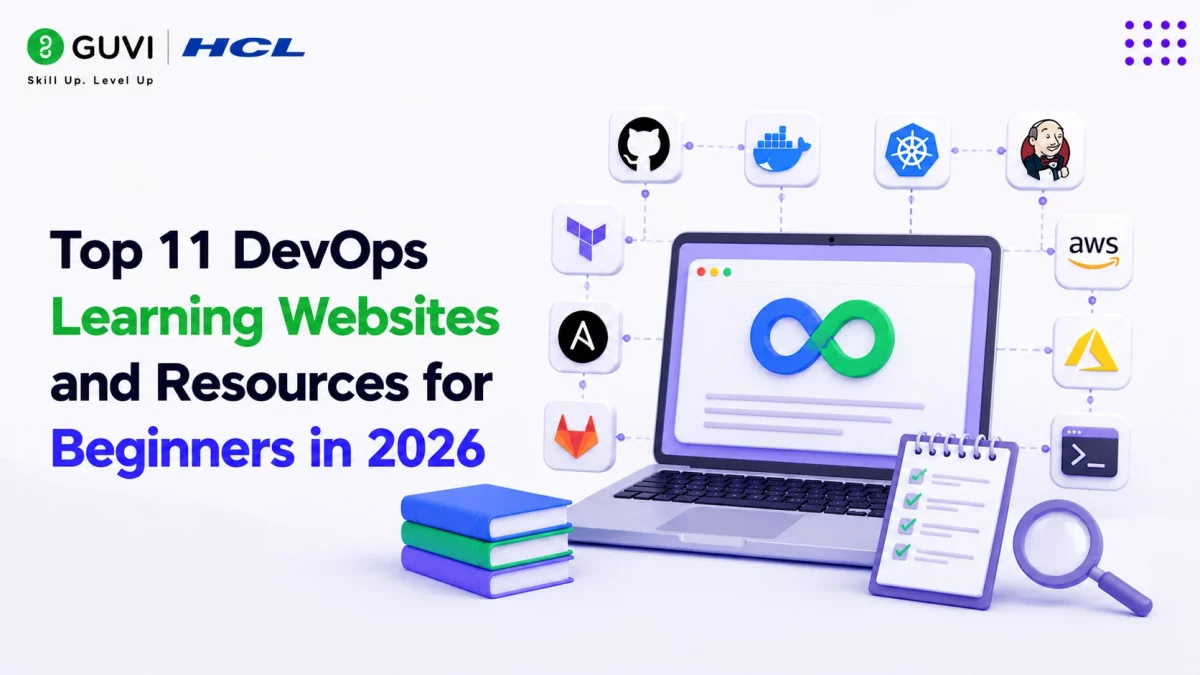
- Top 11 DevOps Learning Websites and Resources for Beginners in 2026
- HCL GUVI
- KodeKloud
- Linux Foundation Training
- Apiumhub
- Atlassian DevOps
- BMC DevOps Blog
- DevOpsCube
- DevOps.com
- Docker Docs
- DZone DevOps
- InfoWorld DevOps
- How to Choose the Right Website for You
- DevOps Roadmap for Beginners in 2026
- Common Mistakes Beginners Make Learning DevOps
- DevOps Career Paths and Salary in 2026
- The Bottom Line
- FAQs
- Which is the best website to learn DevOps for beginners?
- What skills are required to start learning DevOps?
- Is DevOps a good career in 2026?
- Can beginners learn DevOps without coding experience?
- Which DevOps tools should beginners learn first?
TL;DR Summary
- What it is: merging development and operations to speed up software delivery and cut downtime
- Where to start: Linux, Git, and networking, before Docker, CI/CD, cloud, and Kubernetes
- Best structured websites to learn DevOps: HCL GUVI and KodeKloud for guided, hands-on learning
- Best free references: DevOpsCube for tutorials, Docker’s own docs for containers
- Salary: DevOps engineers in the US average $116,000 to $180,000 a year; in India, that’s roughly ₹4-8 LPA for freshers, rising to ₹18-36+ LPA at senior levels
What is DevOps?
DevOps merges software development and IT operations into one automated workflow, so code moves from a developer’s laptop to production without slow handoffs.
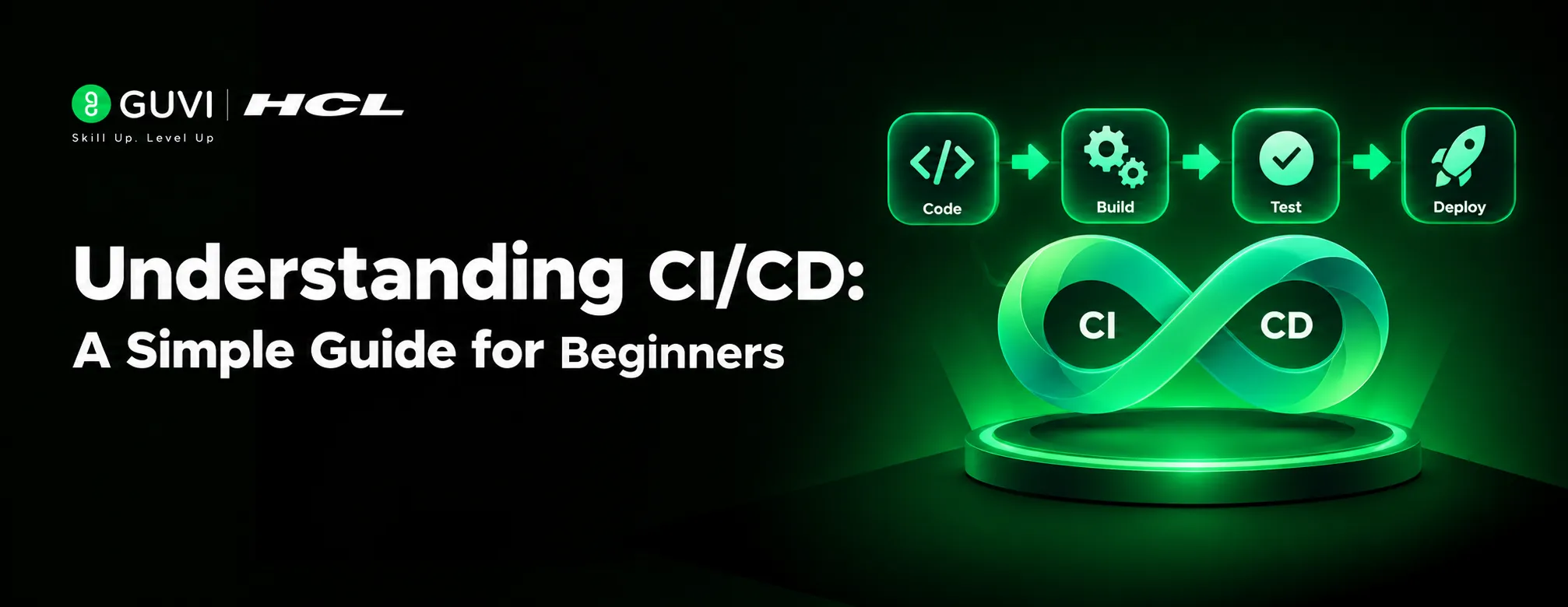
It relies on CI/CD, Infrastructure as Code (IaC), containerization, and orchestration, using tools like Git, Jenkins, Docker, Kubernetes, Terraform, and cloud platforms like AWS and Azure.
- DevOps engineers in the U.S. earn an average salary between $116,000 and $180,000 per year, making it a high-value tech career path.
Why Learn DevOps as a Beginner?
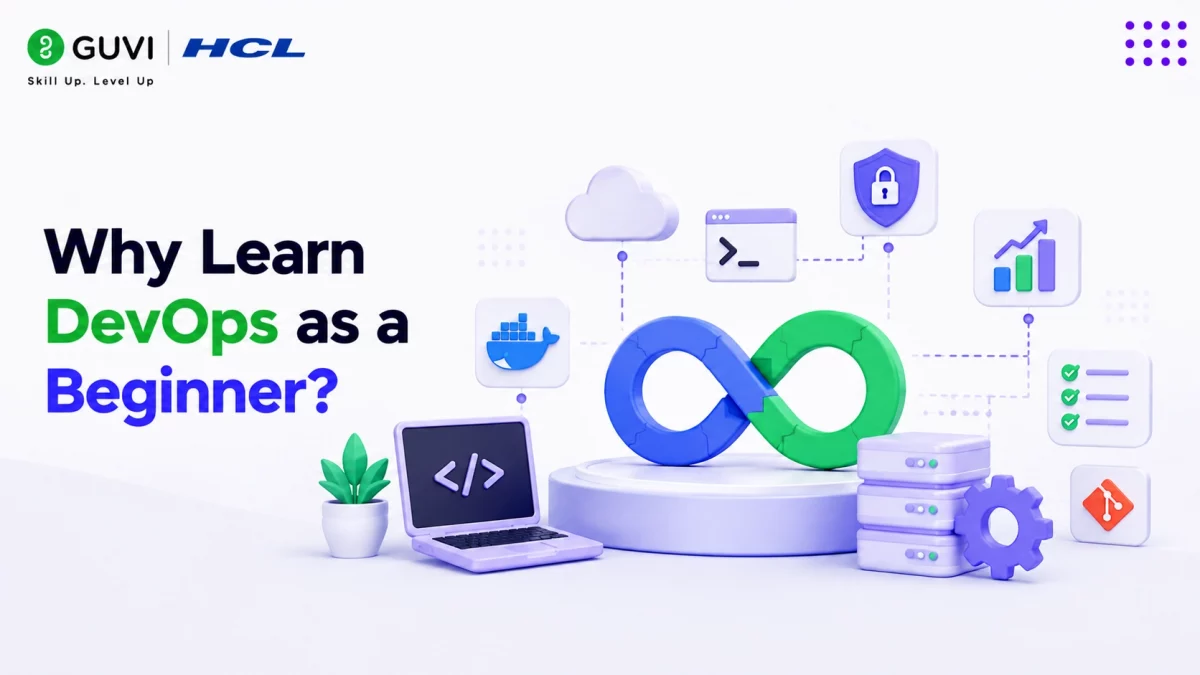
The demand behind all these websites to learn DevOps comes down to a few concrete reasons:
- High demand: DevOps roles remain in short supply across software, SaaS, fintech, and cloud companies.
- Strong pay: Automation and infrastructure skills consistently earn competitive salaries.
- Genuinely hands-on: you work with real infrastructure and pipelines, not just theory.
- Multiple paths: DevOps skills open doors to Cloud Engineer, SRE, and Platform Engineer roles too.
- Works everywhere: startups, enterprise software, healthcare, gaming, and finance all hire for it.
Best Websites to Learn DevOps at a Glance
| S.No | Website | Type | Best For |
|---|---|---|---|
| 1 | HCL GUVI | Structured course platform | Mentorship, projects, and placement support |
| 2 | KodeKloud | Interactive lab platform | Browser-based, hands-on practice |
| 3 | Linux Foundation Training | Official certification body | CNCF-backed Kubernetes credentials |
| 4 | Apiumhub | Consulting company blog | Real production engineering insight |
| 5 | Atlassian DevOps | Toolchain documentation | Jira, Bitbucket, and DevOps culture |
| 6 | BMC DevOps Blog | Enterprise blog | Large-scale, enterprise DevOps |
| 7 | DevOpsCube | Tutorial site | Step-by-step, command-based guides |
| 8 | DevOps.com | Industry media | Trends, case studies, expert commentary |
| 9 | Docker Docs | Official documentation | Learning containers from the source |
| 10 | DZone DevOps | Community publication | Broad, community-written deep dives |
| 11 | InfoWorld DevOps | Tech journalism | Industry analysis and tool comparisons |
- The global DevOps market is expected to grow from $14.95 billion in 2025 to $18.77 billion in 2026, showing rising demand for DevOps skills.
Top 11 DevOps Learning Websites and Resources for Beginners in 2026
1. HCL GUVI
The first of the websites to learn DevOps on this list, and arguably the most beginner-friendly.
- What it is: A structured, mentor-supported ed-tech platform built for guided learning rather than scattered tutorials.
- What it covers: Linux, Git, Docker, Kubernetes, Jenkins, CI/CD, and cloud computing, taught with hands-on projects.
- Duration: Self-paced courses, or a 4-month (weekday) / 6-month (weekend) mentor-led program.
- Fee: Self-paced DevOps fundamentals starts around ₹799; the full mentor-led program uses EMI-based pricing confirmed at enrollment.
- Certification: Yes, backed by NSDC and HCL GUVI, with some tracks carrying IIT-M Pravartak backing, a genuine differentiator among websites to learn DevOps that only offer a plain completion certificate.
- Who it’s for: Complete beginners who want structure, mentorship, and placement support for engineering roles, instead of piecing together free websites to learn DevOps themselves.
- Link: www.guvi.in
2. KodeKloud
Another strong pick among websites to learn DevOps, especially if you learn best by doing rather than watching.
- What it is: A learning-by-doing platform built around live, browser-based labs instead of passive video lessons.
- What it covers: Docker, Kubernetes, Ansible, Terraform, Jenkins, and Linux, with real commands from lesson one.
- Duration: Self-paced, with structured beginner-to-advanced learning paths, one of the more flexible setups among websites to learn DevOps.
- Fee: Standard plan starts at $15/month billed annually ($180/year).
- Rating: 4.8 out of 5 based on thousands of learner reviews, the highest rating among all the websites to learn DevOps covered in this guide.
- Certification: Course completion certificates, plus direct prep for CNCF certifications (CKA, CKAD, CKS).
- Who it’s for: Beginners and working professionals who learn best by typing real commands, not watching lectures.
- Link: kodekloud.com
3. Linux Foundation Training
The one entry among these websites to learn DevOps that’s genuinely an official body, not a third party.
- What it is: The official training and certification body behind Linux and Kubernetes, backed directly by the CNCF.
- What it covers: Linux administration, Kubernetes, containers, and cloud-native orchestration.
- Duration: Self-paced, with certification exams booked separately once you’re ready.
- Fee: Course and certification pricing varies by track; KodeKloud and other partners often offer discounted certification vouchers, which is worth checking before paying full price on any of these websites to learn DevOps.
- Certification: Yes, official CNCF-backed credentials (CKA, CKAD, CKS, KCNA) that are widely recognized by employers.
- Who it’s for: Learners who specifically want a credential with real weight on a resume, not just knowledge.
- Link: training.linuxfoundation.org
4. Apiumhub
A slightly different kind of entry among websites to learn DevOps, since it’s written by a consulting company, not an education platform.
- What it is: The blog of a software development and DevOps consulting company, written from real production experience.
- What it covers: CI/CD workflows, container orchestration, microservices, and Infrastructure as Code.
- Duration: Free reading, no structured course.
- Fee: Free.
- Certification: No.
- Who it’s for: Developers who’ve learned the basics and want to see how DevOps is actually applied at scale.
- Link: apiumhub.com
5. Atlassian DevOps
- What it is: Atlassian’s own resource hub explaining how its tools fit into modern, Agile DevOps pipelines.
- What it covers: CI/CD, Agile-DevOps integration, and incident management using Jira, Bitbucket, Bamboo, and Opsgenie.
- Duration: Free reading, no structured course.
- Fee: Free.
- Certification: No, though Atlassian offers separate product certifications elsewhere.
- Who it’s for: Beginners who want to understand the project management and culture side of DevOps, not just the tools.
- Link: atlassian.com/devops
6. BMC DevOps Blog
Worth bookmarking among websites to learn DevOps if enterprise-scale work is your actual goal.
- What it is: An enterprise-focused blog covering DevOps at large-company scale.
- What it covers: IT operations, automation, hybrid cloud, AIOps, and ITSM integration.
- Duration: Free reading, no structured course.
- Fee: Free.
- Certification: No.
- Who it’s for: Anyone targeting a role at a large, established company rather than a startup.
- Link: bmc.com/blogs/categories/devops
7. DevOpsCube
One of the more practical, free websites to learn DevOps once you’re past the absolute basics.
- What it is: A free tutorial site built around step-by-step, command-based implementation guides.
- What it covers: Kubernetes, Docker, Jenkins, Terraform, Linux, monitoring, and AWS.
- Duration: Free reading, no structured course.
- Fee: Free.
- Certification: No.
- Who it’s for: Learners who already know roughly what they’re building and just need a clear walkthrough.
- Link: devopscube.com
8. DevOps.com
- What it is: One of the largest dedicated DevOps media and industry-news platforms.
- What it covers: DevOps trends, DevSecOps, observability, and enterprise-scale software delivery.
- Duration: Free reading, best treated as ongoing reading rather than a course.
- Fee: Free.
- Certification: No.
- Who it’s for: Working professionals who want to stay current, not beginners looking for a first tutorial.
- Link: devops.com

9. Docker Docs
Probably the most essential single-tool resource among websites to learn DevOps on this entire list.
- What it is: Docker‘s own official documentation and learning resources for containerization.
- What it covers: Containers, image creation, networking, and deployment portability.
- Duration: Free reading, self-paced.
- Fee: Free.
- Certification: No official certification through the docs themselves; Docker Certified Associate is a separate paid exam.
- Who it’s for: Anyone serious about CI/CD or cloud-native work, since Docker underpins so much of it.
- Link: docs.docker.com
10. DZone DevOps
One of the more community-driven websites to learn DevOps on this list, written by working professionals rather than a single institution.
- What it is: A community-driven technical publication written by working developers and DevOps professionals.
- What it covers: Kubernetes, automation, cloud-native systems, CI/CD, and infrastructure scaling.
- Duration: Free reading, no structured course.
- Fee: Free.
- Certification: No.
- Who it’s for: Learners looking for a specific, niche topic other beginner-focused sites don’t cover.
- Link: dzone.com
11. InfoWorld DevOps
The last of the 11 websites to learn DevOps on this list, and one of the more analytical ones.
- What it is: A technology journalism outlet covering DevOps trends and tool comparisons.
- What it covers: Cloud computing, Kubernetes, platform engineering, and DevOps tool analysis.
- Duration: Free reading, no structured course.
- Fee: Free.
- Certification: No.
- Who it’s for: Readers who already know the basics and want independent tool comparisons, not a first tutorial.
- Link: infoworld.com/category/devops
How to Choose the Right Website for You
Among all the websites to learn DevOps on this list, here’s how to actually pick one:
- Want structure and mentorship? Start with HCL GUVI or KodeKloud.
- Want a recognized certification? Linux Foundation Training carries genuine institutional weight.
- Already know the basics, want free practice? DevOpsCube and Docker’s own docs cover this well, or dive into a dedicated Kubernetes roadmap if that’s your next focus.
- Want to stay current once you’re working? DevOps.com, DZone, and InfoWorld work better as ongoing reading.
- Want to see DevOps at enterprise scale? Apiumhub and BMC show what large, complex environments look like.
No single one of these websites to learn DevOps does everything. Most people combine a structured course with one or two free references for ongoing practice.
DevOps Roadmap for Beginners in 2026
This roadmap works alongside any of the websites to learn DevOps covered above.
Step 1: Learn Linux fundamentals. Commands, file systems, permissions, and shell scripting, since most DevOps infrastructure runs on Linux servers.
Step 2: Learn Git and version control. Repositories, commits, branching, merging, and pull requests.
Step 3: Understand networking basics. IP addressing, DNS, HTTP/HTTPS, SSH, ports, and load balancing.
Step 4: Master containerization with Docker. Images, containers, Dockerfiles, volumes, and networking.
Step 5: Learn CI/CD pipelines. Jenkins, GitHub Actions, GitLab CI/CD, and automated testing and deployment.
Step 6: Study cloud computing. Pick one of AWS, Azure, or Google Cloud and go deep on compute, storage, and IAM.
Step 7: Learn Kubernetes basics. Pods, deployments, services, and container orchestration.
Step 8: Explore Infrastructure as Code. Terraform and Ansible for automated provisioning.
Step 9: Understand monitoring and observability. Prometheus, Grafana, logging, and alerting.
Step 10: Build real projects. Deploy containerized apps and host projects on a real cloud platform.
Step 11: Target certifications. AWS Cloud Practitioner, Docker Certified Associate, Kubernetes (CKA/CKAD), or Terraform Associate.
Common Mistakes Beginners Make Learning DevOps
This mistake shows up regardless of which websites to learn DevOps you’re using:
- Jumping straight to Kubernetes. Without Linux and networking basics first, Kubernetes concepts won’t make real sense.
- Watching without building. DevOps is a hands-on skill; passively watching videos doesn’t build real competence.
- Trying to learn every tool at once. Spreading effort across five CI/CD tools at once means none of them reach a usable depth.
- Skipping the “why.” Memorizing Terraform syntax without understanding why Infrastructure as Code matters makes the knowledge brittle.
- Ignoring monitoring until the end. Treating observability as an afterthought leaves a real gap employers screen for.
DevOps Career Paths and Salary in 2026
DevOps skills open more doors than just the “DevOps Engineer” title itself:
| Role | What They Do | Average Salary (India) |
|---|---|---|
| DevOps Engineer | Builds and maintains CI/CD pipelines and deployment automation | ₹8.5 LPA |
| Site Reliability Engineer (SRE) | Focuses on uptime, incident response, and system reliability | ₹13 LPA |
| Cloud Engineer | Designs and manages cloud infrastructure (AWS, Azure, GCP) | ₹6.8 LPA |
| Platform Engineer | Builds internal tools and platforms that other engineers use | ₹12.3 LPA |
| Automation Engineer | Specializes in scripting and automating repetitive operational tasks | ₹6.5 LPA |
That salary potential is a big reason so many people search for websites to learn DevOps every year: DevOps engineers in India average ₹8.5 LPA, with pay ranging from ₹5 LPA to ₹13.5 LPA and top earners crossing ₹21 LPA.
The global DevOps market itself is projected to grow from $14.95 billion in 2025 to $18.77 billion in 2026, a clear signal that demand isn’t slowing down.
The Bottom Line
DevOps remains one of the most in-demand career paths in 2026, and among all the websites to learn DevOps covered here, no single one teaches all of it well.
Structured platforms like HCL GUVI and KodeKloud handle guided learning, Linux Foundation Training handles credibility, and free sites like DevOpsCube and Docker’s own docs handle ongoing practice.
Start with Linux, Git, Docker, and CI/CD, then move into Kubernetes and cloud computing. Which specific website you pick from this list matters less than actually building something real along the way.
FAQs
Which is the best website to learn DevOps for beginners?
Platforms like HCL GUVI, KodeKloud, Linux Foundation Training, and DevOpsCube are highly beginner-friendly because they provide hands-on labs, practical projects, and structured DevOps learning paths.
What skills are required to start learning DevOps?
Beginners should learn Linux, Git, Docker, CI/CD pipelines, cloud computing, Kubernetes, and Infrastructure as Code (IaC) fundamentals.
Is DevOps a good career in 2026?
Yes, DevOps remains one of the most in-demand careers due to growing adoption of cloud computing, automation, Kubernetes, and CI/CD workflows across industries.
Can beginners learn DevOps without coding experience?
Yes, beginners can start DevOps without advanced coding skills by first learning Linux commands, Git workflows, cloud basics, and automation concepts gradually.
Which DevOps tools should beginners learn first?
Beginners should start with Git, Docker, Jenkins, Kubernetes, Terraform, and cloud platforms like AWS or Azure.
Success Stories

About the Author
Jebasta
I translate the language of data into stories that anyone can understand. As a writer with a data science background, I simplify analytics, AI, and decision-making so beginners and enthusiasts can confidently explore the world of data.
View all posts by Jebasta
Connect with me @





















Did you enjoy this article?