


Career Articles
Accountant vs Data Analyst Salary in India After Switching Careers - Best Guide
Finance Managers: Could Data Science Be Your Next Career Move?
Insurance Claims Executive to Data Analyst: Is It a Good Switch?
Banking Executive (Loans, KYC) to Data Analyst: Skills and Career Path


Get In Touch For Details! Request More Information
Crack the TCS IPA Exam: Top Questions and Exclusive Tips for Success!
Aug 04, 2026 8 Min Read 191806 Views
(Last Updated)
Table of contents
- TL;DR Summary
- Introduction
- TCS IPA at a Glance
- What is the TCS IPA Exam?
- TCS IPA vs TCS NQT vs TCS Xplore: What's the Difference?
- TCS IPA Exam Pattern & Syllabus
- MCQ Section — 50 Marks
- Coding Section — 50 Marks
- Top TCS IPA Questions & Answers
- A. KYT — Know Your TCS
- B. BizSkill
- C. UI: HTML & CSS
- D. Unix
- E. Java & Python MCQs
- F. SQL / MySQL / PLSQL
- G. Coding Section: Problems & Solutions
- How to Score 80+ in TCS IPA 2026: 8 Proven Tips
- Best Resources for TCS IPA Exam Preparation
- Conclusion
- FAQs
- Is TCS IPA compulsory for all TCS new joiners?
- What is the passing mark for TCS IPA?
- Can I reattempt the TCS IPA exam?
- How is TCS IPA different from TCS NQT?
- How long should I prepare for TCS IPA?
- How often is the TCS IPA Exam conducted?
- Does your TCS IPA score affect your appraisal?
- How difficult are the TCS IPA exam questions?
TL;DR Summary
The TCS IPA Exam evaluates your technical knowledge, coding ability, and business skills through MCQs and programming questions. This guide covers the latest exam pattern, sample questions, preparation tips, and scoring strategy to help you prepare confidently and maximize your chances of earning a high score and onboarding incentives.
Introduction
So you’ve got your TCS offer letter, and now someone mentioned the TCS IPA exam. What exactly is it, and should you be worried?
Short answer: no. But you should absolutely be prepared, because this one exam can put ₹60,000 extra in your pocket before your first day of work. Score above 55% and you earn a ₹40,000 joining bonus. Clear 80%+? Add another ₹20,000 on top of that. Since 2025, it’s mandatory for all new TCS joiners, and that remains true in 2026.
This article covers everything you need, the exam structure, the real MCQs section by section, Java and Python coding problems with solutions, and the exact strategy to hit 80+. Let’s get started.
TCS IPA at a Glance
Here’s a quick snapshot of the TCS IPA Exam:
| Detail | Info |
| Full form | iON Proctored Assessment |
| Duration | 120 minutes |
| Total marks | 100 (MCQs: 50 + Coding: 50) |
| Language choice | Java or Python |
| Bonus at 55%+ | ₹40,000 joining bonus |
| Bonus at 80%+ | Additional ₹20,000 + early onboarding + preferred location* |
| Mandatory? | Yes, for all TCS new joiners |
| Mode | In-person at authorised TCS iON centres |
*Subject to TCS business demands and unit mapping.
Unlike many recruitment assessments, the TCS IPA Exam is not an elimination test. There is no publicly announced pass or fail score. Instead, your performance determines bonus eligibility and may influence onboarding benefits, subject to TCS policies and business requirements.
What is the TCS IPA Exam?
TCS IPA (iON Proctored Assessment) is a 120-minute, 100-mark test conducted at authorised TCS iON centres. It tests your programming ability, SQL knowledge, UI basics, Unix commands, business communication, and TCS company knowledge, a broad but very learnable set of topics.
The IPA is not an elimination test. Scoring below 55% does not cancel your offer letter or affect your joining. The exam exists purely to determine your bonus eligibility — so think of it as a paid challenge, not a gate.
The exam is split into two sections: MCQs (50 marks, 50 minutes) and Coding (50 marks, 70 minutes). You can switch between sections freely during the exam, a flexibility that smart candidates use to their advantage.
TCS IPA vs TCS NQT vs TCS Xplore: What’s the Difference?
If you’re preparing for your onboarding, it’s easy to confuse TCS IPA, TCS NQT, and TCS Xplore. Understanding the role of each is an important part of TCS IPA exam preparation, as every stage serves a different purpose in your journey from candidate to employee.
| Feature | TCS NQT | TCS Xplore | TCS IPA |
| Purpose | Hiring assessment | Learning & onboarding platform | Post-offer assessment |
| When It Happens | Before receiving an offer | After joining/pre-joining learning | Before onboarding (for eligible candidates) |
| Who Takes It? | Job applicants | TCS selected candidates | TCS new joiners |
| Focus Areas | Aptitude, reasoning, coding | Technical learning modules | MCQs, coding, SQL, Unix, BizSkill, KYT |
| Duration | Varies | Self-paced | 120 minutes |
| Outcome | Job selection | Learning completion | Bonus eligibility and onboarding benefits |
TCS IPA Exam Pattern & Syllabus
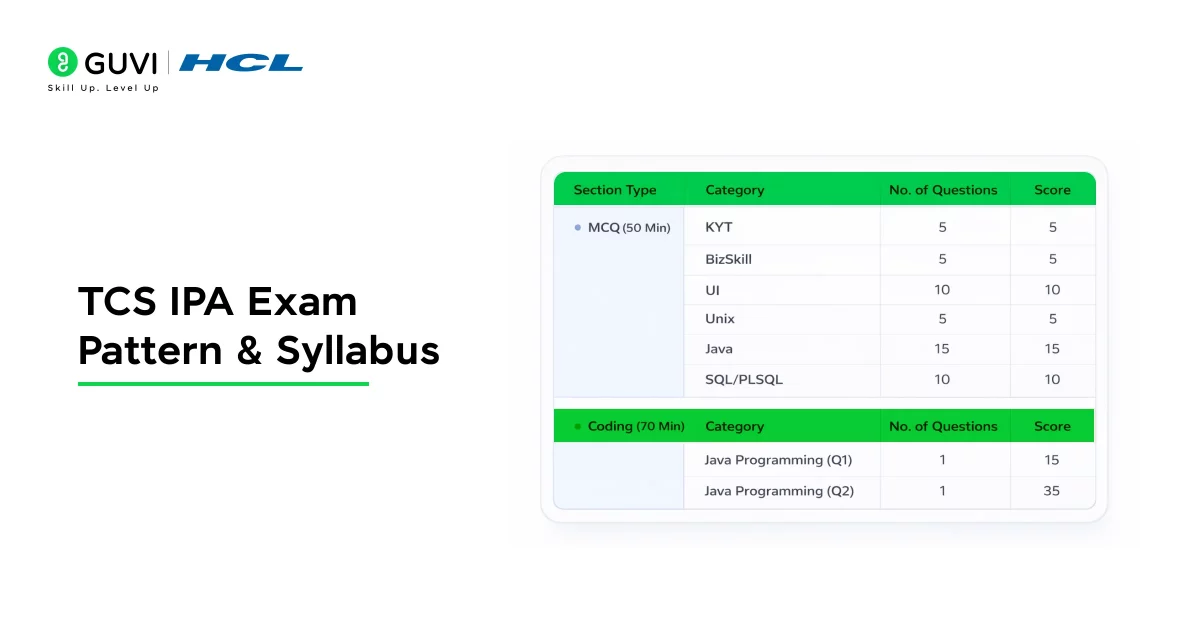
Knowing the structure in detail is half the preparation done. Here’s the complete, section-wise breakdown, in a format you can actually refer back to.
MCQ Section — 50 Marks
| Sub-Section | Topics Covered | Questions | Marks |
| KYT (Know Your TCS) | TCS history, CEO, awards, subsidiaries, milestones | 5 | 5 |
| BizSkill | Professional ethics, business communication, situation-based Qs | 5 | 5 |
| UI | HTML, CSS, JavaScript syntax and basics | 10 | 10 |
| Unix | Basic Unix/Linux commands and OS concepts | 5 | 5 |
| Java or Python | Core language concepts based on your choice | 15 | 15 |
| SQL/PLSQL or MySQL | Database queries and fundamentals | 10 | 10 |
| Total | 50 | 50 |
Coding Section — 50 Marks
| Problem | Difficulty | Marks | Key Topics |
| Problem 1 | Easy | 15 | Strings, arrays, basic I/O, simple logic |
| Problem 2 | Complex | 35 | OOP: classes, static methods, inheritance, filtering/sorting |
| Total | 50 |
Did You Know? Each coding problem has 4 test cases. Pass all 4 for both questions and you score the full 50 coding marks. That means you only need 30 out of 50 MCQ marks to cross 80% — which is very achievable once you stop treating the coding section as optional.
Top TCS IPA Questions & Answers
This is the core of your preparation. Below are real, frequently appearing MCQs from every sub-section, plus coding problems with complete solutions. The correct answers are in bold.
A. KYT — Know Your TCS
These 5 questions are among the easiest marks on the paper, if you’ve spent 30 minutes with TCS Xplore’s “Know Your Organisation” module.
1. When was Tata Consultancy Services established?
a. 1978 | b. 1968 | c. 1988 | d. 1958
2. Who is the current CEO & MD of TCS (as of 2026)?
a. Rajesh Gopinathan | b. K. Krithivasan | c. N. Chandrasekaran | d. Cyrus Mistry
3. TCS is a subsidiary of which group?
a. Reliance | b. Wipro | c. Tata Group | d. Mahindra
4. TCS’s “BaNCS” platform is used primarily in which industry?
a. Healthcare | b. Banking and Finance | c. Manufacturing | d. Retail
5. Which is TCS’s AI-powered software engineering platform?
a. Ignio | b. Infosphere | c. MasterCraft | d. Polaris
6. TCS was the first Indian IT company to cross which market cap milestone?
a. $50B | b. $200B | c. $100B | d. $500B
B. BizSkill
Scenario-based and communication questions dominate here. The logic is consistent, professional, ethical, client-first thinking always wins.
1. What are the stages in the IBC approach?
a. Introduction, Body, Cohesion | b. Introduction, Body, Content | c. Introduction, Body, Conclusion | d. None
2. In a client meeting, if you don’t know an answer, you should:
a. Stay silent | b. Bluff confidently | c. Acknowledge and follow up later | d. Change the topic
3. Which is an example of non-verbal communication?
a. Emails | b. Phone calls | c. Body language | d. Reports
4. In formal email writing, what should be avoided?
a. Subject line | b. Greeting | c. Abbreviations & emojis | d. Closing remarks
5. Active listening in business communication primarily helps to:
a. Reduce workload | b. Build trust and clarity | c. Replace verbal communication | d. None
C. UI: HTML & CSS
You don’t need to be a front-end developer to crack this section. A solid understanding of basic HTML tags and CSS properties is enough for all 10 marks.
1. What is the correct CSS syntax to set a border with colour?
a. border-line | b. border: solid DodgerBlue | c. border: 2px solid DodgerBlue | d. None
2. In HTML5, which tag is semantic?
a. <div> | b. <article> | c. <span> | d. <br>
3. Which HTML attribute provides alternate text for an image?
a. title | b. src | c. alt | d. caption
4. Which CSS property controls the stacking order of elements?
a. display | b. z-index | c. order | d. position
5. Which HTML tag creates a dropdown list?
a. <input> | b. <list> | c. <select> | d. <dropdown>
6. Which CSS property makes text bold?
a. text-decoration | b. font-weight | c. text-style | d. emphasis
7. Which CSS unit is relative to the parent element?
a. px | b. cm | c. em | d. in
8. Which HTML element creates the largest heading?
a. h6 | b. h3 | c. h1 | d. title
Revising HTML & CSS for TCS IPA? Get quick, beginner-friendly references: HTML Tutorial for Beginners & CSS Tutorial for Beginners
D. Unix
Five questions, all command-based. Memorise the core commands below and you’ll pick up all 5 marks with ease.
1. Which command shows the present working directory?
a. dir | b. pwd | c. whereami | d. home
2. Which command changes file/directory permission levels?
a. passwd | b. unset | c. return | d. chmod
3. Which command lists all files, including hidden ones?
a. ls -l | b. ls -s | c. ls -a | d. ls -h
4. Which command terminates a process by PID?
a. stop pid | b. kill -9 pid | c. exit pid | d. quit pid
5. Which command searches for a pattern inside a file?
a. find | b. awk | c. grep “pattern” filename | d. locate
Unix questions in TCS IPA almost always come from a fixed pool of ~30 commands. Practicing a Unix quick-reference sheet for one hour the day before your exam is one of the highest-ROI prep activities you can do.
E. Java & Python MCQs
This is your 15-mark section, and it’s where preparation in your chosen language really pays off. Here’s a mix from both, since the concept areas overlap heavily.
1. Which keyword inherits a class in Java?
a. implements | b. extends | c. super | d. inherits
2. Which exception is thrown on dividing by zero in Java?
a. NullPointerException | b. IOException | c. ArithmeticException | d. RuntimeError
3. Which is not an OOP principle?
a. Abstraction | b. Encapsulation | c. Polymorphism | d. Compilation
4. Default value of int in Java is:
a. null | b. 0 | c. garbage value | d. not defined
5. What is the output of x = sum(range(7)) → print(x) in Python?
a. 20 | b. 21 | c. 22 | d. 23
6. Which of these is immutable in Python?
a. List | b. Tuple | c. Dictionary | d. Set
7. What does bool(“”) return in Python?
a. True | b. False | c. None | d. Error
8. Which keyword defines a function in Python?
a. def | b. func | c. function | d. lambda
Confused about inheritance, polymorphism, or OOP in Java? Revise every core concept in one place: Java Tutorial for Beginners
F. SQL / MySQL / PLSQL
10 marks and very learnable. SQL candidates — don’t skip PLSQL. It has appeared in Java-track papers and missing it costs you easy marks.
1. Which clause filters rows in SQL?
a. GROUP BY | b. WHERE | c. HAVING | d. SELECT
2. Which command removes a table from the database?
a. DELETE TABLE | b. DROP TABLE | c. REMOVE TABLE | d. ERASE TABLE
3. Which keyword removes duplicate rows from results?
a. UNIQUE | b. GROUP | c. LIMIT | d. DISTINCT
4. What is the default sort order of ORDER BY?
a. DESC | b. ASC | c. RANDOM | d. NONE
5. Which command permanently saves changes in a transaction?
a. ROLLBACK | b. COMMIT | c. SAVEPOINT | d. STORE
6. Which type of trigger fires before an event in PLSQL?
a. BEFORE trigger | b. AFTER trigger | c. DURING trigger | d. PRE trigger
7. Which keyword is used to exit a loop in PLSQL?
a. STOP | b. EXIT | c. BREAK | d. LEAVE
PLSQL loops, EXIT statements, and cursors appear more often than most candidates expect in TCS IPA. Revise them all in one place: PL/SQL Tutorial
G. Coding Section: Problems & Solutions
The coding section is where the exam is genuinely won. Below are the two problem types you’ll encounter, with working solutions in both languages.
Problem 1: Easy (15 Marks): Count Uppercase & Lowercase Letters
Write a program to count uppercase and lowercase letters in a string. Ignore digits and spaces.
Input: HellO WoRLD
Output:
Uppercase: 6
Lowercase: 4
Python Solution:
def count_case(s):

    upper, lower = 0, 0

    for ch in s:

        if 'A' <= ch <= 'Z':

            upper += 1

        elif 'a' <= ch <= 'z':

            lower += 1

    return upper, lower

s = input().strip()

u, l = count_case(s)

print("Uppercase:", u)

print("Lowercase:", l)
Java Solution:

import java.util.*;

public class Main {

    public static void main(String[] args) {

        Scanner sc = new Scanner(System.in);

        String str = sc.nextLine();

        int upper = 0, lower = 0;

        for (char ch : str.toCharArray()) {

            if (Character.isUpperCase(ch)) upper++;

            else if (Character.isLowerCase(ch)) lower++;

        }

        System.out.println("Uppercase: " + upper);

        System.out.println("Lowercase: " + lower);

    }

}
Problem 2 — Complex (35 Marks): Filter Products by Category
Read `n` product objects (id, name, price, category). Read a category string `C`. Print the average price of matching products rounded to 2 decimal places. Print `0.00` if none match.
Input:
3
101 Phone 199.99 Electronics
102 Shirt 49.99 Apparel
103 Laptop 999.00 Electronics
Electronics
Output: 599.50
Python Solution:
class Product:

    def __init__(self, pid, name, price, category):

        self.pid = pid

        self.name = name

        self.price = price

        self.category = category

n = int(input().strip())

products = []

for _ in range(n):

    data = input().strip().split()

    products.append(Product(int(data[0]), data[1], float(data[2]), data[3]))

C = input().strip()

filtered = [p.price for p in products if p.category == C]

print(f"{sum(filtered)/len(filtered):.2f}" if filtered else "0.00")
Java Solution:
import java.util.*;

class Product {

    int id; String name, category; double price;

    Product(int id, String name, double price, String category) {

        this.id = id; this.name = name;

        this.price = price; this.category = category;

    }

    public static double avgByCategory(Product[] arr, String C) {

        double total = 0; int count = 0;

        for (Product p : arr) {

            if (p.category.equals(C)) { total += p.price; count++; }

        }

        return count == 0 ? 0.00 : total / count;

    }

}

public class Main {

    public static void main(String[] args) {

        Scanner sc = new Scanner(System.in);

        int n = Integer.parseInt(sc.nextLine().trim());

        Product[] products = new Product[n];

        for (int i = 0; i < n; i++) {

            String[] d = sc.nextLine().trim().split(" ");

            products[i] = new Product(Integer.parseInt(d[0]), d[1], Double.parseDouble(d[2]), d[3]);

        }

        String C = sc.nextLine().trim();

        System.out.printf("%.2f%n", Product.avgByCategory(products, C));

    }

}
How to Score 80+ in TCS IPA 2026: 8 Proven Tips
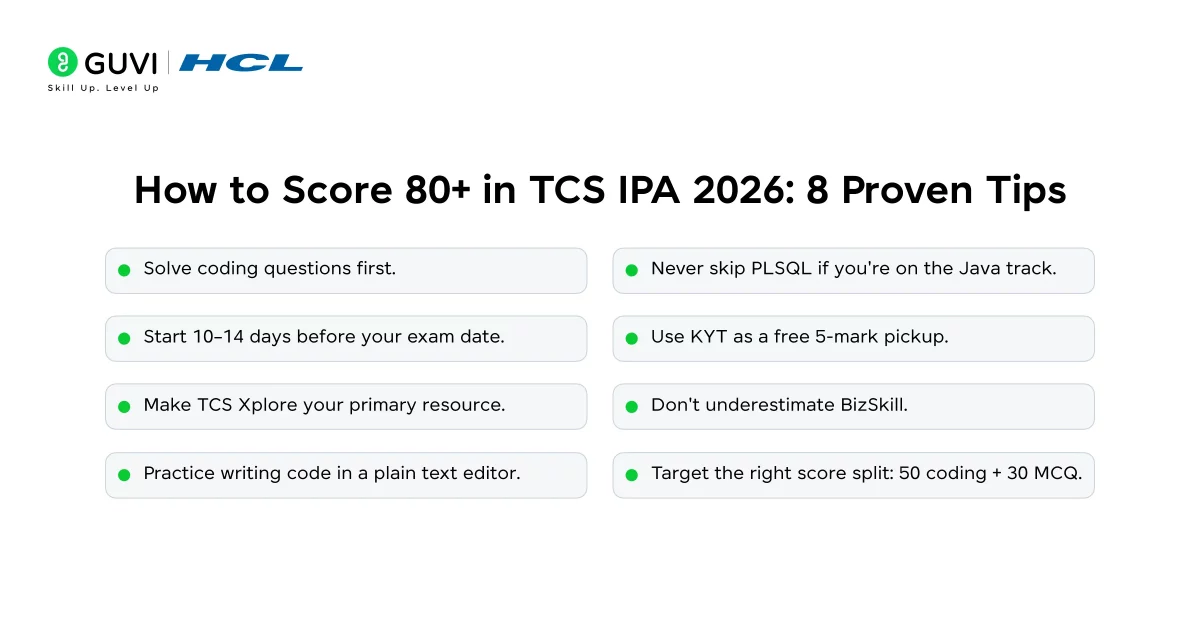
Knowing the syllabus gets you in the room. These eight tips get you to 80+. Every one of them comes from strategies shared by students who cleared the exam in their first attempt.
1. Solve coding questions first. The moment the exam begins, go straight to the coding section. Two correct solutions guarantee all 50 coding marks. You then only need 30 out of 50 MCQ marks to hit 80%, and that pressure shift changes everything.
2. Start 10–14 days before your exam date. You don’t need months of prep. Students consistently report that 10–14 days of focused work — around 2 hours daily — is enough to score 80+. Starting a month early is ideal; less than a week is a gamble.
3. Make TCS Xplore your primary resource. TCS Xplore has “Java Learning Path 1,” “Xplore Hands-On,” and “Know Your Organisation” — all of which map directly to IPA sections. These are the official prep materials and the closest thing to the real exam environment you’ll find.
4. Practice writing code in a plain text editor. The IPA coding interface is a basic text box — no IntelliJ, no VS Code, no autocomplete. If you’ve only ever coded with an IDE, this will slow you down. Spend the last few days writing 3–4 programs daily in Notepad or a plain editor to get comfortable.
5. Never skip PLSQL if you’re on the Java track. It’s the most common preparation mistake. Students focus on SQL and assume PLSQL won’t appear — it does, and missing it costs 5–10 marks. One hour of PLSQL revision the night before is worth every minute.
6. Use KYT as a free 5-mark pickup. TCS history, CEO, flagship products, market cap — these questions repeat across batches with minimal variation. Thirty minutes with Xplore’s “Know Your Organisation” module is all you need to secure all 5 KYT marks.
7. Don’t underestimate BizSkill. Scenario-based professional communication questions feel soft, but they’re predictable. The pattern is always client-first, ethical, follow-up-oriented thinking. Go through TCS Xplore’s business webinar recordings and the “7 Cs of communication” — that’s all the prep this section needs.
8. Target the right score split: 50 coding + 30 MCQ. Don’t aim to be perfect across every section. The realistic 80+ strategy is: lock in 50 coding marks, then focus your MCQ prep on your strongest 3–4 sections. You can afford to drop marks in a couple of sections and still hit 80.
Best Resources for TCS IPA Exam Preparation
After understanding the exam pattern and practicing the sample questions, the next step is choosing the right resources. Start with TCS Xplore, then use these additional platforms to strengthen your concepts and coding skills.
| Resource | How It Helps |
| TCS Xplore | Your primary preparation resource for KYT, BizSkill, Java Learning Path, Hands-on modules, and company-specific learning. |
| MDN Web Docs | Quick revision of HTML, CSS, and JavaScript concepts. |
| HCL GUVI Free Resources | Practice Java, Python, SQL, HTML, CSS, and programming fundamentals through beginner-friendly tutorials and learning resources. |
| LeetCode / HackerRank | Improve coding speed and problem-solving for the coding section. |
Conclusion
In conclusion, the TCS IPA exam is genuinely one of the better-designed assessments in the Indian IT onboarding process, because it rewards structured preparation with real money. If you go in knowing the pattern, solve coding first, and spend 10–14 days on the right material, scoring 80+ is not just possible, it’s the expected outcome for a well-prepared candidate.
You don’t need to be a competitive programmer. You don’t need months of prep. You need a clear plan, the right practice problems, and the right environment to practice in. To sharpen your coding skills before the exam, explore HCL GUVI’s CodeKata, where you can solve coding challenges, strengthen your problem-solving ability, and build the confidence needed for technical assessments like TCS IPA.
Good luck, you’ve already taken the first step by preparing.
FAQs
1. Is TCS IPA compulsory for all TCS new joiners?
Yes. Since 2025 and continuing in 2026, the IPA is mandatory for all new TCS joiners. Skipping it is not an option once you’re in the onboarding process.
2. What is the passing mark for TCS IPA?
There is no elimination threshold. Scoring 55%+ earns a ₹40,000 joining bonus; 80%+ earns an additional ₹20,000. Below 55% means you join without a bonus — your offer remains valid.
3. Can I reattempt the TCS IPA exam?
Currently, TCS does not offer a reattempt window. You get one attempt, which is all the more reason to prepare properly.
4. How is TCS IPA different from TCS NQT?
TCS NQT is the recruitment test you take to receive a TCS offer letter. TCS IPA is taken after you already have the offer, it’s a joining assessment that determines your bonus and early onboarding eligibility, not your employment status.
5. How long should I prepare for TCS IPA?
10–14 days of focused daily practice (2 hours/day) is enough for most students to score 80+. Students who start a month ahead can aim for near-perfect scores with less daily pressure.
How often is the TCS IPA Exam conducted?
The TCS IPA Exam is typically conducted once for each batch of eligible new joiners during the onboarding process. The exact exam date and schedule may vary depending on your joining batch, business unit, and location. TCS usually shares the exam details and instructions through official onboarding communication channels.
Does your TCS IPA score affect your appraisal?
The TCS IPA Exam is primarily conducted to determine bonus eligibility and support the onboarding process for new joiners. It is not generally considered a part of the regular employee appraisal cycle. However, onboarding benefits and internal policies may vary based on business requirements and TCS guidelines.
How difficult are the TCS IPA exam questions?
Most TCS IPA exam questions are aimed at assessing your understanding of programming fundamentals, business communication, SQL, Unix, and basic web technologies. While the MCQs are generally straightforward with proper preparation, the coding section requires logical thinking and consistent practice.
Success Stories

About the Author
Lukesh S
A professional content writer who has experience in freelancing and now working as a Technical Content Writer at HCL GUVI having sound knowledge in Blog Writing and Creative Writing!
View all posts by Lukesh S
Connect with me @

Did you enjoy this article?
Comments









This article helped me in easy understanding of what IPA exactly is. Thank You to the team of GUVI
First of all tq so much for this very info and guidance. I wanted to know that what if someone scores even less than 55% or 80% in the ipa exam as mentioned in this article? And is the incentive just for the first month while joining? Please someone let me know.