


Career Articles
From IT Support to AI Engineer: A Realistic Career Switch Guide 2026
AI/ML Upskilling: Build In-House or Partner? Best Guide for TA Teams 2026
Is the HCL GUVI AI/ML Program Right for You? A Quick Self-Assessment
Inside the HCL GUVI AI/ML Curriculum: What You’ll Actually Build

Get In Touch For Details! Request More Information
Top 5 Job-Oriented Courses After Mechanical Engineering
May 04, 2026 5 Min Read 22540 Views
(Last Updated)
Mechanical engineering has always been one of the most versatile and foundational branches of engineering. But today, the job market is shifting fast. Traditional roles are evolving, and companies are looking for engineers who can combine core mechanical knowledge with modern technologies like AI, automation, and data analytics.
So, what should you do after your degree? Should you stick to core mechanical roles, or pivot into emerging tech fields?
This blog answers that question by breaking down the top 5 job-oriented courses after mechanical engineering. Whether you want high-paying tech roles, core design jobs, or leadership positions, these courses can help you make a strategic career move.
Quick Answer:
Mechanical engineering graduates can significantly boost their career prospects by choosing job-oriented courses aligned with current industry demand. The top options include Data Science, Artificial Intelligence & Machine Learning, CAD/CAE, Robotics & Automation, and Supply Chain Management. These courses help you transition into high-growth roles such as data analyst, AI engineer, design engineer, robotics specialist, and operations manager. The right course depends on your interest, whether it is core engineering, software, or management. Upskilling in these areas improves employability, salary potential, and career flexibility across industries.
Table of contents
- Why You Need Job-Oriented Courses After Mechanical Engineering
- Top 5 Job-Oriented Courses After Mechanical Engineering (Detailed Breakdown)
- Data Science and Analytics
- Artificial Intelligence and Machine Learning
- CAD/CAE (Design & Simulation)
- Robotics and Automation
- Supply Chain Management
- How to Choose the Right Course After Mechanical Engineering Based on Your Interest
- Tech & Coding → Data Science / AI
- Core Engineering → CAD/CAE
- Hardware & Systems → Robotics and Automation
- Business & Operations → Supply Chain Management
- Based on Career Goals
- High Salary → Artificial Intelligence, Data Science
- Core Stability → CAD/CAE
- Future Growth → Robotics and Automation
- Leadership Roles → Supply Chain Management
- Final Decision Framework
- Final Takeaway
- Conclusion
- FAQs
- Which course is best after mechanical engineering for a high salary?
- Can mechanical engineers switch to IT or software roles?
- Is it better to stay in core mechanical engineering or switch fields?
Why You Need Job-Oriented Courses After Mechanical Engineering
Mechanical engineering provides a strong technical base, but many graduates struggle with job readiness due to a lack of industry-specific skills. Job-oriented courses bridge this gap by:
- Providing hands-on, practical experience
- Aligning skills with industry demand
- Opening opportunities beyond core mechanical roles
- Improving salary potential and job stability
Top 5 Job-Oriented Courses After Mechanical Engineering (Detailed Breakdown)
1. Data Science and Analytics
Data science has moved far beyond IT companies. Today, manufacturing, automotive, energy, and even supply chain operations rely heavily on data-driven decision-making. Mechanical engineers already work with systems, measurements, and optimisation, which makes the transition into data science relatively smooth.
What You Will Learn:
- Programming with Python and SQL for data handling
- Data cleaning, preprocessing, and exploratory analysis
- Data visualisation using tools like Power BI and Tableau
- Basics of machine learning for prediction and optimisation
How It Connects to Mechanical Engineering:
- Predictive maintenance in manufacturing plants
- Quality control using statistical analysis
- Performance optimisation of machines and systems
Career Roles:
- Data Analyst
- Business Analyst
- Data Scientist
Salary & Demand Insight: Data roles are among the highest-paying entry points for engineers shifting domains, especially in product, fintech, and manufacturing analytics.
Why Choose This: If you enjoy working with numbers, identifying patterns, and solving real-world problems using data, this field offers strong career growth and cross-industry flexibility.
Start your data science journey with practical, job-ready skills. Enroll in HCL GUVI’s Data Science and Analytics course to learn core concepts, tools, and real-world applications through structured, self-paced modules.
2. Artificial Intelligence and Machine Learning
Artificial Intelligence and Machine Learning are redefining how machines operate, learn, and optimise themselves. From autonomous vehicles to smart factories, AI is deeply integrated into modern engineering systems.
What You Will Learn:
- Core machine learning algorithms (regression, classification, clustering)
- Deep learning and neural networks
- Model training, evaluation, and deployment
- Working with real-world datasets and AI frameworks
How It Connects to Mechanical Engineering:
- Autonomous systems and robotics
- Smart manufacturing and Industry 4.0
- AI-driven design optimisation
Career Roles:
- AI Engineer
- ML Engineer
- Research Analyst
Salary & Demand Insight: AI roles are among the most future-proof and premium-paying careers globally, with increasing demand across startups and large enterprises.
Why Choose This: Ideal for those who want to work on cutting-edge technologies and be part of the future of intelligent systems and automation.
Build end-to-end expertise in AI with structured, industry-aligned learning. Join HCL GUVI’s Artificial Intelligence and Machine Learning Course to learn through live online classes by industry experts and Intel engineers, master in-demand skills like Python, ML, MLOps, Generative AI, and Agentic AI, and gain hands-on experience with 20+ industry-grade projects, 1:1 doubt sessions, and placement support with 1000+ hiring partners.
3. CAD/CAE (Design & Simulation)
CAD and CAE remain the backbone of core mechanical engineering careers. With industries focusing on faster product development and reduced prototyping costs, simulation-driven design has become critical.
What You Will Learn:
- 3D modelling using SolidWorks, CATIA, and AutoCAD
- Finite Element Analysis (FEA) for stress, thermal, and fluid simulations
- Product lifecycle and design validation
- Simulation tools for real-world testing
How It Connects to Mechanical Engineering:
- Product design and development
- Structural and thermal analysis
- Automotive and aerospace engineering applications
Career Roles:
- Design Engineer
- Simulation Engineer
- Product Development Engineer
Salary & Demand Insight: Core mechanical roles remain stable, with high demand in manufacturing, automotive, and aerospace sectors.
Why Choose This: Best suited for those who want to stay in core engineering and build deep expertise in design and simulation.
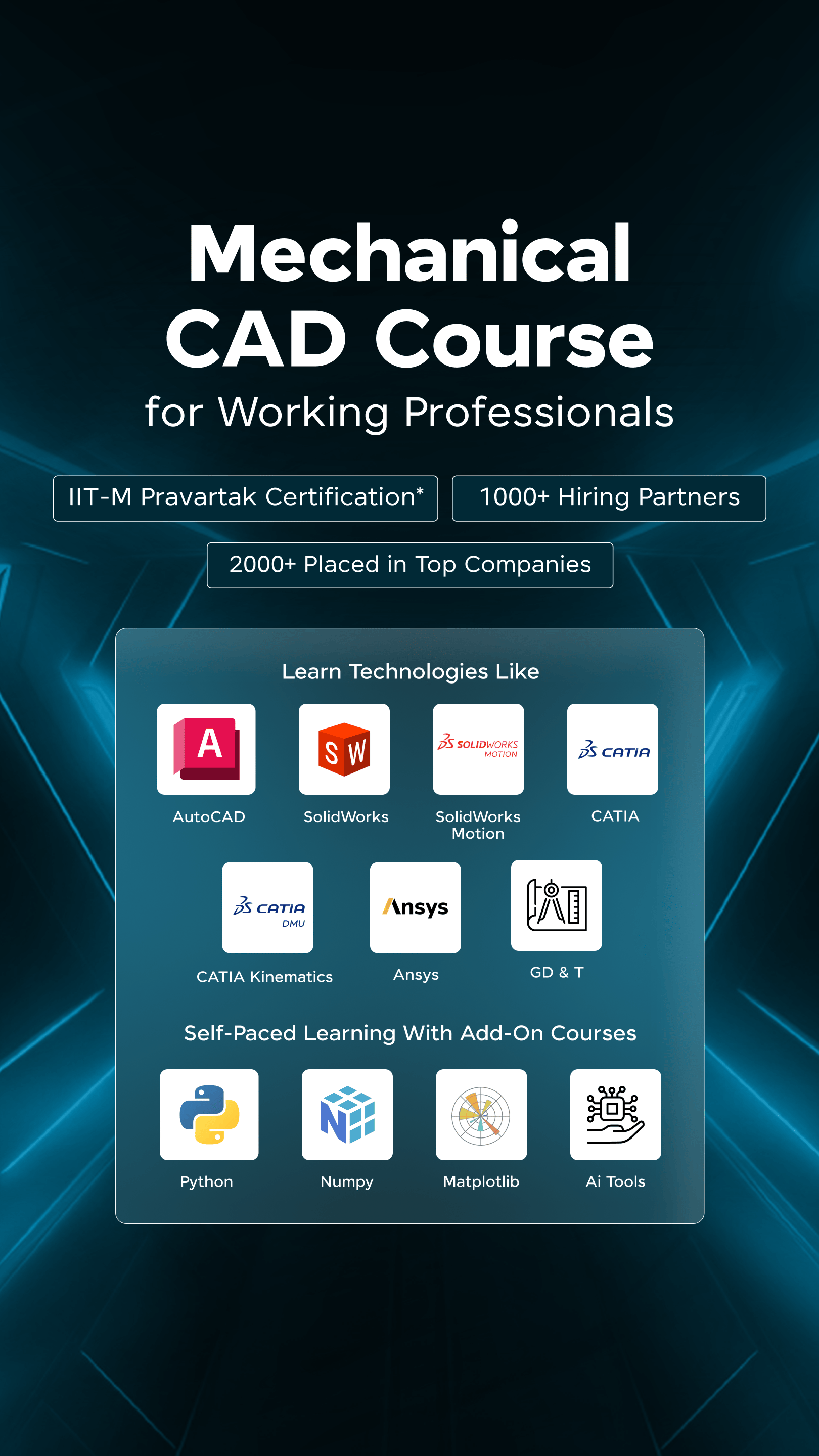
Build job-ready CAD skills with hands-on, industry-focused training. Join HCL GUVI’s Mechanical CAD Zen Class to learn core design tools, work on real projects, and gain placement support.
4. Robotics and Automation
Robotics and automation are at the heart of modern manufacturing. From assembly lines to warehouse automation, industries are rapidly adopting robotic systems to improve efficiency and reduce manual effort.
What You Will Learn:
- PLC programming and industrial automation systems
- Embedded systems and sensor integration
- Mechatronics and control systems
- Robotics design and programming
How It Connects to Mechanical Engineering:
- Integration of mechanical systems with electronics and software
- Industrial automation and smart factories
- Robotics in production and inspection
Career Roles:
- Robotics Engineer
- Automation Engineer
- Control Systems Engineer
Salary & Demand Insight: With Industry 4.0 adoption increasing, automation roles are seeing strong growth in manufacturing and logistics sectors.
Why Choose This: Perfect for those interested in building intelligent machines and working at the intersection of mechanical, electrical, and software systems.
Build practical robotics skills and work on real-world automation projects. Enroll in HCL GUVI’s Robotics course to learn core concepts, hands-on implementation, and industry-relevant applications.
5. Supply Chain Management
Supply chain management has evolved into a data-driven, technology-enabled field. Mechanical engineers, with their understanding of systems and processes, are well-suited for operations and logistics roles.
What You Will Learn:
- Logistics and transportation planning
- Inventory and warehouse management
- Demand forecasting and operations strategy
- Supply chain analytics and optimisation
How It Connects to Mechanical Engineering:
- Production planning and operations
- Manufacturing workflows and efficiency
- End-to-end product lifecycle management
Career Roles:
- Supply Chain Analyst
- Operations Manager
- Logistics Manager
Salary & Demand Insight: Post-pandemic, supply chain roles have seen a surge in demand due to global disruptions and the need for resilient systems.

Why Choose This: A great option if you are interested in business, strategy, and managing large-scale operations rather than technical roles.
How to Choose the Right Course After Mechanical Engineering Based on Your Interest
1. Tech & Coding → Data Science / AI
If you are naturally inclined towards programming, logical thinking, and solving analytical problems, Data Science or AI is a strong fit.
How to evaluate yourself:
- Do you enjoy working with data, numbers, and patterns?
- Are you comfortable learning programming languages like Python?
- Do you prefer solving abstract problems over working with physical systems?
What to expect:
- More screen time and coding-heavy work
- Continuous learning due to fast-evolving tools
- Opportunities across industries, not limited to mechanical domains
Reality check: This path requires consistency in coding practice and strong fundamentals in mathematics and statistics.
2. Core Engineering → CAD/CAE
If you chose mechanical engineering because you enjoy machines, design, and physical systems, CAD/CAE is the most aligned path.
How to evaluate yourself:
- Do you enjoy subjects like mechanics, thermodynamics, and design?
- Are you interested in how products are built and tested?
- Do you prefer hands-on engineering over software-based roles?
What to expect:
- Work closely with product design, simulation, and testing
- Roles in automotive, aerospace, heavy engineering industries
- Slower but stable career growth compared to tech roles
Reality check: Growth depends heavily on domain expertise and experience rather than quick skill switches.
3. Hardware & Systems → Robotics and Automation
If you are interested in how machines interact with electronics and software, robotics is the ideal middle ground.
How to evaluate yourself:
- Do you like working with circuits, sensors, and control systems?
- Are you curious about automation, smart factories, or robotics?
- Do you enjoy interdisciplinary learning across mechanical, electrical, and software domains?
What to expect:
- Combination of hardware and software skills
- Work in manufacturing, automation, and emerging tech sectors
- Increasing demand due to Industry 4.0 adoption
Reality check: You will need to build skills across multiple domains, not just mechanical engineering.
4. Business & Operations → Supply Chain Management
If you are more inclined towards planning, coordination, and decision-making rather than technical design, supply chain is a strong option.
How to evaluate yourself:
- Do you enjoy organising systems and processes?
- Are you interested in how products move from factory to customer?
- Do you prefer managerial or strategic roles over technical execution?
What to expect:
- Work in logistics, operations, procurement, and planning
- Exposure to business strategy and decision-making
- Faster transition into managerial roles compared to technical paths
Reality check: Requires strong communication, analytical thinking, and understanding of business processes.
Based on Career Goals
1. High Salary → Artificial Intelligence, Data Science
These domains offer some of the highest starting salaries due to demand-supply gaps.
Why:
- High demand across industries
- Direct impact on business decisions and revenue
- Scalable skills that apply globally
2. Core Stability → CAD/CAE
If your priority is long-term stability in core engineering, CAD/CAE is a reliable path.
Why:
- Consistent demand in manufacturing and product-based industries
- Clear career progression based on experience
- Lower volatility compared to tech roles
3. Future Growth → Robotics and Automation
Automation is expanding rapidly, making robotics a future-proof domain.
Why:
- Increasing adoption of smart manufacturing
- Integration of AI, IoT, and robotics
- Demand expected to rise across industries
4. Leadership Roles → Supply Chain Management
If your long-term goal is to move into leadership and decision-making roles, supply chain offers a clear path.
Why:
- Direct involvement in business operations
- Faster transition into managerial roles
- High impact on company efficiency and profitability
Final Decision Framework
Before choosing, ask yourself these three questions:
- What kind of work do I enjoy daily?
Coding, designing, building, or managing? - What level of risk am I comfortable with?
High growth but competitive vs stable but slower growth? - Where do I see myself in 5-10 years?
Technical expert, AI specialist, robotics engineer, or business leader?
Final Takeaway
There is no universally “best” course. The right course is the one that aligns your interest + skill + market demand.
- Choose Data Science/AI if you want flexibility and high-paying tech roles
- Choose CAD/CAE if you want to stay in core mechanical engineering
- Choose Robotics if you want future-ready, interdisciplinary roles
- Choose Supply Chain if you want to move into business and leadership
A well-informed choice here can define the direction of your entire career.
Conclusion
Choosing the right course after mechanical engineering can completely change your career trajectory. The key is to align your interests with market demand. Whether you move into AI, stick with core design, or shift towards management, the right upskilling path will open doors to better roles, higher salaries, and long-term career growth.
If you are serious about building a future-ready career, now is the time to invest in the right skills and take that next step.
FAQs
Which course is best after mechanical engineering for a high salary?
Courses in Data Science and Artificial Intelligence are among the best options for high-paying jobs. They offer strong demand across industries and higher starting salaries compared to most core mechanical roles.
Can mechanical engineers switch to IT or software roles?
Yes, mechanical engineers can easily transition into IT roles by learning programming, data science, or AI. Their analytical and problem-solving skills make the shift smoother with the right training.
Is it better to stay in core mechanical engineering or switch fields?
It depends on your interest and career goals. Core fields like CAD/CAE offer stability, while fields like AI, data science, and robotics provide faster growth and higher salary potential.
Success Stories

About the Author
Vaishali
I'm a seasoned writer with four years of experience across technical, non-technical, and just about every genre or niche you can imagine. Adaptable and curious, I enjoy exploring new topics and making information engaging and easy to understand. Fueled by a steady stream of tea, I approach each project with creativity, reliability, and genuine enthusiasm for storytelling.
View all posts by Vaishali
Connect with me @











Did you enjoy this article?