


DevOps Articles
DevOps for Experienced Professionals: What to Learn Beyond the Basics
How to Build DevOps Portfolio Projects While Working Full-Time
DevOps Learning Plan for IT Professionals Who Already Know Linux
How to Assess the Value of DevOps Upskilling for Your Current IT Role

Get In Touch For Details! Request More Information
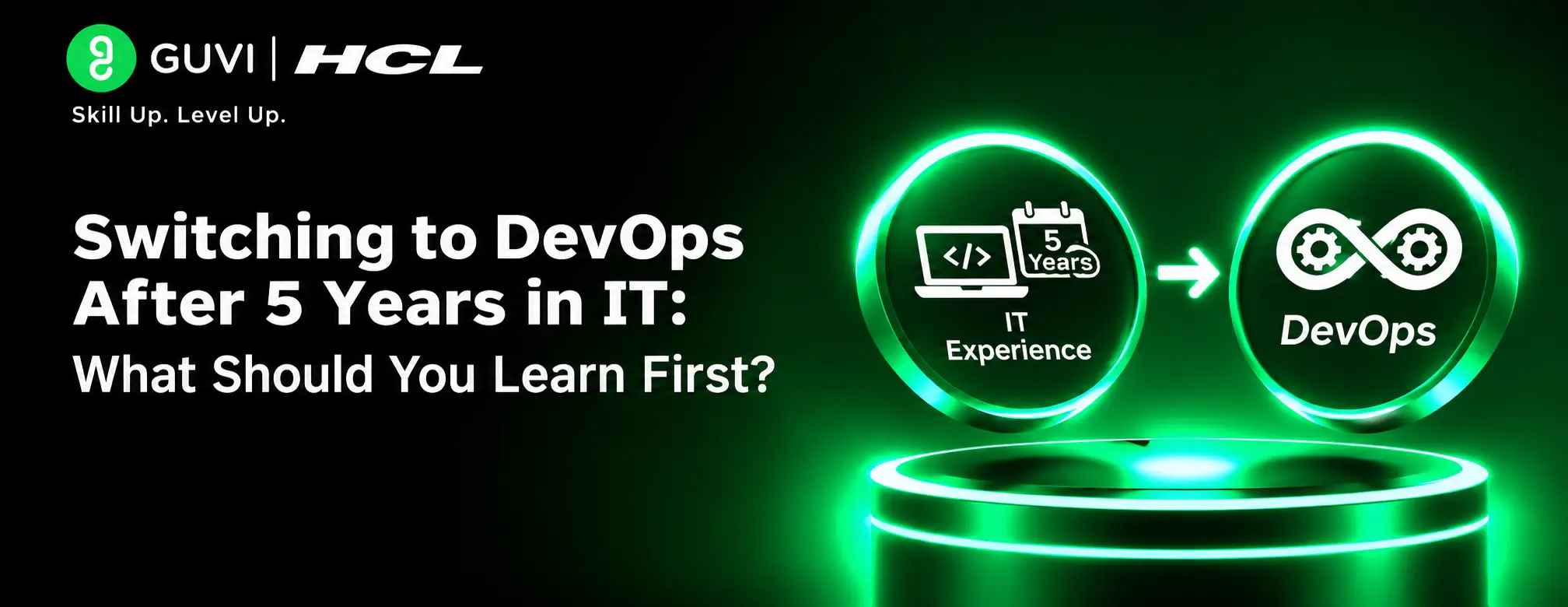
Switching to DevOps After 5 Years in IT: What Should You Learn First?
Nov 13, 2026 3 Min Read 137 Views
(Last Updated)
After five years in IT, switching to DevOps can feel like starting a different career. However, experienced professionals already have exposure to software systems, troubleshooting, application environments, and organisational workflows. These experiences can provide a useful foundation for understanding DevOps responsibilities.
Table of contents
- TL;DR
- Quick Answer
- Start by Evaluating Your Five Years of IT Experience
- Identify Skills You Already Possess
- Recognise the Gaps in Your Current Role
- Prioritise the Technical Foundations You Need
- Strengthen Linux and Networking Knowledge
- Develop Scripting and Version Control Skills
- Move Beyond Traditional IT Operations
- Understand Cloud Infrastructure
- Learn Infrastructure as Code
- Understand Modern Software Delivery Practices
- Learn CI/CD Pipeline Concepts
- Understand Containers and Orchestration
- Choose What to Learn Based on Your Previous IT Role
- If You Have a System Administration Background
- If You Have an Application Support Background
- If You Have a Software Development Background
- Prepare for the Transition Without Undervaluing Your Experience
- Reposition Your Existing Experience
- Target Roles That Match Your Experience
- Conclusion
- Frequently Asked Questions
- Can I switch to DevOps after five years of IT experience?
- What should I learn first when switching to DevOps?
- Is five years of IT experience enough to become a DevOps Engineer?
- Do experienced IT professionals need to learn programming for DevOps?
- Which cloud platform should I learn for a DevOps career?
- Can I move directly from IT support to DevOps?
- How can I demonstrate DevOps skills without professional experience in the field?
TL;DR
- Evaluate your existing IT experience before choosing what to study.
- Identify gaps between your current responsibilities and DevOps requirements.
- Prioritise Linux, networking, scripting, and Git.
- Develop practical knowledge of cloud infrastructure and automation.
- Use existing professional experience to demonstrate your readiness for a role change.
Quick Answer
| Professionals switching to DevOps after five years in IT should first assess their existing technical knowledge rather than repeat everything from the beginning. Linux, networking, scripting, and Git provide important foundations. Next, focus on cloud platforms, CI/CD, containers, and Infrastructure as Code. The exact learning sequence depends on your previous responsibilities, practical exposure, and the requirements of your target DevOps position. |
Start by Evaluating Your Five Years of IT Experience
1. Identify Skills You Already Possess
Your previous responsibilities determine which DevOps concepts may be easier to understand. For example, system administrators may already have experience with operating systems and server management, while application support professionals may understand troubleshooting, logs, and incident resolution.
2. Recognise the Gaps in Your Current Role
DevOps involves responsibilities that extend beyond individual IT functions. You may understand how to maintain an application but have limited experience automating its deployment or managing the infrastructure on which it runs.
Review job descriptions for DevOps positions that match your experience level. Compare their requirements with your current capabilities and create a list of specific knowledge gaps. This assessment will help you avoid spending unnecessary time revisiting subjects you already understand.
Prioritise the Technical Foundations You Need
1. Strengthen Linux and Networking Knowledge
Linux is widely used in server environments and plays an important role in many DevOps workflows. Understand file permissions, process management, services, shell commands, and system logs.
Networking knowledge is equally important when investigating communication between applications and infrastructure. Focus on IP addressing, DNS, ports, HTTP/HTTPS, firewalls, and load balancing.
2. Develop Scripting and Version Control Skills
Automation is a central part of DevOps, making scripting useful for reducing repetitive operational tasks. Start with Bash or Python, depending on your existing experience and the requirements of your target role.
Git is another important skill. Understand branching, merging, pull requests, and conflict resolution. These practices help teams manage code changes and collaborate on shared projects.
Move Beyond Traditional IT Operations
1. Understand Cloud Infrastructure
Many DevOps positions involve working with cloud environments. Choose one platform, such as AWS, Microsoft Azure, or Google Cloud, and understand its core services.
Begin with virtual machines, storage, networking, identity management, and access permissions. Focus on understanding how these components work together rather than memorising service names.
2. Learn Infrastructure as Code
Traditional infrastructure management may involve configuring resources manually. Infrastructure as Code allows teams to define and manage infrastructure through reusable configuration files.
Start with Terraform to understand how infrastructure can be provisioned consistently. You can then explore Ansible for configuration management and repetitive system administration tasks.
Understand Modern Software Delivery Practices
1. Learn CI/CD Pipeline Concepts
Continuous Integration and Continuous Delivery help teams automate different stages of software delivery. Understand how source code moves through building, testing, packaging, and deployment.
Explore tools such as Jenkins or GitHub Actions. Learn how pipeline stages are configured, how automated tests are triggered, and how failed executions are investigated.
2. Understand Containers and Orchestration
Docker allows applications and their dependencies to be packaged into containers. Learn how to create images, manage containers, configure volumes, and establish network communication.
After understanding container fundamentals, explore Kubernetes. Focus initially on pods, deployments, services, and configuration management. Advanced cluster administration can come later as your practical knowledge develops.
Ready to move beyond traditional IT roles? HCL GUVI’s AI Cloud Computing & DevOps Programme helps you develop practical cloud and DevOps skills through expert-led learning, real-world projects and career preparation.

Choose What to Learn Based on Your Previous IT Role
1. If You Have a System Administration Background
Your experience with servers, operating systems, user permissions, and infrastructure maintenance can support a transition into DevOps.
2. If You Have an Application Support Background
Experience investigating application failures, analysing logs, and resolving incidents can be useful when learning monitoring and reliability practices.
3. If You Have a Software Development Background
Your experience with application code, debugging, and version control provides a starting point for understanding automated delivery workflows.
DevOps is a combination of practices, collaboration, and automation rather than a single technology. Knowing several tools is useful, but understanding how development and operations activities connect is what helps professionals work effectively in DevOps environments.
Prepare for the Transition Without Undervaluing Your Experience
1. Reposition Your Existing Experience
Five years of IT experience should not disappear from your professional profile when you apply for DevOps positions. Highlight relevant responsibilities and be specific about what you handled independently and what you implemented through personal projects.
2. Target Roles That Match Your Experience
Read the job requirements carefully before applying and prepare the resume according to it. Five years of general IT experience does not automatically equal five years of DevOps experience, so be prepared to demonstrate the technical capabilities required by each position.
Conclusion
Switching to DevOps after five years in IT does not require abandoning your previous experience. Start by identifying the technical capabilities you already possess, then prioritise the skills missing from your current profile. Focus on foundational knowledge, cloud infrastructure, automated software delivery, and practical implementation. A targeted learning approach can help experienced professionals make a more informed career transition without unnecessarily repeating what they already know.
Frequently Asked Questions
1. Can I switch to DevOps after five years of IT experience?
Yes. Professionals with experience in system administration, application support, software development, and infrastructure operations can transition into DevOps by developing the additional technical skills required for their target roles.
2. What should I learn first when switching to DevOps?
Start by evaluating your existing knowledge of Linux, networking, scripting, and Git. Strengthen any gaps before progressing to cloud platforms, CI/CD, containers, and infrastructure automation.
3. Is five years of IT experience enough to become a DevOps Engineer?
It can provide a useful foundation, but the number of years alone does not determine readiness. Employers also evaluate practical technical knowledge, automation experience, troubleshooting abilities, and familiarity with DevOps workflows.
4. Do experienced IT professionals need to learn programming for DevOps?
They need scripting and programming fundamentals to automate tasks and work with technical workflows. Bash and Python are useful starting points, although the required depth depends on the position.
5. Which cloud platform should I learn for a DevOps career?
AWS, Microsoft Azure, and Google Cloud are all relevant options. Choose one based on the requirements of your target positions and develop practical knowledge of its core infrastructure services.
6. Can I move directly from IT support to DevOps?
Yes, but you may need to develop additional knowledge of scripting, cloud infrastructure, CI/CD, and containers. Your troubleshooting and application support experience can provide a useful starting point.
7. How can I demonstrate DevOps skills without professional experience in the field?
Build an integrated deployment project using Git, Docker, CI/CD, and cloud infrastructure. Document the implementation, configuration decisions, and problems you solved to demonstrate practical understanding.
Success Stories

About the Author
HCL GUVI
This article was selected and published as part of the HCL GUVI AI Blogathon 2026, an initiative designed to encourage students, AI enthusiasts, and aspiring tech writers to simplify complex AI concepts through impactful technical content. The contest recognized high-quality, original, and insightful AI-focused blogs, with selected authors receiving publication opportunities on the HCL GUVI blog platform along with official author credits and recognition.
View all posts by HCL GUVI
Connect with me @



























Did you enjoy this article?