


Data Analysis Articles
Accountant to Data Analyst- Skills Roadmap - Best Guide
Data Analyst Roles for Accountants and Finance Professionals - Best Guide
Auditor to Data Analyst: How Financial Audit Experience Transfers
SQL Python Power BI for Accountants What Should You Learn First? - Best Guide


Get In Touch For Details! Request More Information
Is Switching From BPO to Data Analytics a Good Career Choice? – Best Guide
Oct 21, 2026 6 Min Read 75 Views
(Last Updated)
Is switching from BPO to data analytics a good career choice? Yes, it can be, particularly if you want to use your experience in customer service, operations, or reporting to solve business problems with data. A successful bpo to data analytics transition requires practical data analyst skills, including Excel, SQL, and data visualisation, rather than a certificate alone. Understanding the data analytics career path, potential job roles, salary trade-offs, and transferable BPO skills can help you decide whether this move suits your career goals.
Table of contents
- TL;DR Summary
- Is switching from BPO to data analytics a good career choice?
- Should I Switch From BPO to Data Analytics After 4–5 Years of Experience?
- If you have less than four years of experience
- If you have four or more years of experience
- Which BPO Skills Can Help Me Become a Data Analyst?
- What Jobs Can I Get After Switching From BPO to Data Analytics?
- Will I Get a Salary Hike After Switching From BPO to Data Analytics?
- What Skills Should I Learn to Move From BPO to Data Analytics?
- Which Data Analytics Certificate Is Best for BPO Professionals?
- What Mistakes Should I Avoid When Switching From BPO to Data Analytics?
- Which Is the Best Course for Switching From BPO to Data Analytics?
- Conclusion
- Frequently Asked Questions About Switching From BPO to Data Analytics
- Can I switch from BPO to data analytics without an IT degree?
- Is data analytics better than a BPO career?
- Can I switch to data analytics after five years in BPO?
- Which skill should I learn first?
- Can BPO experience count towards a data analyst career?
- Will I have to accept a lower salary after switching?
- What are the best entry-level jobs after BPO?
- Is a certification enough to get a data analyst job?
TL;DR Summary
Switching from BPO to data analytics can be a good career choice if you enjoy working with data, solving business problems, and learning technical tools. The bpo to data analytics transition is possible for non-IT professionals because skills such as KPI monitoring, customer service, quality assurance, and operations reporting can provide useful business context. To qualify for relevant data analyst jobs, learn Excel, SQL, Power BI, and basic statistics, then build practical projects. Your data analyst career prospects will depend on your technical skills, experience, and target role. Whether you have under four years or more than four years of BPO experience, assess salary expectations and learning requirements before switching.
Is switching from BPO to data analytics a good career choice?
Yes, switching from BPO to data analytics can be a good career choice if you want to move from routine service delivery towards analysing information and supporting business decisions. However, it is not automatically the right move for everyone.
In BPO roles, you may handle customer queries, monitor quality, track productivity, manage escalations, or prepare operational reports. Analytics roles use data to understand patterns, explain performance, and recommend improvements.
Consider making the switch if you:
- Enjoy understanding why a metric improves or declines.
- Like working with spreadsheets, reports, and business problems.
- Want to develop technical skills and use them in different industries.
- Are prepared to build projects and demonstrate your analytical ability.
- Can accept that your first analytics role may not immediately pay more than your current job.
You may prefer to stay in your current career if you strongly dislike working with data or do not have the time to practise new tools. You could also explore a reporting or operations role first instead of making a complete transition immediately.
The best decision is one that improves your long-term options without ignoring your current financial and personal responsibilities.
Should I Switch From BPO to Data Analytics After 4–5 Years of Experience?
Your experience level affects how you should approach the transition. Someone with two years in customer support may need a different strategy from a team leader with six years of operational experience.
| Career stage | Main advantage | Biggest challenge | Recommended approach |
| Under 4 years | More flexibility to build a new skill set | Limited professional experience in analytics | Learn core tools and build practical projects |
| 4+ years | Deeper knowledge of business processes, KPIs, and operations | Risk of moving into a role with less seniority | Target analytics roles connected to existing experience |
| Team leader or manager | Experience with performance reviews and team metrics | May need to prove hands-on technical ability | Build projects using operational data and target suitable analyst or reporting roles |
If you have less than four years of experience
Focus on building a strong technical foundation. Learn Excel, SQL, and Power BI, then create projects that show you can answer business questions with data.
You may need to apply for junior analyst or reporting roles initially. Compare the role’s responsibilities and growth opportunities instead of judging it only by the job title.
If you have four or more years of experience
Do not present yourself as someone with no professional experience. Highlight your knowledge of customer operations, quality, process improvement, reporting, or workforce management wherever it genuinely applies.
For example, a BPO team leader could target operations analytics or workforce reporting roles. Your leadership experience may remain valuable, but you will still need to demonstrate that you can work with data directly.
Which BPO Skills Can Help Me Become a Data Analyst?
Your existing experience can help you understand the business side of analytics, but it does not replace technical training. The goal is to combine what you already know with the tools used to analyse data.
| BPO experience | How it can help in analytics |
| KPI monitoring | Understand performance trends and targets |
| Customer service | Interpret complaints, satisfaction scores, and customer patterns |
| Quality assurance | Identify recurring errors and quality issues |
| Operations reporting | Turn raw figures into structured reports |
| Workforce management | Examine staffing, attendance, productivity, and workload |
| Communication | Explain findings to managers and non-technical teams |
For example, knowing that average handling time is increasing gives you a business question to investigate. Learning SQL and Power BI helps you compare performance across teams, shifts, and issue categories to identify where further investigation is needed.
Explore GUVI’s guide to BPO skills that transfer to data analytics for more examples of how to connect your current experience with the role.
What Jobs Can I Get After Switching From BPO to Data Analytics?
You do not have to target only a general data analyst position. Depending on your skills and previous responsibilities, several adjacent roles may provide a more practical entry point.
- Reporting Analyst: Prepares reports, tracks metrics, and explains performance trends.
- MIS Analyst: Maintains management information systems, spreadsheets, and operational reports.
- Operations Analyst: Examines processes, productivity, costs, and operational performance.
- Workforce Analyst: Analyses staffing requirements, schedules, call volumes, and service levels.
- Quality Analyst: Uses performance data to identify recurring quality issues and improvement opportunities.
- Data Analyst: Collects, cleans, queries, and analyses data to answer business questions.
These roles are not interchangeable, and employers may require different qualifications and tools. Read job descriptions carefully to identify which skills appear most often in the positions you want.
When you are ready to apply, use these data analyst resume tips to present your transferable experience, technical skills, and projects clearly.
Your data analytics career path may begin with reporting or operations analysis and progress towards more advanced analytical responsibilities. That is one possible route, not a mandatory sequence.
Understand how your existing experience can support your transition with this guide to using BPO experience to become a data analyst
Will I Get a Salary Hike After Switching From BPO to Data Analytics?
A move into data analytics does not guarantee an immediate salary increase. Your compensation will depend on the employer, location, previous experience, technical skills, role level, and how closely your experience matches the job.
Before accepting an offer, compare:
- Your current fixed pay and variable compensation.
- The offered salary and any changes to benefits or shift allowances.
- Whether the role is genuinely analytical or mainly involves manual reporting.
- Opportunities to work with databases, dashboards, and business stakeholders.
- The potential to take on more complex responsibilities over time.
For experienced professionals, a junior analytics position may mean a temporary reduction in title or pay. However, an appropriate role that uses both operational knowledge and technical skills may offer a better fit.
Prepare for the next stage with this data analyst interview experience guide, and practise explaining your projects and analytical decisions.
A BPO Professional Can Build a Path Into Analytics
A Reddit user shared that they had worked as a BPO agent and team leader before transitioning into a data analyst role. They said that strong Excel knowledge helped them make the switch, while also cautioning that the transition can involve an initial salary reduction. Their experience highlights an important lesson: your BPO background can provide useful business knowledge, but practical analytical skills are still essential.
Key takeaway: Start by strengthening Excel, then build your SQL and Power BI skills and create projects that demonstrate your ability to analyse real business problems.

What Skills Should I Learn to Move From BPO to Data Analytics?
Build your skills in a practical order rather than trying to master every analytics tool at once.
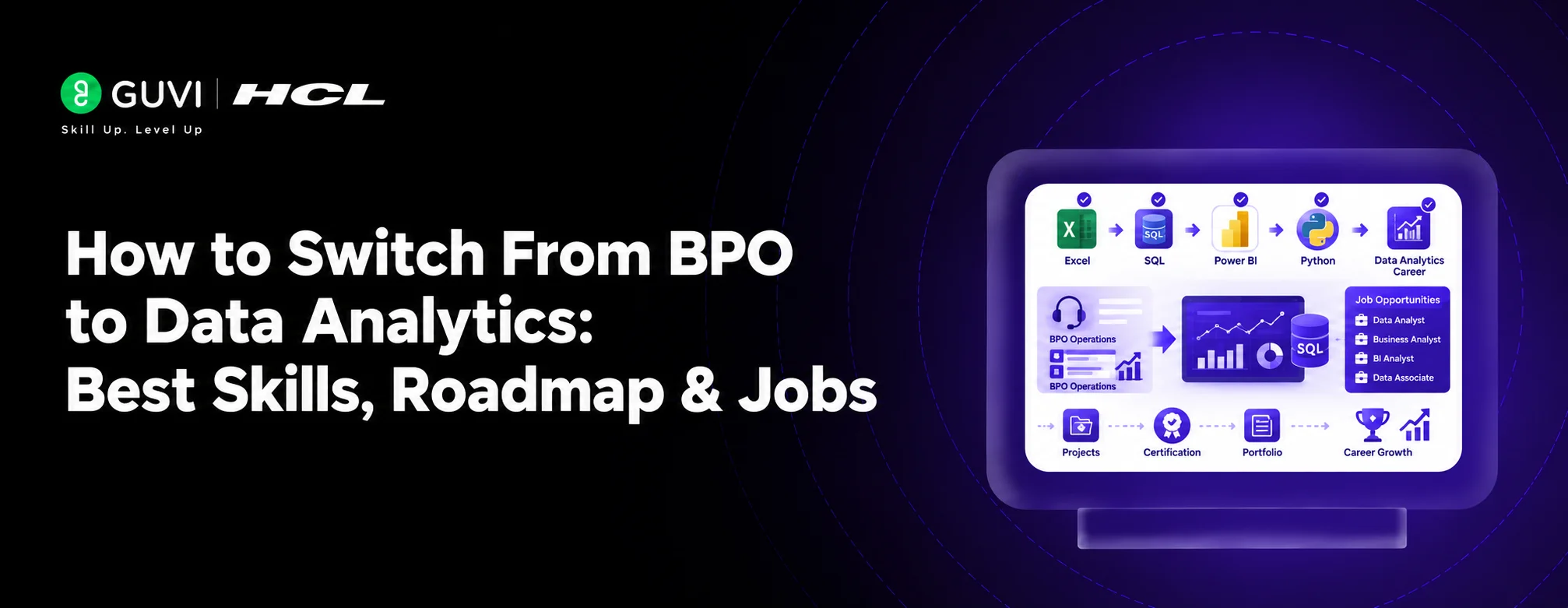
- Excel: Learn formulas, lookup functions, PivotTables, charts, and data cleaning.
If you already use spreadsheets at work, explore this guide on moving from Excel to data analytics to understand how you can build on your existing skills.
- SQL: Practise filtering, grouping, joining, and summarising data stored in databases.
Start with this guide to SQL for data science to understand how SQL helps you query and analyse data.
- Power BI: Build dashboards that explain KPIs and performance trends.
- Basic statistics: Understand averages, percentages, distributions, and correlations.
- Python: Learn the fundamentals when you are ready to automate tasks or analyse data using code.
You can also explore how to use Python in Excel to understand one way Python can support spreadsheet-based analysis.
Your portfolio should contain two or three complete projects. For example, analyse a customer-support dataset to investigate whether resolution times vary by issue type, shift, or team. Explain the question, data preparation, findings, and recommendations.
Use these Power BI project ideas to practise turning datasets into dashboards that communicate business insights.
Which Data Analytics Certificate Is Best for BPO Professionals?
A structured course can help you learn the tools in sequence and practise applying them. A certificate alone, however, does not guarantee a job.
Choose a programme that includes relevant technical skills, practical exercises, projects, and a curriculum that matches the roles you want to pursue.
What Mistakes Should I Avoid When Switching From BPO to Data Analytics?
- Quitting before testing your interest: Try learning Excel and SQL while employed before making a major career decision.
- Collecting certificates without projects: Build evidence that you can analyse data and explain what you found.
- Ignoring your BPO experience: Translate relevant work into accurate examples of KPI monitoring, reporting, customer insights, or process improvement.
- Applying only for data analyst titles: Consider reporting, MIS, workforce, and operations analyst roles when their responsibilities match your skills.
- Expecting a guaranteed salary increase: Compare the complete offer and long-term opportunities rather than assuming every analytics role pays more.
Which Is the Best Course for Switching From BPO to Data Analytics?
HCL GUVI’s Data Science and Analytics Certification Course is our recommended starting point for BPO professionals looking to build practical analytics skills.
Your experience in customer service, operations, or reporting gives you valuable business context. The next step is to develop the technical skills needed to analyse data, identify trends, and support business decisions.
With a curriculum covering data analysis, data cleaning, exploratory data analysis, and machine learning fundamentals, this course is worth considering as you prepare for your career transition.
Ready to take the next step?
Explore the HCL GUVI’s Data Science and Analytics Certification Course
Looking for a broader, structured learning programme?
You can also explore the HCL GUVI’s Data Science Zen Class and compare both options before choosing.
Conclusion
Switching from BPO to data analytics can be worthwhile when your interests, learning goals, and career plans align with analytical work. Your experience with customers, operations, KPIs, and reporting may help you understand business problems, while technical skills allow you to investigate those problems with data.
If you are early in your career, focus on Excel, SQL, Power BI, and practical projects. If you have four or more years of experience, target roles where your domain knowledge remains valuable. Before switching, compare job responsibilities, compensation, and future opportunities so your next move is based on evidence rather than assumptions.
Frequently Asked Questions About Switching From BPO to Data Analytics
Can I switch from BPO to data analytics without an IT degree?
Yes, some analytics roles accept candidates from non-technical backgrounds. Requirements vary by employer, so develop practical skills, build relevant projects, and check the qualifications listed in job descriptions.
Is data analytics better than a BPO career?
Neither career is universally better. Analytics may suit you if you enjoy investigating data and solving business problems, while BPO roles may better match your interests in customer service, operations, or people management.
Can I switch to data analytics after five years in BPO?
Yes. Use your experience in operations, quality, reporting, or team management to target relevant roles, while demonstrating your technical skills through practical projects.
Which skill should I learn first?
Start with Excel if you are new to data work, then learn SQL and a visualisation tool such as Power BI. Add basic statistics and Python as your skills develop.
Can BPO experience count towards a data analyst career?
It can provide useful domain knowledge, particularly when your work involves reports, KPIs, customer trends, quality, or process improvement. You must still demonstrate that you can perform the technical tasks required by the target role.
Will I have to accept a lower salary after switching?
Not necessarily, but it is possible if you move into a more junior role or lack experience with the required tools. Compare the offer, role level, and long-term opportunities before deciding.
What are the best entry-level jobs after BPO?
Reporting Analyst, MIS Analyst, Operations Analyst, Workforce Analyst, and junior Data Analyst positions are worth exploring, depending on your current experience and skills.
Is a certification enough to get a data analyst job?
No certification can guarantee employment. Combine structured learning with hands-on projects, interview preparation, and evidence that you can use data to answer practical business questions.
Success Stories

About the Author
Reemsha Khan
Always been a storyteller at heart. Now, I turn complex topics into simple, easy-to-understand stories through content. Hope you find it helpful.
View all posts by Reemsha Khan
Connect with me @









Did you enjoy this article?