


Data Science Articles
Finance Career Growth After 5+ Years: Should You Add Data Skills?
What BPO Skills for Data Analytics Transfer to a Data Analyst Career? - Best Guide
BPO Experience for Data Analyst Jobs Does It Count When Applying? - Best Guide
What's Career Growth After 5 Years in BPO? Are You Missing Out on a Data Analyst Career?


Get In Touch For Details! Request More Information
Which Data Roles Suit a BPO Team Lead With People-Management Experience?
Oct 09, 2026 4 Min Read 23 Views
(Last Updated)
Moving from a BPO Team Lead role into data analytics can be a practical career transition for professionals from non-IT backgrounds. Team leaders already work with performance metrics, productivity reports, quality scores, customer data, and operational KPIs. The key is to combine that business experience with relevant data skills.
Table of contents
- TL;DR
- Quick Answer
- Why BPO Team Leads Can Move Into Data Roles
- Which Data Roles Suit a BPO Team Lead?
- Reporting Analyst
- MIS Analyst
- Operations Analyst
- Business Analyst
- Data Analyst
- How People-Management Experience Helps
- What Skills Should You Learn for the Transition?
- Excel
- SQL
- Power BI
- Statistics
- Python
- BPO to Data Analytics: A Practical Career Path
- How to Make Your BPO Experience Relevant
- Can a Non-IT Professional Eventually Become a Data Scientist?
- A Simple Transition Plan
- Conclusion
- FAQs
- Can a BPO Team Lead become a Data Analyst?
- What is the easiest data role to transition into from BPO?
- Can I move from BPO to data analytics without an IT degree?
- Does people-management experience help in Data Analyst roles?
- Should I learn Python before SQL?
- Can a BPO professional become a Data Scientist?
- What is a good career path from BPO to Data Science?
TL;DR
- BPO Team Leads can transition into several data-related roles.
- Practical starting points include Reporting Analyst, MIS Analyst, Operations Analyst, and Data Analyst.
- People-management experience can help with roles involving business reporting and performance analysis.
- Excel, SQL, Power BI, and basic statistics are useful skills to develop.
- A BPO-to-data analyst transition can eventually lead toward advanced analytics and Data Science.
Quick Answer
Why BPO Team Leads Can Move Into Data Roles
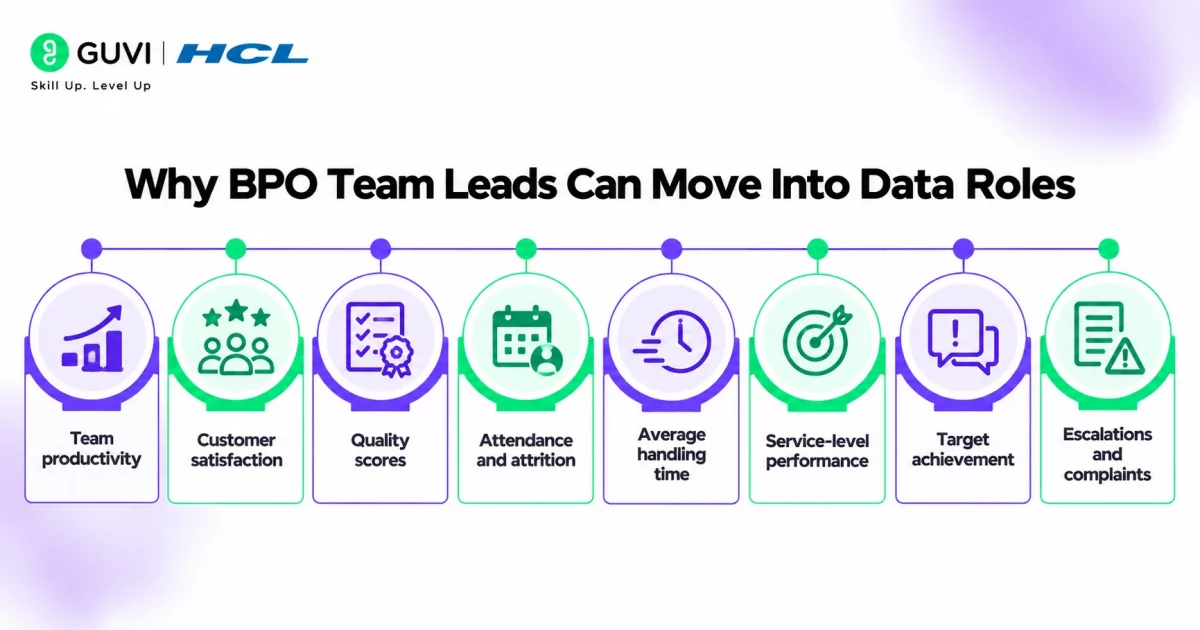
BPO Team Leads already work with data as part of their daily responsibilities.
You may have experience tracking:
- Team productivity
- Customer satisfaction
- Quality scores
- Attendance and attrition
- Average handling time
- Service-level performance
- Target achievement
- Escalations and complaints
The transition involves learning how to analyze this information more deeply and use it to identify patterns, explain performance changes, and support business decisions.
This makes your existing BPO experience relevant rather than something you need to completely leave behind.
Which Data Roles Suit a BPO Team Lead?
1. Reporting Analyst
Reporting roles can be a straightforward first step for someone with BPO experience.
You may already be familiar with preparing daily, weekly, or monthly performance reports. As a Reporting Analyst, you can build on that experience by learning advanced Excel, SQL, and dashboarding tools.
2. MIS Analyst
MIS roles are another potential entry point for a BPO-to-data analyst transition.
MIS Analysts typically work with operational data and reports. Your understanding of BPO metrics can help you understand what different KPIs mean and why they matter to the business.
3. Operations Analyst
This can be particularly relevant for an experienced Team Lead.
Instead of managing a team directly, you use operational data to identify inefficiencies, understand performance trends, and support process improvements.
Your knowledge of how BPO operations actually work can be useful when interpreting the numbers.
4. Business Analyst
Business Analyst roles can suit professionals who enjoy understanding business problems and communicating solutions.
Your people-management experience can help because Team Leads already communicate with employees, managers, and other stakeholders.
However, Business Analyst roles vary considerably, so check individual job descriptions before applying.
5. Data Analyst
After developing stronger technical skills, you can target Data Analyst positions.
A Data Analyst typically works with datasets to identify trends, create reports and dashboards, and communicate insights to stakeholders.
For a BPO professional, projects involving customer service, employee performance, workforce management, or operational efficiency can demonstrate relevant experience.
How People-Management Experience Helps
Your management experience should not be ignored during the transition.
As a Team Lead, you may already have experience with:
- Communication: Explaining performance and providing feedback.
- Problem-solving: Identifying why targets or KPIs are not being achieved.
- Decision-making: Taking action based on operational information.
- Stakeholder management: Communicating with managers, employees, and other teams.
- Performance analysis: Comparing individual or team results against targets.
These are valuable because analytics is not only about using tools. Data professionals also need to understand business problems and communicate what the data means.
What Skills Should You Learn for the Transition?
To move from BPO to data analytics, focus on practical skills first.
1. Excel
Start with formulas, PivotTables, data cleaning, lookups, and dashboards.
2. SQL
Learn how to retrieve and analyze information from databases. Focus on filtering, grouping, joins, and aggregations before moving into more advanced concepts.
3. Power BI
Learn how to turn business data into interactive dashboards and reports.
4. Statistics
Understand basic concepts such as averages, distributions, percentages, correlation, and trends.
5. Python
Python can be added once you have a foundation in analytics. It becomes more useful as you move toward advanced analysis and Data Science.

BPO to Data Analytics: A Practical Career Path
You do not necessarily need to jump directly from Team Lead to Data Scientist.
A more gradual career transition could look like:
BPO Team Lead → MIS/Reporting Analyst → Operations/Business Analyst → Data Analyst → Senior Data Analyst → Data Science/Advanced Analytics
The exact path will depend on your existing responsibilities, technical skills, experience, and the requirements of the roles you target.
How to Make Your BPO Experience Relevant
One mistake career changers make is presenting their previous experience as unrelated.
Instead of only saying that you managed a team, highlight the analytical aspects of your work.
For example:
- Monitored team KPIs and performance trends.
- Analyzed productivity and quality metrics.
- Prepared operational reports for management.
- Identified performance gaps and recommended improvements.
- Used customer or process data to support decisions.
This helps recruiters see the connection between your BPO background and analytics.
Can a Non-IT Professional Eventually Become a Data Scientist?
Yes, but Data Science generally requires a broader technical foundation than entry-level analytics.
For a non-IT professional, it can be more practical to first establish yourself in data analytics and then build toward areas such as Python, statistics, machine learning, and predictive modeling.
Your BPO experience can remain useful because you understand real operational and customer problems that data can help solve.
A Simple Transition Plan
- Map your existing experience: Identify the KPIs, reports, and business problems you already work with.
- Strengthen Excel: Become comfortable analyzing operational datasets.
- Learn SQL: Practice querying and summarizing data.
- Build Power BI skills: Create dashboards around BPO metrics.
- Learn basic statistics: Understand how to interpret trends and performance.
- Create relevant projects: Use customer service, employee performance, or operations datasets.
- Target suitable roles: Start with MIS, Reporting, Operations, Business Analyst, or Data Analyst positions.
- Build toward Data Science: Add Python and advanced statistics as your career progresses.
Conclusion
A BPO Team Lead does not have to start from zero when moving into data. Experience with KPIs, reporting, team performance, customer operations, and problem-solving provides a useful foundation.
For many professionals, MIS Analyst, Reporting Analyst, Operations Analyst, Business Analyst, and Data Analyst roles can provide practical entry points. From there, developing stronger analytics and technical skills can create a path toward advanced analytics and Data Science.
The goal is not to erase your BPO background. It is to combine your operational and people-management experience with data skills and turn it into a new career direction.
FAQs
1. Can a BPO Team Lead become a Data Analyst?
Yes. A BPO Team Lead can transition into Data Analytics by developing skills such as Excel, SQL, Power BI, and statistics.
2. What is the easiest data role to transition into from BPO?
MIS Analyst, Reporting Analyst, or Operations Analyst can be practical starting points because they can build on existing reporting and operational experience.
3. Can I move from BPO to data analytics without an IT degree?
Yes. A non-IT background does not automatically prevent you from entering analytics. Your focus should be on developing relevant skills and demonstrating them through projects.
4. Does people-management experience help in Data Analyst roles?
Yes. Communication, stakeholder management, problem-solving, and performance analysis can be useful when working with business teams and presenting insights.
5. Should I learn Python before SQL?
For many career changers, SQL is a practical first choice because it is widely used for working with business databases. Python can follow as you build your analytics foundation.
6. Can a BPO professional become a Data Scientist?
Yes, but it generally requires additional skills in Python, statistics, machine learning, and advanced data analysis. Starting with Data Analytics can provide a more gradual transition.
7. What is a good career path from BPO to Data Science?
A possible path is BPO Team Lead → MIS/Reporting Analyst → Data/Business Analyst → Senior Data Analyst → Data Science or Advanced Analytics.
Success Stories

About the Author
HCL GUVI
This article was selected and published as part of the HCL GUVI AI Blogathon 2026, an initiative designed to encourage students, AI enthusiasts, and aspiring tech writers to simplify complex AI concepts through impactful technical content. The contest recognized high-quality, original, and insightful AI-focused blogs, with selected authors receiving publication opportunities on the HCL GUVI blog platform along with official author credits and recognition.
View all posts by HCL GUVI
Connect with me @












Did you enjoy this article?