


Forward Deployed Engineer Articles
Debugging Latency Issues in Customer-Deployed AI Systems
Go vs Python for Forward Deployed Engineering Workloads
Forward Deployed Engineering in Government and Public Sector
Forward Deployed Engineering in Manufacturing and Industrial AI


Get In Touch For Details! Request More Information

Cohere’s Forward Deployed Engineers and the Agentic Platform
Sep 25, 2026 4 Min Read 22 Views
(Last Updated)
A Cohere forward deployed engineer helps connect enterprise AI capabilities with practical customer requirements. Rather than focusing only on internal product development, forward deployed engineers work closely with organizations to understand their workflows, solve technical challenges, and help deploy AI solutions in real-world environments.
This approach is particularly relevant as enterprises adopt agentic AI. AI agents need more than a capable language model. They may need access to enterprise data, secure integrations, retrieval systems, APIs, workflow tools, and appropriate controls before they can deliver useful results.
Cohere’s enterprise-focused AI platform provides technologies for organizations building AI applications and agents. Forward deployed engineers can help translate those capabilities into customer-specific implementations.
Table of contents
- TL;DR Summary
- What Is a Cohere Forward Deployed Engineer?
- Why Does Agentic AI Need Forward Deployed Engineers?
- What Do Cohere Forward Deployed Engineers Do?
- Understand Customer Requirements
- Build AI Applications
- Integrate Enterprise Systems
- Work With Data and Retrieval
- Deploy and Troubleshoot Solutions
- How Does the Agentic Platform Change Engineering Work?
- What Skills Does a Cohere Forward Deployed Engineer Need?
- AI and Machine Learning
- Programming
- APIs and Integrations
- Cloud and Deployment
- Communication
- How Is the Role Different From Traditional AI Engineering?
- How Can Engineers Prepare for the Role?
- Start Your Learning Journey with HCL GUVI
- Conclusion
- FAQs
- What is a Cohere forward deployed engineer?
- What does a forward deployed engineer do with agentic AI?
- What skills does a Cohere forward deployed engineer need?
- Is forward deployed engineering the same as AI engineering?
- Do forward deployed engineers need to understand APIs?
- How can I prepare for a forward deployed AI engineering role?
TL;DR Summary
- A Cohere forward deployed engineer helps enterprises apply AI technologies to real-world technical and business problems.
- The role combines software engineering, AI, data, integrations, and customer-facing problem-solving.
- Forward deployed engineers can support agentic AI implementations involving enterprise data, retrieval, APIs, and workflows.
- Strong Python, APIs, cloud, AI, debugging, and communication skills are valuable.
- The role is well suited to engineers who enjoy solving ambiguous problems and working directly with customers.
What Is a Cohere Forward Deployed Engineer?
A Cohere forward deployed engineer is a technical professional who works closely with enterprise customers to develop and implement AI solutions for specific use cases.
Traditional AI engineering may focus on building models, platforms, or reusable product capabilities. Forward deployed engineering operates closer to the customer, where engineers need to understand existing systems, data, security requirements, and business workflows.
The work can involve building prototypes, integrating APIs, connecting enterprise data, developing AI applications, troubleshooting deployments, and helping customers move solutions toward production.
This makes the role a combination of AI engineering, software development, solutions engineering, and customer-focused problem-solving.
Ready to build skills for the growing AI industry? HCL GUVI’s Artificial Intelligence & Machine Learning Course helps you develop practical AI and machine learning skills through hands-on projects and industry-focused training.
Why Does Agentic AI Need Forward Deployed Engineers?
AI agents are designed to do more than generate text. They can potentially reason through tasks, retrieve information, interact with tools, and execute parts of a workflow.
However, enterprise environments introduce additional requirements.
An AI agent may need to:
- Access approved internal information.
- Connect with enterprise applications.
- Call APIs securely.
- Retrieve relevant documents.
- Follow organizational permissions.
- Produce reliable outputs.
- Operate within existing workflows.
Forward deployed engineers can help address these implementation challenges by adapting AI capabilities to each customer’s technical environment.
An enterprise AI agent is rarely just a language model. Reliable agentic applications usually require supporting components such as data access, retrieval, tools, application logic, evaluation, security, and monitoring.
What Do Cohere Forward Deployed Engineers Do?
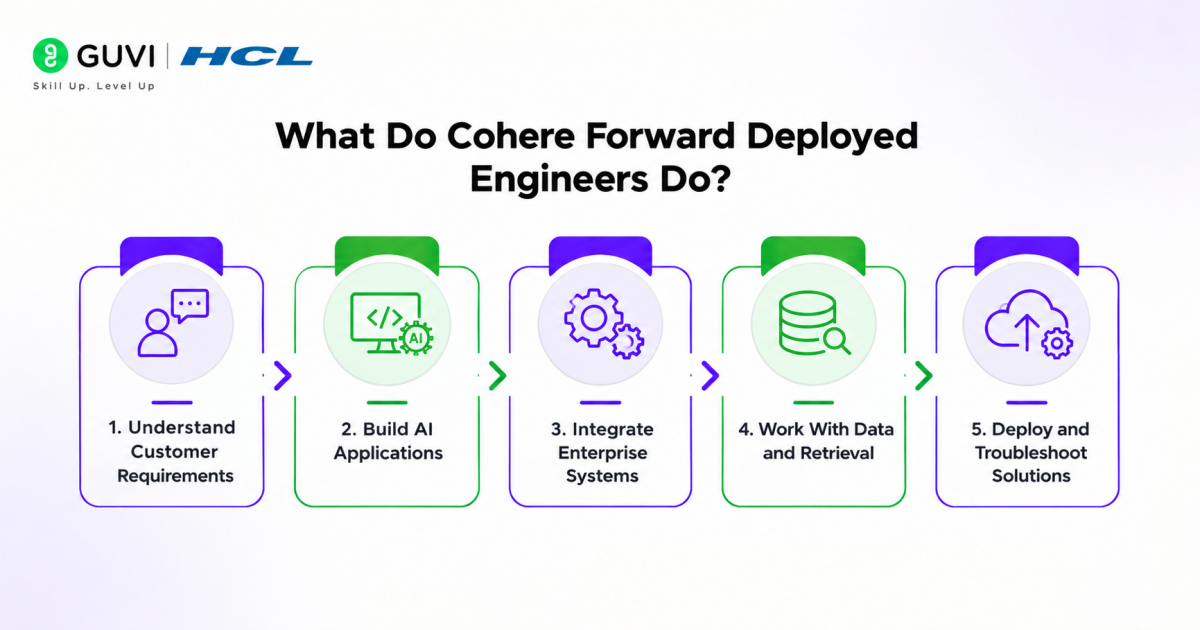
The exact work can vary by customer and project, but several responsibilities are common.
1. Understand Customer Requirements
Engineers need to understand the business problem before deciding how AI should be applied.
A customer might want to automate research, improve internal knowledge access, or streamline a business workflow. The engineer must determine the underlying technical requirements.
2. Build AI Applications
Forward deployed engineers can create prototypes and applications using AI capabilities, APIs, retrieval systems, and supporting software components.
The objective is generally to solve a practical problem rather than demonstrate AI capabilities in isolation.
3. Integrate Enterprise Systems
Enterprise AI applications often need to interact with existing databases, APIs, document repositories, authentication systems, and business applications.
Engineers may design these integrations and troubleshoot problems that arise during implementation.
4. Work With Data and Retrieval
Enterprise AI systems often need access to private or domain-specific information. Engineers may help structure data pipelines, retrieval workflows, and evaluation processes so AI systems can access relevant information.
5. Deploy and Troubleshoot Solutions
Moving from prototype to production can introduce challenges involving infrastructure, latency, authentication, permissions, data quality, and application reliability.
Forward deployed engineers help identify and solve these issues.
How Does the Agentic Platform Change Engineering Work?
Agentic AI changes the engineering problem because the application is not necessarily limited to a single input-and-output interaction.
A simplified agentic workflow can look like:
User request → Agent reasoning → Retrieval → Tool/API call → Processing → Response or actionEach step introduces engineering considerations.
For example, an agent may need to retrieve information from an enterprise knowledge base before using a tool to perform an action. Engineers need to consider authentication, error handling, permissions, latency, and evaluation throughout the workflow.
This means forward deployed engineers need to understand both AI capabilities and conventional software engineering.
Pro Tip: When building an AI agent, define what the agent is allowed to access and do. Clear tool boundaries, permissions, and failure-handling mechanisms are just as important as the model itself.

What Skills Does a Cohere Forward Deployed Engineer Need?
A broad technical foundation is valuable for this role.
1. AI and Machine Learning
You should understand language models, embeddings, retrieval-augmented generation, prompt design, model evaluation, and agentic workflows.
2. Programming
Python is particularly useful for AI applications, data processing, automation, and API integrations.
Knowledge of JavaScript or TypeScript can also be useful for application development.
3. APIs and Integrations
Understanding REST APIs, authentication, JSON, webhooks, databases, and application architecture helps engineers connect AI systems with enterprise software.
4. Cloud and Deployment
Knowledge of containers, cloud platforms, CI/CD, logging, monitoring, and basic infrastructure can help when taking AI applications into production.
5. Communication
Customer-facing work requires the ability to explain technical concepts clearly, gather requirements, discuss trade-offs, and communicate project progress.
Best Practice: Develop T-shaped skills. Build deep expertise in AI or software engineering while maintaining working knowledge of cloud, data, APIs, security, and customer problem-solving.
How Is the Role Different From Traditional AI Engineering?
| Area | Traditional AI Engineering | Forward Deployed Engineering |
| Primary focus | AI products and systems | Customer-specific AI solutions |
| Requirements | Often product-defined | Frequently customer-driven |
| Data | Standardized or controlled | Customer-specific |
| Integrations | Product-level | Enterprise-specific |
| Communication | Mainly internal | Customers and internal teams |
| Problem scope | Often specialized | Broad and adaptable |
Forward deployed engineering does not replace AI engineering. Product and platform teams build reusable capabilities, while forward deployed teams can help apply those capabilities to specific customer environments.
How Can Engineers Prepare for the Role?
Start with strong programming and AI fundamentals. Learn Python, APIs, databases, cloud concepts, machine learning, retrieval systems, and modern AI application development.
Then build an end-to-end AI project. For example, create an enterprise-style knowledge assistant that uses retrieval, connects to an API, implements authentication, evaluates responses, and includes basic monitoring.
You should also practice customer-style problem solving. Take an ambiguous business requirement and identify the problem, ask clarifying questions, propose an architecture, and explain the trade-offs.
Warning: Do not prepare only by learning prompt engineering. Forward deployed AI roles require software engineering, integration, debugging, deployment, evaluation, and communication skills as well.
Start Your Learning Journey with HCL GUVI
Ready to build skills for the growing AI industry? HCL GUVI’s Artificial Intelligence & Machine Learning Course helps you develop practical AI and machine learning skills through hands-on projects and industry-focused training.
Conclusion
A Cohere forward deployed engineer sits at the intersection of enterprise AI, software engineering, and customer problem-solving. As organizations move from experimenting with AI to deploying agents inside real workflows, they need engineers who can connect models and platforms with existing data, applications, and business processes.
The role therefore requires more than knowledge of AI models. Strong programming, API integration, cloud, data, evaluation, debugging, and communication skills can help engineers build reliable solutions that work in real customer environments. For engineers interested in applied AI, forward deployment offers an opportunity to work on technically challenging problems while directly contributing to enterprise AI adoption.
FAQs
What is a Cohere forward deployed engineer?
A Cohere forward deployed engineer helps enterprise customers develop and implement AI solutions for specific business and technical requirements. The role combines AI, software engineering, integrations, and customer collaboration.
What does a forward deployed engineer do with agentic AI?
They can help build and deploy agentic applications that connect AI models with enterprise data, APIs, tools, retrieval systems, and business workflows.
What skills does a Cohere forward deployed engineer need?
Useful skills include Python, AI and machine learning, APIs, databases, cloud platforms, retrieval systems, debugging, software architecture, and customer communication.
Is forward deployed engineering the same as AI engineering?
No. AI engineering focuses broadly on developing AI-powered systems, while forward deployed engineering typically adds a stronger customer-facing and implementation focus.
Do forward deployed engineers need to understand APIs?
Yes. APIs are often important when connecting AI applications and agents with enterprise systems, databases, and external tools.
How can I prepare for a forward deployed AI engineering role?
Learn AI application development, Python, APIs, cloud technologies, databases, retrieval systems, and software engineering fundamentals. Build end-to-end projects and practice solving ambiguous customer problems.
Success Stories

About the Author
HCL GUVI
This article was selected and published as part of the HCL GUVI AI Blogathon 2026, an initiative designed to encourage students, AI enthusiasts, and aspiring tech writers to simplify complex AI concepts through impactful technical content. The contest recognized high-quality, original, and insightful AI-focused blogs, with selected authors receiving publication opportunities on the HCL GUVI blog platform along with official author credits and recognition.
View all posts by HCL GUVI
Connect with me @










Did you enjoy this article?