


Forward Deployed Engineer Articles
Excalidraw and Whiteboarding: How FDEs Communicate Technical Solutions
How to Fine-Tune Open-Source Models as a Forward Deployed Engineer
Rate Limiting, Retries, and Caching: Production AI Patterns for FDEs
How to Run a Great Client Demo as a Forward Deployed Engineer


Get In Touch For Details! Request More Information
LinkedIn Profile Tips for Aspiring Forward Deployed Engineers
Sep 27, 2026 4 Min Read 238 Views
(Last Updated)
A strong LinkedIn profile can help aspiring Forward Deployed Engineers communicate their technical direction before a recruiter reaches the interview stage. Because FDE work combines software engineering, deployment, customer collaboration, and practical problem-solving, your profile should show more than a collection of technologies. It should make your experience, projects, strengths, and career direction easy to understand.
Table of contents
- TL;DRSummary
- How Should You Position Your LinkedIn Profile?
- How Should You Position Yourself on LinkedIn?
- What Should Your LinkedIn Headline Say?
- How Should You Write Your About Section?
- What Experience and Skills Should You Highlight?
- What Experience Should You Highlight?
- How Should You Describe Your Projects?
- Which Skills Should You Add?
- How Important Are Projects on LinkedIn?
- How Can You Demonstrate FDE-Style Experience?
- How Can You Show Customer-Facing Experience?
- What Should You Add to the Featured Section?
- Should You Add Certifications?
- How Can You Make Your Experience Results-Focused?
- Which Keywords Should Aspiring FDEs Use?
- How Can You Demonstrate FDE-Style Problem Solving?
- How Should You Maintain and Review Your LinkedIn Profile?
- How Active Should You Be on LinkedIn?
- What Should You Check Before Publishing?
- What Should You Do After Optimizing Your Profile?
- Conclusion
- FAQs
- What should an aspiring FDE put on LinkedIn?
- Should I put “Aspiring FDE” in my LinkedIn headline?
- What projects are useful for an FDE LinkedIn profile?
- Do FDE candidates need customer experience?
- Should I list every technical skill I know?
- Are certifications important for FDE roles?
- How can I make my LinkedIn profile stand out for FDE roles?
TL;DR Summary
- Position your profile around technical capability, problem-solving, and FDE readiness.
- Highlight projects involving APIs, AI, cloud, integrations, and deployment.
- Use your headline and About section to communicate your career direction clearly.
- Show ownership and outcomes instead of simply listing technologies.
Quick Answer
| The best LinkedIn profile tips for aspiring forward deployed engineers focus on demonstrating capabilities rather than simply adding “FDE” to your headline. Highlight software engineering, system design, cloud, AI, integrations, deployment, and customer-facing experience where applicable. Use your projects and experience descriptions to show how you handled requirements, made technical decisions, solved problems, and delivered practical results. |
How Should You Position Your LinkedIn Profile?
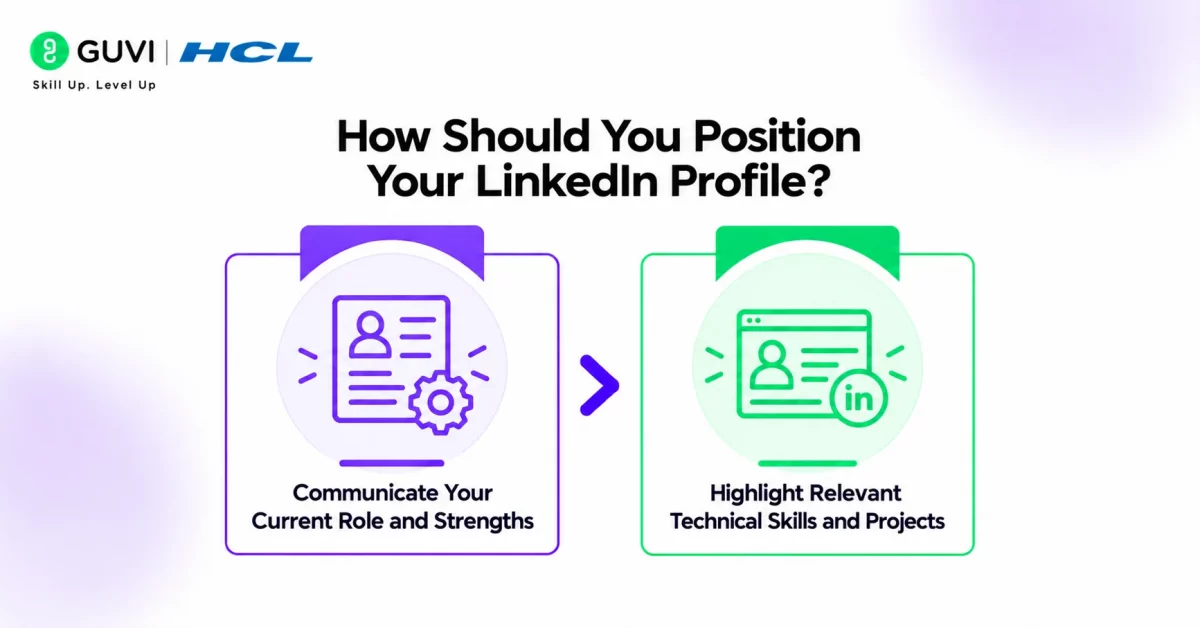
How Should You Position Yourself on LinkedIn?
- Your profile should quickly communicate what you currently do, what you are good at, and where you want to go.
- If you are a backend engineer, emphasize backend systems, APIs, cloud, AI applications, and end-to-end development.
- If you are a fresher, emphasize practical projects and technical strengths rather than claiming professional FDE experience.
Accuracy matters. If you have not worked as an FDE, describe yourself as an aspiring FDE and let your projects demonstrate why you are preparing for the role.
What Should Your LinkedIn Headline Say?
Your headline should provide more context than your current job title.
A useful structure is:
Current role | Technical strengths | Career direction
For example:
Backend Engineer | APIs, Cloud & AI Applications | Aspiring Forward Deployed Engineer
For a fresher:
Software Engineering Graduate | Python, APIs & AI | Aspiring Forward Deployed Engineer
Keep the headline focused. Avoid filling it with unrelated keywords that you cannot support through your experience.
How Should You Write Your About Section?
Your About section should explain your technical foundation, the problems you enjoy solving, and the direction you are pursuing.
Start with your current engineering strengths, mention meaningful projects, and explain your interest in broader problem-solving, integrations, deployment, or customer requirements.
Avoid turning the section into a keyword list. Writing “Python, AWS, Docker, SQL, AI, APIs” tells recruiters what you have encountered, but not what you can actually build.
What Experience and Skills Should You Highlight?
What Experience Should You Highlight?
Prioritize responsibilities that demonstrate transferable FDE capabilities.
These can include:
- Building backend services
- Developing APIs and integrations
- Deploying applications
- Working with cloud infrastructure
- Debugging production issues
- Gathering requirements
- Collaborating with stakeholders
- Translating requirements into technical solutions
- Improving performance or reliability
Your job title does not have to be FDE for this experience to be relevant.
How Should You Describe Your Projects?
Projects are particularly important when you do not have direct FDE experience.
Describe each project around the:
- Problem
- Solution
- Technology
- Outcome
Instead of writing, “Built an AI chatbot using Python,” explain what the application actually did, which systems it connected, and what problem it addressed.
A project combining document retrieval, APIs, authentication, an AI model, and cloud deployment can demonstrate much more breadth when the technical decisions are explained clearly.
Forward Deployed Engineers combine technical expertise with customer-focused problem-solving to build practical solutions for real-world business needs.
Which Skills Should You Add?
Prioritize skills that support your target FDE roles:
- Software engineering
- Python or JavaScript
- APIs
- Databases
- System design
- Cloud computing
- DevOps
- AI application development
- Data engineering
- Technical communication
Do not add every technology you have briefly encountered. A focused skills section is more credible and easier for recruiters to evaluate.
How Important Are Projects on LinkedIn?
Projects provide evidence that you can apply knowledge beyond coursework.
Choose projects that demonstrate complete workflows instead of isolated features.
A strong project could combine a backend service, database, external API, authentication, cloud deployment, and AI component.
Explain your contribution, architecture, challenges, and reasoning so the recruiter can understand your engineering ability.
How Can You Demonstrate FDE-Style Experience?
How Can You Show Customer-Facing Experience?
Customer experience does not have to come from an FDE position.
Freelancing, internships, consulting work, stakeholder discussions, and collaborative projects can all demonstrate relevant experience.
If you gathered requirements, explained technical decisions, handled feedback, or changed an implementation based on user needs, describe those activities specifically.
This shows that you can connect technical work with real requirements.
What Should You Add to the Featured Section?
Use the Featured section to showcase your strongest evidence.
Good choices include:
- Deployed projects
- GitHub repositories
- Technical case studies
- Project demonstrations
- Technical articles
- Presentations
- Relevant certifications
Choose a few strong resources instead of adding everything you have created.
Should You Add Certifications?
Certifications can support your profile, but they should not dominate it.

Credentials demonstrate structured learning, while projects demonstrate application.
For example, a cloud certification becomes more useful when your profile also shows a cloud-deployed application.
Connect certifications to practical work whenever possible.
How Can You Make Your Experience Results-Focused?
- Describe what changed because of your work.
- Instead of simply writing “Developed backend APIs,” explain what those APIs enabled, which systems they connected, or what workflow they improved.
- When you have genuine measurements, include them.
- Response time, processing volume, reliability improvements, cost reductions, or adoption can make your contribution easier to understand.
- Never invent metrics.
Which Keywords Should Aspiring FDEs Use?
Use relevant terminology naturally throughout your profile.
Useful terms include Forward Deployed Engineer, software engineering, system design, cloud deployment, APIs, integrations, AI engineering, customer solutions, production systems, and end-to-end ownership.
Do not repeat the same keyword throughout every section. Your profile should read naturally while still making your career direction clear.
How Can You Demonstrate FDE-Style Problem Solving?
Show situations where you investigated a problem before deciding what to build.
Explain how you:
- Identified a requirement
- Evaluated possible approaches
- Selected an architecture
- Implemented the solution
- Handled unexpected issues
- Improved the result
This demonstrates engineering judgment and adaptability instead of simply showing that you know a particular framework.
How Should You Maintain and Review Your LinkedIn Profile?
How Active Should You Be on LinkedIn?
You do not need to post every day.
Focus on useful technical and professional activity.
Share meaningful project updates, lessons from engineering work, technical explanations, or insights from what you are learning.
Engage thoughtfully with relevant discussions and build genuine professional connections.
What Should You Check Before Publishing?
Review your profile from a recruiter’s perspective.
Within a few seconds, they should understand your technical background, target direction, strongest skills, and practical experience.
Check your:
- Headline
- About section
- Experience descriptions
- Projects
- Skills
- Certifications
- Featured section
- Profile photo
Make sure they communicate a consistent professional direction.
Ready to strengthen the technical skills you showcase on LinkedIn? Build practical AI expertise with HCL GUVI’s Artificial Intelligence & Machine Learning Certification Bundle and turn your learning into portfolio-ready projects.
What Should You Do After Optimizing Your Profile?
- Your LinkedIn profile should support an active job search rather than sit unchanged.
- Connect with FDEs, software engineers, AI engineers, recruiters, and technical leaders working in relevant organizations.
- When you apply for FDE roles, make sure your profile, resume, GitHub, and portfolio tell the same story.
- Consistency makes your career direction easier to understand.
The HCL GUVI Artificial Intelligence eBook can also support your AI fundamentals as you develop the technical knowledge reflected in your profile.
Conclusion
The strongest LinkedIn profile tips for aspiring forward deployed engineers focus on evidence rather than simply adding an FDE title.
Your profile should connect your existing engineering experience with system design, integrations, cloud, AI, deployment, communication, and practical problem-solving.
Describe meaningful projects, explain your contributions, and highlight genuine outcomes.
A strong LinkedIn profile cannot replace relevant experience, but it can make your existing capabilities much easier for recruiters and hiring teams to recognize.
FAQs
1. What should an aspiring FDE put on LinkedIn?
Highlight software engineering, cloud, AI, integrations, system design, deployment, projects, and relevant customer-facing experience.
2. Should I put “Aspiring FDE” in my LinkedIn headline?
Yes, if Forward Deployed Engineering is genuinely your target career direction. Keep the rest of the headline focused on your actual strengths.
3. What projects are useful for an FDE LinkedIn profile?
Projects involving APIs, databases, cloud deployment, AI applications, integrations, and realistic workflows can demonstrate relevant capabilities.
4. Do FDE candidates need customer experience?
No. However, experience gathering requirements, communicating with users, and responding to feedback can strengthen your profile.
5. Should I list every technical skill I know?
No. Prioritize skills you can demonstrate through professional experience, substantial projects, or practical work.
6. Are certifications important for FDE roles?
Certifications can support your profile, but practical projects, engineering ability, communication, and problem-solving are more important.
7. How can I make my LinkedIn profile stand out for FDE roles?
Show technical depth, cross-functional skills, end-to-end ownership, practical projects, deployment experience, measurable outcomes, and clear communication.
Success Stories

About the Author
HCL GUVI
This article was selected and published as part of the HCL GUVI AI Blogathon 2026, an initiative designed to encourage students, AI enthusiasts, and aspiring tech writers to simplify complex AI concepts through impactful technical content. The contest recognized high-quality, original, and insightful AI-focused blogs, with selected authors receiving publication opportunities on the HCL GUVI blog platform along with official author credits and recognition.
View all posts by HCL GUVI
Connect with me @









Did you enjoy this article?