


Forward Deployed Engineer Articles
Excalidraw and Whiteboarding: How FDEs Communicate Technical Solutions
How to Fine-Tune Open-Source Models as a Forward Deployed Engineer
Rate Limiting, Retries, and Caching: Production AI Patterns for FDEs
How to Run a Great Client Demo as a Forward Deployed Engineer


Get In Touch For Details! Request More Information
A Day in the Life of a Forward Deployed Engineer
Sep 27, 2026 3 Min Read 353 Views
(Last Updated)
A day in the life of a forward-deployed engineer usually involves customer conversations, technical problem-solving, coding, system design, deployment, and debugging. Unlike engineers who mainly work from a fixed backlog, FDEs move between customer needs and implementation.
Table of contents
- TL;DR Summary
- What Does a Forward Deployed Engineer Do Each Day?
- How Does the Morning Usually Start?
- What Happens During Customer Discovery?
- When Does an FDE Start Coding?
- Does a Forward Deployed Engineer Code All Day?
- How Does System Design Fit Into an FDE's Day?
- What Happens When Something Breaks?
- How Much Time Does an FDE Spend With Customers?
- What Does a Real-World FDE Day Look Like?
- Which Skills Does an FDE Use Throughout the Day?
- What Happens Toward the End of the Day?
- How Can You Build the Skills Needed for FDE Roles?
- How Can You Prepare for a Forward Deployed Engineering Career?
- Conclusion
- FAQs
- What does a Forward Deployed Engineer do every day?
- Do Forward Deployed Engineers code?
- How much customer interaction does an FDE have?
- What technologies do Forward Deployed Engineers use?
- Do FDEs need AI skills?
- How is an FDE different from a software engineer?
- Is Forward Deployed Engineering a good career?
TL;DR Summary
- FDEs combine customer discovery, coding, system design, deployment, and troubleshooting.
- Their priorities shift with customer needs and production requirements.
- FDEs turn ambiguous problems into practical, production-ready solutions.
- The role requires engineering depth, communication, adaptability, and problem-solving.
Quick Answer
| A Forward Deployed Engineer typically spends the day understanding customer problems, building and testing technical solutions, resolving blockers, and supporting production deployment. The role combines engineering with customer collaboration, so an FDE may move from a customer meeting to coding, system design, evaluation, or debugging within the same day directly. |
What Does a Forward Deployed Engineer Do Each Day?
A Forward Deployed Engineer spends the day understanding customer problems, building solutions, deploying them, and improving them through real-world feedback. The role generally covers discovery, technical scoping, implementation, deployment, and adoption. Current FDE job descriptions describe ownership across discovery, system design, implementation, evaluation, production rollout, and customer collaboration.
How Does the Morning Usually Start?
The morning often starts with reviewing priorities, customer messages, deployment status, and blockers. An FDE may join a customer meeting to confirm priorities and decide which issue needs attention.
What Happens During Customer Discovery?
- Customer discovery helps an FDE understand the actual workflow, constraints, and desired outcome before deciding what to build. The engineer asks how users complete tasks, which systems and data are involved, where problems occur, and what success should look like.
- This information turns a vague request into technical requirements, and current FDE roles emphasize working directly with customers to identify use cases and move solutions toward production.
When Does an FDE Start Coding?
- An FDE starts coding once the problem is clear enough to test or implement a practical solution. The work may involve an API integration, backend service, data pipeline, frontend component, AI workflow, or custom application.
- Because the code must reach production, authentication, testing, monitoring, reliability, data access, and maintainability influence implementation decisions.
Does a Forward Deployed Engineer Code All Day?
No, coding is only one part of an FDE’s day because customer discovery, architecture, deployment, evaluation, communication, and troubleshooting are also core responsibilities. The balance changes according to the project stage.
How Does System Design Fit Into an FDE’s Day?
- System design helps an FDE determine how a customer-specific solution should connect with existing infrastructure and operate reliably in production. The engineer may evaluate APIs, databases, authentication, cloud services, data flows, monitoring, scalability, and cost.
- The objective is a design that fits the customer’s environment while balancing speed, quality, reliability, and maintainability.
- System Design Roadmap can help engineers strengthen their understanding of architecture, APIs, databases, scalability, and technical trade-offs.
What Happens When Something Breaks?
- When a production problem occurs, the FDE investigates the failure, restores functionality, communicates its impact, and works toward preventing it from happening again. Debugging may involve logs, API traces, data inspection, reproduction, model evaluation, or collaboration with customer engineers.
- After the immediate issue is fixed, the FDE may improve monitoring, testing, documentation, or deployment processes.
FDE teams can turn lessons from customer deployments into reusable tools, playbooks, technical patterns, and product feedback.
How Much Time Does an FDE Spend With Customers?
Customer interaction can take a significant part of an FDE’s schedule because customers provide essential context. Conversations may involve engineers, operators, domain experts, or stakeholders.
What Does a Real-World FDE Day Look Like?
A realistic day could begin with a customer meeting, followed by scoping a request and building an integration against the customer’s systems. Later, the FDE might run evaluations, review results with stakeholders, fix a production issue, and plan the next deployment step.

Which Skills Does an FDE Use Throughout the Day?
FDEs rely on software engineering, system design, cloud deployment, API integration, AI development, testing, evaluation, communication, and prioritization. They need enough breadth to move between unfamiliar systems without getting blocked by every new technology.
Key skills include:
- Software engineering
- System design
- Cloud and deployment
- API integration
- AI application development
- Testing and evaluation
- Customer discovery
- Communication
The HCL GUVI Artificial Intelligence eBook can help strengthen foundational AI knowledge, which is useful for FDEs working on AI-powered applications and solutions.
What Happens Toward the End of the Day?
The day often ends with reviewing progress, documenting decisions, sharing customer feedback, and planning the next technical steps. An FDE may record deployment results, blockers, findings, and decisions.
How Can You Build the Skills Needed for FDE Roles?
Strengthen your AI engineering foundation through practical learning. Build AI and machine learning skills with HCL GUVI’s Artificial Intelligence & Machine Learning Certification Bundle and develop the technical foundation needed for modern AI-focused engineering roles.
How Can You Prepare for a Forward Deployed Engineering Career?
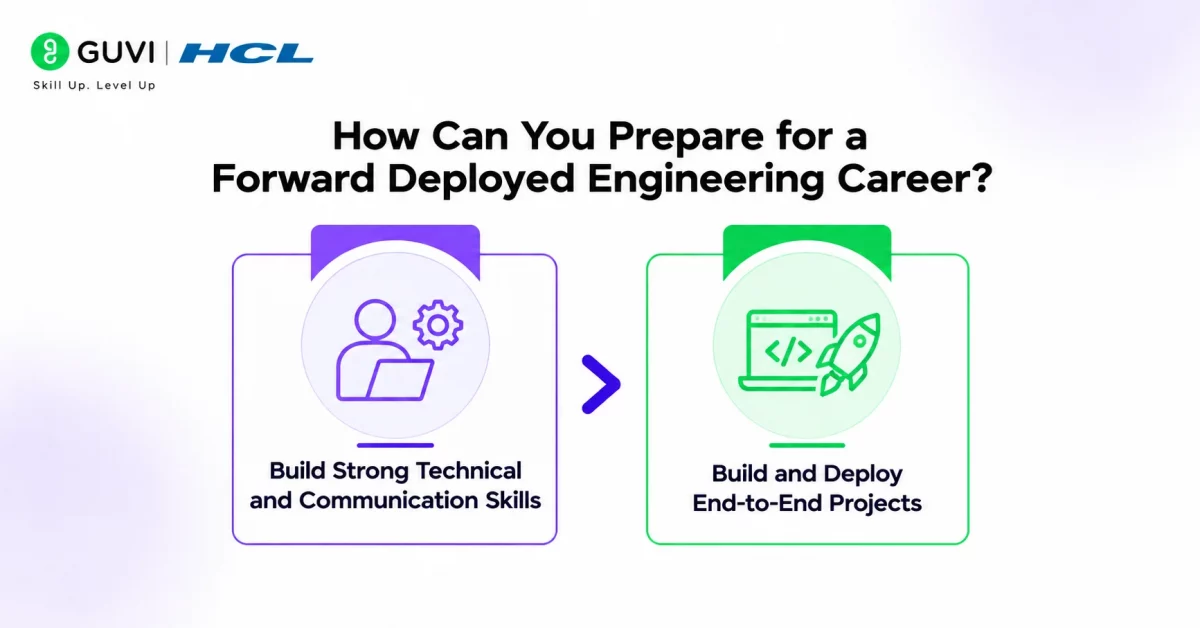
- Build strong software engineering fundamentals and expand into system design, cloud deployment, integrations, AI applications, and customer communication.
- Build a project from problem definition through deployment, document the architecture and trade-offs, test it, monitor it, and measure its usefulness.
Conclusion
A day in the life of a forward-deployed engineer can move from customer discovery to system design, coding, debugging, evaluation, and deployment within one day. The schedule changes with each customer’s requirements, project stage, and production priorities.
The role requires more than programming. Successful FDEs combine engineering depth with communication, adaptability, system thinking, and customer awareness. For engineers considering this path, building complete solutions and connecting technical decisions with measurable customer outcomes is a strong way to prepare.
FAQs
1. What does a Forward Deployed Engineer do every day?
A Forward Deployed Engineer works on customer problems through discovery, coding, system design, deployment, testing, and troubleshooting.
2. Do Forward Deployed Engineers code?
Yes, but coding is only one responsibility. FDEs also handle customer collaboration, architecture, deployment, evaluation, and problem-solving.
3. How much customer interaction does an FDE have?
Customer interaction varies by project, but FDEs commonly participate in requirements discussions, demonstrations, feedback sessions, and adoption activities.
4. What technologies do Forward Deployed Engineers use?
FDEs may work with APIs, databases, cloud platforms, AI models, data pipelines, monitoring systems, and enterprise integrations.
5. Do FDEs need AI skills?
Practical AI skills are increasingly useful for FDEs working on AI applications and production deployment.
6. How is an FDE different from a software engineer?
An FDE generally owns broader customer problems from discovery through production adoption, while software engineers often focus on defined product or platform responsibilities.
7. Is Forward Deployed Engineering a good career?
Yes, especially for engineers who enjoy ambiguity, customer interaction, problem-solving, and end-to-end ownership.
Success Stories

About the Author
HCL GUVI
This article was selected and published as part of the HCL GUVI AI Blogathon 2026, an initiative designed to encourage students, AI enthusiasts, and aspiring tech writers to simplify complex AI concepts through impactful technical content. The contest recognized high-quality, original, and insightful AI-focused blogs, with selected authors receiving publication opportunities on the HCL GUVI blog platform along with official author credits and recognition.
View all posts by HCL GUVI
Connect with me @










Did you enjoy this article?