


Artificial Intelligence and Machine Learning Articles
Finance Manager to Data Analytics: Career Growth, Salary and Seniority
How to Evaluate LLM Outputs in Production Deployments
AI/ML Skills Gap 2026: Why Companies Can't Find Job-Ready Talent
20 AI/ML Interview Questions Recruiters Can Use Without a Tech Background - Best Guide


Get In Touch For Details! Request More Information
The Cold Start Problem in Recommender Systems
Sep 04, 2026 3 Min Read 346 Views
(Last Updated)
Recommender systems rely on user interactions such as clicks, ratings, purchases, views, and searches to generate personalized suggestions. But what happens when there is little or no interaction data? This is known as the Cold Start Problem.
The Cold Start Problem occurs when a recommender system cannot make reliable recommendations because it lacks sufficient information about a new user, a new item, or sometimes the entire system. Solving this challenge is important for platforms that constantly acquire users, add products, or introduce new content.
Table of contents
- TL;DR Summary
- What Is the Cold Start Problem?
- Types of Cold Start Problems
- Why Does Cold Start Happen?
- Cold Start and Collaborative Filtering
- Solving the New User Cold Start
- Popularity-Based Recommendations
- Solving the New Item Cold Start
- Using Content-Based Filtering
- Hybrid Recommendation Systems
- Key Takeaways
- Conclusion
- FAQs
- What is the Cold Start Problem in recommender systems?
- What are the three types of cold start?
- How can recommender systems solve user cold start?
- How does content-based filtering help with item cold start?
- Why are hybrid recommender systems useful for cold start?
TL;DR Summary
- The Cold Start Problem occurs when a recommender lacks sufficient historical interaction data.
- It commonly affects new users and new items.
- User, item, and system cold starts require different solutions.
- Content-based methods, onboarding, popularity signals, and hybrid models can reduce the problem.
- Cold-start strategies should gradually transition toward personalized recommendations as interaction data increases.
What Is the Cold Start Problem?
The Cold Start Problem is a challenge in recommendation systems where insufficient historical data makes it difficult to generate relevant recommendations.
Most collaborative filtering systems learn from interactions between users and items.
For example:
User → Watches → MovieOver time, thousands of these interactions help the system learn preferences.
But a newly registered user might have no viewing history. Similarly, a newly added movie may have no ratings or interactions.
Without enough information, the recommender has limited evidence for deciding what to recommend.
Read More: Building a Recommendation System in Python from Scratch
Build smarter recommendation systems with HCL GUVI’s Artificial Intelligence & Machine Learning Course. Learn machine learning, recommendation systems, and AI through practical, industry-focused projects.
Types of Cold Start Problems
There are three common categories.
- User Cold Start
This occurs when a new user joins a platform without an interaction history.
For example, a streaming service does not initially know whether a new user prefers:
- Action movies
- Documentaries
- Comedy
- Drama
The system needs information before it can create highly personalized recommendations.
- Item Cold Start
This occurs when a new product, movie, article, or other item is introduced without interaction data.
For example, a newly published article may have no clicks or reading history. A collaborative filtering model may struggle to recommend it because no users have interacted with it yet.
- System Cold Start
System cold start occurs when an entirely new recommendation platform has little or no historical interaction data.
In this situation, there may be:
- Few users
- Few items
- Few interactions
- Limited behavioral information
This is generally the most challenging form because both user and item information may be limited.
Cold start is not limited to recommendation engines. Similar problems can appear in machine learning systems whenever a model must make predictions for entities with little or no historical data.
Why Does Cold Start Happen?
Recommender systems depend heavily on historical signals.
Common causes include:
- New users joining a platform.
- New products being added.
- New content being published.
- Limited ratings or reviews.
- Sparse interaction data.
- Newly launched platforms.
The problem becomes particularly noticeable in systems that depend heavily on collaborative filtering.
Cold Start and Collaborative Filtering
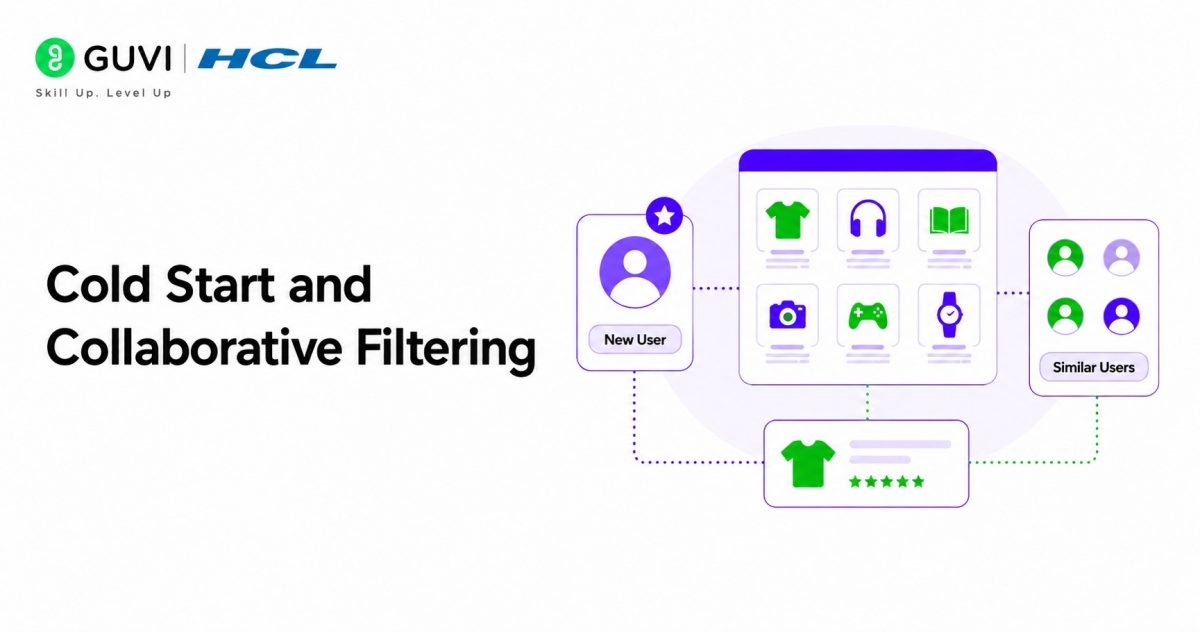
Collaborative filtering recommends items based on patterns in user-item interactions.
For example, if:
User A → likes → Product Xand
User B → likes → Product Xthe system may infer that users with similar behavior could also like Product X.
But a new user with no interactions has no behavioral profile.
Likewise, a new product has no interaction history.
This creates the classic cold-start problem.
Pro Tip: Do not depend entirely on collaborative filtering when your platform frequently introduces new users or items. Combine behavioral signals with content and contextual information.
Solving the New User Cold Start
One common solution is to collect information during onboarding.
A platform might ask users to select:
- Favorite genres
- Preferred topics
- Product categories
- Interests
- Price ranges
For example, a music platform could ask a new user to choose several favorite artists or genres.
These initial preferences provide enough information to generate early recommendations.
Popularity-Based Recommendations
Another approach is to recommend popular items.
For a new user, the system might initially display:

- Trending products
- Popular movies
- Frequently purchased items
- Highly rated content
This provides useful recommendations until enough personalized interaction data becomes available.
Best Practice: Treat popularity-based recommendations as a temporary fallback rather than a permanent substitute for personalization.
Solving the New Item Cold Start
New items can often be recommended using their content characteristics.
For example, a new movie could be described using:
- Genre
- Cast
- Director
- Language
- Keywords
- Description
A content-based recommender can compare these characteristics with items users have previously interacted with.
Suppose a user frequently watches science-fiction movies. A newly released science-fiction movie can be recommended even if nobody has rated it yet.
Using Content-Based Filtering
Content-based filtering is particularly useful for new items because it does not necessarily require historical interactions for the item itself.
The system can create a representation of the item’s attributes and compare it with the user’s known interests.
For example:
User Profile → Science Fiction + Technology

New Item → Science Fiction + AI
The system can identify potential relevance based on content similarity.
Hybrid Recommendation Systems
Hybrid recommender systems combine multiple recommendation approaches.
A hybrid system might use:
- Collaborative filtering
- Content-based filtering
- Popularity
- User demographics or preferences
- Contextual information
This allows the system to fall back to alternative signals when interaction data is missing.
For example:
New User → Onboarding + Popularity

New Item → Content Similarity

Established User + Item → Collaborative Filtering + Content
This creates a more flexible recommendation pipeline.
Key Takeaways
- The Cold Start Problem occurs when recommendation systems lack sufficient interaction data.
- User cold start affects people with little or no history.
- Item cold start affects newly introduced products or content.
- System cold start affects newly launched platforms.
- Onboarding can provide valuable initial user preferences.
- Content-based filtering can help recommend new items.
- Hybrid models combine multiple signals to reduce cold-start limitations.
- Cold-start performance should be evaluated separately.
Build smarter recommendation systems with HCL GUVI’s Artificial Intelligence & Machine Learning Course. Learn machine learning, recommendation systems, and AI through practical, industry-focused projects.
Conclusion
The Cold Start Problem is one of the fundamental challenges in recommender systems. A system cannot rely entirely on historical interactions when users and items are constantly changing.
Effective solutions combine multiple sources of information. Onboarding preferences can help with new users, while content-based features can make new items discoverable. Popularity and contextual signals can provide useful fallback recommendations, while hybrid systems can gradually shift toward more personalized predictions.
The goal is not simply to eliminate cold start but to design a recommendation experience that remains useful from a user’s first interaction and becomes increasingly personalized as meaningful data accumulates.
FAQs
What is the Cold Start Problem in recommender systems?
The Cold Start Problem occurs when a recommender system lacks enough historical information to generate reliable recommendations for new users, new items, or a new platform.
What are the three types of cold start?
The three common types are user cold start, item cold start, and system cold start.
How can recommender systems solve user cold start?
They can use onboarding preferences, popular items, contextual signals, search behavior, and other explicit or early behavioral information.
How does content-based filtering help with item cold start?
Content-based filtering can recommend new items using their attributes or descriptions even when the items have little or no interaction history.
Why are hybrid recommender systems useful for cold start?
Hybrid systems combine collaborative, content-based, popularity, and contextual signals, allowing the system to continue making recommendations when one source of information is unavailable.
Success Stories

About the Author
HCL GUVI
This article was selected and published as part of the HCL GUVI AI Blogathon 2026, an initiative designed to encourage students, AI enthusiasts, and aspiring tech writers to simplify complex AI concepts through impactful technical content. The contest recognized high-quality, original, and insightful AI-focused blogs, with selected authors receiving publication opportunities on the HCL GUVI blog platform along with official author credits and recognition.
View all posts by HCL GUVI
Connect with me @








Did you enjoy this article?