


Artificial Intelligence and Machine Learning Articles
Dependency Parsing in NLP Explained
Coreference Resolution: How AI Tracks Pronouns


Get In Touch For Details! Request More Information

Matrix Factorization for Recommendations
Aug 25, 2026 4 Min Read 24 Views
(Last Updated)
How does a streaming platform predict which movie you might enjoy next—even when you have never rated it? One answer is Matrix Factorization, a machine learning technique that discovers hidden patterns in user-item interactions.
Instead of relying only on visible information such as genres or product descriptions, Matrix Factorization learns relationships between users and items from their historical behavior. It has become a foundational technique for recommendation systems across movies, music, e-commerce, and other platforms.
Table of contents
- TL;DR
- What Is Matrix Factorization?
- How Does Matrix Factorization Work?
- What Are Latent Factors?
- How Does Matrix Factorization Predict Recommendations?
- Matrix Factorization for Explicit vs Implicit Feedback
- What Are the Advantages of Matrix Factorization?
- What Are Its Limitations?
- Matrix Factorization vs Content-Based Filtering
- Where Is Matrix Factorization Used?
- Key Takeaways
- Conclusion
- FAQs
- What is Matrix Factorization in recommendation systems?
- Why is Matrix Factorization useful for recommendations?
- What are latent factors in Matrix Factorization?
- Can Matrix Factorization handle implicit feedback?
- What is the main limitation of Matrix Factorization?
TL;DR
- Matrix Factorization breaks a large user-item matrix into smaller latent-factor matrices.
- These latent factors capture hidden patterns in user preferences and item characteristics.
- The model predicts how users may interact with items they have not seen.
- It works especially well when platforms have substantial interaction data.
- Cold-start and sparse-data problems remain important limitations.
What Is Matrix Factorization?
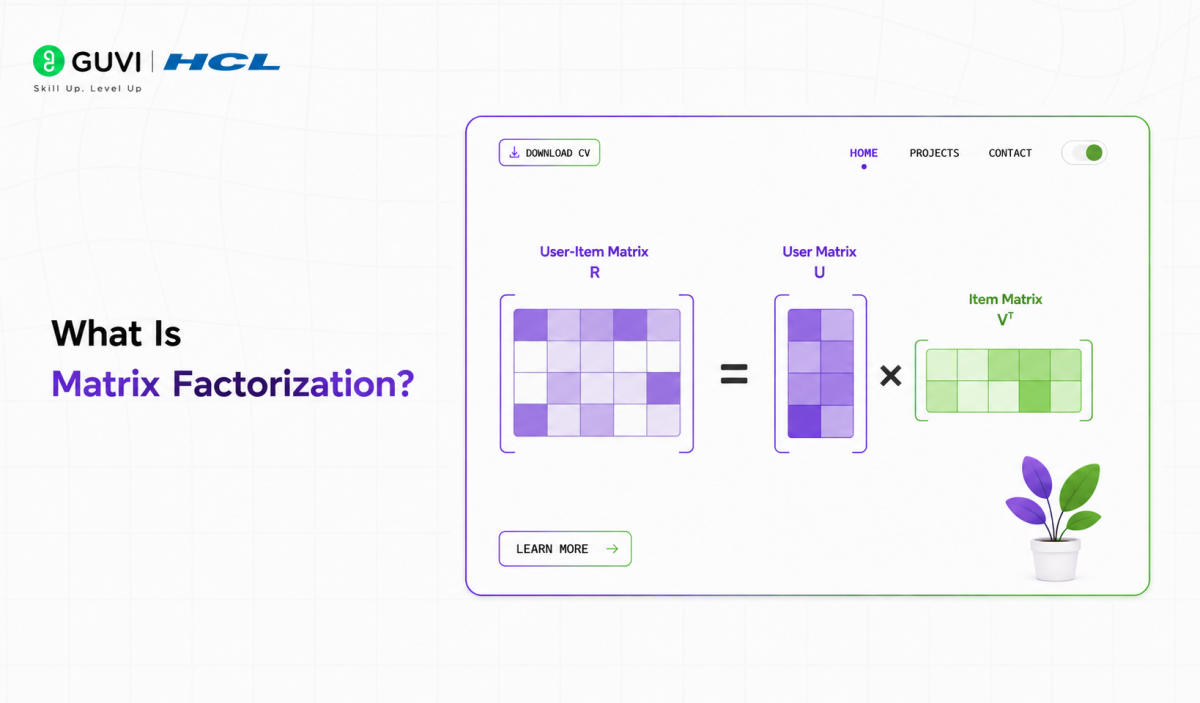
Matrix Factorization is a recommendation technique that represents users and items using smaller numerical matrices. The model learns latent factors—hidden characteristics that help explain why particular users interact with particular items.
For example, a movie recommendation system may learn factors that roughly represent preferences for action, comedy, drama, or science fiction. These factors do not have to be explicitly defined by developers—the algorithm discovers them from interaction patterns.
The basic idea is:
User-Item Matrix ≈ User Factors × Item Factors
The resulting matrices can then be used to estimate missing user-item interactions.
Read More: Building a Recommendation System in Python from Scratch
Master recommendation techniques with HCL GUVI’s Artificial Intelligence & Machine Learning Course. Learn machine learning, deep learning, and real-world AI applications through practical projects.
How Does Matrix Factorization Work?
Imagine a platform with thousands of users and movies. A user-item matrix records interactions such as ratings, purchases, or views.
However, most users interact with only a small fraction of available items. This creates a sparse matrix with many missing values.
Matrix Factorization attempts to represent this large matrix using smaller matrices.
The process generally involves:
- Creating a user-item interaction matrix.
- Choosing the number of latent factors.
- Learning user and item factor values.
- Predicting missing interactions.
- Ranking items for each user.
The model adjusts its factor values during training so its predictions become closer to known interactions.
Matrix Factorization became particularly well known through the Netflix Prize, where collaborative filtering techniques played a major role in improving movie-rating prediction.
What Are Latent Factors?
Latent factors are hidden patterns learned from user-item behavior. They provide a compact representation of users and items.
For example, a movie recommendation model might discover factors related to:
- Genre preferences
- Viewing patterns
- Audience preferences
- Movie characteristics
- User taste profiles
These factors are not necessarily directly interpretable. A factor might represent a combination of several characteristics rather than one specific attribute.
Pro Tip: Increasing the number of latent factors does not automatically improve recommendations. Too many factors can make a model memorize training data instead of learning patterns that generalize to new interactions.
How Does Matrix Factorization Predict Recommendations?
After training, each user and item has a corresponding vector of latent factors. The model calculates how well a user’s vector matches an item’s vector.
A higher predicted score means the model believes the user is more likely to interact with that item.
For example, if a user’s latent representation strongly matches the representation of several movies, those movies can receive higher recommendation scores.
The platform can then:
- Exclude items the user has already consumed.
- Calculate predicted scores for remaining items.
- Rank items by score.
- Recommend the highest-ranked results.
Matrix Factorization for Explicit vs Implicit Feedback
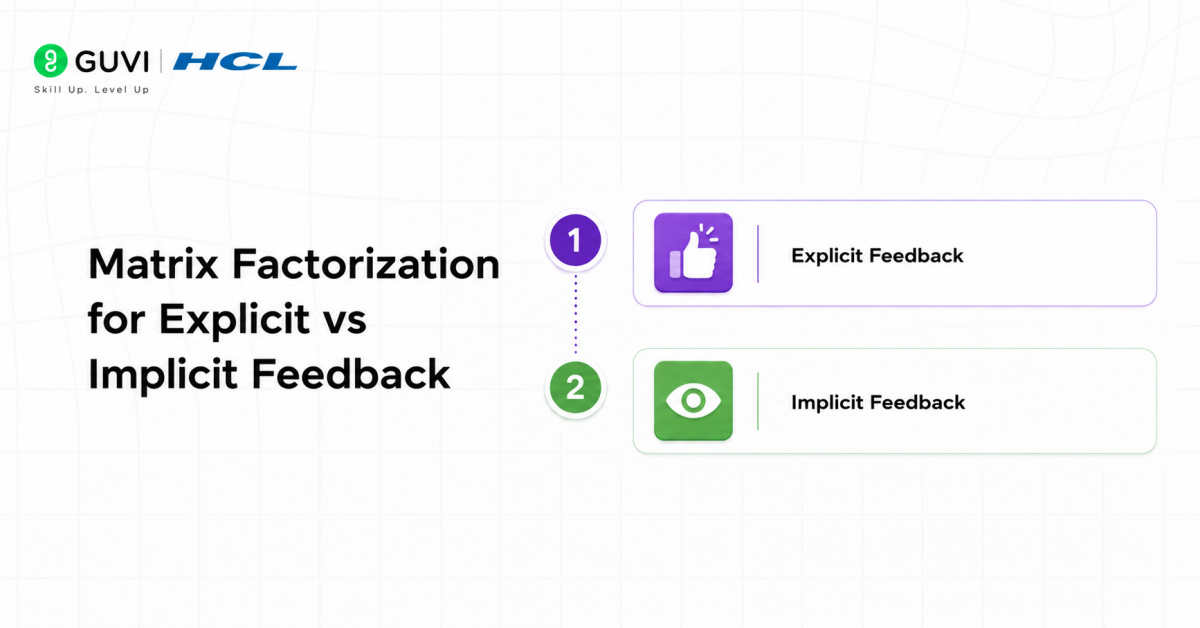
Matrix Factorization can work with different types of user behavior.
- Explicit Feedback
Explicit feedback is information users deliberately provide, such as:
- Star ratings
- Likes
- Reviews
- Thumbs up or down
This type of data clearly communicates user preferences but can be difficult to collect at scale.
- Implicit Feedback
Implicit feedback comes from user behavior rather than direct ratings.
Examples include:
- Clicks
- Purchases
- Views
- Watch time
- Saves
Implicit signals are often much more abundant, but they can be harder to interpret. A user clicking an item does not necessarily mean they liked it.
Best Practice: Treat implicit interactions carefully. A purchase, click, and brief page view may represent very different levels of user interest.

What Are the Advantages of Matrix Factorization?
Matrix Factorization offers several strengths that make it useful for recommendation systems.
- Compact representation: A massive user-item matrix can be represented using smaller latent-factor matrices. This makes it easier to learn hidden relationships between users and items.
- Personalization: The model learns individual user preferences rather than recommending only globally popular items. This allows recommendations to vary significantly between users.
- Pattern discovery: The model can identify relationships that are difficult to define manually. Similar users and items can emerge naturally from interaction data.
These properties make Matrix Factorization a strong baseline for many collaborative recommendation problems.
What Are Its Limitations?
Matrix Factorization also has important weaknesses. The most common challenge is the cold-start problem.
A new user has little or no interaction history, so the model has limited information for learning their preferences. A new item creates a similar problem because there are not yet enough interactions to learn its latent representation.
Other limitations include:
- Sparse interaction data
- Cold-start users and items
- Difficulty incorporating rich content directly
- Dependence on historical behavior
- Challenges with rapidly changing preferences
Warning: A Matrix Factorization model can reinforce existing user behavior. If the training data contains strong popularity biases, recommendations may repeatedly favor already popular items.
Matrix Factorization vs Content-Based Filtering
Matrix Factorization and Content-Based Filtering use different sources of information.
| Factor | Matrix Factorization | Content-Based Filtering |
| Main signal | User-item interactions | Item characteristics |
| Learns from | User behavior | Item features and user profile |
| New items | Challenging | Usually easier |
| Rich metadata | Not required | Important |
| Hidden preferences | Strong capability | More limited |
Many production recommendation systems combine these approaches rather than relying on only one.
Where Is Matrix Factorization Used?
Matrix Factorization can be applied wherever users interact with a collection of items.
Common applications include:
- Movie recommendations
- Music discovery
- Product recommendations
- News personalization
- Online learning platforms
- Content recommendation
For example, an e-commerce platform can use purchase and browsing data to estimate which products a customer may be interested in next.
Key Takeaways
- Matrix Factorization learns hidden relationships between users and items.
- It represents users and items using latent factors.
- The technique can predict missing interactions and rank recommendations.
- Explicit and implicit feedback can both be used.
- Cold-start and sparse-data problems remain major challenges.
- Combining Matrix Factorization with content-based or other methods can improve recommendation quality.
Master recommendation techniques with HCL GUVI’s Artificial Intelligence & Machine Learning Course. Learn machine learning, deep learning, and real-world AI applications through practical projects.
Conclusion
Matrix Factorization provides a powerful way to uncover hidden preference patterns in recommendation data. By transforming a large user-item matrix into compact latent representations, it can estimate which items a user may prefer—even when direct interactions are missing.
Its limitations mean it is not always the complete solution. However, as a collaborative filtering technique and a foundation for more advanced recommender systems, Matrix Factorization remains an important concept for anyone working with personalized recommendations.
FAQs
What is Matrix Factorization in recommendation systems?
Matrix Factorization decomposes a user-item interaction matrix into smaller user and item factor matrices to predict missing entries in the matrix.
Why is Matrix Factorization useful for recommendations?
It can discover hidden patterns in user behavior and use those patterns to generate personalized item recommendations.
What are latent factors in Matrix Factorization?
Latent factors are hidden numerical representations that capture patterns in user preferences and item characteristics.
Can Matrix Factorization handle implicit feedback?
Yes. Matrix Factorization can be adapted to behavioral signals such as clicks, purchases, views, and watch history.
What is the main limitation of Matrix Factorization?
Its biggest challenges include sparse data and the cold-start problem for new users and items.
Success Stories

About the Author
HCL GUVI
This article was selected and published as part of the HCL GUVI AI Blogathon 2026, an initiative designed to encourage students, AI enthusiasts, and aspiring tech writers to simplify complex AI concepts through impactful technical content. The contest recognized high-quality, original, and insightful AI-focused blogs, with selected authors receiving publication opportunities on the HCL GUVI blog platform along with official author credits and recognition.
View all posts by HCL GUVI
Connect with me @











Did you enjoy this article?