


Artificial Intelligence and Machine Learning Articles
Dependency Parsing in NLP Explained
Coreference Resolution: How AI Tracks Pronouns


Get In Touch For Details! Request More Information
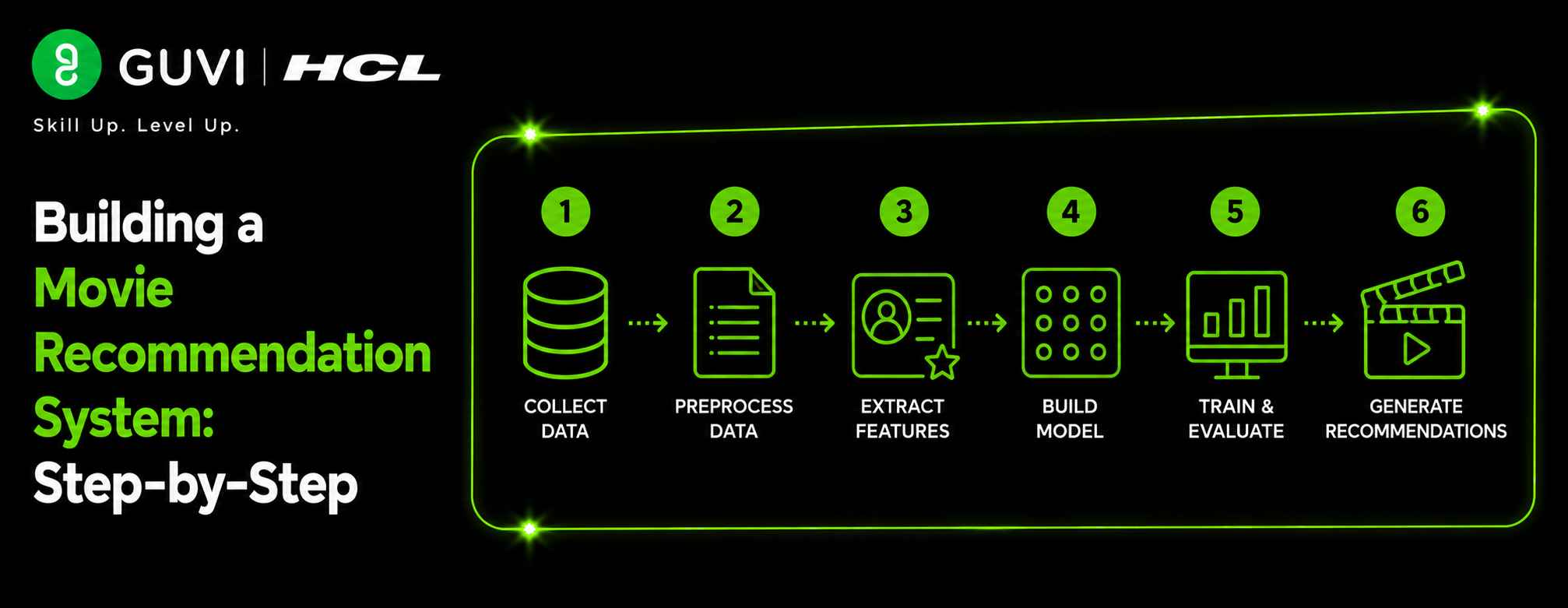
Building a Movie Recommendation System: Step-by-Step
Aug 25, 2026 3 Min Read 20 Views
(Last Updated)
Movie recommendation systems help users discover films that match their interests. They can analyze movie information, user ratings, viewing history, or similarities between films to generate personalized suggestions. Building a Movie Recommendation System is a practical way to understand recommendation algorithms, data preprocessing, similarity measures, and machine learning workflows.
Table of contents
- TL;DR
- Quick Answer
- What Is a Movie Recommendation System?
- Types of Movie Recommendation Systems
- Content-Based Filtering
- Collaborative Filtering
- Hybrid Recommendation
- How to Build a Movie Recommendation System
- Step 1: Collect Movie Data
- Step 2: Clean the Data
- Step 3: Select Relevant Features
- Step 4: Represent the Movies
- Step 5: Calculate Similarity
- Step 6: Generate Recommendations
- Step 7: Evaluate the System
- Example of Content-Based Recommendation
- Common Similarity Techniques
- Cosine Similarity
- Euclidean Distance
- A Practical Recommendation Workflow
- When Should You Use Each Approach?
- Content-Based Filtering
- Collaborative Filtering
- Hybrid Systems
- Key Concepts to Remember
- A Practical Project Workflow
- Define the Recommendation Goal
- Prepare the Dataset
- Engineer Features
- Build a Baseline
- Generate Recommendations
- Evaluate Results
- Improve the System
- Real-World Applications
- Streaming Platforms
- Entertainment Apps
- Personalized Homepages
- Search and Discovery
- Best Practices
- Conclusion
- FAQs
- What is a Movie Recommendation System?
- What is content-based filtering?
- What is collaborative filtering?
- What is a hybrid recommendation system?
- What is cosine similarity used for?
- What is the cold-start problem?
- How can a movie recommendation system be improved?
TL;DR
- Recommendation systems suggest movies based on available data.
- Content-based systems use movie characteristics.
- Collaborative filtering uses user-item interactions.
- Hybrid systems combine multiple approaches.
- Good recommendations depend heavily on data quality.
Quick Answer
| A Movie Recommendation System analyzes information such as movie genres, ratings, user preferences, or viewing history to recommend relevant films. A basic system can use content-based filtering to find movies similar to those a user already likes, while collaborative filtering can recommend movies based on the preferences of similar users. The choice depends on the available data and application requirements. |
What Is a Movie Recommendation System?
A movie recommendation system predicts which movies a user may prefer based on available information.
For example, if a user frequently watches science-fiction and action movies, the system can identify similar movies and recommend them.
A recommendation system generally uses:
- Movie information
- User preferences
- Ratings
- Viewing history
- User-movie interactions
Types of Movie Recommendation Systems
Content-Based Filtering
Content-based systems recommend movies based on their characteristics.
These characteristics can include:
- Genre
- Actors
- Director
- Keywords
- Plot information
If a user likes a particular science-fiction movie, the system can recommend other movies with similar characteristics.
Collaborative Filtering
Collaborative filtering uses interactions between users and movies.
For example, if two users have similar movie preferences and one user likes a movie that the other has not watched, the system can recommend that movie.
Hybrid Recommendation
Hybrid systems combine content-based and collaborative approaches to use multiple sources of information.
How to Build a Movie Recommendation System
Step 1: Collect Movie Data
Gather information such as movie titles, genres, descriptions, ratings, and other relevant attributes.
Step 2: Clean the Data
Handle missing values, duplicates, inconsistent formats, and other data-quality issues.
Step 3: Select Relevant Features
Choose information that can help determine movie similarity or user preferences.
Step 4: Represent the Movies
Convert textual or categorical information into numerical representations that a recommendation algorithm can process.
Step 5: Calculate Similarity
For a content-based system, calculate how similar movies are based on their representations.
Step 6: Generate Recommendations
When a user selects a movie, identify other movies with high similarity scores.
Step 7: Evaluate the System
Test whether the recommendations are relevant using suitable evaluation methods.
Example of Content-Based Recommendation
Suppose a user likes:
Movie A → Action + Science Fiction
The system compares Movie A with other movies based on their features.
If:
Movie B → Action + Science Fiction
Movie B may receive a high similarity score and be recommended.
Common Similarity Techniques
Cosine Similarity
Cosine similarity measures how similar two numerical vectors are based on their orientation.
It is commonly used when comparing vector representations of movie features.
Euclidean Distance
Euclidean distance measures the geometric distance between two points or vectors.
The appropriate similarity measure depends on how the movie data is represented.
A Practical Recommendation Workflow
Movie Data → Data Cleaning → Feature Engineering → Vector Representation → Similarity Calculation → Ranking → Recommendations
For collaborative filtering, the workflow can instead focus on:
User-Movie Interactions → Preference Modeling → Candidate Generation → Ranking → Recommendations
The HCL GUVI’s Artificial Intelligence eBook introduces artificial intelligence, machine learning, generative AI, and intelligent automation concepts, helping learners understand modern AI technologies and their practical applications.
When Should You Use Each Approach?
Content-Based Filtering
Use it when detailed information about movies is available but user interaction data is limited.
Collaborative Filtering
Use it when you have sufficient user-movie interaction data and want recommendations based on behavioral patterns.
Hybrid Systems
Use them when you have both detailed movie information and substantial user interaction data.
Recommendation systems can suffer from the cold-start problem. A new movie with little interaction data or a new user with no viewing history can be difficult to recommend effectively, which is one reason hybrid approaches can be useful.

Key Concepts to Remember
- Content-based filtering uses item characteristics.
- Collaborative filtering uses user-item interactions.
- Hybrid systems combine multiple recommendation approaches.
- Feature engineering affects recommendation quality.
- Similarity measures help identify related movies.
- Ranking determines which recommendations are presented first.
A Practical Project Workflow
1. Define the Recommendation Goal
Decide whether the system should recommend similar movies, personalize recommendations, or both.
2. Prepare the Dataset
Clean movie metadata and user interaction information.
3. Engineer Features
Convert genres, descriptions, keywords, ratings, or other relevant information into usable features.
4. Build a Baseline
Start with a simple content-based or popularity-based recommendation approach.
5. Generate Recommendations
Calculate similarity or preference scores and rank candidate movies.
6. Evaluate Results
Measure recommendation quality using appropriate offline metrics or user feedback.
7. Improve the System
Add collaborative filtering, better features, or a hybrid approach when the baseline is insufficient.
Real-World Applications
Streaming Platforms
Recommend movies based on viewing history and user preferences.
Entertainment Apps
Help users discover relevant movies from large catalogs.
Personalized Homepages
Rank movies according to individual user interests.
Search and Discovery
Suggest related movies when users search for a particular title or genre.
Professionals interested in artificial intelligence, machine learning, and recommendation systems can strengthen their expertise through HCL GUVI’s Artificial Intelligence and Machine Learning Course.
Best Practices
- Keep movie and user data clean and consistent.
- Choose features that are relevant to recommendations.
- Start with a simple baseline before using complex models.
- Address the cold-start problem where appropriate.
- Avoid recommending only extremely popular movies.
- Evaluate recommendations using suitable metrics.
- Continuously improve the system using user feedback.
Conclusion
Building a Movie Recommendation System involves collecting and cleaning data, selecting useful features, representing movies numerically, calculating similarities or modeling user preferences, and ranking recommendations. Content-based filtering is a useful starting point, while collaborative filtering and hybrid systems can provide more personalized results when sufficient interaction data is available. A strong recommendation system combines good data, appropriate algorithms, and continuous evaluation.
FAQs
1. What is a Movie Recommendation System?
A Movie Recommendation System predicts or suggests movies that a user may find relevant based on movie characteristics, user preferences, or interaction history.
2. What is content-based filtering?
Content-based filtering recommends movies based on similarities between their characteristics, such as genres, keywords, actors, or descriptions.
3. What is collaborative filtering?
Collaborative filtering uses patterns in user-item interactions to recommend movies based on the preferences of similar users.
4. What is a hybrid recommendation system?
A hybrid system combines multiple recommendation approaches, such as content-based and collaborative filtering.
5. What is cosine similarity used for?
Cosine similarity can measure similarity between numerical vector representations of movies, making it useful for content-based recommendation systems.
6. What is the cold-start problem?
The cold-start problem occurs when there is insufficient information about a new user or movie to generate reliable personalized recommendations.
7. How can a movie recommendation system be improved?
Improve data quality, engineer better features, incorporate user interactions, address cold-start cases, evaluate recommendation quality, and consider hybrid recommendation approaches.
Success Stories

About the Author
HCL GUVI
This article was selected and published as part of the HCL GUVI AI Blogathon 2026, an initiative designed to encourage students, AI enthusiasts, and aspiring tech writers to simplify complex AI concepts through impactful technical content. The contest recognized high-quality, original, and insightful AI-focused blogs, with selected authors receiving publication opportunities on the HCL GUVI blog platform along with official author credits and recognition.
View all posts by HCL GUVI
Connect with me @








Did you enjoy this article?