


Artificial Intelligence and Machine Learning Articles
Finance Manager to Data Analytics: Career Growth, Salary and Seniority
How to Evaluate LLM Outputs in Production Deployments
AI/ML Skills Gap 2026: Why Companies Can't Find Job-Ready Talent
20 AI/ML Interview Questions Recruiters Can Use Without a Tech Background - Best Guide

Get In Touch For Details! Request More Information
AI in HR and Recruitment: Resume Screening and Bias Risks
Aug 27, 2026 3 Min Read 391 Views
(Last Updated)
Artificial intelligence is increasingly used in recruitment to help organizations process applications, identify relevant candidates, and streamline hiring workflows. AI in HR and Recruitment can make resume screening faster, but automated systems can also reproduce or amplify biases present in historical hiring data or system design. This guide explains how AI is used in recruitment, how resume screening works, and the key bias risks organizations need to consider.
Table of contents
- TL;DR
- Quick Answer
- Why AI Is Used in Recruitment
- How AI Resume Screening Works
- Step 1: Collect Resumes
- Step 2: Extract Information
- Step 3: Match Candidate Information
- Step 4: Rank or Filter Candidates
- Step 5: Recruiter Review
- What Are Bias Risks in AI Recruitment?
- Historical Hiring Data
- Biased Features
- Unrepresentative Data
- Labeling or Evaluation Bias
- Why Human Oversight Matters
- Benefits of AI in HR Recruitment
- Faster Screening
- Consistent Processing
- Reduced Administrative Work
- Scalable Recruitment
- When Should You Use AI in HR Recruitment?
- Resume Screening
- Candidate Matching
- Large Applicant Pools
- Recruitment Administration
- Human Decision Support
- Key Concepts to Remember
- A Practical AI Resume-Screening Workflow
- Define Job Requirements
- Collect Applications
- Extract Candidate Information
- Match Candidates
- Evaluate Screening Results
- Conduct Human Review
- Monitor Outcomes
- Real-World Applications
- Resume Screening
- Candidate Matching
- Interview Scheduling
- Job Description Analysis
- Best Practices
- Conclusion
- FAQs
- How is AI used in recruitment?
- What is AI resume screening?
- How can AI recruitment systems become biased?
- Can removing demographic information eliminate AI bias?
- Why is human oversight important in AI recruitment?
- Can AI replace recruiters?
- How can organizations reduce bias in AI recruitment?
TL;DR
- AI can automate parts of the recruitment process.
- Resume screening systems identify candidates based on predefined criteria.
- Historical hiring data can introduce bias into AI systems.
- Human oversight is important for high-impact hiring decisions.
- Regular testing can help identify unfair outcomes.
Quick Answer
| AI in HR Recruitment uses artificial intelligence to support tasks such as resume screening, candidate matching, job description analysis, and applicant prioritization. While these tools can reduce manual workload and speed up hiring, they may produce biased results if their training data, criteria, or design reflects existing inequalities. Regular evaluation and human oversight are therefore important. |
Why AI Is Used in Recruitment
Recruiters may receive hundreds or thousands of applications for a single position. AI tools can help process this information more efficiently.
Common uses include:
- Resume screening
- Candidate matching
- Skill extraction
- Applicant ranking
- Interview scheduling
- Job description analysis
- Candidate communication
How AI Resume Screening Works
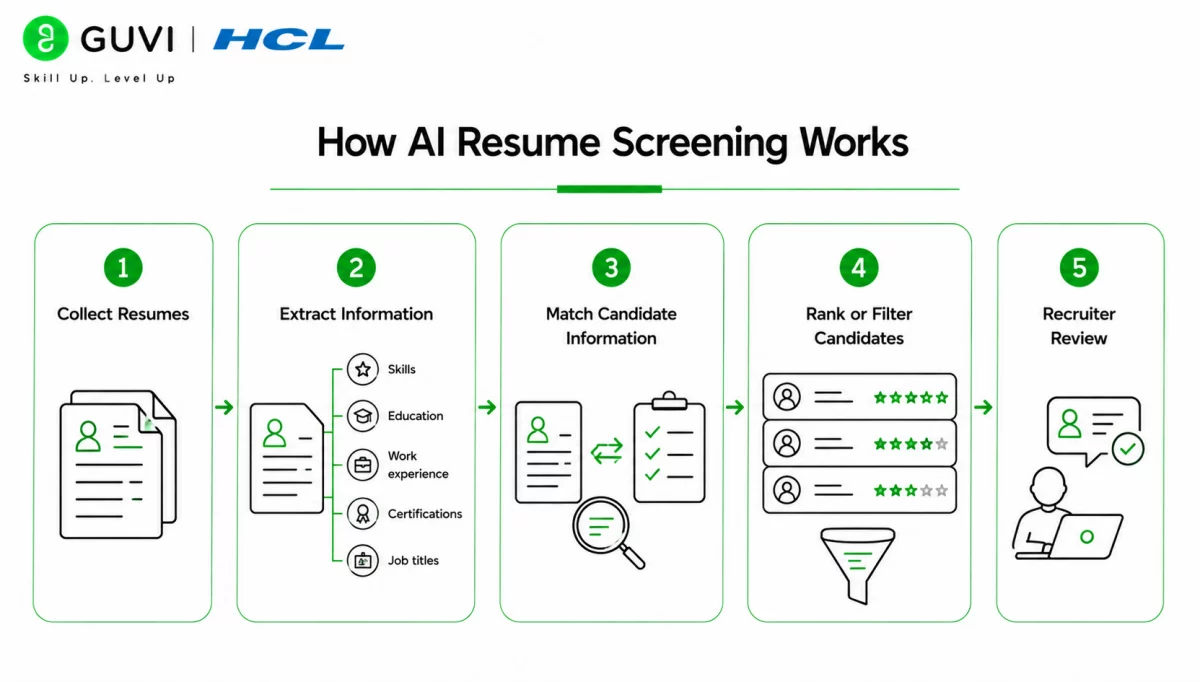
An AI-powered screening system typically analyzes information from a candidate’s resume and compares it with requirements associated with a job.
Step 1: Collect Resumes
The system receives resumes submitted by candidates.
Step 2: Extract Information
AI can identify information such as:
- Skills
- Education
- Work experience
- Certifications
- Job titles
Step 3: Match Candidate Information
The system compares extracted information with job requirements.
Step 4: Rank or Filter Candidates
Candidates may be prioritized based on predefined criteria or model-generated scores.
Step 5: Recruiter Review
Recruiters review candidates selected by the system and continue the hiring process.
What Are Bias Risks in AI Recruitment?
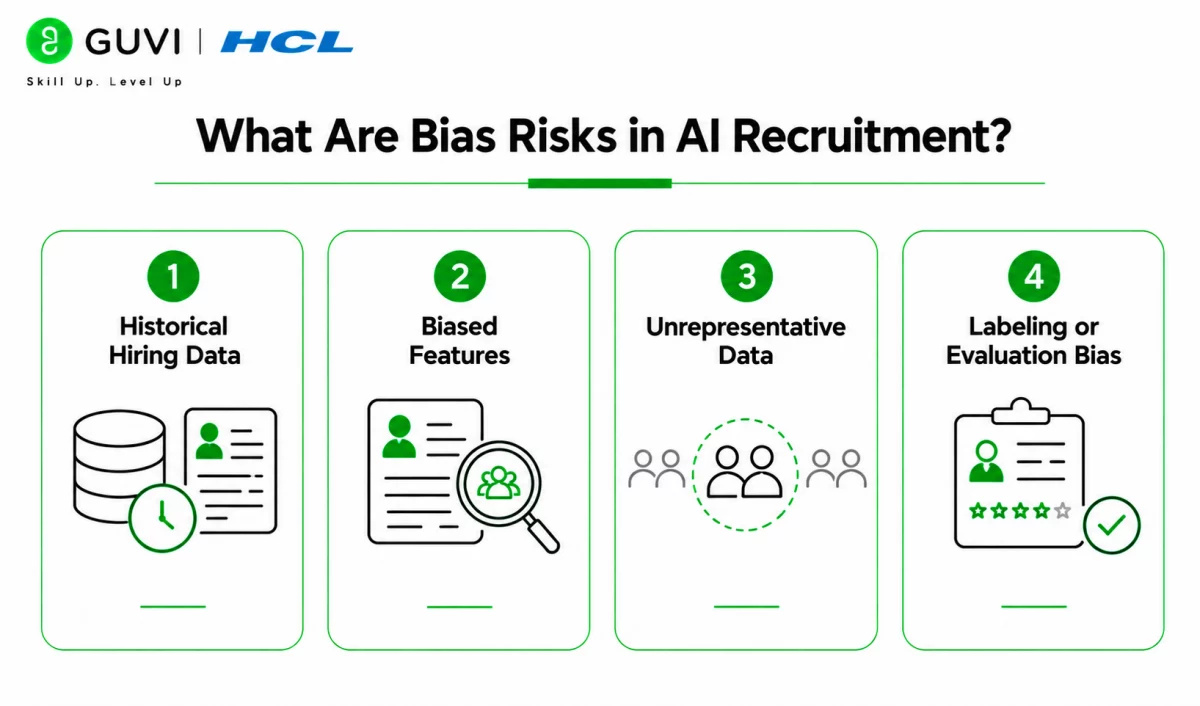
AI recruitment bias occurs when an automated system produces systematically unfair outcomes for certain candidates or groups.
Bias can enter the recruitment process through several sources.
Historical Hiring Data
If historical hiring decisions contained bias, a model trained on those decisions may learn and reproduce those patterns.
Biased Features
Certain resume characteristics may act as indirect signals for demographic characteristics, even when sensitive attributes are not explicitly used.
Unrepresentative Data
A model trained on a narrow candidate population may perform differently for candidates outside that population.
Labeling or Evaluation Bias
If historical hiring outcomes are treated as indicators of candidate quality, existing human judgments may become part of the model’s training signal.
Why Human Oversight Matters
AI screening should support recruitment decisions rather than automatically determine a candidate’s suitability without appropriate review.
Human recruiters can:
- Review borderline cases
- Investigate unexpected rankings
- Consider context missing from resumes
- Identify potential system errors
- Challenge inappropriate recommendations
Do not assume that removing demographic information automatically removes bias. Other resume features can sometimes act as proxies for sensitive characteristics. Recruitment systems should therefore be evaluated based on their outcomes, not just the fields they directly use.
Benefits of AI in HR Recruitment
Faster Screening
AI can process large numbers of resumes more quickly than manual review alone.
Consistent Processing
Automated systems can apply defined screening criteria consistently.
Reduced Administrative Work
Recruiters can spend less time on repetitive resume-processing tasks.
Scalable Recruitment
AI tools can help organizations manage large applicant volumes.
When Should You Use AI in HR Recruitment?
AI in HR Recruitment is most useful when organizations handle large applicant volumes or repetitive recruitment tasks.
Resume Screening
Use AI to quickly identify resumes containing relevant skills, qualifications, and experience.
Candidate Matching
AI can match candidate profiles with job requirements based on predefined criteria.
Large Applicant Pools
Automated screening can help recruiters process high volumes of applications more efficiently.
Recruitment Administration
AI can support repetitive tasks such as interview scheduling, candidate communication, and information extraction.

Human Decision Support
Use AI to assist recruiters while keeping appropriate human review for important hiring decisions.
Professionals interested in artificial intelligence, machine learning, automation, and responsible AI can strengthen their expertise through HCL GUVI’s Artificial Intelligence and Machine Learning Course.
Key Concepts to Remember
- AI can assist with resume screening and candidate matching.
- Historical hiring data can introduce bias.
- Resume features can sometimes act as proxies for sensitive characteristics.
- Overall screening efficiency does not guarantee fairness.
- Human oversight remains important.
- Recruitment models should be regularly evaluated for unexpected outcomes.
A Practical AI Resume-Screening Workflow
1. Define Job Requirements
Identify the skills, qualifications, experience, and other job-related criteria needed for the position.
2. Collect Applications
Gather candidate resumes and application information.
3. Extract Candidate Information
Use AI to identify relevant skills, experience, education, certifications, and other information.
4. Match Candidates
Compare candidate information against the defined job requirements.
5. Evaluate Screening Results
Check whether the system is consistently identifying relevant candidates and whether unexpected patterns appear.
6. Conduct Human Review
Recruiters review AI-generated recommendations and consider relevant information that automated screening may miss.
7. Monitor Outcomes
Continue evaluating the system to identify performance changes or potential disparities over time.
Real-World Applications
Resume Screening
Identify candidates whose qualifications align with specific job requirements.
Candidate Matching
Help recruiters find applicants with relevant skills and experience.
Interview Scheduling
Automate repetitive scheduling and coordination tasks.
Job Description Analysis
Analyze job descriptions to identify required skills and improve recruitment workflows.
The HCL GUVI’s Artificial Intelligence eBook introduces artificial intelligence, machine learning, generative AI, and intelligent automation concepts, helping learners understand modern AI technologies and their practical applications.
Best Practices
- Use job-related criteria that are clearly defined.
- Test screening systems for unexpected disparities.
- Review historical data for potential sources of bias.
- Do not rely exclusively on automated rankings.
- Maintain human oversight for important hiring decisions.
- Monitor recruitment outcomes regularly.
- Update screening criteria when job requirements change.
Conclusion
AI in HR Recruitment can make resume screening and other recruitment tasks faster and more scalable. However, efficiency should not come at the expense of fairness. Historical data, unrepresentative datasets, and proxy features can introduce bias into automated screening. Combining AI-assisted recruitment with appropriate testing, human oversight, and continuous monitoring can help organizations build more reliable hiring workflows.
FAQs
1. How is AI used in recruitment?
AI can support resume screening, candidate matching, skill extraction, applicant ranking, interview scheduling, and job description analysis.
2. What is AI resume screening?
AI resume screening uses automated systems to extract candidate information and evaluate how closely a resume matches predefined job requirements.
3. How can AI recruitment systems become biased?
Bias can enter through historical hiring data, unrepresentative training data, biased evaluation criteria, or resume features that act as proxies for sensitive characteristics.
4. Can removing demographic information eliminate AI bias?
No. Other features can indirectly correlate with demographic characteristics. Systems should therefore be evaluated based on their outcomes as well as their input features.
5. Why is human oversight important in AI recruitment?
Human review allows recruiters to investigate automated recommendations, consider context the system may miss, and challenge potentially inappropriate screening outcomes.
6. Can AI replace recruiters?
AI can automate or assist with repetitive recruitment tasks, but important hiring decisions still benefit from appropriate human judgment and oversight.
7. How can organizations reduce bias in AI recruitment?
Organizations can use relevant screening criteria, evaluate historical data, test model outcomes across relevant groups, maintain human oversight, and continuously monitor the system after deployment.
Success Stories

About the Author
HCL GUVI
This article was selected and published as part of the HCL GUVI AI Blogathon 2026, an initiative designed to encourage students, AI enthusiasts, and aspiring tech writers to simplify complex AI concepts through impactful technical content. The contest recognized high-quality, original, and insightful AI-focused blogs, with selected authors receiving publication opportunities on the HCL GUVI blog platform along with official author credits and recognition.
View all posts by HCL GUVI
Connect with me @







Did you enjoy this article?