


Artificial Intelligence and Machine Learning Articles
Generative Adversarial Networks (GANs): The Complete Guide
LSTM Networks Explained: Solving the Vanishing Gradient Problem


Get In Touch For Details! Request More Information
GRU vs LSTM: Which Should You Use?
Aug 26, 2026 4 Min Read 21 Views
(Last Updated)
GRU vs LSTM is used if you are building a sequence model. Both architectures solve the same core problem: they help recurrent networks remember important information over time without suffering badly from vanishing gradients. In practice, that means GRU is often the better first choice. LSTM becomes attractive when your sequences are long, your patterns are subtle, or you really need that extra edge in accuracy.
| Direct Answer Box: GRU vs LSTM comes down to a simple trade-off: GRU is faster and simpler, while LSTM is more expressive and better at very long or complex sequences. If your sequences are short to medium and you care about speed, start with GRU. If you need fine-grained memory control on long sequences, choose LSTM. |
Table of contents
- TL;DR Summary
- What Are GRU and LSTM?
- LSTM: Three Gates and a Separate Memory
- GRU: Two Gates and a Combined State
- GRU vs LSTM: Key Differences
- When to Use GRU
- Use GRU when:
- When to Use LSTM
- Use LSTM when:
- Performance and Practical Trade-offs
- Rule-of-thumb checklist
- GRU vs LSTM for Common Tasks
- Time series forecasting
- Natural language tasks
- Edge and mobile deployment
- A Practical Decision Flow for GRU vs LSTM
- Common Mistakes to Avoid
- What to Do Next
- Conclusion
- FAQs
- What is the main difference between GRU and LSTM?
- Is GRU faster than LSTM?
- When should I use GRU instead of LSTM?
- Does LSTM always outperform GRU?
TL;DR Summary
- GRU trains faster and uses fewer parameters than LSTM.
- LSTM is stronger on very long sequences and complex dependencies.
- For most practical tasks, GRU is a good default starting point.
- Upgrade to LSTM when GRU underfits, or sequences exceed a few hundred steps.
- Always benchmark both on your own data if time and resources allow.
What Are GRU and LSTM?
Both GRU (Gated Recurrent Unit) and LSTM (Long Short-Term Memory) are variants of RNNs designed to handle sequential data more effectively than vanilla recurrent networks.
GRU is faster and lighter for short-to-medium sequences; LSTM handles very long, complex dependencies better. Learn AI & ML with HCL GUVI’s Artificial Intelligence and Machine Learning course.
LSTM: Three Gates and a Separate Memory
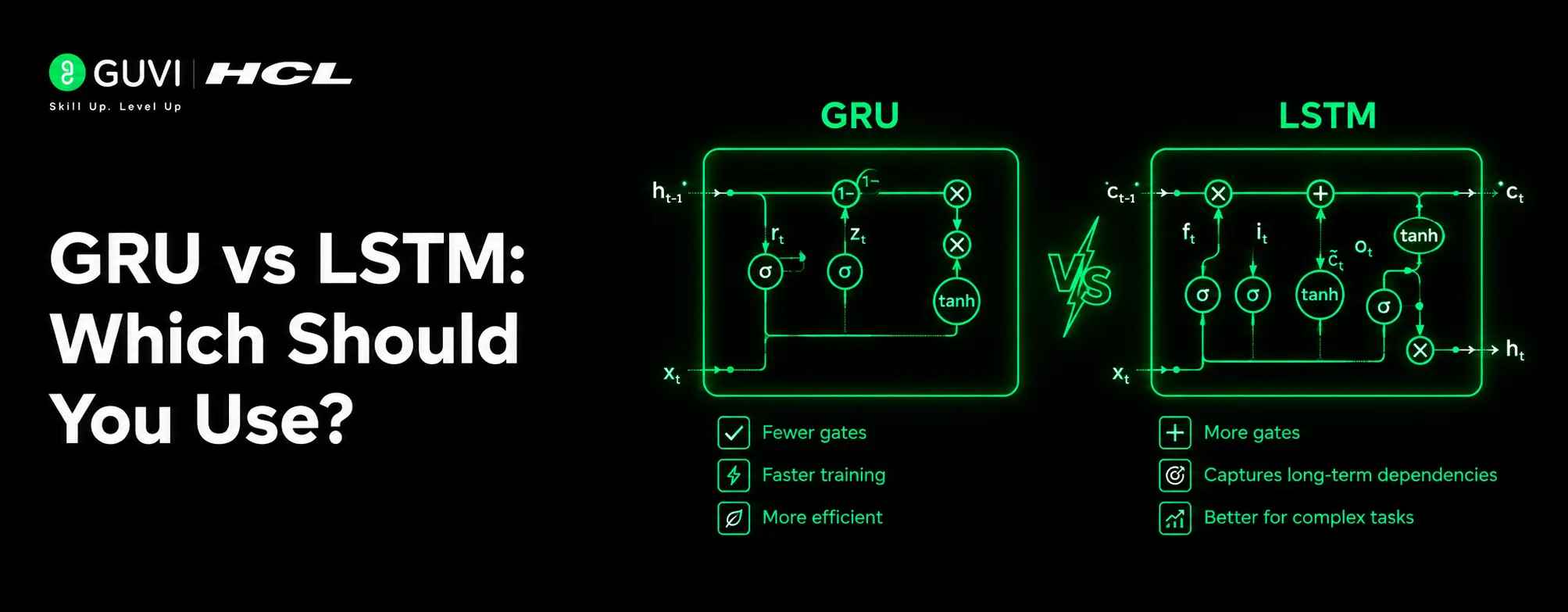
LSTM uses three gates:
- Forget gate: decides what to discard from the cell state.
- Input gate: decides what new information to add.
- Output gate: decides what to output as the hidden state.
LSTM also maintains a separate cell state and hidden state. This separation gives it more control over long-term memory.
GRU: Two Gates and a Combined State
GRU simplifies this design:
- Update gate: blends old and new information.
- Reset gate: controls how much past information to forget.
GRU combines the cell state and hidden state into a single hidden state. This reduces parameters and makes the unit faster to train.
GRU vs LSTM: Key Differences
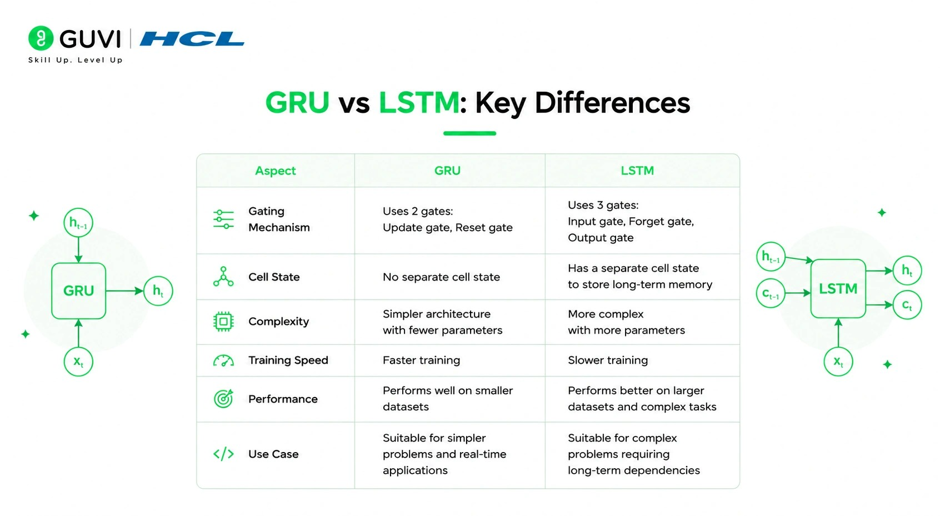
The clearest way to compare GRU vs LSTM is by looking at structure, performance, and practical fit.
| Factor | GRU | LSTM |
| Gates | 2 (update, reset) | 3 (forget, input, output) |
| Internal states | 1 (combined) | 2 (cell + hidden) |
| Parameters | Fewer | More |
| Training speed | Faster | Slower |
| Memory usage | Lower | Higher |
| Expressiveness | Moderate | Higher |
| Best for | Short to medium sequences, speed | Long sequences, complex dependencies |
| Overfitting risk | Lower (fewer params) | Higher (more params) |
This structural difference explains why GRU is often preferred for prototyping and resource-constrained settings, while LSTM is preferred when you need fine control over long-term memory.
GRUs are simpler and faster than LSTMs, using fewer parameters and gates, so they often match LSTM accuracy on short-to-medium sequences while training 25–40% quicker.
When to Use GRU
GRU is usually the better starting point when speed, simplicity, or resource constraints matter.
Use GRU when:
- Sequences are short to medium (under a few hundred steps).
- You have limited training data.
- You need fast training or rapid iteration.
- You are deploying to edge or mobile devices.
- Inference latency is a key requirement.
- You want fewer hyperparameters to tune.
💡 Pro Tip: If your sequence length is under 200–300 steps, start with GRU. It is simpler, faster, and often matches LSTM performance.
When to Use LSTM
LSTM shines when the task involves very long or complex temporal dependencies.
Use LSTM when:
- Sequences are long (hundreds to thousands of steps).
- The task involves subtle long-range patterns (for example, document-level context).
- You have large datasets and enough compute to train bigger models.
- Accuracy is more important than training speed.
- You need fine-grained control over what to forget and what to retain.
⚠️ Warning: Do not default to LSTM just because it is “more powerful.” On many tasks, GRU performs just as well with less cost.
Performance and Practical Trade-offs
On many short-to-medium sequence tasks, GRUs match or outperform LSTMs with fewer parameters. LSTMs retain a slight edge on very long sequences where fine-grained memory control matters.
Choosing between them depends on sequence length, dataset size, latency constraints, and hardware budget—not hype.
Rule-of-thumb checklist
- Sequences under 100 steps → start with GRU.
- Sequences 100–500 steps → try GRU first; test LSTM if underfitting.
- Sequences over 500 steps → start with LSTM.
- Small dataset → prefer GRU.
- Large dataset → LSTM may use its extra capacity productively.
- Real-time or low-latency streaming → GRU.
- Server-side batch inference → either choose based on validation performance.
✅ Best Practice: Train a small GRU model first. If it solves your problem, ship it. If it underfits, try LSTM with careful hyperparameter tuning.

GRU vs LSTM for Common Tasks
Different tasks put different pressure on sequence models.
1. Time series forecasting
- Short to medium windows → GRU is often enough.
- Very long history or multi-step forecasts → LSTM may help.
2. Natural language tasks
- Short sentences, simple classification → GRU.
- Long documents, machine translation, or complex language modeling → LSTM or attention-based models.
3. Edge and mobile deployment
- GRU is usually preferred because of lower memory and faster inference.
- LSTM is used only when the accuracy gain justifies the extra cost.
A Practical Decision Flow for GRU vs LSTM
Here is a simple flow you can follow:
- Check sequence length.
Short to medium → try GRU. Very long → try LSTM. - Check dataset size.
Small → GRU to reduce overfitting risk. Large → LSTM can use its capacity. - Check constraints.
Limited compute or strict latency → GRU. Ample compute, accuracy-critical → LSTM. - Benchmark.
If possible, train both with proper tuning and pick the winner on a held-out validation set.
📊 Data Point: In many practical benchmarks, GRU is the better default. It trains faster and often reaches similar accuracy to LSTM on short and medium sequences.
Common Mistakes to Avoid
- Choosing LSTM by default because it is “more advanced.”
- Ignoring sequence length and dataset size.
- Comparing GRU and LSTM without tuning hyperparameters for both.
- Using very deep recurrent stacks when a simpler model would suffice.
- Overlooking attention-based or transformer models when sequences are very long.
- Forgetting to measure inference latency and memory usage in production.
What to Do Next
If you are starting a new sequence project:
- Begin with a GRU baseline.
- Tune hidden size, learning rate, and dropout.
- If GRU underfits or sequences are very long, test LSTMs.
- Compare both on validation metrics, not just training loss.
- Include latency and memory measurements if you plan to deploy.
GRU vs LSTM is not a philosophical debate. It is an engineering choice. The right answer is the one that meets your accuracy, speed, and cost requirements on your specific data.
GRU is faster and lighter for short-to-medium sequences; LSTM handles very long, complex dependencies better. Learn AI & ML with HCL GUVI’s Artificial Intelligence and Machine Learning course.
Conclusion
In the GRU vs LSTM question, there is no single “best” model. GRU is simpler, faster, and often sufficient for short to medium sequences. LSTM is more expressive and better suited for very long or complex dependencies.
Start with GRU for most tasks. Move to LSTM when you have clear reasons: very long sequences, complex temporal patterns, or when that extra accuracy truly matters.
FAQs
What is the main difference between GRU and LSTM?
GRU uses two gates and a combined hidden state, while LSTM uses three gates and separate cell and hidden states. This makes GRU simpler and faster, while LSTM is more expressive.
Is GRU faster than LSTM?
Yes. GRU has fewer parameters and a simpler structure, so it typically trains faster and uses less memory than LSTM.
When should I use GRU instead of LSTM?
Use GRU when sequences are short to medium, data is limited, or you need fast training and low-latency inference.
Does LSTM always outperform GRU?
No. On many tasks with short to medium sequences, GRU performs similarly to LSTM. LSTM’s advantage appears mainly on very long or complex sequences.
Success Stories

About the Author
HCL GUVI
This article was selected and published as part of the HCL GUVI AI Blogathon 2026, an initiative designed to encourage students, AI enthusiasts, and aspiring tech writers to simplify complex AI concepts through impactful technical content. The contest recognized high-quality, original, and insightful AI-focused blogs, with selected authors receiving publication opportunities on the HCL GUVI blog platform along with official author credits and recognition.
View all posts by HCL GUVI
Connect with me @







Did you enjoy this article?