


Artificial Intelligence and Machine Learning Articles
What Is the FP-Growth Algorithm for Association Rule Mining?
Genetic Algorithms: Nature-Inspired Optimization Explained


Get In Touch For Details! Request More Information

Apriori Algorithm and Market Basket Analysis Explained
Aug 25, 2026 4 Min Read 33 Views
(Last Updated)
The Apriori algorithm is a popular machine learning algorithm used to discover frequent itemsets and product associations in transaction data. Market Basket Analysis uses these patterns to reveal which products are often purchased together, helping businesses make smarter decisions.
Table of contents
- TL;DR: Apriori Algorithm and Market Basket Analysis
- What Is Market Basket Analysis?
- How Purchase Patterns Are Discovered
- What Is the Apriori Algorithm?
- The Apriori Principle
- Why Pruning Matters
- How the Apriori Algorithm Works
- Step 1: Identify Individual Items
- Step 2: Create Larger Itemsets
- Step 3: Prune Infrequent Candidates
- Step 4: Generate Association Rules
- Important Metrics in Market Basket Analysis
- Support
- Confidence
- Lift
- Example of Market Basket Analysis
- Applications of the Apriori Algorithm
- Product Recommendations
- Store Layout Planning
- Promotional Bundles
- Inventory Planning
- Customer Personalization
- Advantages of the Apriori Algorithm
- Limitations of the Apriori Algorithm
- Conclusion
- FAQs
- What is the Apriori Algorithm used for?
- What is Market Basket Analysis?
- What is the difference between support and confidence?
- What does lift mean in Market Basket Analysis?
- Is the Apriori Algorithm suitable for large datasets?
TL;DR: Apriori Algorithm and Market Basket Analysis
- Apriori Algorithm and Market Basket Analysis help businesses discover frequently purchased item combinations and uncover valuable customer buying patterns.
- The Apriori algorithm identifies frequent itemsets using support, confidence, and lift to generate actionable association rules for better business decisions.
- Apriori Algorithm and Market Basket Analysis are widely used in retail, e-commerce, recommendation systems, inventory management, and targeted marketing to improve sales and customer experience.
What Is Market Basket Analysis?
Market basket analysis is a data mining technique used to discover relationships between products that customers purchase together. Retailers and e-commerce businesses use it to understand shopping behavior and improve product placement, promotions, recommendations, and inventory planning. ibm+1
For example, if many customers buy bread and butter in the same transaction, a business may place these products nearby or recommend one when a customer views the other.
Apriori finds frequent itemsets and association rules to power market basket analysis for smarter retail insights. Learn AI & ML with HCL GUVI’s Artificial Intelligence and Machine Learning course.
How Purchase Patterns Are Discovered
Market basket analysis examines transaction data rather than individual products. Each transaction is treated as a group of items, also called an itemset.
The analysis looks for repeated combinations and converts them into association rules such as:
text
Bread → Butter
This rule suggests that customers who purchase bread may also be likely to purchase butter. It does not automatically prove that one product causes the other.
What Is the Apriori Algorithm?
The Apriori Algorithm is an unsupervised machine learning and data mining technique used to find frequent itemsets and generate association rules. It is one of the traditional algorithms used for market basket analysis. IBM + 1
The algorithm begins with individual products and gradually creates larger item combinations. It removes combinations that do not meet a minimum frequency requirement, reducing unnecessary calculations.
1. The Apriori Principle
The Apriori Algorithm is based on a simple principle: If an itemset is infrequent, all larger itemsets containing it will also be infrequent.
For example, if customers rarely buy milk and cereal together, combinations such as milk, cereal, and cookies are unlikely to meet the required frequency threshold. The algorithm can discard those larger combinations without testing them in detail.
2. Why Pruning Matters
A transaction database may contain thousands of products and millions of possible combinations. Testing every possible itemset would require significant time and memory.
The Apriori principle reduces the search space by eliminating unlikely combinations early. This makes the analysis more efficient and focuses attention on patterns that may be useful.
How the Apriori Algorithm Works
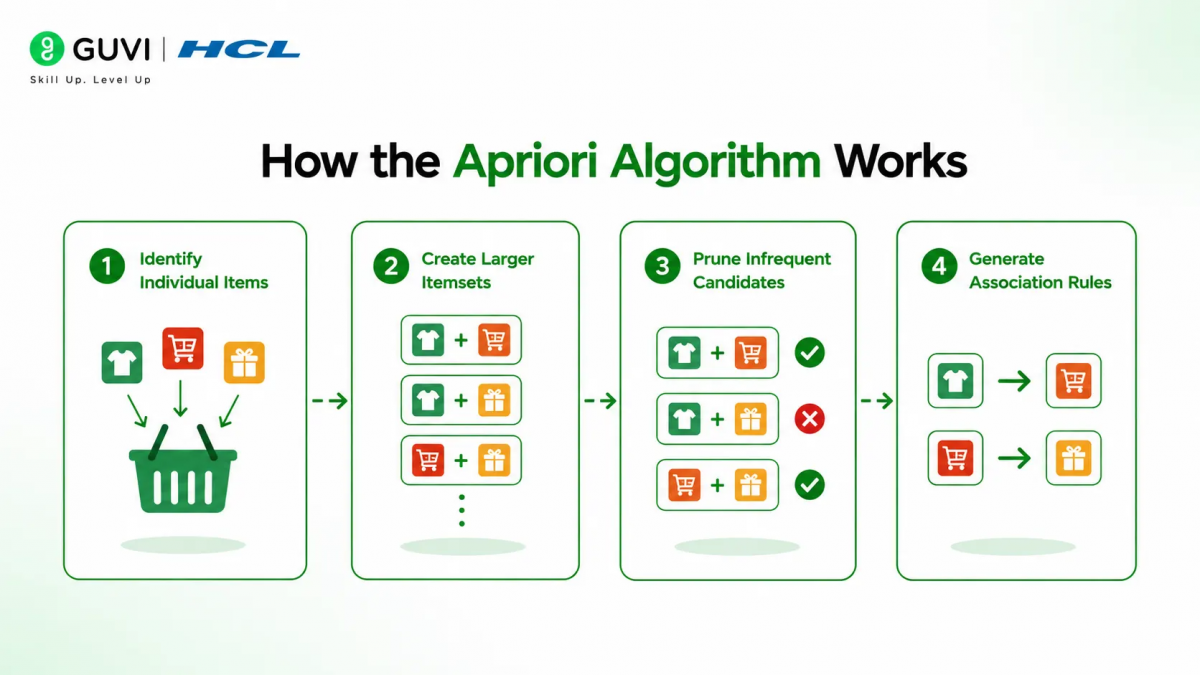
The Apriori algorithm follows an iterative process that repeatedly generates, evaluates, and filters itemsets.
Step 1: Identify Individual Items
The algorithm first counts how often each product appears in the transaction database. Products that meet the minimum support threshold are kept as frequent one-itemsets.
Step 2: Create Larger Itemsets
The algorithm combines frequent one-itemsets to create two-itemsets. It then checks which pairs meet the minimum support requirement.
The same process continues with three-itemsets, four-itemsets, and larger combinations until no additional frequent itemsets can be created.
Step 3: Prune Infrequent Candidates
Any itemset that fails to meet the minimum support threshold is removed. Larger itemsets containing that combination can also be eliminated based on the Apriori principle.
Step 4: Generate Association Rules
After finding frequent itemsets, the algorithm creates rules from them. These rules are evaluated using support, confidence, and lift.
The Apriori Algorithm can reduce millions of possible product combinations by eliminating infrequent itemsets before larger combinations are tested. This pruning process is the main reason it remains useful for understanding purchase patterns.
Important Metrics in Market Basket Analysis
1. Support
Support measures how frequently an itemset appears in all transactions.
| Support(A)=Transactions containing ATotal transactionsSupport(A) = \frac{\text{Transactions containing A}}{\text{Total transactions}}Support(A)=Total transactionsTransactions containing A |
For example, if bread appears in 300 out of 1,000 transactions, its support is 30%.
High support means the combination occurs frequently enough to be considered relevant.
2. Confidence
Confidence measures how often item B appears in transactions that already contain item A.
| Confidence(A→B)=Support(A∪B)Support(A)Confidence(A \rightarrow B) = \frac{Support(A \cup B)}{Support(A)}Confidence(A→B)=Support(A)Support(A∪B) |
If 70% of customers who buy bread also buy butter, the rule “Bread → Butter” has a confidence of 70%.

Confidence shows how reliable a rule appears to be, but it does not always indicate a meaningful relationship.
3. Lift
Lift compares the confidence of a rule with the general popularity of the recommended item.
| Lift(A→B)=Confidence(A→B)Support(B)Lift(A \rightarrow B) = \frac{Confidence(A \rightarrow B)}{Support(B)}Lift(A→B)=Support(B)Confidence(A→B) |
A lift value greater than 1 suggests that A and B appear together more often than expected by chance. A lift close to 1 may indicate little meaningful relationship, while a value below 1 may suggest a negative association.
Example of Market Basket Analysis
Suppose a store records the following transactions:
| Transaction | Products |
| 1 | Bread, Butter |
| 2 | Bread, Milk |
| 3 | Bread, Butter, Milk |
| 4 | Butter, Milk |
| 5 | Bread, Butter |
The Apriori Algorithm counts the individual products first. It then examines pairs such as bread and butter, bread and milk, and butter and milk.
If bread and butter appear together often enough, the algorithm may create the rule:
text
Bread → Butter
The business can evaluate this rule using confidence and lift before using it for recommendations or promotions.
Applications of the Apriori Algorithm
1. Product Recommendations
Online stores can recommend products based on items frequently purchased together. This can improve cross-selling and help customers discover relevant products.
2. Store Layout Planning
Retailers can place related items closer together to make shopping more convenient and encourage additional purchases.
3. Promotional Bundles
Businesses can create product bundles from commonly associated items. For example, a store might offer a discounted package containing coffee, filters, and sugar.
4. Inventory Planning
Frequent item combinations can help businesses anticipate demand and maintain suitable stock levels for related products.
5. Customer Personalization
E-commerce platforms can use association rules to personalize product suggestions based on a customer’s cart or purchase history.
Apriori finds frequent itemsets and association rules to power market basket analysis for smarter retail insights. Learn AI & ML with HCL GUVI’s Artificial Intelligence and Machine Learning course.
Advantages of the Apriori Algorithm
- The algorithm uses a clear process based on frequency and pruning. Its results are relatively easy to explain to business teams.
- It works well with retail receipts, shopping carts, and other datasets where each record contains a group of items.
- The resulting rules can support decisions about promotions, recommendations, store arrangement, and inventory.
Limitations of the Apriori Algorithm
- Apriori may become slow when the dataset contains many products or when the minimum support threshold is set too low.
- The algorithm may generate many candidate itemsets before filtering them, which can increase memory usage.
- Poorly selected support and confidence thresholds may produce too many rules or remove useful patterns.
- A rule shows that items occur together. It does not prove that buying one product causes customers to buy another.
Conclusion
Choose support and confidence thresholds based on the size and purpose of the dataset. Review lift as well, because high confidence can sometimes occur simply because one product is already very popular.
Remove duplicate or irrelevant transactions before analysis, and consider time periods, customer segments, and seasonal behavior. A product association that is strong during a holiday season may not remain useful throughout the year.
FAQs
1. What is the Apriori Algorithm used for?
The Apriori algorithm is used to identify frequent itemsets and generate association rules from transaction data.
2. What is Market Basket Analysis?
Market Basket Analysis examines products that customers frequently purchase together to reveal shopping patterns.
3. What is the difference between support and confidence?
Support measures how often an itemset appears overall, while confidence measures how often one item appears when another item is already present.
4. What does lift mean in Market Basket Analysis?
Lift measures whether two products occur together more often than would be expected based on their individual popularity.
5. Is the Apriori Algorithm suitable for large datasets?
It can be used for large datasets, but it may become computationally expensive when there are many products and possible combinations.
Success Stories

About the Author
HCL GUVI
This article was selected and published as part of the HCL GUVI AI Blogathon 2026, an initiative designed to encourage students, AI enthusiasts, and aspiring tech writers to simplify complex AI concepts through impactful technical content. The contest recognized high-quality, original, and insightful AI-focused blogs, with selected authors receiving publication opportunities on the HCL GUVI blog platform along with official author credits and recognition.
View all posts by HCL GUVI
Connect with me @








Did you enjoy this article?