


Entrepreneurship Articles
How to Raise Seed Funding for Your Startup: A Complete Guide for Founders
Value Proposition Canvas: How to Define Your Startup's Edge
What Is Social Entrepreneurship? Building Businesses That Create Social Impact (2026 Guide)
Product Market Fit: How to Know You’ve Found It - Best Guide


Get In Touch For Details! Request More Information
Business Model Canvas Explained: Best Guide (2026)
Aug 07, 2026 7 Min Read 44 Views
(Last Updated)
Table of contents
- TL;DR
- What is Business Model Canvas?
- Why is Business Model Canvas Important?
- Business Model Canvas vs Lean Canvas
- The 9 Building Blocks of a Business Model Canvas
- Customer Segments
- Value Propositions
- Channels
- Customer Relationships
- Revenue Streams
- Key Resources
- Key Activities
- Key Partnerships
- Cost Structure
- How to Create a Business Model Canvas Step-by-Step
- Step 1: Define Your Customer Segments
- Step 2: Identify the Customer Problem
- Step 3: Define Your Value Proposition
- Step 4: Select Your Channels
- Step 5: Plan Customer Relationships
- Step 6: Identify Revenue Streams
- Step 7: List Key Resources
- Step 8: Identify Key Activities
- Step 9: Estimate Costs
- Real-World Example: Airbnb's Business Model Canvas
- Common Mistakes When Creating a Business Model Canvas
- Focusing on the Product Instead of the Customer
- Trying to Serve Everyone
- Ignoring Revenue and Costs
- Treating the Canvas as a One-Time Activity
- Making Assumptions Without Validation
- Best Practices for Building an Effective Business Model Canvas
- Business Model Canvas for Startups in 2026
- Build Your Startup Skills with HCL GUVI
- Conclusion
- FAQs
- What is a Business Model Canvas?
- Who should use a Business Model Canvas?
- What are the nine building blocks of a Business Model Canvas?
- What is the difference between a Business Model Canvas and a Lean Canvas?
- Is a Business Model Canvas better than a business plan?
- Can established businesses use a Business Model Canvas?
- How often should a Business Model Canvas be updated?
- Can I create a Business Model Canvas without business experience?
TL;DR
A Business Model Canvas is a one-page visual framework that helps entrepreneurs describe, design, and improve how a business creates, delivers, and captures value. Instead of writing a lengthy business plan, startups can quickly map out their customers, value proposition, revenue streams, costs, partnerships, and key activities using a single template. Whether you’re launching your first startup, validating an idea, or learning entrepreneurship, understanding the Business Model Canvas helps you make better business decisions and identify opportunities before investing significant time or money.
Launching a successful business requires more than just a great idea—it requires a clear plan for how the business will create value and generate revenue. That’s exactly where the Business Model Canvas becomes useful.
Instead of spending weeks writing a traditional business plan, entrepreneurs can use a Business Model Canvas to visualize their entire business on a single page. It helps founders identify customers, define value propositions, estimate costs, and understand revenue opportunities before investing heavily in their startup.
If you’re a student, aspiring entrepreneur, or startup founder, this guide will help you understand the Business Model Canvas in the simplest way possible.
If you’re beginning your startup journey, it’s also helpful to understand what entrepreneurship is before creating your first Business Model Canvas.
What is Business Model Canvas?
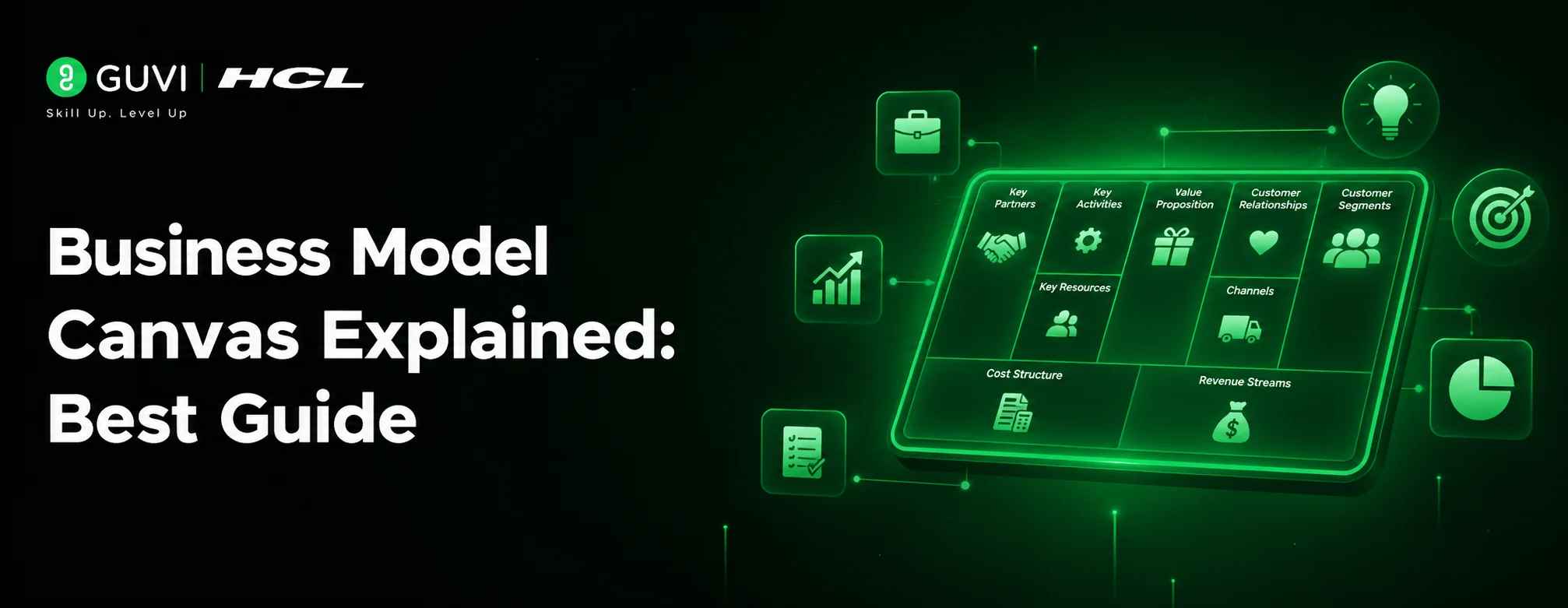
A Business Model Canvas is a visual framework used to describe how a business operates. It breaks down an entire business into nine essential building blocks, making it easier to understand how different parts of the business work together.
Instead of creating a lengthy document filled with assumptions, the Business Model Canvas allows entrepreneurs to quickly organise their ideas, identify gaps, and refine their business model as they learn more about customers and the market.
At its core, the framework answers a few important questions:
- Who are your customers?
- What value do you offer them?
- How will you deliver that value?
- How will your business earn money?
- What resources and partners do you need?
Because everything fits on one page, updating and improving the Business Model Canvas becomes much easier than rewriting an entire business plan.
If you’re unsure whether you’re building a startup or simply running a business, understanding Entrepreneurship vs Business provides useful context before creating your Business Model Canvas.
Why is Business Model Canvas Important?
The Business Model Canvas helps entrepreneurs think strategically before investing time and money into building a product or launching a business.
Instead of relying on assumptions, it encourages founders to evaluate every important aspect of their business model—from customer needs to revenue generation.
Some key benefits include:
- Provides a complete business overview on a single page.
- Helps validate startup ideas quickly.
- Makes it easier to identify risks and gaps.
- Improves communication among co-founders and investors.
- Supports faster decision-making.
- Simplifies startup planning compared to traditional business plans.
Whether you’re building a technology startup, an e-commerce business, or a social enterprise, the Business Model Canvas helps you stay focused on what truly matters.
Business Model Canvas vs Lean Canvas
Although both frameworks help entrepreneurs plan businesses visually, they serve slightly different purposes.
| Feature | Business Model Canvas | Lean Canvas |
| Primary Focus | Business model design | Startup problem validation |
| Best For | Existing businesses and startups | Early-stage startups |
| Created By | Alexander Osterwalder | Ash Maurya |
| Customer Focus | Customer segments and value | Customer problems and solutions |
| Revenue Planning | Detailed | Simplified |
| Risk Analysis | Limited | Strong emphasis |
| Ideal Use Case | Building sustainable business models | Testing startup ideas quickly |
If your goal is to understand how a business functions as a whole, the Business Model Canvas is usually the better starting point. If you’re still validating a startup idea and testing assumptions, a lean canvas may be more appropriate.
The Business Model Canvas is used by startups, established companies, consultants, and academic institutions because it turns a business model into a simple one-page visual. Strategyzer’s research found that users value the framework for creating a shared language, improving strategic discussions, and identifying gaps across the business model.

The 9 Building Blocks of a Business Model Canvas
The Business Model Canvas consists of nine interconnected building blocks. Together, they explain how a business creates value for customers, delivers that value efficiently, and generates revenue. Understanding each block individually makes it much easier to design a strong business model.
1. Customer Segments
Customer Segments define the specific groups of people or organizations your business wants to serve. Every successful Business Model Canvas begins with understanding who your customers are because everything else depends on their needs.
Ask yourself:
- Who is my ideal customer?
- What problems do they face?
- Which customer group should I prioritise first?
Example
A food delivery startup may serve:
- College students
- Working professionals
- Families
- Restaurants
Each segment may require different pricing, promotions, and services.
2. Value Propositions
Your Value Proposition explains why customers should choose your product or service instead of a competitor’s.
It answers one simple question:
“What unique value are you offering?”
A strong value proposition may include:
- Solving a major customer problem
- Saving time
- Reducing costs
- Offering better convenience
- Providing a unique experience
Example
Uber’s value proposition isn’t just transportation—it’s convenient, on-demand rides available through a mobile app.
3. Channels
Channels describe how customers discover, purchase, and receive your product or service.
Choosing the right channels is essential because even a great product won’t succeed if customers can’t easily access it.
Common channels include:
- Company website
- Mobile app
- Social media
- Online marketplaces
- Retail stores
- Sales representatives
Your Business Model Canvas should include the channels that best match your target audience.
4. Customer Relationships
Customer Relationships explain how your business interacts with customers before, during, and after a purchase.
Different businesses require different relationship strategies.
Examples include:
- Self-service
- Personal assistance
- Community support
- Loyalty programs
- Automated customer service
- Dedicated account managers
Building strong customer relationships improves satisfaction, encourages repeat purchases, and increases referrals.
5. Revenue Streams
Revenue Streams explain how your business earns money.
Every Business Model Canvas should clearly identify all income sources.
Common revenue models include:
- Product sales
- Subscription plans
- Licensing
- Advertising
- Transaction fees
- Commission-based earnings
- Freemium upgrades
Example
Netflix generates revenue through monthly subscriptions, while YouTube earns primarily from advertising.
6. Key Resources
Key Resources are the assets required to operate your business successfully.
These resources may be:
- Physical (equipment, offices)
- Human (employees, founders)
- Intellectual (patents, software, brand)
- Financial (capital, investments)
Without the right resources, even the best business idea cannot succeed.
7. Key Activities
Key Activities are the most important tasks your business performs every day.
These activities depend on your business model.
Examples include:
- Product development
- Marketing
- Manufacturing
- Customer support
- Logistics
- Software development
- Research and innovation
For SaaS companies, software development is a key activity. For e-commerce businesses, inventory management and delivery become critical.
8. Key Partnerships
Most businesses don’t operate alone.
Key Partnerships identify suppliers, vendors, technology providers, logistics partners, investors, and strategic collaborators who help your business function efficiently.
Examples include:
- Payment gateway providers
- Cloud service providers
- Manufacturers
- Logistics companies
- Marketing agencies
Strong partnerships reduce costs, improve efficiency, and help startups scale faster.
9. Cost Structure
Every business incurs costs.
The Cost Structure section identifies the major expenses involved in operating the business.
Typical costs include:
- Employee salaries
- Marketing campaigns
- Office rent
- Software subscriptions
- Manufacturing
- Shipping
- Technology infrastructure
Understanding costs helps entrepreneurs estimate profitability and make informed financial decisions.
How to Create a Business Model Canvas Step-by-Step
Creating a Business Model Canvas doesn’t require expensive software or months of planning. In fact, many successful startups begin with a simple one-page canvas.
Follow these steps:
Step 1: Define Your Customer Segments
Identify exactly who your product is designed for.
Avoid trying to serve everyone.
Step 2: Identify the Customer Problem
Understand the biggest challenge your customers face.
Talk to potential users instead of making assumptions to understand the voice of the customer.
Step 3: Define Your Value Proposition
Explain how your solution is different from existing alternatives.
Focus on customer benefits rather than product features.
Step 4: Select Your Channels
Decide how customers will discover, purchase, and receive your product.
Choose only the channels that are most effective for your audience.
Step 5: Plan Customer Relationships
Decide how you’ll acquire, support, and retain customers over time.
Building long-term customer relationships becomes easier when you understand the principles of customer lifecycle marketing.
Step 6: Identify Revenue Streams
List every way your business will generate income.
Consider both short-term and recurring revenue opportunities.
Step 7: List Key Resources
Write down the people, technology, funding, and assets required to launch your business.
Step 8: Identify Key Activities
Determine the daily operations that keep your business running.
Step 9: Estimate Costs
Finally, identify your major business expenses to ensure your business model is financially sustainable.
Once you’ve completed all nine sections, review the entire Business Model Canvas to ensure every block aligns with your overall business strategy.
After completing your Business Model Canvas, the next logical step is developing a structured product development strategy to turn your idea into a real product.
Real-World Example: Airbnb’s Business Model Canvas
One of the best ways to understand a Business Model Canvas is by looking at a well-known company.
Here’s a simplified version of Airbnb’s business model:
| Building Block | Airbnb Example |
| Customer Segments | Travellers and property hosts |
| Value Proposition | Affordable stays and income opportunities for hosts |
| Channels | Website and mobile app |
| Customer Relationships | Self-service platform with reviews and support |
| Revenue Streams | Booking commissions and service fees |
| Key Resources | Digital platform, brand, technology |
| Key Activities | Platform development, trust & safety, marketing |
| Key Partnerships | Property hosts, payment providers |
| Cost Structure | Technology, operations, customer support, marketing |
This example demonstrates how a Business Model Canvas gives entrepreneurs a clear overview of how an entire business operates—all on a single page.
Unlike a traditional business plan that can take days or even weeks to prepare, a Business Model Canvas allows entrepreneurs to visualise their entire business model on a single page. This makes it easier to discuss ideas with mentors, investors, and team members before investing significant time or money.
Common Mistakes When Creating a Business Model Canvas
Even though the Business Model Canvas is designed to simplify startup planning, many beginners make mistakes that reduce its effectiveness. Avoiding these common errors will help you build a stronger and more realistic business model.
1. Focusing on the Product Instead of the Customer
Many entrepreneurs spend too much time describing their product while paying very little attention to customer needs.
Fix: Start with your customer segments and their biggest problems before designing your solution.
2. Trying to Serve Everyone
A Business Model Canvas becomes weak when the target audience is too broad.
Fix: Clearly define your ideal customer. It’s better to solve one group’s problem exceptionally well than to solve everyone’s problem poorly.
3. Ignoring Revenue and Costs
Some founders focus entirely on the product and forget to evaluate whether the business can actually make money.
Fix: Estimate your revenue streams and cost structure early to understand business viability.
4. Treating the Canvas as a One-Time Activity
Markets change, customer behaviour evolves, and competitors introduce new products.
Fix: Review and update your Business Model Canvas regularly as you gather customer feedback.
5. Making Assumptions Without Validation
Many startups fill their canvas using guesses instead of customer insights.
Fix: Validate every major assumption through customer interviews, surveys, or prototype testing before scaling.
Every startup journey has opportunities and challenges, so understanding the advantages and disadvantages of entrepreneurship helps founders prepare more effectively.
Best Practices for Building an Effective Business Model Canvas
A Business Model Canvas works best when it’s treated as a living document rather than a final business plan.
Here are some practical tips:
- Keep every section concise and easy to understand.
- Base decisions on customer research instead of assumptions.
- External factors influencing entrepreneurship can also shape your business model over time.
- Focus on solving one clear customer problem.
- Update your canvas after every major customer insight.
- Collaborate with your team when filling out each block.
- Test ideas with a Minimum Viable Product (MVP) before making large investments.
- Review competitors to identify opportunities for differentiation.
Following these practices helps ensure your Business Model Canvas remains practical and actionable as your business grows.
Business Model Canvas for Startups in 2026
Startup planning has changed significantly over the past few years. Today, founders validate ideas much faster, gather customer feedback earlier, and rely on data-driven decisions instead of lengthy planning documents.
In 2026, the Business Model Canvas continues to be one of the most popular frameworks for startup planning because it enables entrepreneurs to:
- Test business ideas quickly.
- Adapt to changing customer needs.
- Collaborate efficiently with co-founders and investors.
- Refine business strategies before investing significant capital.
- Combine customer feedback with rapid product iterations.
As startups grow, understanding the difference between Business Analytics and Data Analytics helps founders make smarter product and business decisions.
Many startup incubators, entrepreneurship programs, and innovation hubs encourage founders to prepare a Business Model Canvas before developing a detailed business plan because it provides a clearer picture of how the business will operate.
Once your canvas is ready, building practical entrepreneurship projects is one of the best ways to validate your business idea.
The Business Model Canvas is particularly valuable for founders building digital entrepreneurship ventures because it allows rapid experimentation and iteration.
Build Your Startup Skills with HCL GUVI
Creating a strong Business Model Canvas is only the first step toward building a successful business.
To turn your business idea into a real product or startup, you also need practical skills in customer research, product development, business strategy, marketing, financial planning, and entrepreneurship.
HCL GUVI’s Entrepreneurship Program helps aspiring founders learn these essential skills through structured learning, practical projects, expert mentorship, and industry-relevant case studies.
Whether you’re validating your first startup idea or planning your next venture, building strong entrepreneurial fundamentals can significantly improve your chances of long-term success.
Conclusion
A Business Model Canvas is one of the simplest yet most powerful tools for planning a business. By organising your customers, value proposition, revenue streams, resources, partnerships, and costs on a single page, it helps you understand how your business creates and delivers value.
Rather than treating it as a one-time document, continuously refine your Business Model Canvas as you gather customer feedback and learn from the market. Combined with practical validation and strategic thinking, it can become the foundation for building a successful and sustainable startup.
FAQs
1. What is a Business Model Canvas?
A Business Model Canvas is a one-page strategic planning framework that helps entrepreneurs describe how a business creates, delivers, and captures value. It consists of nine interconnected building blocks covering customers, value proposition, revenue, resources, and operations.
2. Who should use a Business Model Canvas?
A Business Model Canvas is useful for startup founders, entrepreneurs, students, product managers, business analysts, and anyone planning a new business or improving an existing one.
3. What are the nine building blocks of a Business Model Canvas?
The nine building blocks are Customer Segments, Value Propositions, Channels, Customer Relationships, Revenue Streams, Key Resources, Key Activities, Key Partnerships, and Cost Structure.
4. What is the difference between a Business Model Canvas and a Lean Canvas?
A Business Model Canvas focuses on designing an overall business model, while a lean canvas is specifically designed for early-stage startups to validate problems, solutions, and business assumptions quickly.
5. Is a Business Model Canvas better than a business plan?
A Business Model Canvas is not a replacement for a business plan. Instead, it serves as a visual planning tool that helps entrepreneurs organise and validate business ideas before creating a detailed business plan.
6. Can established businesses use a Business Model Canvas?
Yes. Many established companies use a Business Model Canvas to analyse existing business models, identify new growth opportunities, launch new products, or adapt to changing market conditions.
7. How often should a Business Model Canvas be updated?
There is no fixed schedule. You should review and update your Business Model Canvas whenever customer needs, market conditions, revenue models, or business strategies change.
8. Can I create a Business Model Canvas without business experience?
Absolutely. The Business Model Canvas is designed to simplify business planning, making it accessible even for beginners. With customer research and continuous learning, anyone can use it to organise and validate a business idea.
Success Stories

About the Author
Reemsha Khan
Always been a storyteller at heart. Now, I turn complex topics into simple, easy-to-understand stories through content. Hope you find it helpful.
View all posts by Reemsha Khan
Connect with me @












Did you enjoy this article?