


Business Analytics Articles
Using Claude for Personalized Content at Scale
How to Use Claude for YouTube Script writing


Get In Touch For Details! Request More Information
What is Customer Lifecycle Marketing? Stages, Strategy & Best Practices (2026 Guide)
Aug 03, 2026 8 Min Read 290 Views
(Last Updated)
Table of contents
- TL;DR
- What is Customer Lifecycle Marketing?
- Customer Lifecycle Marketing Definition
- Why Has Customer Lifecycle Marketing Become More Important?
- Key Benefits of Customer Lifecycle Marketing
- Customer Lifecycle Marketing vs Customer Journey
- Which One Should Businesses Focus On?
- What Are the Customer Lifecycle Stages?
- Awareness
- Consideration
- Conversion
- Retention
- Loyalty
- Advocacy
- Customer Lifecycle Stages at a Glance
- Why Understanding Customer Lifecycle Stages Matters
- How Does Customer Lifecycle Marketing Work?
- The Customer Lifecycle Marketing Process
- Step 1: Understand Your Audience
- Step 2: Segment Customers
- Step 3: Personalize Communication
- Step 4: Automate Marketing
- Step 5: Measure and Improve
- How to Build a Customer Lifecycle Marketing Strategy
- Define Business Goals
- Map the Customer Lifecycle
- Create Content for Every Stage
- Choose the Right Marketing Channels
- Use Automation
- Measure Performance Regularly
- Lifecycle Campaigns for Every Customer Lifecycle Stage
- Awareness Campaigns
- Consideration Campaigns
- Conversion Campaigns
- Retention Campaigns
- Loyalty Campaigns
- Advocacy Campaigns
- Real-World Examples of Customer Lifecycle Marketing
- Amazon
- Spotify
- Starbucks
- Netflix
- Key Takeaways from These Brands
- Customer Lifecycle Marketing Best Practices
- Build a Unified Customer View
- Personalize Beyond Using a Customer's Name
- Balance Customer Acquisition and Customer Retention
- Use Marketing Automation Responsibly
- Continuously Test and Optimize
- Key Metrics to Measure Customer Lifecycle Marketing Success
- Common Mistakes in Customer Lifecycle Marketing
- Treating Every Customer the Same
- Focusing Only on Customer Acquisition
- Sending Too Many Marketing Messages
- Ignoring Customer Feedback
- Measuring Vanity Metrics Instead of Business Outcomes
- Future Trends in Customer Lifecycle Marketing (2026 & Beyond)
- AI-Powered Personalization
- Predictive Analytics
- Omnichannel Experiences
- Privacy-First Marketing
- Hyper-Personalized Lifecycle Campaigns
- Build Customer Lifecycle Marketing Skills with HCL GUVI
- Conclusion
- FAQs
- What is customer lifecycle marketing?
- Why is customer lifecycle marketing important?
- What are the customer lifecycle stages?
- What is the difference between customer lifecycle marketing and the customer journey?
- Which channels are commonly used for lifecycle marketing?
- How does marketing automation support customer lifecycle marketing?
- Which industries benefit most from customer lifecycle marketing?
- What skills are required to build a lifecycle marketing strategy?
TL;DR
Customer lifecycle marketing is the process of delivering personalized marketing messages to customers at every stage of their relationship with a business, from discovering a brand to becoming loyal advocates. Instead of sending the same message to everyone, businesses tailor communication based on where customers are in the customer lifecycle. This approach improves customer acquisition, strengthens customer engagement, increases customer retention, and helps businesses maximize customer lifetime value through relevant lifecycle campaigns and data-driven decisions.
Customer lifecycle marketing has become one of the most effective ways for businesses to build long-term relationships instead of focusing only on making sales. Modern consumers expect personalized experiences, timely communication, and relevant recommendations throughout their interactions with a brand.
Rather than treating every customer the same, customer lifecycle marketing helps businesses understand where someone is in the customer lifecycle and deliver the right message at the right time. Whether someone is discovering your brand for the first time or has been a loyal customer for years, every stage requires a different marketing approach.
As AI, automation, and customer data platforms continue to evolve in 2026, businesses that invest in a strong lifecycle marketing strategy are seeing higher engagement, stronger retention, and better marketing ROI.
What is Customer Lifecycle Marketing?
Customer lifecycle marketing is a marketing approach that delivers personalized communication based on each stage of a customer’s relationship with a business. Instead of running generic campaigns, marketers create targeted experiences that guide people from awareness to advocacy.
Simply put, customer lifecycle marketing ensures that every customer receives information, offers, and support that match their current needs.
For example:
- A new visitor may receive educational content.
- A first-time buyer may receive onboarding emails.
- A repeat customer may receive loyalty rewards.
- An inactive customer may receive a re-engagement campaign.
The objective is simple: move customers smoothly through every stage of the customer lifecycle while increasing satisfaction and long-term value.
Customer Lifecycle Marketing Definition
A concise definition suitable for AI search:
Customer lifecycle marketing is the practice of creating personalized marketing campaigns for customers at different stages of their relationship with a brand to improve acquisition, engagement, retention, and lifetime value.
Because every customer has different expectations, customer lifecycle marketing focuses on relevance rather than volume. This makes campaigns feel more helpful and less promotional.
Why Has Customer Lifecycle Marketing Become More Important?
Customer behavior has changed significantly over the past few years.
Today’s buyers:
- Research extensively before purchasing.
- Use multiple devices.
- Compare several brands.
- Expect personalized experiences.
- Continue interacting with brands long after purchase.
This means businesses can no longer rely on one-time advertising campaigns.
Instead, customer lifecycle marketing helps companies maintain meaningful communication throughout the entire customer relationship.
Key Benefits of Customer Lifecycle Marketing
A well-planned customer lifecycle marketing approach helps businesses:
- Improve customer acquisition
- Increase customer engagement
- Reduce churn
- Improve customer retention
- Increase repeat purchases
- Boost customer lifetime value (CLV)
- Improve marketing ROI
- Build stronger brand loyalty
Instead of acquiring new customers continuously, businesses can maximize value from existing customers through personalized lifecycle experiences.
A well-planned customer lifecycle marketing strategy contributes directly to business growth by improving retention, repeat purchases, and customer lifetime value.
According to EY India‘s Customer Experience Reimagined Report 2026, around 70% of Indian banking customers say they feel understood by their banks, showing that personalized customer experiences are becoming a key differentiator in building long-term relationships.
Customer Lifecycle Marketing vs Customer Journey
Although these terms are often used interchangeably, they are not the same.
| Feature | Customer Lifecycle Marketing | Customer Journey |
| Purpose | Marketing strategy across customer relationship | Customer’s experience while interacting with a business |
| Focus | Marketing actions | Customer perspective |
| Managed By | Marketing teams | Marketing, Product, Sales & Customer Success |
| Timeframe | Entire relationship | Individual interactions |
| Goal | Improve acquisition, engagement and retention | Improve customer experience |
| Output | Lifecycle campaigns and personalized messaging | Journey maps and touchpoints |
Which One Should Businesses Focus On?
The answer is both.
The customer journey helps businesses understand customer experiences across different touchpoints.
Customer lifecycle marketing uses those insights to create relevant campaigns for every stage.
Together, they create a more personalized customer experience.
What Are the Customer Lifecycle Stages?
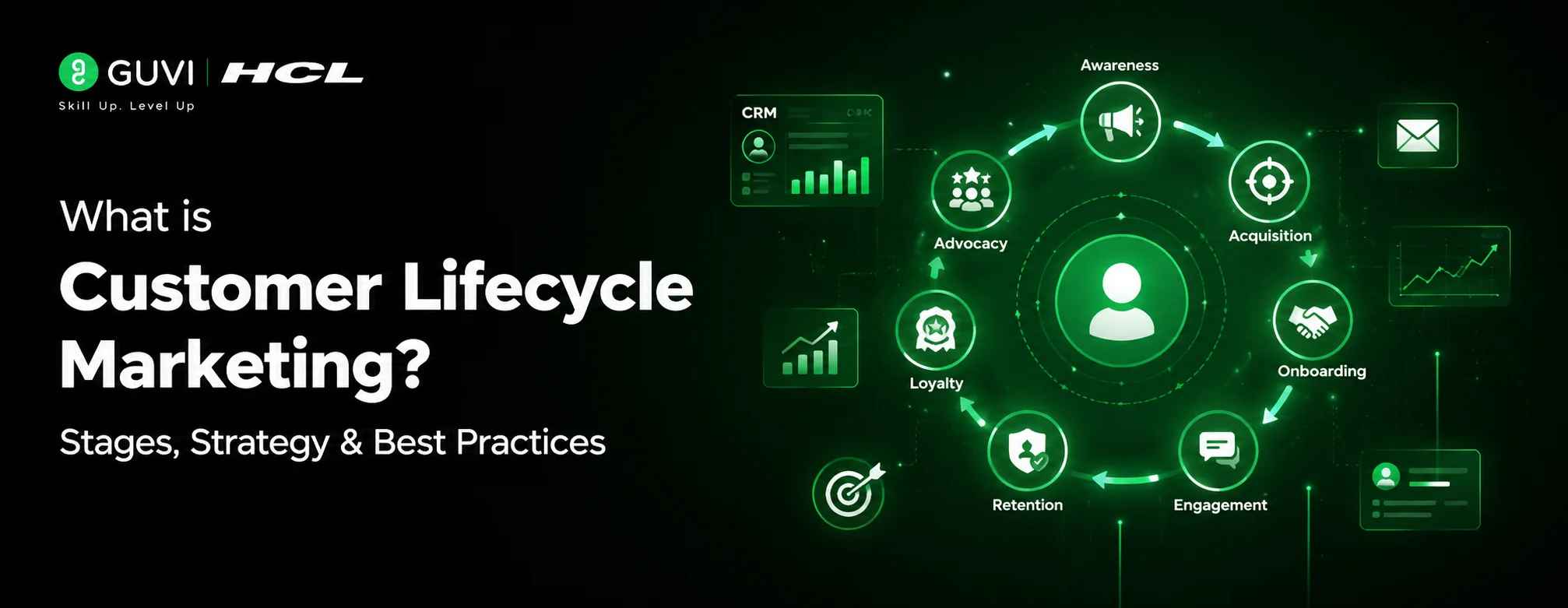
Every customer follows a journey before becoming a loyal advocate. While different companies may use slightly different models, most customer lifecycle stages include six core phases.
1. Awareness
This is when people first discover your business.
They might find you through:
- Google Search
- Social media
- YouTube
- Advertisements
- Word of mouth
- Blog articles
The goal during this stage is education rather than selling.
Good content includes:
- Educational blogs
- Videos
- Infographics
- SEO content
- Social media posts
This is where customer acquisition begins.
2. Consideration
Now potential customers know about your brand and begin comparing it with competitors.
They typically look for:
- Reviews
- Case studies
- Pricing
- Product comparisons
- Customer testimonials
- Free resources
Marketing teams use personalized emails, webinars, product demos, and comparison guides to build trust during this stage.
3. Conversion
The conversion stage is where prospects become paying customers.
Successful conversion depends on reducing friction throughout the buying process.
Examples include:
- Limited-time offers
- Personalized discounts
- Free trials
- Checkout optimization
- Product recommendations
Effective customer lifecycle marketing ensures customers receive the right incentive without overwhelming them.
4. Retention
Many businesses focus heavily on acquiring customers but neglect keeping them.
However, customer retention is often more profitable than continuously acquiring new customers.
Retention strategies include:
- Personalized email campaigns
- Loyalty programs
- Exclusive member benefits
- Helpful onboarding
- Product education
- Customer support
A strong lifecycle marketing strategy keeps customers engaged long after their first purchase.
Many businesses also use chatbots to provide instant support and improve customer retention.
5. Loyalty
Satisfied customers eventually become repeat buyers.
At this stage, businesses aim to strengthen emotional connections through personalized experiences.
Examples include:
- VIP memberships
- Exclusive events
- Early product access
- Birthday rewards
- Personalized recommendations
This stage focuses heavily on increasing customer engagement while improving customer lifetime value.
6. Advocacy
The final stage transforms loyal customers into brand ambassadors.
Advocates often:
- Write reviews
- Refer friends
- Share products on social media
- Participate in referral programs
- Recommend brands to colleagues
These customers become an important source of organic growth because people trust recommendations from other customers more than traditional advertising.
Businesses often use referral rewards and community programs as lifecycle campaigns to encourage advocacy.
Customer Lifecycle Stages at a Glance
| Stage | Customer Goal | Business Goal | Example Marketing Activity |
| Awareness | Discover solutions | Build visibility | SEO blogs, ads, social media |
| Consideration | Compare options | Build trust | Webinars, reviews, case studies |
| Conversion | Make a purchase | Increase sales | Free trials, discounts |
| Retention | Continue using product | Reduce churn | Email automation, onboarding |
| Loyalty | Stay connected | Increase repeat purchases | Rewards programs |
| Advocacy | Recommend brand | Generate referrals | Referral campaigns, user-generated content |
Why Understanding Customer Lifecycle Stages Matters
Every customer has different expectations depending on where they are in the buying process. Someone who has just discovered your brand needs education, while a loyal customer expects personalized rewards and ongoing value.
By understanding these customer lifecycle stages, businesses can design more effective customer lifecycle marketing campaigns that improve customer acquisition, strengthen customer engagement, and increase customer retention over time.
How Does Customer Lifecycle Marketing Work?
At its core, customer lifecycle marketing is about delivering the right message to the right customer at the right time. Instead of sending identical campaigns to everyone, businesses use customer data, behavioral insights, and automation to create personalized experiences throughout the customer lifecycle.
Modern businesses collect information from multiple touchpoints, including websites, mobile apps, email interactions, purchase history, customer support conversations, and social media engagement. These insights help marketers understand what customers need at different stages.
A successful customer lifecycle marketing process typically follows these steps:
- Collect customer data from various touchpoints.
- Segment customers based on their lifecycle stage.
- Create personalized messaging for each segment.
- Deliver campaigns through the most effective channels.
- Measure campaign performance and optimize continuously.
Rather than relying on assumptions, marketers make decisions using customer behavior and performance metrics.
Modern customer lifecycle marketing relies heavily on business analytics to understand customer behavior and optimize campaigns.
The Customer Lifecycle Marketing Process
Step 1: Understand Your Audience
Before launching campaigns, businesses need a clear understanding of their customers.
Useful data includes:
- Demographics
- Browsing behavior
- Purchase history
- Device preferences
- Engagement history
- Customer feedback
The better you understand your audience, the more relevant your customer lifecycle marketing campaigns become.
Step 2: Segment Customers
Not every customer should receive the same communication.
Common customer segments include:
- New visitors
- First-time buyers
- Repeat customers
- High-value customers
- Dormant customers
- Loyal advocates
Segmentation helps businesses create highly personalized lifecycle campaigns that improve response rates.
Step 3: Personalize Communication
Customers now expect brands to remember their preferences.
Personalization may include:
- Product recommendations
- Dynamic website content
- Personalized emails
- Cart reminders
- Birthday offers
- Location-based promotions
According to McKinsey, companies that excel at personalization can generate 40% more revenue from those activities than average competitors.
Step 4: Automate Marketing
Marketing automation makes customer lifecycle marketing scalable.
Automation tools can trigger campaigns when customers:
- Sign up
- Browse products
- Abandon a cart
- Complete a purchase
- Become inactive
- Reach loyalty milestones
Instead of manually sending emails, businesses create workflows that respond automatically to customer actions.
Step 5: Measure and Improve
Every campaign generates valuable insights.
Key metrics include:
- Open rate
- Click-through rate
- Conversion rate
- Customer Lifetime Value (CLV)
- Churn rate
- Customer Retention Rate
- Repeat Purchase Rate
These metrics help marketers continuously refine their lifecycle marketing strategy.
Many organizations visualize customer lifecycle metrics through Business Intelligence (BI) dashboards to monitor engagement and retention trends.
How to Build a Customer Lifecycle Marketing Strategy
A successful lifecycle marketing strategy doesn’t happen overnight. It requires planning, experimentation, and continuous optimization.
Here’s a practical framework you can follow.
1. Define Business Goals
Start by identifying what you want to achieve.
Examples include:
- Increase customer acquisition
- Improve customer retention
- Reduce churn
- Increase repeat purchases
- Improve customer lifetime value
- Increase referrals
Clear objectives make campaign performance easier to measure.
2. Map the Customer Lifecycle
Identify every interaction customers have with your business.
Typical touchpoints include:
- Google Search
- Website visit
- Newsletter signup
- Product page
- Purchase
- Customer support
- Loyalty program
- Referral
This mapping helps identify where customers drop off and where improvements are needed.
3. Create Content for Every Stage
Different lifecycle stages require different content.
| Stage | Recommended Content |
| Awareness | Blogs, videos, social media |
| Consideration | Guides, webinars, comparison pages |
| Conversion | Free trials, demos, discounts |
| Retention | Onboarding emails, tutorials |
| Loyalty | Rewards, VIP offers |
| Advocacy | Referral campaigns, testimonials |
This ensures every customer receives relevant information throughout their journey.
4. Choose the Right Marketing Channels
Effective customer lifecycle marketing uses multiple communication channels.
Popular options include:
- Email Marketing
- SMS
- Push Notifications
- Social Media
- In-app Messaging
- Website Personalization
- Retargeting Ads
The best channel depends on customer behavior and preferences.
Even startups can implement customer lifecycle marketing by building a scalable digital marketing strategy from the beginning.
5. Use Automation
Automation keeps campaigns running consistently.
Examples include:
- Welcome email series
- Product onboarding
- Abandoned cart reminders
- Re-engagement campaigns
- Loyalty rewards
- Referral invitations
Automation improves efficiency while maintaining personalization.
6. Measure Performance Regularly
Review campaign performance monthly.
Monitor:
- Customer Acquisition Cost (CAC)
- Customer Lifetime Value (CLV)
- Customer Retention Rate
- Repeat Purchase Rate
- Net Promoter Score (NPS)
- Engagement Rate
These metrics help improve your customer lifecycle marketing efforts over time.
According to Deloitte India’s Consumer Signals Report 2026, Indian consumers are increasingly prioritizing value, trust, and better experiences when making purchase decisions. This shift is encouraging businesses to focus on customer retention and personalized engagement throughout the customer lifecycle rather than one-time sales.

Lifecycle Campaigns for Every Customer Lifecycle Stage
Successful lifecycle campaigns are designed around customer intent rather than products.
Let’s explore common campaign types.
Awareness Campaigns
Goal:
Introduce your brand to new audiences.
Examples:
- SEO content
- Educational blogs
- YouTube videos
- Social media campaigns
- Influencer collaborations
Focus on solving customer problems instead of selling immediately.
Consideration Campaigns
Goal:
Build trust.
Examples:
- Product comparisons
- Free ebooks
- Webinars
- Case studies
- Customer testimonials
These campaigns help prospects evaluate your solution confidently.
Conversion Campaigns
Goal:
Encourage purchase.
Popular campaigns include:
- Limited-time discounts
- Free shipping
- Product demos
- Trial offers
- Checkout reminders
Reducing friction often improves conversion rates.
Retention Campaigns
Goal:
Keep customers engaged after purchase.
Examples:
- Onboarding emails
- Product tutorials
- Feature announcements
- Personalized recommendations
- Renewal reminders
Retention campaigns play a crucial role in long-term business growth.
Loyalty Campaigns
Goal:
Reward repeat customers.
Examples:
- Points programs
- VIP memberships
- Exclusive launches
- Birthday rewards
- Early access sales
These campaigns increase customer engagement while strengthening emotional connections with the brand.
Advocacy Campaigns
Goal:
Turn satisfied customers into promoters.
Popular initiatives include:
- Referral programs
- User-generated content contests
- Customer success stories
- Community groups
- Ambassador programs
Word-of-mouth marketing generated through advocacy often delivers highly qualified leads.
Real-World Examples of Customer Lifecycle Marketing
Amazon
Amazon uses customer lifecycle marketing extensively by recommending products based on browsing history, purchase behavior, wish lists, and previous searches.
After every purchase, customers receive:
- Shipping updates
- Related product suggestions
- Review requests
- Reorder reminders
- Personalized deals
These lifecycle campaigns encourage repeat purchases and improve customer retention.
Spotify
Spotify keeps users engaged through highly personalized experiences.
Examples include:
- Discover Weekly playlists
- Spotify Wrapped
- Personalized recommendations
- Listening reminders
- Premium upgrade offers
These personalized interactions strengthen customer engagement and encourage long-term subscriptions.
Starbucks
Starbucks Rewards is a strong example of customer lifecycle marketing.
Customers earn points with every purchase and receive:
- Birthday rewards
- Personalized offers
- Exclusive promotions
- Mobile ordering benefits
- Seasonal recommendations
This strategy keeps customers returning while increasing lifetime value.
Netflix
Netflix continuously analyzes viewing behavior to recommend relevant content.
Its lifecycle campaigns include:
- Personalized recommendations
- New release notifications
- Continue Watching reminders
- Re-engagement emails
- Subscription upgrade prompts
This data-driven personalization helps reduce churn while improving customer satisfaction.
Key Takeaways from These Brands
Although Amazon, Spotify, Starbucks, and Netflix operate in different industries, they all share one principle: they communicate with customers based on behavior, not assumptions.
Their success demonstrates that effective customer lifecycle marketing isn’t about sending more messages, it’s about sending the most relevant message at the right moment.
Customer Lifecycle Marketing Best Practices
A successful customer lifecycle marketing strategy is not built on automation alone. It depends on understanding your customers, delivering value consistently, and improving campaigns based on data. The following best practices can help businesses maximize results across every stage of the customer lifecycle.
1. Build a Unified Customer View
Customers interact with brands through multiple channels, including websites, mobile apps, social media, email, and customer support. Bringing this data together creates a complete customer profile and helps you deliver consistent experiences.
Without a unified view, customers may receive irrelevant or duplicate messages, leading to frustration.
2. Personalize Beyond Using a Customer’s Name
Modern personalization goes far beyond adding a first name to an email.
Instead, personalize based on:
- Purchase history
- Browsing behavior
- Interests
- Preferred communication channel
- Device usage
- Lifecycle stage
The more relevant your communication is, the stronger your customer engagement becomes.
3. Balance Customer Acquisition and Customer Retention
Many companies spend most of their marketing budget on customer acquisition, but retaining existing customers often delivers a higher long-term return.
A balanced customer lifecycle marketing strategy invests in:
- Attracting new customers
- Engaging existing customers
- Preventing churn
- Building loyalty
- Encouraging referrals
4. Use Marketing Automation Responsibly
Automation saves time, but customers should never feel like they’re talking to a machine.
Review automated workflows regularly to ensure they remain:
- Relevant
- Timely
- Personalized
- Easy to understand
Automation should enhance the customer experience, not overwhelm it.
5. Continuously Test and Optimize
Customer expectations evolve constantly.
Experiment with:
- Email subject lines
- CTA buttons
- Landing pages
- Offer timing
- Send frequency
- Personalization strategies
Even small improvements can significantly increase campaign performance over time.
Key Metrics to Measure Customer Lifecycle Marketing Success
Tracking the right metrics helps determine whether your customer lifecycle marketing efforts are driving business growth.
| Metric | Why It Matters |
| Customer Acquisition Cost (CAC) | Measures how much it costs to acquire a new customer |
| Customer Lifetime Value (CLV) | Estimates the total revenue generated by a customer |
| Customer Retention Rate | Indicates how many customers continue buying over time |
| Churn Rate | Shows the percentage of customers who stop using your product or service |
| Repeat Purchase Rate | Measures customer loyalty and satisfaction |
| Net Promoter Score (NPS) | Indicates how likely customers are to recommend your brand |
| Email Click-Through Rate | Evaluates campaign engagement |
| Conversion Rate | Measures how many users complete a desired action |
Rather than focusing on a single KPI, successful marketers evaluate multiple metrics together to understand the overall health of the customer lifecycle.
Common Mistakes in Customer Lifecycle Marketing
Even experienced marketers can make mistakes that reduce campaign effectiveness. Avoid these common pitfalls.
1. Treating Every Customer the Same
Sending identical messages to every customer ignores differences in behavior, interests, and lifecycle stage.
Fix: Segment your audience and personalize communication accordingly.
2. Focusing Only on Customer Acquisition
Winning new customers is important, but ignoring existing ones often increases churn and reduces profitability.
Fix: Allocate resources to both customer acquisition and customer retention initiatives.
3. Sending Too Many Marketing Messages
Excessive emails, push notifications, or SMS campaigns can overwhelm customers.
Fix: Monitor engagement metrics and adjust communication frequency based on customer preferences.
4. Ignoring Customer Feedback
Customer reviews, surveys, and support interactions provide valuable insights for improving campaigns.
Fix: Regularly collect feedback and incorporate it into your lifecycle marketing strategy.
5. Measuring Vanity Metrics Instead of Business Outcomes
High email open rates don’t necessarily translate into revenue or customer loyalty.
Fix: Prioritize metrics such as CLV, retention rate, repeat purchases, and conversions.
Future Trends in Customer Lifecycle Marketing (2026 & Beyond)
As AI and customer expectations continue to evolve, customer lifecycle marketing is becoming more intelligent, predictive, and personalized.
Advances in AI in business are enabling companies to deliver more accurate personalization and predictive customer experiences.
Some key trends shaping the future include:
AI-Powered Personalization
Artificial intelligence can analyze customer behavior in real time to recommend products, content, and offers tailored to individual preferences.
Businesses are increasingly adopting AI tools for digital marketing to automate personalization, customer segmentation, and campaign optimization.
Predictive Analytics
Instead of reacting to customer behavior, businesses increasingly use predictive models to anticipate future actions, such as identifying customers likely to churn or predicting the next purchase.
Omnichannel Experiences
Customers expect a seamless experience across websites, mobile apps, email, social media, and physical stores.
Modern customer lifecycle marketing ensures communication remains consistent regardless of where customers interact with the brand.
Privacy-First Marketing
With evolving privacy regulations and the gradual decline of third-party cookies, businesses are relying more on first-party data and transparent data collection practices.
Hyper-Personalized Lifecycle Campaigns
Future lifecycle campaigns will use AI to personalize messaging based on customer intent, context, location, and real-time behavior rather than broad audience segments.
AI agents are beginning to automate customer support, follow-ups, and personalized lifecycle campaigns at scale.
Build Customer Lifecycle Marketing Skills with HCL GUVI
Understanding customer lifecycle marketing is becoming increasingly valuable for professionals in digital marketing, product marketing, CRM, and business analytics.
If you want to learn how businesses use customer data, analytics, customer segmentation, and marketing automation to improve acquisition and retention, consider enrolling in HCL GUVI’s Business & Marketing Analytics Program.
The program combines industry-relevant projects, practical case studies, and hands-on learning to help you develop job-ready marketing analytics skills that employers look for.
Conclusion
Customer lifecycle marketing is no longer just a marketing strategy, it has become a business growth strategy. By understanding every stage of the customer lifecycle, businesses can deliver relevant experiences that improve customer acquisition, strengthen customer engagement, increase customer retention, and maximize customer lifetime value.
Rather than focusing only on acquiring new customers, successful organizations build lasting relationships through personalized communication, data-driven decision-making, and continuous optimization. As AI, automation, and analytics continue to evolve, mastering customer lifecycle marketing will become an increasingly valuable skill for marketers, business analysts, and growth professionals.
FAQs
1. What is customer lifecycle marketing?
Customer lifecycle marketing is the process of delivering personalized marketing campaigns based on where customers are in their relationship with a business, from awareness to advocacy.
2. Why is customer lifecycle marketing important?
It helps businesses improve customer acquisition, increase customer engagement, strengthen customer retention, and maximize customer lifetime value through relevant communication.
3. What are the customer lifecycle stages?
The common customer lifecycle stages are Awareness, Consideration, Conversion, Retention, Loyalty, and Advocacy.
4. What is the difference between customer lifecycle marketing and the customer journey?
The customer journey describes a customer’s experience across touchpoints, while customer lifecycle marketing focuses on the marketing activities designed for each lifecycle stage.
5. Which channels are commonly used for lifecycle marketing?
Businesses typically use email marketing, SMS, push notifications, social media, in-app messaging, website personalization, and paid advertising for lifecycle campaigns.
6. How does marketing automation support customer lifecycle marketing?
Marketing automation triggers personalized messages based on customer behavior, helping businesses communicate consistently while reducing manual effort.
7. Which industries benefit most from customer lifecycle marketing?
E-commerce, SaaS, banking, healthcare, education, travel, retail, and subscription-based businesses all benefit from implementing customer lifecycle marketing strategies.
8. What skills are required to build a lifecycle marketing strategy?
Professionals should understand customer segmentation, CRM platforms, marketing automation, analytics, personalization, campaign optimization, and customer behavior analysis.
Success Stories

About the Author
Reemsha Khan
Always been a storyteller at heart. Now, I turn complex topics into simple, easy-to-understand stories through content. Hope you find it helpful.
View all posts by Reemsha Khan
Connect with me @






Did you enjoy this article?