


Digital Marketing Articles
What is Performance Marketing? Complete Guide for 2026
What is the Voice of the Customer and Why Does it Matter
What is A/B Testing in Marketing? A Beginner’s Guide to Smarter Campaign Optimization
What is Lead Nurturing in Marketing? A Practical Guide for Beginners


Get In Touch For Details! Request More Information
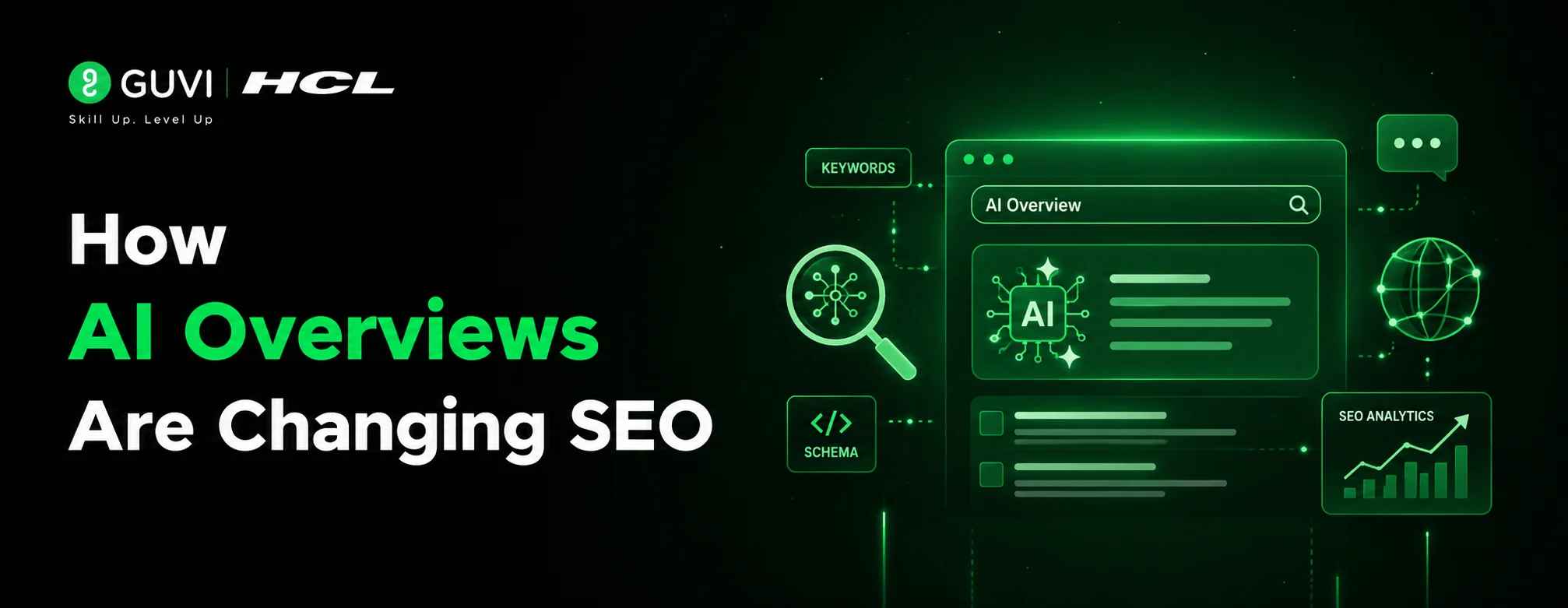
How AI Overviews Are Changing SEO in 2026 – Best Guide
Aug 03, 2026 8 Min Read 239 Views
(Last Updated)
Table of contents
- TL;DR
- What Has Changed in SEO Because of AI Overviews?
- What Are Google AI Overviews?
- Do AI Overviews Replace Traditional Optimization?
- How Do AI Overviews Work?
- Google Interprets the Query
- Query Fan-Out Explores Related Questions
- Google Retrieves Eligible Sources
- The Answer Is Generated and Grounded
- The User Chooses the Next Action
- Traditional Search vs AI-Powered Search
- How Do AI Overviews Affect Rankings and Traffic?
- Organic Rankings Can Receive Less Attention
- Click-Through Rates Can Change
- Commercial Search Is Also Being Affected
- Rankings and Citations Are Not Identical
- Brand Visibility Can Begin Before a Visit
- What Content Can Earn Visibility in AI Overviews?
- Original Information
- Clear Answers With Supporting Depth
- Consistent Brand and Author Information
- Accessible Text and Useful Media
- How Can You Optimize SEO for AI Overviews?
- Map the Complete User Need
- Use Natural Question-Based Headings
- Add Click-Worthy Value
- Strengthen Trust and Accuracy
- Maintain Technical Foundations
- Refresh Pages When the Information Changes
- Build Strong Internal Topic Connections
- Use Generative AI Responsibly
- How Should You Measure Generative Search Performance?
- Measure Three Layers of Performance
- Use Google Search Console’s Generative Reports
- Combine Search Data With Business Analytics
- Real-World Examples
- Example 1: An Indian Edtech Company Improves a Career Guide
- Example 2: A Bengaluru SaaS Company Adds Original Evidence
- Example 3: A Healthcare Website Prioritizes Review
- Common Mistakes
- Build AI and Analytics Skills With HCL GUVI
- Conclusion
- FAQs
- What Are Google’s AI Summaries?
- How Are AI Overviews Changing SEO?
- Do Generated Summaries Replace Traditional Results?
- Can Generated Answers Reduce Website Traffic?
- Can a Page Rank Well Without Being Cited?
- How Can I Optimize SEO for AI Overviews?
- Is Special Schema Needed?
- Does Google Use llms.txt for AI Search?
- How Can Teams Track AI Overview Visibility?
- Is AI Search Optimization a Useful Career Skill?
TL;DR
AI Overviews are changing SEO by placing AI-generated answers above or among traditional search results. They can reduce clicks for simple queries, cite sources beyond the usual top-ranking pages, and make brand visibility important alongside traffic. Strong SEO foundations still matter. To adapt, create original and trustworthy content, answer related questions clearly, maintain technically accessible pages, and offer value that a short summary cannot replace. Measure impressions, citations, branded searches, qualified visits, and conversions instead of relying only on rankings and click-through rate.
AI Overviews are changing SEO because a first-page position no longer guarantees that a user will visit the website.
Google can now generate a direct response, combine information from several sources, and display supporting links within the results page. A user may read the answer, ask another question, visit a cited source, or finish the search without clicking.
For marketers, writers, business owners, and learners, SEO now needs to earn rankings, citations, brand recognition, and meaningful actions.
This shift is part of the wider impact of AI on how people discover information, compare options, and make decisions online.
What Has Changed in SEO Because of AI Overviews?
AI Overviews have changed how users discover information and how businesses evaluate search performance.
The most important changes are:
- Ranking first does not always mean receiving the first visible position.
- Simple informational searches may generate fewer website visits.
- Google can cite sources that are not among the familiar top organic results.
- Content needs to answer connected questions, not merely repeat one keyword.
- Original research, first-hand experience, and useful examples have greater strategic value.
- Brand mentions and citations can create visibility before a website visit.
- SEO reporting must include generative-search impressions, branded demand, assisted conversions, and lead quality.
- Websites need to offer tools, evidence, templates, or detailed guidance that a generated summary cannot fully replace.
A similar answer-first behaviour can also be seen in voice search and its impact on SEO, where users often expect one immediate response instead of several website options.
This does not mean traditional SEO is finished. It means the journey now contains an answer layer between the query and the website.
What Are Google AI Overviews?
Google AI Overviews are generated summaries displayed when Google believes an AI-created response can help a user understand a question or explore a topic.
The answer may combine information from several indexed webpages and display links to supporting sources. Unlike a featured snippet, which usually extracts a passage from one page, the generated response can synthesize multiple perspectives.
Google says its generative search features use the company’s existing Search index, ranking systems, and quality systems. Therefore, established SEO foundations remain relevant.
Do AI Overviews Replace Traditional Optimization?
No. AI Overviews add a new search-result format, but they do not replace traditional SEO practices such as crawlability, relevance, internal links, useful content, page experience, and authority.
Google describes answer engine optimization and generative engine optimization as work that still falls within the broader search experience. Its official guidance says established SEO practices continue to matter for generative results.
The difference is that success is no longer measured only by where a page ranks. Teams must also ask whether the page was selected as a source and whether that exposure contributed to a useful business outcome.
How Do AI Overviews Work?
Google does not publish every source-selection signal, but its documentation explains the main process at a practical level.
1. Google Interprets the Query
The system identifies the user’s likely search intent, topic, entities, and required level of detail.
A basic definition may need a short answer. A question involving a comparison, plan, or buying decision may require several supporting ideas.
2. Query Fan-Out Explores Related Questions
Google says its generative features can use query fan-out, where the system performs multiple related searches to develop a broader response.
For example, a query about improving an ecommerce conversion rate may lead to supporting searches about checkout friction, product-page trust, mobile usability, payment options, and analytics.
This means SEO content should cover the main question and its important supporting questions naturally. Creating many thin pages for slightly different keyword variations is less useful than building one well-structured resource.
3. Google Retrieves Eligible Sources
A page needs to be indexed and eligible to appear with a standard Google Search snippet before it can be considered for generative features.
Technical accessibility does not guarantee inclusion. It simply allows the page to compete.
4. The Answer Is Generated and Grounded
The system creates a response using retrieved information and displays links that help users explore the topic further.
The cited set may differ from the standard organic results because the system may need a source for a specific supporting claim rather than one page for the entire query.
5. The User Chooses the Next Action
After reading AI Overviews, a user may open a source, refine the query, ask a follow-up question, use another search feature, or end the session.
That final choice is why SEO must balance immediate answer visibility with deeper value that earns a click.
Google AI Overviews can use query fan-out, which means Google may run several related searches for one user query before generating an answer. This allows the overview to cover connected subtopics and cite a wider range of supporting webpages than a traditional search result.
Traditional Search vs AI-Powered Search
| Factor | Traditional organic search | AI-powered search strategy |
| Main goal | Rank pages and attract visits | Earn rankings, source visibility, brand recognition, and qualified visits |
| Typical result | Organic listing or standard SERP feature | Generated answer, cited sources, media, and organic listings |
| Query handling | Matches queries with relevant pages | May expand a query into several related searches |
| Content approach | Comprehensive page built around search intent | Comprehensive page with clear answer blocks, evidence, and original value |
| Main metrics | Position, impressions, CTR, sessions, conversions | Generative impressions, citations, branded searches, clicks, assisted conversions |
| Keyword approach | Primary term plus relevant variations | Topic, entities, related questions, scenarios, and decision context |
| Technical needs | Crawlable, indexable, usable website | The same technical foundations |
| Main risk | Low position limits discovery | The generated answer satisfies the user before a visit |
| Main opportunity | Direct organic traffic | Visibility across complex searches and related subqueries |
AI-powered search extends SEO rather than replacing it. A weak page does not become citation-worthy simply because it contains a short definition or several question headings.
How Do AI Overviews Affect Rankings and Traffic?
AI Overviews affect visibility, click behaviour, keyword strategy, and reporting.
Organic Rankings Can Receive Less Attention
A page may retain the same position while receiving fewer visits because the generated answer occupies prominent space above it.
This effect is more likely for queries that can be answered through a definition, short list, quick comparison, or basic explanation.
Click-Through Rates Can Change
AI Overviews can reduce clicks when the generated response fully answers a simple question. This is especially common for definitions, short explanations, basic comparisons, and step-based informational searches.
However, the impact is not the same for every query. Users may still visit a website when they need detailed evidence, original research, an interactive tool, a template, product information, or expert guidance.
SEO teams should therefore compare click-through rates by search intent instead of judging the entire website through one average. Informational queries may lose more clicks, while commercial, transactional, and complex research queries can still attract valuable visits.
Commercial Search Is Also Being Affected
AI Overviews are no longer limited to definitions and simple informational questions. They can also appear when users compare products, evaluate services, research brands, or explore different options before making a decision.
For example, a user searching for the best analytics platform for a startup may receive a generated comparison before opening any website. This means businesses must optimize content not only for informational visibility but also for product discovery and consideration.
Commercial pages should clearly explain product differences, use cases, limitations, pricing factors, and decision criteria. This gives search systems useful information to summarize while giving potential customers a reason to visit the full page.
Rankings and Citations Are Not Identical
A high ranking can support selection because Google’s generative features use core Search systems. However, being on page one does not guarantee that a page will be cited.
The system may choose one source for a definition, another for a statistic, and another for a practical example. Content must therefore contain specific passages that support different parts of the user’s question.
Brand Visibility Can Begin Before a Visit
A user may notice a company in AI Overviews and search for that brand later.
That journey may appear as a branded query, direct visit, assisted conversion, call, product comparison, or course enquiry rather than an immediate organic click.
Modern SEO reporting should account for discovery before the website session.
What Content Can Earn Visibility in AI Overviews?
No format guarantees selection. However, useful, accessible, and distinctive content gives Google more meaningful material to retrieve.
Original Information
Google advises publishers to create content with first-hand experience, a distinctive perspective, and value beyond what a generated answer can easily reproduce.
Useful additions include:
- First-party research
- Expert commentary
- Real workflow screenshots
- Indian market examples
- Product testing
- Case studies
- Calculators and templates
- Clear decision frameworks
A generic summary of existing articles gives readers and search systems little reason to prefer the source.
Clear Answers With Supporting Depth
Place a direct answer below a natural question-based heading. Then explain the limitations, examples, process, evidence, and next steps.
A useful answer block should:
- State the answer in the first sentence
- Name the topic clearly
- Avoid vague references such as “this” or “as explained above”
- Cite measurable or changing claims
- Make sense when extracted on its own
- Lead naturally into deeper guidance
Consistent Brand and Author Information
Search systems need to understand who created the content and why the source is credible.
Keep author names, expertise, company information, product names, About-page details, and structured data consistent across the website.
Accessible Text and Useful Media
Use logical headings, descriptive internal links, readable text, relevant images, accurate alt text, and mobile-friendly layouts.
Google recommends high-quality images and videos because generative search experiences can display visual content alongside webpage links.
In 2026, 60% of Indian online searchers said they begin at least one new search each day using an AI assistant. This shows how quickly answer-first and conversational search behaviour is becoming part of online discovery in India.
How Can You Optimize SEO for AI Overviews?
The best AI search optimization plan begins with useful content and strong technical foundations.
1. Map the Complete User Need
Start with the main query and identify:

- The direct answer
- Related definitions
- Likely follow-up questions
- Comparisons and alternatives
- Evidence needed for trust
- The next action the reader may take
Understanding how to optimize keywords for SEO can help you group related queries naturally without repeating every keyword variation throughout the page.
This structure prepares the page for the original search and the related queries that may be explored through query fan-out.
2. Use Natural Question-Based Headings
Write headings that reflect how a person would ask the question.
Give a concise answer first, then add depth. This supports readers, featured snippets, and AI search without turning the page into disconnected fragments.
3. Add Click-Worthy Value
The generated summary may satisfy the basic question, so the page needs something more useful than a longer definition.
Add:
- Downloadable checklists
- Original datasets
- Templates
- Interactive tools
- Detailed implementation steps
- Expert recommendations
- Before-and-after examples
- Industry-specific advice
The goal is not to hide the answer. It is to answer clearly and then provide value that deserves further exploration.
4. Strengthen Trust and Accuracy
Use official or primary sources for product features, technical guidance, research, policies, and changing information.
Identify the author, show relevant experience, review dates carefully, and verify every measurable claim.
5. Maintain Technical Foundations
Check that important pages are:
- Crawlable
- Indexable
- Canonicalized correctly
- Internally linked
- Mobile friendly
- Fast enough for users
- Accessible without blocked main content
- Supported by accurate structured data where relevant
Using clear headings, descriptive links, lists, and other HTML tags helps browsers, users, and search engines understand the page structure.
Google does not require any special markup for a page to appear in AI Overviews. Focus instead on making the page crawlable, useful, accurate, and easy to understand.
You can continue using standard structured data where relevant, but it should accurately represent the information visible on the page. Structured data can help Google understand your content, but it does not guarantee inclusion in an AI Overview or any other enhanced search result.
6. Refresh Pages When the Information Changes
Update substantive information such as features, examples, processes, screenshots, sources, and market conditions.
Do not change the publication date merely to create the appearance of freshness. Search performance benefits from accurate updates, not cosmetic edits.
7. Build Strong Internal Topic Connections
Use descriptive internal links to connect the article with deeper resources on search intent, keyword research, technical optimization, content strategy, AI tools, and analytics.
This helps users continue learning and helps search systems understand the website’s topic structure.
8. Use Generative AI Responsibly
The right AI tools for SEO can support research organization, content outlines, gap analysis, and editing.
Google warns that generating many pages without adding user value may violate its scaled content abuse policy. Every AI-assisted page should be reviewed, fact-checked, localized, and improved with real expertise.
How Should You Measure Generative Search Performance?
Rankings and organic sessions remain useful, but they do not show the full search journey.
Measure Three Layers of Performance
| Layer | Metrics | What it explains |
| Visibility | AI impressions, cited pages, rankings, branded mentions | Whether the content appears during discovery |
| Engagement | Clicks, CTR, page engagement, downloads, tool usage | Whether visibility generates useful visits |
| Business impact | Leads, sales, calls, assisted conversions, branded demand | Whether search supports business goals |
Suitable SEO tools for digital marketing can help you track rankings, impressions, technical issues, backlinks, SERP changes, and organic performance.
Separate informational, commercial, transactional, and branded queries. Each category has different click expectations and conversion value.
Use Google Search Console’s Generative Reports
On June 3, 2026, Google announced dedicated Search Console views for impressions in generative features, including AI Overviews, AI Mode, and generative experiences in Discover. The rollout initially covered a subset of websites.
Where available, these reports can help teams examine AI Overviews impressions by page, country, device, and date.
Combine Search Data With Business Analytics
A citation does not always create an immediate visit. A conversion may happen after several searches or channels.
Combine Search Console, analytics, CRM data, branded-search trends, and controlled prompt monitoring. This gives marketing teams a more realistic picture of how visibility contributes to demand and revenue.
You can also use SEO automation tools to reduce repetitive reporting and monitoring work, but important recommendations should still be reviewed manually.
Real-World Examples
Example 1: An Indian Edtech Company Improves a Career Guide
An Indian edtech platform publishes an article about business analyst skills.
The original page contains a generic skills list. The updated page begins with a direct answer, explains how each skill is used at work, includes Indian project examples, adds a skills table, and cites reliable employment sources.
The generated summary may use the concise definition, while learners still have a reason to visit for the roadmap, projects, tools, and course guidance.
Example 2: A Bengaluru SaaS Company Adds Original Evidence
A Bengaluru SaaS company targets a query about choosing a customer analytics platform.
Instead of publishing a generic product list, it creates an evaluation framework covering setup time, data sources, privacy controls, reporting needs, integration effort, and team size.
This approach provides clear evidence for AI search while giving decision-makers a scorecard and screenshots that cannot be fully reproduced in a short answer.
Example 3: A Healthcare Website Prioritizes Review
A healthcare provider publishes pages with visible doctor credentials, medical review dates, source-backed claims, appointment steps, and location information.
The company does not use AI to create hundreds of unchecked medical articles. Search publishing in the AI era requires stricter review when inaccurate information could affect a person’s health or safety.
Common Mistakes
- Treating AI search as a replacement for organic strategy: Google’s generative features still use core Search systems. Fix crawlability, relevance, authority, and user experience before chasing new tactics.
- Publishing generic summaries: Content that repeats common information is easy to replace. Add original experience, data, examples, tools, or expert interpretation.
- Assuming schema guarantees inclusion: Structured data can support eligible search features, but it does not guarantee citations in AI Overviews.
- Tracking rankings without context: A stable position may produce a different CTR when the result layout changes. Segment performance by query intent and search feature.
- Forcing keywords into every paragraph: Repetition can harm readability and trust. Good content uses natural language while covering the subject completely.
Build AI and Analytics Skills With HCL GUVI
To understand AI-powered search, you need both content strategy and measurement skills.
HCL GUVI’s Business and Marketing Analytics with AI Tools program helps you explore analytics, dashboards, customer behaviour, and AI-supported marketing decisions.
For deeper knowledge of machine learning, data systems, and generative technology, explore HCL GUVI’s Advanced Data Science and Generative AI Program.
Choose the path that matches whether you want to measure digital performance or understand the technology behind modern AI search.
Conclusion
AI Overviews are changing SEO from a traffic-only practice into a wider visibility and business-measurement discipline. Strong technical foundations, useful content, and relevance still matter, but teams must also create citation-ready answers, original value, clear entity signals, and deeper resources that justify a visit. Track rankings and clicks alongside generative impressions, branded demand, assisted conversions, and lead quality. As AI-powered search expands, professionals who combine SEO, content strategy, analytics, and generative AI knowledge will be better prepared to earn visibility and turn it into meaningful outcomes.
FAQs
What Are Google’s AI Summaries?
They are Google-generated summaries that answer some searches using information retrieved from multiple web sources. They can include links that help users explore supporting pages.
How Are AI Overviews Changing SEO?
AI Overviews are changing SEO by placing generated answers before or among organic results, influencing clicks, expanding source selection, and making citations and brand visibility important performance outcomes.
Do Generated Summaries Replace Traditional Results?
No. They appear alongside organic listings and other search features. The exact layout depends on the query, location, device, and Google’s decision about whether a generated answer is useful.
Can Generated Answers Reduce Website Traffic?
Yes, especially when a simple informational question is answered completely on the results page. The effect varies by query intent, industry, country, and the additional value offered by the website.
Can a Page Rank Well Without Being Cited?
Yes. Ranking and source selection use related Search systems, but they are not identical outcomes. A page may rank highly while another source is selected for a specific supporting claim.
How Can I Optimize SEO for AI Overviews?
Answer the main question directly, cover related questions, add original evidence, cite reliable sources, maintain technical accessibility, and provide useful depth beyond the generated summary.
Is Special Schema Needed?
No. Google says no special AI schema is required. Use valid structured data for supported search features and make sure the markup matches visible page content.
Does Google Use llms.txt for AI Search?
Google states that it does not use llms.txt for Google Search. The file is not required for inclusion in its generative search features.
How Can Teams Track AI Overview Visibility?
Use Google Search Console’s generative reporting where available, manual source checks, branded-search trends, analytics, and conversion data.
Is AI Search Optimization a Useful Career Skill?
Yes. It combines organic search, content strategy, analytics, user behaviour, technical understanding, and generative AI literacy, making it useful for marketing, growth, content, and digital analytics roles.
Success Stories

About the Author
Reemsha Khan
Always been a storyteller at heart. Now, I turn complex topics into simple, easy-to-understand stories through content. Hope you find it helpful.
View all posts by Reemsha Khan
Connect with me @











Did you enjoy this article?