


Full Stack Development Articles
Claude for Architecture and Engineering Documentation
Freelancing as a Python Developer: Getting Your First Client


Get In Touch For Details! Request More Information
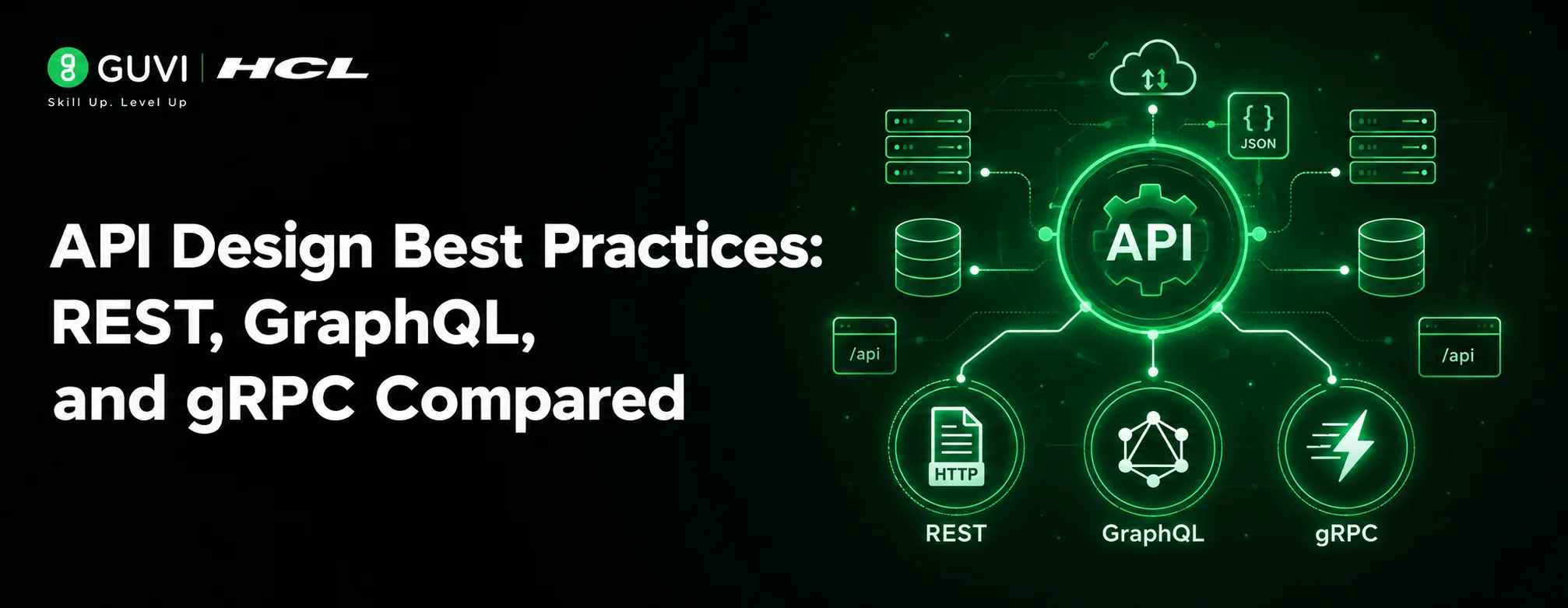
API Design Best Practices: REST, GraphQL, and gRPC Compared
Aug 06, 2026 4 Min Read 393 Views
(Last Updated)
Table of contents
- TL;DR Summary
- Introduction
- Quick Answer
- What Is API Design and Why Does It Matter?
- What Is REST?
- Example REST Endpoint
- Sample Response
- REST Best Practices
- What Is GraphQL?
- Example Query
- Example Response
- Why Do Developers Choose GraphQL?
- Common Use Cases
- What Is gRPC?
- Example Service Definition
- Why Is gRPC so fast?
- REST vs GraphQL vs gRPC: Feature Comparison
- Which API Architecture Should You Choose?
- Choose REST When
- Choose GraphQL When
- Choose gRPC When
- API Design Best Practices Regardless of Architecture
- Pros and Cons Comparison
- Real-World Architecture Example
- Conclusion
- FAQs
- What is the difference between REST, GraphQL, and gRPC?
- Which API architecture is best for microservices?
- Is GraphQL replacing REST?
- Why is gRPC faster than REST?
- Is GraphQL suitable for public APIs?
TL;DR Summary
- REST remains the most widely used API architecture.
- GraphQL reduces over-fetching and under-fetching of data.
- gRPC offers superior performance and low latency.
- REST is best for public-facing APIs.
- GraphQL excels in data-rich applications.
- gRPC is ideal for microservices and internal service communication.
Introduction
Modern applications rarely operate in isolation. Whether you’re building a mobile app, microservices platform, SaaS product, or AI-powered application, APIs are the backbone that connects systems and enables data exchange.
However, choosing the wrong API architecture can create performance bottlenecks, increase development complexity, and limit scalability. Should you use REST, GraphQL, or gRPC? The answer depends on your use case, team expertise, and system requirements.
In this article, you’ll learn the strengths, weaknesses, and best practices of REST, GraphQL, and gRPC, along with real-world scenarios that help you make the right architectural decision.
Build better APIs with the right mix of REST, GraphQL, and gRPC. Master MongoDB and backend skills with HCL GUVI’s MongoDB course.
Quick Answer
REST, GraphQL, and gRPC are three popular API architectures used for communication between applications and services. REST is simple, widely adopted, and ideal for public APIs.
GraphQL allows clients to request exactly the data they need, making it suitable for complex frontend applications. gRPC delivers high-performance communication using Protocol Buffers and is commonly used in microservices and internal systems where speed and efficiency are critical.
What Is API Design and Why Does It Matter?
API design is the process of defining how software systems communicate with each other. A well-designed API improves developer experience, performance, maintainability, and scalability.
Poor API design often leads to:
- Slow application performance
- Difficult integrations
- Increased maintenance costs
- Security vulnerabilities
- Inconsistent user experiences
Effective API design focuses on simplicity, reliability, scalability, and clear documentation.
Data Point
Industry surveys consistently show that developer experience and API usability directly influence adoption rates, integration speed, and long-term platform success.
What Is REST?
REST (Representational State Transfer) is an architectural style that uses standard HTTP methods such as GET, POST, PUT, PATCH, and DELETE to interact with resources.
REST treats everything as a resource accessible through URLs.
Example REST Endpoint
GET /users/123
Sample Response
{
“id”: 123,
“name”: “John Doe”,
“email”: “[email protected]”
}
REST has become the default choice for web APIs because of its simplicity and broad ecosystem support.
REST Best Practices
- Use Meaningful Resource Names
Good:
/users
/orders
/products
Avoid:
/getUsers
/createOrder
- Use Correct HTTP Methods
| Method | Purpose |
| GET | Retrieve data |
| POST | Create data |
| PUT | Replace data |
| PATCH | Update data |
| DELETE | Remove data |
- Version Your APIs
Example:
/api/v1/users
Versioning prevents breaking changes from affecting existing clients.
- Return Proper Status Codes
| Code | Meaning |
| 200 | Success |
| 201 | Created |
| 400 | Bad Request |
| 401 | Unauthorized |
| 404 | Not Found |
| 500 | Server Error |
Best Practice
Always provide meaningful error messages alongside HTTP status codes.
What Is GraphQL?
GraphQL is a query language and runtime that allows clients to request exactly the data they need from a single endpoint.
Instead of multiple REST endpoints, GraphQL typically exposes one endpoint.
Example Query
{
user(id: 123) {
name
}
}
Example Response
{
“data”: {
“user”: {
“name”: “John Doe”,
“email”: “[email protected]”
}
}
}
GraphQL was designed to solve common REST challenges such as over-fetching and under-fetching data.
Build better APIs with the right mix of REST, GraphQL, and gRPC. Master MongoDB and backend skills with HCL GUVI’s MongoDB course.
Why Do Developers Choose GraphQL?
GraphQL gives frontend developers greater control over data retrieval.
Benefits include:
- Single endpoint
- Reduced network requests
- Flexible data fetching
- Strong schema definitions
- Better support for complex applications
Common Use Cases
- Mobile applications
- E-commerce platforms
- Social media apps
- SaaS dashboards
Pro Tip
GraphQL shines when multiple frontend teams need different data views from the same backend.
What Is gRPC?
gRPC is a high-performance Remote Procedure Call (RPC) framework developed by Google. It uses Protocol Buffers (Protobuf) for efficient serialization and HTTP/2 for communication.
Unlike REST, gRPC focuses on service methods rather than resources.
Example Service Definition
service UserService {
rpc GetUser(UserRequest)
returns (UserResponse);

}
This definition automatically generates client and server code in multiple programming languages.
Why Is gRPC so fast?
gRPC achieves high performance through:
- Binary serialization
- HTTP/2 multiplexing
- Smaller payload sizes
- Efficient network usage
- Built-in streaming support
These characteristics make gRPC popular in large-scale distributed systems.
Data Point
Performance benchmarks across enterprise environments often show gRPC consuming less bandwidth and achieving lower latency than equivalent REST implementations for service-to-service communication.
REST vs GraphQL vs gRPC: Feature Comparison
| Feature | REST | GraphQL | gRPC |
| Learning Curve | Easy | Medium | Medium |
| Performance | Good | Good | Excellent |
| Multiple Endpoints | Yes | No | No |
| Strong Typing | Limited | Strong | Strong |
| Streaming Support | Limited | Limited | Excellent |
| Browser Support | Excellent | Excellent | Limited |
| Mobile Efficiency | Good | Excellent | Excellent |
| Microservices | Good | Good | Excellent |
Which API Architecture Should You Choose?
Choose REST When
REST is ideal when simplicity and interoperability are your primary goals.
Best for:
- Public APIs
- CRUD applications
- Third-party integrations
- Small to medium projects
Example
Payment gateways, CMS platforms, and SaaS products commonly expose REST APIs.
Choose GraphQL When
GraphQL works best when frontend applications require flexible access to data.
Best for:
- Mobile apps
- Data-heavy dashboards
- Multi-platform applications
- Rapidly evolving UIs
Example
Social networks and analytics platforms frequently benefit from GraphQL.
Choose gRPC When
gRPC excels in high-performance distributed systems.
Best for:
- Microservices
- Real-time systems
- Internal APIs
- High-throughput workloads
Example
Streaming platforms, financial systems, and large cloud-native applications often use gRPC internally.
API Design Best Practices Regardless of Architecture
- Prioritize Consistency
Naming conventions should remain uniform across all endpoints and services.
- Design for Scalability
Anticipate future growth when defining resources, schemas, and service contracts.
- Implement Strong Security
Use:
- OAuth 2.0
- JWT authentication
- Rate limiting
- Encryption
- Input validation
Warning
Security should be part of API design from day one, not added later.
- Create Excellent Documentation
Popular tools include:
- OpenAPI
- Swagger
- GraphQL Playground
- Postman Collections
Good documentation improves adoption and reduces support requests.
- Monitor and Observe
Track:
- Latency
- Error rates
- Throughput
- Availability
- API usage trends
Operational visibility becomes critical as systems scale.
Pros and Cons Comparison
| Architecture | Pros | Cons |
| REST | Simple, mature ecosystem, broad adoption | Over-fetching, multiple requests |
| GraphQL | Flexible queries, efficient data retrieval | More complexity, caching challenges |
| gRPC | High performance, strong typing, streaming | Limited browser support, steeper learning curve |
Real-World Architecture Example
Many modern organizations use all three technologies together rather than choosing only one.
Example architecture:
Frontend Applications
↓
GraphQL
↓
API Gateway Layer
↓
Microservices (gRPC)
↓
Databases & External APIs
Public-facing applications benefit from GraphQL’s flexibility, while internal services communicate using gRPC for speed and efficiency.
REST APIs may still exist for third-party integrations and external developer access.
Conclusion
Choosing between REST, GraphQL, and gRPC isn’t about finding a winner—it’s about selecting the right tool for the right problem. REST offers simplicity and broad compatibility, GraphQL provides flexibility and efficient data retrieval, and gRPC delivers exceptional performance for distributed systems.
The most successful API strategies focus on developer experience, scalability, security, and maintainability rather than blindly following technology trends.
FAQs
1. What is the difference between REST, GraphQL, and gRPC?
REST uses resource-based HTTP endpoints, GraphQL allows flexible client-driven queries through a single endpoint, and gRPC uses high-performance RPC communication with Protocol Buffers.
2. Which API architecture is best for microservices?
gRPC is often preferred for microservices because of its performance, strong typing, and efficient service-to-service communication.
3. Is GraphQL replacing REST?
No. GraphQL complements REST in many environments, but REST remains widely used due to its simplicity and mature ecosystem.
4. Why is gRPC faster than REST?
gRPC uses binary serialization and HTTP/2, resulting in smaller payloads, lower latency, and more efficient communication.
5. Is GraphQL suitable for public APIs?
Yes. GraphQL works well for public APIs, particularly when clients require flexible access to data.
Success Stories

About the Author
HCL GUVI
This article was selected and published as part of the HCL GUVI AI Blogathon 2026, an initiative designed to encourage students, AI enthusiasts, and aspiring tech writers to simplify complex AI concepts through impactful technical content. The contest recognized high-quality, original, and insightful AI-focused blogs, with selected authors receiving publication opportunities on the HCL GUVI blog platform along with official author credits and recognition.
View all posts by HCL GUVI
Connect with me @



























Did you enjoy this article?