


Full Stack Development Articles
Claude for Architecture and Engineering Documentation
Freelancing as a Python Developer: Getting Your First Client


Get In Touch For Details! Request More Information

Linux Command Line Skills Every Developer Needs in 2026
Aug 17, 2026 4 Min Read 353 Views
(Last Updated)
Table of contents
- TL;DR
- Introduction
- Data Point
- Direct Answer Box
- What Are Linux Command Line Skills?
- Key Components of Linux Command Line Skills
- Did You Know?
- Why Are Linux Command Line Skills Important?
- Benefits of Linux Command Line Skills
- Data Point
- Linux Command Line Skills Every Developer Needs in 2026
- Navigating the File System
- Managing Files and Directories
- Understanding File Permissions
- Searching Files and Content
- Monitoring Processes
- Working with Package Managers
- Shell Scripting Basics
- Using SSH for Remote Access
- Warning
- How Linux Command Line Skills Improve Developer Productivity
- Key Areas Improved by Linux Skills
- Real-World Applications of Linux Command Line Skills
- Cloud Computing
- DevOps and Automation
- Web Server Administration
- Cybersecurity
- Software Development
- ✅ Best Practice
- Key Takeaways
- What To Do Next
- Conclusion
- FAQs
- What are Linux command line skills?
- Why are Linux command-line skills important for developers?
- Which Linux commands should beginners learn first?
- What is Bash scripting?
- Is Linux used in cloud computing?
- How does SSH help developers?
- Are Linux command line skills useful in DevOps?
TL;DR
- Linux command line skills remain essential for developers working with servers, cloud platforms, and DevOps tools.
- The Linux terminal helps automate tasks, manage systems, and improve development efficiency.
- Skills such as file navigation, permissions management, process monitoring, and shell scripting are highly valuable.
- Command-line proficiency enables developers to work effectively across Linux-based environments.
- Learning Linux fundamentals can significantly enhance career opportunities in software development and DevOps.
Introduction
As cloud computing, DevOps, and automation continue to grow, mastering Linux command line skills has become essential for developers. The Linux terminal helps manage systems, automate workflows, and troubleshoot applications efficiently. To build these practical skills, HCL GUVI’s Introduction to Linux Shell Scripting with Bash Course offers hands-on training in Linux commands, shell scripting, and automation fundamentals.
Data Point
Linux powers most cloud infrastructure, web servers, and supercomputers worldwide, making Linux skills highly valuable for modern technology professionals.
Source: https://www.linuxfoundation.org/research
Direct Answer Box
Linux command line skills refer to the ability to interact with Linux systems through terminal commands to manage files, monitor processes, configure permissions, automate tasks, and administer systems. These skills help developers work more efficiently, troubleshoot issues faster, and operate effectively in cloud and server environments.
Source: https://training.linuxfoundation.org/resources/
What Are Linux Command Line Skills?
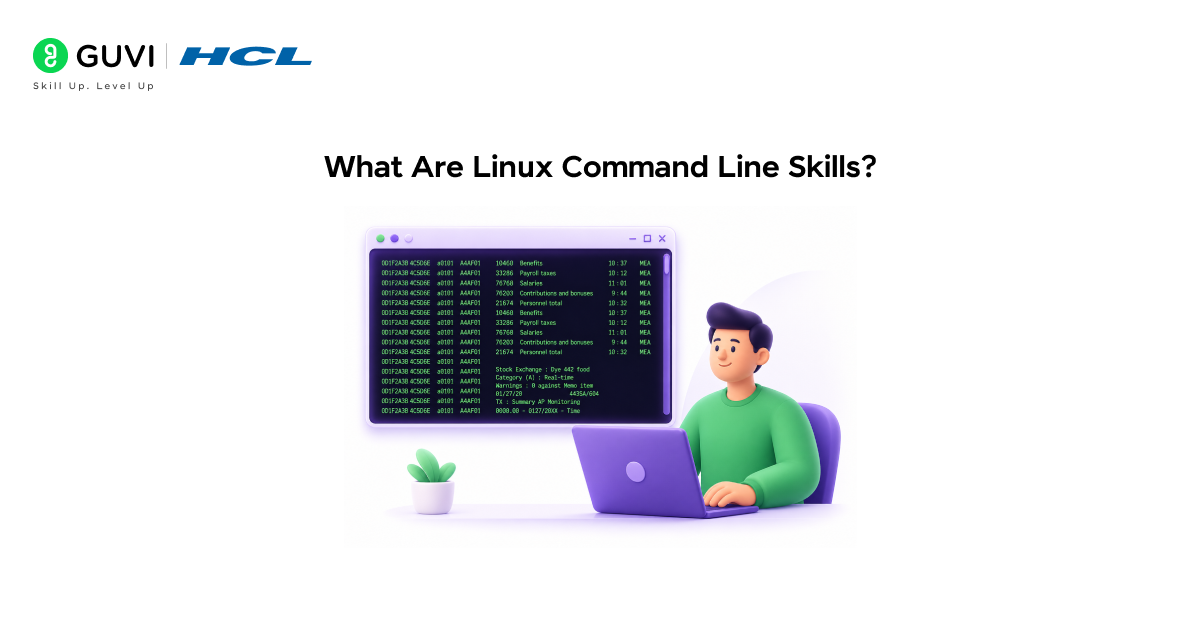
Linux command line skills involve using terminal commands to interact directly with the operating system. Instead of relying solely on graphical interfaces, developers can execute commands to perform tasks quickly and efficiently.
These skills are particularly important because Linux remains the dominant operating system for servers, cloud environments, and containerized applications. Understanding how to use the command line allows developers to automate repetitive tasks, manage resources, and troubleshoot systems effectively.
Key Components of Linux Command Line Skills
- Navigation – Moving through directories and file systems.
- File Management – Creating, editing, copying, and deleting files.
- Permissions – Controlling access to files and directories.
- Process Management – Monitoring and managing running applications.
- Networking – Diagnosing connectivity and network issues.
- Automation – Writing shell scripts to streamline workflows.
Did You Know?
Many popular technologies, including Docker, Kubernetes, and major cloud platforms, rely heavily on Linux-based environments and command-line tools.
Source: https://www.kernel.org/
Why Are Linux Command Line Skills Important?
Developers who possess strong Linux command line skills can work more efficiently, automate repetitive tasks, and interact directly with production environments. These abilities are highly valued across software development, DevOps, cloud computing, and cybersecurity roles.
Benefits of Linux Command Line Skills
| Benefit | Why It Matters |
| Faster Troubleshooting | Helps identify and resolve issues quickly |
| Better Automation | Reduces repetitive manual tasks |
| Improved Productivity | Speeds up development workflows |
| Cloud Readiness | Supports cloud and server management |
| Career Growth | Increases opportunities in technical roles |
Data Point
Linux is widely used across enterprise servers, cloud infrastructure, embedded systems, and development environments, making command-line expertise a highly sought-after skill.
Source: https://www.redhat.com/en/topics/linux
If you’re interested in exploring automation, cloud operations, and deployment workflows, HCL GUVI’s DevOps for Beginners eBook provides a practical introduction to CI/CD, containerization, infrastructure automation, and cloud technologies commonly used alongside Linux systems.
Linux Command Line Skills Every Developer Needs in 2026
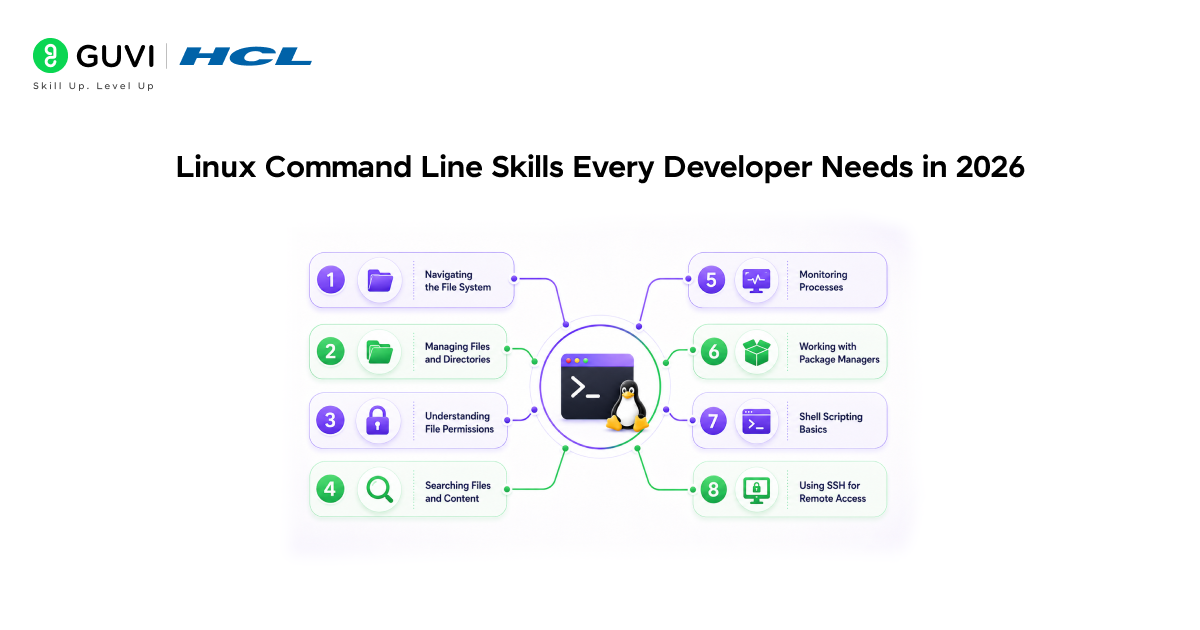
1. Navigating the File System
Every Linux user should know how to move between directories, locate files, and inspect folder structures.
Common commands include:
- pwd
- ls
- cd
- tree
These commands form the foundation of daily Linux usage.
2. Managing Files and Directories
Developers frequently create, modify, move, and delete files.
Useful commands include:
- mkdir
- cp
- mv
- rm
- touch
Efficient file management improves productivity and organization.
3. Understanding File Permissions
Linux uses permission settings to control access to files and directories.
Developers should understand:
- chmod
- chown
- groups
- user permissions
Proper permission management is essential for system security.
4. Searching Files and Content
Locating files quickly is an important productivity skill.
Common commands include:
- find
- grep
- locate
- which
These tools help developers search for files, configurations, and specific content.
5. Monitoring Processes
Applications running on Linux generate processes that require monitoring and management.
Important commands include:
- ps
- top
- htop
- kill
Process monitoring helps maintain system performance and stability.
6. Working with Package Managers
Package managers simplify software installation and updates.
Examples include:
- apt
- yum
- dnf
- snap
Understanding package management is important for maintaining Linux systems.
7. Shell Scripting Basics
Shell scripts automate repetitive tasks and improve operational efficiency.

Developers can automate:
- Backups
- Deployments
- Log analysis
- System monitoring
Learning Bash scripting is one of the most valuable Linux command-line skills for modern developers.
8. Using SSH for Remote Access
Secure Shell (SSH) enables developers to connect to remote systems securely.
SSH is commonly used for:
- Server administration
- Cloud management
- Remote troubleshooting
- Deployment tasks
Source: https://www.openssh.com/manual.html
Warning
Avoid running unfamiliar commands with administrative privileges unless you fully understand their impact. Certain commands can modify critical system files, affect running services, or cause data loss if executed incorrectly.
How Linux Command Line Skills Improve Developer Productivity

Developers often work with servers, cloud platforms, containers, and deployment pipelines. Command-line proficiency allows them to complete tasks faster than relying solely on graphical interfaces.
Instead of navigating multiple menus, developers can execute commands directly, automate workflows, and manage systems more efficiently.
Key Areas Improved by Linux Skills
- Automation
- System Administration
- Troubleshooting
- Cloud Operations
- DevOps Workflows
- Server Management
- Development Efficiency
- Technical Problem Solving
Organizations increasingly value professionals who can confidently operate Linux environments and automate routine tasks.
Real-World Applications of Linux Command Line Skills
1. Cloud Computing
Developers use Linux commands to manage cloud-based virtual machines and infrastructure.
2. DevOps and Automation
Linux powers many CI/CD pipelines, automation workflows, and deployment processes.
3. Web Server Administration
Administrators manage web servers, logs, and configurations through terminal commands.
4. Cybersecurity
Security professionals use Linux tools for monitoring, auditing, and incident response.
5. Software Development
Developers rely on command-line tools for version control, package management, and environment configuration.
✅ Best Practice
Build the habit of using terminal commands regularly instead of relying entirely on graphical interfaces. Consistent practice helps improve speed, confidence, and problem-solving ability over time.
To strengthen your command-line proficiency and automation skills, HCL GUVI’s Introduction to Linux Shell Scripting with Bash Course offers practical experience with Linux environments, Bash scripting, and real-world workflows.
Key Takeaways
- Linux command line skills remain highly valuable in 2026.
- Terminal proficiency improves productivity and troubleshooting.
- Shell scripting enables powerful automation capabilities.
- Linux skills support cloud, DevOps, and software development careers.
- Consistent practice is the best way to build command-line confidence.
What To Do Next
After learning these concepts, explore:
- Bash Scripting
- Linux System Administration
- DevOps Fundamentals
- Docker and Containers
- Kubernetes Basics
- Cloud Infrastructure Management
Developing strong Linux skills today can open doors to a wide range of technical career opportunities.
Conclusion
Mastering Linux command line skills enables developers to work more efficiently, automate repetitive tasks, and manage systems with greater confidence. As Linux continues to power modern servers, cloud platforms, and development environments, command-line proficiency remains a valuable professional skill. By learning core Linux commands, shell scripting, and system management techniques, developers can improve productivity and adapt more effectively to evolving technology landscapes.
FAQs
1. What are Linux command line skills?
Linux command line skills involve using terminal commands to manage files, processes, permissions, networking, and system operations.
2. Why are Linux command-line skills important for developers?
They improve productivity, support automation, and help developers work effectively in cloud and server environments.
3. Which Linux commands should beginners learn first?
Beginners should start with commands such as ls, cd, pwd, mkdir, cp, mv, and rm.
4. What is Bash scripting?
Bash scripting involves writing scripts that automate repetitive Linux tasks using command-line instructions.
5. Is Linux used in cloud computing?
Yes. Most cloud servers and infrastructure platforms run Linux-based operating systems.
6. How does SSH help developers?
SSH enables secure remote access to servers and cloud environments for administration and troubleshooting.
7. Are Linux command line skills useful in DevOps?
Yes. Linux skills are fundamental for DevOps practices, including automation, deployment, monitoring, and infrastructure management.
Success Stories

About the Author
Vishalini Devarajan
An Aerospace Engineer turned content writer, I focus on making complex concepts easy to understand through well-structured, reader-friendly blogs. Whether it’s a technical topic or a non-technical one, I love creating content that is clear, engaging, and impactful.
View all posts by Vishalini Devarajan
Connect with me @



































Did you enjoy this article?