


UI/UX Designing Articles
What is a Design System? The Ultimate Guide to Building Consistent UIs
What is UX Writing? A Complete Guide to Mastering Microcopy and Content Design
What is a UX Audit? A Complete & Best Guide to User Experience Evaluation
How HCL GUVI Zen Class Helps You Build a Job-Ready UI/UX Portfolio


Get In Touch For Details! Request More Information
What is Design Thinking? A Complete 2026 Guide to the Process, Methodology, and Real Best Examples
Jul 22, 2026 10 Min Read 561 Views
(Last Updated)
Table of contents
- TL;DR
- Introduction
- What is Design Thinking?
- What is Design Thinking in Simple Words?
- Why is it Called Human-Centered Design?
- Why is Design Thinking Important?
- It Reduces Product Failure
- It Encourages Innovation
- It Improves Customer Experience
- It Saves Development Costs
- It Promotes Cross-Functional Collaboration
- Statistics That Show Why Design Thinking Matters
- Evolution of Design Thinking
- From Design Discipline to Business Strategy
- 1969 - Herbert Simon
- 1990s - IDEO Popularized the Approach
- 2005 Onwards - Stanford d.school
- Core Principles of Design Thinking
- Empathy Comes First
- Collaboration Drives Better Ideas
- Experiment Before Investing
- Iteration is Continuous
- Focus on the Problem Before the Solution
- Creativity Should Be Structured
- Design Thinking vs Traditional Problem Solving
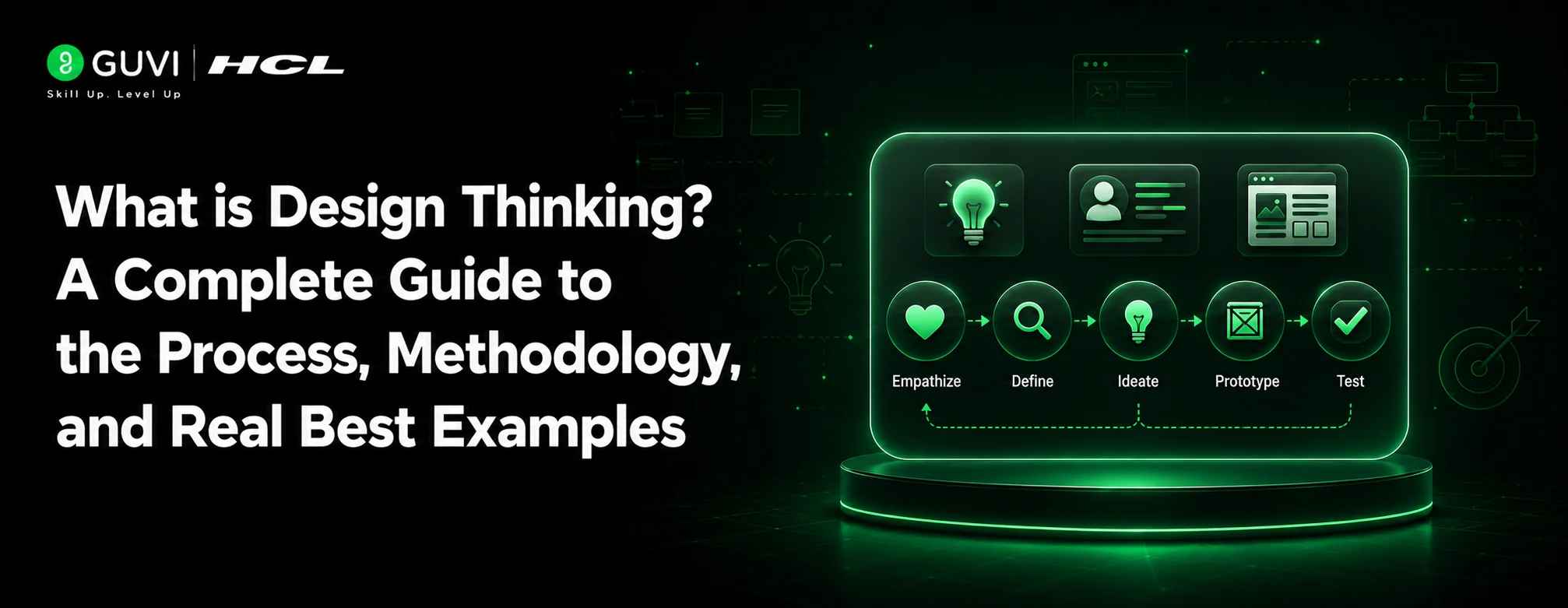
- What are the 5 Stages of the Design Thinking Process?
- Empathize
- Example
- Define
- Ideate
- Prototype
- Example
- Test
- Design Thinking Methodology Explained
- Human-Centered Design: The Foundation of Design Thinking
- Human-Centered Design vs User-Centered Design
- Popular Design Thinking Tools
- Popular Design Thinking Frameworks
- Stanford d.school Framework
- IDEO Framework
- Double Diamond Framework
- Google Design Sprint
- Design Thinking in UI/UX Design
- Example: Food Delivery App
- Design Thinking Across Industries
- Healthcare
- Education
- Banking and Finance
- Retail and E-commerce
- Manufacturing
- Government Services
- Real-World Design Thinking Examples
- Airbnb
- Netflix
- Apple
- Uber
- Benefits of Design Thinking
- Challenges and Limitations of Design Thinking
- Common Mistakes to Avoid When Using Design Thinking
- Skipping User Research
- Defining the Wrong Problem
- Falling in Love with the First Idea
- Ignoring User Feedback
- Treating Design Thinking as a Linear Process
- How to Learn Design Thinking?
- Ready to Build Practical Design Thinking Skills?
- Career Opportunities After Learning Design Thinking
- Ready to Put Design Thinking into Practice?
- Final Words
- Frequently Asked Questions
- What is Design Thinking in simple words?
- What are the five stages of the Design Thinking process?
- What is the difference between Design Thinking and Agile?
- Is Design Thinking only for designers?
- Why is human-centered design important?
- Which industries use Design Thinking?
- Can beginners learn Design Thinking?
- How does Design Thinking help in UI/UX design?
TL;DR
- Design Thinking is a human-centered approach to solving complex problems by understanding users, challenging assumptions, generating creative ideas, building prototypes, and testing solutions.
- Unlike traditional problem-solving methods, the Design Thinking process focuses on empathy and continuous iteration, making it one of the most effective methodologies for developing products, services, and experiences that people genuinely need.
- Today, organizations ranging from startups to Fortune 500 companies use Design Thinking methodology to drive innovation, improve customer satisfaction, and reduce product failures.
Introduction
From mobile banking and healthcare apps to e-commerce platforms and AI-powered products, users expect seamless and intuitive digital experiences. According to the PwC Future of Customer Experience Survey, customers increasingly consider experience to be as important as the products or services themselves.
To meet these expectations, organizations are embracing Design Thinking, a human-centered approach that helps teams design solutions based on empathy, experimentation, and continuous improvement rather than assumptions.
Despite its popularity, many people still assume Design Thinking is only for UI/UX designers or creative professionals. In reality, it is a structured problem-solving framework that helps teams understand user needs before building solutions. Without this approach, businesses often spend months developing products that fail to solve real customer problems.
This guide explains ‘what is Design Thinking’, how the Design Thinking methodology works, why human-centered design is at its core, and how organizations use it to create innovative products. You’ll also explore its principles, evolution, and practical applications before diving into the complete Design Thinking process.
What is Design Thinking?
Design Thinking is a human-centered approach to solving problems that puts real user needs at the center of every decision, instead of relying on assumptions or gut feeling. Rather than jumping straight to a solution, you start by understanding the person you’re designing for: what frustrates them, what they need, and what they’re actually trying to achieve.
At its core, Design Thinking methodology combines empathy, creativity, and rational analysis. It’s not just for designers either.
Product managers, engineers, marketers, and business leaders use it to tackle everything from app redesigns to hospital workflows. The goal is always the same: build something that genuinely solves a human problem, tested and refined through real feedback rather than guesswork.
According to McKinsey’s five-year study of 300 publicly listed companies, top-quartile performers on the McKinsey Design Index generated 32% higher revenue growth and 56% higher total returns to shareholders than their industry peers.
What is Design Thinking in Simple Words?
In designing a new mobile banking app, a traditional approach might begin with a list of features the company wants to include.
A Design Thinking approach starts differently. Instead of asking, “What features should we build?”, it asks:
- Who are our users?
- What challenges do they face?
- Why are they struggling?
- How can we make their lives easier?
Only after understanding these answers does the team begin designing a solution.
Simply put, Design Thinking is about solving problems from the user’s perspective rather than the organization’s assumptions.
Why is it Called Human-Centered Design?
The phrase human-centered design reflects the core philosophy of Design Thinking: every decision should prioritize the people who will use the final product.
Rather than designing for technology or business goals alone, teams focus on understanding users’ behaviors, emotions, motivations, and pain points.
For example:
- A hospital redesigns patient check-in to reduce waiting anxiety.
- An e-commerce company simplifies checkout to reduce cart abandonment.
- A learning platform redesigns its dashboard based on how students actually study.
In every case, the goal is the same, design solutions around people instead of processes.
Key Insight: Human-centered design doesn’t ask, “Can we build this?” It asks, “Should we build this, and will it genuinely help users?”
Why is Design Thinking Important?
Modern consumers expect products that are intuitive, personalized, and easy to use. Meeting these expectations requires more than technical expertise, it requires understanding human behavior.
Here’s why organizations increasingly rely on the Design Thinking methodology:
It Reduces Product Failure
Many products fail because they solve the wrong problem. Design Thinking validates user needs early, helping teams avoid costly mistakes.
It Encourages Innovation
Instead of relying on assumptions, teams continuously explore multiple ideas before selecting the best solution.
This often leads to breakthrough innovations rather than incremental improvements.
It Improves Customer Experience
Products designed around real user behavior are easier to understand, more enjoyable to use, and more likely to retain customers.
It Saves Development Costs
Finding usability issues during prototyping is significantly cheaper than fixing them after a product launch.
It Promotes Cross-Functional Collaboration
Design Thinking brings together designers, developers, marketers, researchers, and business stakeholders to solve problems collectively rather than in silos.
Statistics That Show Why Design Thinking Matters
| Statistic | Source |
| Design-driven companies outperformed the S&P 500 by 211% over a 10-year period. | Design Management Institute |
| The updated Design Value Index reported 219% higher returns than the S&P 500 over ten years. | Design Management Institute |
| McKinsey’s research found that companies in the top quartile of design performance achieved significantly higher revenue growth and shareholder returns than industry peers. | The Business Value of Design by McKinsey (2018) |
| Nielsen Norman Group states that investing in usability and UX research reduces costly redesigns and improves product success by identifying user issues early. | Nielsen Norman Group |
Airbnb was close to shutting down in its early years. The founders improved the platform only after personally meeting hosts, understanding their struggles, and redesigning the experience around real user needs. This user-first mindset became one of the most celebrated Design Thinking examples in the startup world.
Evolution of Design Thinking
Although Design Thinking became mainstream in the 2000s, its roots go back several decades.
From Design Discipline to Business Strategy
The concept evolved through contributions from researchers, educators, and design firms.
1969 – Herbert Simon
In The Sciences of the Artificial, Herbert Simon introduced design as a structured process for solving complex problems rather than simply creating visual artifacts.
1990s – IDEO Popularized the Approach
Global design consultancy IDEO transformed Design Thinking into a practical innovation framework used by businesses to create user-focused products and services.
2005 Onwards – Stanford d.school
Stanford University’s d.school introduced Design Thinking as an interdisciplinary methodology, enabling students from engineering, business, medicine, and design to collaborate on solving real-world challenges.
Today, Design Thinking is used far beyond product design. Governments, healthcare providers, educational institutions, and technology companies apply it to improve services, optimize workflows, and enhance customer experiences.
Core Principles of Design Thinking
Regardless of the industry, successful Design Thinking initiatives are built on a few fundamental principles.
Empathy Comes First
Understanding users is more important than immediately proposing solutions.
Collaboration Drives Better Ideas
People from different backgrounds contribute diverse perspectives, leading to more innovative outcomes.
Experiment Before Investing
Instead of spending months building a perfect product, teams create simple prototypes and learn from user feedback.
Iteration is Continuous
Design Thinking views failure as valuable feedback. Every test improves the solution.
Focus on the Problem Before the Solution
Great innovators spend more time defining the right problem than rushing toward an answer.
Creativity Should Be Structured
Brainstorming is only one part of Design Thinking. Creative ideas must ultimately solve genuine user needs.
| Principle | Purpose |
| Empathy | Understand users deeply |
| Collaboration | Generate diverse ideas |
| Experimentation | Reduce uncertainty |
| Iteration | Improve continuously |
| User Focus | Solve real problems |
| Creativity | Develop innovative solutions |
Design Thinking vs Traditional Problem Solving
At first glance, Design Thinking and traditional problem-solving may seem similar, they both aim to solve problems. However, their approaches differ significantly.
The following comparison highlights the key differences between the two approaches.
| Design Thinking | Traditional Problem Solving |
| Starts with understanding users | Starts with defining the business problem |
| Focuses on empathy and user needs | Focuses on efficiency and predefined goals |
| Encourages experimentation and iteration | Follows a fixed, linear process |
| Welcomes feedback throughout development | Feedback is usually collected after completion |
| Flexible and adaptive | Structured and sequential |
| Prioritizes innovation | Prioritizes execution |
While traditional problem-solving works well for straightforward or repetitive tasks, Design Thinking is more effective for tackling complex challenges where user expectations, behaviors, and requirements are constantly evolving.
What are the 5 Stages of the Design Thinking Process?
The Design Thinking process is a structured yet flexible framework that helps teams solve problems creatively while keeping users at the center of every decision.
Rather than following a rigid sequence, these five stages often overlap, allowing teams to revisit earlier steps as they gain new insights.
1. Empathize
The first stage focuses on understanding your users and the challenges they face. Instead of relying on assumptions, teams interact directly with users to learn about their needs, motivations, frustrations, and behaviors.
Common research methods include:
- User interviews
- Surveys and questionnaires
- Field observations
- Shadowing users in real environments
- Customer journey mapping
Example
Imagine you’re designing a food delivery app. Instead of immediately adding new features, you interview customers and discover that many struggle to track delivery updates accurately. This insight becomes the foundation for the design process.
2. Define
Once enough user research has been collected, the next step is to clearly define the problem.
Rather than creating a solution immediately, teams analyze the research findings, identify recurring patterns, and frame a meaningful problem statement.
A well-defined problem statement typically follows this format:
User + Need + Insight
For example:
“Busy professionals need a faster way to reorder groceries because they have limited time to browse products every week.”
A clearly defined problem ensures the team focuses on solving the right challenge instead of addressing symptoms.
Product managers use Design Thinking to validate customer problems before defining product roadmaps. By combining user research with business goals, they can prioritize features that create meaningful value.
If you’re interested in this intersection, explore our guide on Design Thinking in Product Management to understand how leading product teams apply this methodology throughout the product lifecycle.
3. Ideate
With the problem clearly defined, it’s time to generate possible solutions.
The goal during ideation is to explore as many ideas as possible without judging them too early. Encouraging diverse perspectives often leads to more innovative outcomes.
Popular ideation techniques include:
- Brainstorming
- Crazy 8s
- SCAMPER
- Mind Mapping
- Reverse Thinking
At this stage, quantity matters more than perfection. Teams evaluate and refine ideas later.
4. Prototype
Instead of investing significant time and resources into developing a complete product, Design Thinking encourages building simple, low-cost prototypes.
These prototypes allow teams to test concepts quickly and gather valuable feedback before full-scale development.
Common prototype formats include:
- Paper sketches
- Wireframes
- Clickable mockups
- Interactive prototypes
- Physical product models
Popular design tools include:
- Figma
- Adobe XD
- Sketch
- InVision
Example
Before launching a new banking application, a design team creates an interactive Figma prototype and tests it with users. Feedback reveals that customers struggle to locate the “Transfer Money” option, prompting the team to revise the navigation before development begins.
Prototyping is more than creating wireframes; it’s about validating ideas before investing in development. In UI/UX design, prototypes help designers gather feedback, identify usability issues, and refine user experiences through rapid iteration.
Learn more in our detailed guide on Design Thinking and Prototyping in UI/UX.
5. Test
The final stage involves evaluating the prototype with real users to determine whether it effectively solves their problem.
User testing helps identify usability issues, uncover unexpected behaviors, and validate design decisions.
Teams often assess factors such as:
- Ease of use
- Task completion rates
- User satisfaction
- Accessibility
- Overall experience
Importantly, testing does not mark the end of the Design Thinking process. Insights gathered during this stage frequently lead teams back to earlier phases, making Design Thinking an iterative methodology focused on continuous improvement.
According to the Nielsen Norman Group, usability testing with just five participants can uncover a significant proportion of usability issues, making early testing both efficient and cost-effective.
Design Thinking Methodology Explained
The Design Thinking methodology is not a strict step-by-step process. Instead, it is an iterative framework that encourages continuous learning, experimentation, and refinement.
Unlike traditional project methodologies, teams can revisit any stage whenever new insights emerge. For example, user testing may reveal previously overlooked pain points, requiring additional research or ideation before moving forward.
This flexibility makes Design Thinking especially valuable for solving complex problems where user needs evolve over time.
The methodology is built on four key characteristics:
- Human-centered: Every decision begins with understanding users.
- Collaborative: Cross-functional teams contribute diverse perspectives.
- Iterative: Solutions are refined through repeated testing and feedback.
- Experimental: Teams learn quickly by building and validating ideas early.
By embracing these principles, organizations can reduce uncertainty, improve customer satisfaction, and develop products that better align with real-world needs.
Human-Centered Design: The Foundation of Design Thinking
At the heart of Design Thinking lies human-centered design, an approach that prioritizes people throughout the design and problem-solving process.
Instead of focusing solely on business objectives or technical feasibility, human-centered design begins by understanding users’ needs, behaviors, motivations, and challenges.
This approach encourages teams to design products and services that are not only functional but also intuitive, accessible, and meaningful. By involving users throughout the development process, organizations can create solutions that address real-world problems and deliver better experiences.

Human-Centered Design vs User-Centered Design
Although these terms are often used interchangeably, there is a subtle difference between them.
| Human-Centered Design | User-Centered Design |
| Focuses on the broader human experience, including emotions, accessibility, and social impact | Primarily focuses on improving product usability for specific users |
| Considers long-term needs and contexts | Concentrates on user interactions with a product |
| Often applied to services, systems, and policies | Commonly applied to digital products and interfaces |
In practice, both approaches complement each other and are widely used in UI/UX design and product development.
Popular Design Thinking Tools
Different stages of the Design Thinking process require different tools to understand users, organize ideas, build prototypes, and validate solutions. Choosing the right tool helps teams collaborate effectively and make informed design decisions.
| Design Thinking Stage | Popular Tools | Purpose |
| Empathize | User Interviews, Surveys, Observation | Understand user needs |
| Define | Affinity Mapping, Empathy Maps | Organize research findings |
| Ideate | Brainstorming, Mind Maps, Crazy 8s | Generate creative ideas |
| Prototype | Figma, Adobe XD, Sketch | Build interactive prototypes |
| Test | Maze, UsabilityHub, UserTesting | Collect user feedback |
These tools enable teams to validate ideas early, reducing the risk of building products that fail to meet user expectations.
Popular Design Thinking Frameworks
While the five-stage Design Thinking process is the most widely recognized, several frameworks adapt these principles to different industries and project requirements.
Stanford d.school Framework
Developed by Stanford University’s Hasso Plattner Institute of Design, this framework popularized the five-stage process:
- Empathize
- Define
- Ideate
- Prototype
- Test
It is widely taught in universities and adopted by startups and product teams worldwide.
IDEO Framework
IDEO, a global design consultancy, helped bring Design Thinking into mainstream business innovation.
The IDEO framework emphasizes:
- Inspiration
- Ideation
- Implementation
This approach encourages continuous experimentation and collaboration while solving complex business problems.
Double Diamond Framework
Created by the UK Design Council, the Double Diamond model divides problem-solving into four phases:
- Discover
- Define
- Develop
- Deliver
The framework encourages teams to first explore the problem thoroughly before narrowing down solutions.
While the five-stage Design Thinking process is widely adopted, the Double Diamond Framework provides another structured way to explore and solve complex problems. It separates problem discovery from solution development, helping teams avoid solving the wrong challenge.
Read our complete Guide to Design Thinking and the Double Diamond Framework to understand how the two approaches complement each other.
Google Design Sprint
Developed by Google Ventures, the Design Sprint condenses the Design Thinking methodology into a structured five-day process.
It helps teams rapidly:
- Understand problems
- Generate ideas
- Build prototypes
- Test solutions with users
Design Sprints are particularly useful for startups and product teams working under tight deadlines.
Design Thinking in UI/UX Design
Design Thinking has become one of the most important methodologies in UI/UX design because it aligns product development with user needs rather than assumptions.
A typical UI/UX project naturally follows the Design Thinking process:
- Empathize: Conduct user interviews and research.
- Define: Identify usability challenges.
- Ideate: Explore multiple interface solutions.
- Prototype: Create wireframes and interactive designs.
- Test: Validate designs through usability testing.
Example: Food Delivery App
A team is redesigning a food delivery application.
During user interviews, they discover that customers become frustrated when they cannot easily reorder their favorite meals.
Instead of adding more promotional banners, the team introduces a “Reorder Previous Orders” feature directly on the home screen. After usability testing, task completion time decreases, and user satisfaction improves significantly.
This example demonstrates how Design Thinking transforms research insights into user-focused design decisions.
Design Thinking Across Industries
Although Design Thinking is closely associated with UI/UX, its applications extend across numerous industries.
Healthcare
Hospitals use Design Thinking to improve patient experiences, streamline appointment scheduling, and simplify medical services.
Education
Educational institutions redesign learning platforms based on how students learn, collaborate, and access course materials.
Banking and Finance
Banks improve digital onboarding, simplify online transactions, and enhance mobile banking experiences.
Retail and E-commerce
Retailers optimize shopping journeys, improve checkout experiences, and personalize product recommendations.
Manufacturing
Manufacturers redesign products based on customer feedback, improving usability and reducing production waste.
Government Services
Public organizations apply Design Thinking to simplify citizen services, improve accessibility, and enhance digital governance.
Airbnb’s turnaround is one of the most cited Design Thinking examples. Instead of immediately changing its platform, the founders visited hosts, observed their experiences, and identified that poor-quality property photos were discouraging bookings. By improving photography and focusing on user needs, Airbnb significantly increased customer trust and accelerated its growth.
Real-World Design Thinking Examples
Airbnb
Facing slow growth, Airbnb’s founders personally met hosts to understand their challenges. Their research revealed that low-quality listing photos reduced customer confidence. By improving visual presentation and simplifying the booking experience, Airbnb transformed user trust and scaled into one of the world’s leading hospitality platforms.
Netflix
Netflix continuously uses customer data, usability research, and experimentation to personalize recommendations and improve content discovery. Features such as personalized homepages and intelligent search are rooted in understanding user behavior rather than relying solely on technical innovation.
Apple
Apple’s products consistently demonstrate human-centered design by combining functionality with simplicity. From intuitive interfaces to seamless ecosystem integration, Apple focuses on reducing complexity and delivering exceptional user experiences.
Uber
Uber simplified urban transportation by addressing common customer frustrations such as uncertain pricing, difficult taxi bookings, and payment inconvenience. Its user-centered approach made ride-hailing faster, more transparent, and easier to use.
Benefits of Design Thinking
Organizations across industries adopt Design Thinking because it creates value for both businesses and customers.
Some of its key benefits include:
- Encourages innovation through creative problem-solving.
- Improves customer satisfaction by addressing real user needs.
- Reduces development risks through early testing.
- Promotes collaboration across multidisciplinary teams.
- Accelerates product improvement through continuous feedback.
- Builds products that are intuitive, accessible, and user-friendly.
Whether developing a mobile app, redesigning a business process, or launching a new service, the Design Thinking methodology helps organizations make more informed and user-focused decisions.
Challenges and Limitations of Design Thinking
While Design Thinking is highly effective, it is not without challenges.
Some common limitations include:
- Conducting quality user research can be time-consuming.
- Frequent iterations may extend project timelines.
- Teams may struggle to balance user needs with business goals.
- Collaboration across multiple departments requires strong communication.
- Poorly defined research can lead to ineffective solutions.
Recognizing these challenges helps organizations implement Design Thinking more effectively and maximize its impact.
Common Mistakes to Avoid When Using Design Thinking
While the Design Thinking methodology is highly effective, beginners often make mistakes that reduce its impact. Avoiding these pitfalls can help you create solutions that truly address user needs.
1. Skipping User Research
Many teams jump directly into brainstorming without understanding the people they’re designing for. Conducting interviews, surveys, or observations first ensures your solutions are based on real insights rather than assumptions.
2. Defining the Wrong Problem
A poorly defined problem often leads to ineffective solutions. Spend enough time analyzing user research and framing a clear problem statement before moving to ideation.
3. Falling in Love with the First Idea
The goal of ideation is to explore multiple possibilities. Limiting yourself to the first solution may prevent you from discovering more innovative and effective alternatives.
4. Ignoring User Feedback
Building a prototype is only half the process. Testing with real users and refining your solution based on feedback is what makes Design Thinking truly iterative.
5. Treating Design Thinking as a Linear Process
The Design Thinking process is flexible. Teams often revisit earlier stages as new insights emerge, making continuous improvement a key part of the methodology.
How to Learn Design Thinking?
Learning Design Thinking doesn’t require years of experience. By following a structured roadmap and practicing with real-world projects, you can gradually build the skills needed for UI/UX design and product innovation.
| Stage | What to Learn |
| Step 1 | Understand Design Thinking principles and human-centered design |
| Step 2 | Learn user research methods and empathy mapping |
| Step 3 | Practice defining user problems and creating personas |
| Step 4 | Explore ideation techniques such as brainstorming and mind mapping |
| Step 5 | Build wireframes and prototypes using tools like Figma |
| Step 6 | Conduct usability testing and iterate based on feedback |
| Step 7 | Create portfolio projects showcasing your Design Thinking process |
The best way to master Design Thinking is by applying it to real-world challenges, documenting your decisions, and continuously refining your approach.
Ready to Build Practical Design Thinking Skills?
Reading about Design Thinking is the first step, but the real learning comes from applying it to real-world challenges.
If you want hands-on experience with user research, ideation, prototyping, and innovation frameworks, explore HCL GUVI’s Design Thinking Course, where you’ll work on practical scenarios and learn how organizations use Design Thinking to solve business problems.
Career Opportunities After Learning Design Thinking
As organizations increasingly prioritize user experience, professionals with Design Thinking skills are in high demand across industries.
Some popular career paths include:
| Role | Average Annual Salary (India) |
| UI Designer | ₹4–8 LPA |
| UX Designer | ₹6–12 LPA |
| Product Designer | ₹10–20 LPA |
| UX Researcher | ₹8–18 LPA |
| Service Designer | ₹8–16 LPA |
Source: Glassdoor, AmbitionBox, and industry salary reports (2026). Salaries vary based on location, company, and experience.
Ready to Put Design Thinking into Practice?
Understanding the concepts is only the beginning. The real learning happens when you apply the Design Thinking process to solve real user problems through hands-on projects, usability testing, and portfolio building.
If you’re looking to build these practical skills, explore the HCL GUVI UI/UX Design Course under the Zen Class programs. It covers user research, wireframing, prototyping, usability testing, and industry-relevant projects to help you become job-ready in UI/UX design.
Final Words
Design Thinking is more than a framework; it’s a mindset that places people at the center of innovation.
By combining empathy, creativity, experimentation, and continuous improvement, the Design Thinking methodology helps organizations develop products and services that solve genuine user problems.
Understanding what is Design Thinking equips you with a practical approach to creating meaningful solutions. Start by practicing the five stages, work on real-world projects, and continuously learn from user feedback to strengthen your problem-solving skills.
Frequently Asked Questions
1. What is Design Thinking in simple words?
Design Thinking is a human-centered approach to solving problems. It focuses on understanding users, generating creative ideas, building prototypes, and improving solutions through continuous feedback.
2. What are the five stages of the Design Thinking process?
The five stages are Empathize, Define, Ideate, Prototype, and Test. Together, they help teams understand users and develop solutions iteratively.
3. What is the difference between Design Thinking and Agile?
Design Thinking helps teams identify the right problem and design user-focused solutions, while Agile focuses on efficiently developing and delivering those solutions through iterative software development.
4. Is Design Thinking only for designers?
No. Design Thinking is used by product managers, software developers, entrepreneurs, marketers, educators, healthcare professionals, and business leaders to solve complex challenges.
5. Why is human-centered design important?
Human-centered design ensures that products and services are built around real user needs, resulting in better usability, customer satisfaction, and long-term adoption.
6. Which industries use Design Thinking?
Design Thinking is widely used in technology, healthcare, education, banking, retail, manufacturing, government services, and many other industries.
7. Can beginners learn Design Thinking?
Absolutely. Anyone can learn Design Thinking by understanding its principles, practicing user research, creating prototypes, and applying the methodology to real-world projects.
8. How does Design Thinking help in UI/UX design?
It helps designers understand user behavior, identify usability issues, validate ideas through testing, and create digital experiences that are intuitive, accessible, and user-focused.
Success Stories

About the Author
Hashmithaa
Hi, I’m Hashmithaa — a content writer with a love for words. Writing isn’t just what I do; it’s how I connect, communicate, and create meaning in a noisy digital world. And if my words help someone make a better decision, learn something new, or feel more confident, then I’ve done my job well.
View all posts by Hashmithaa
Connect with me @








Did you enjoy this article?