


Digital Marketing Articles
What is Performance Marketing? Complete Guide for 2026
What is the Voice of the Customer and Why Does it Matter
What is A/B Testing in Marketing? A Beginner’s Guide to Smarter Campaign Optimization
What is Lead Nurturing in Marketing? A Practical Guide for Beginners


Get In Touch For Details! Request More Information
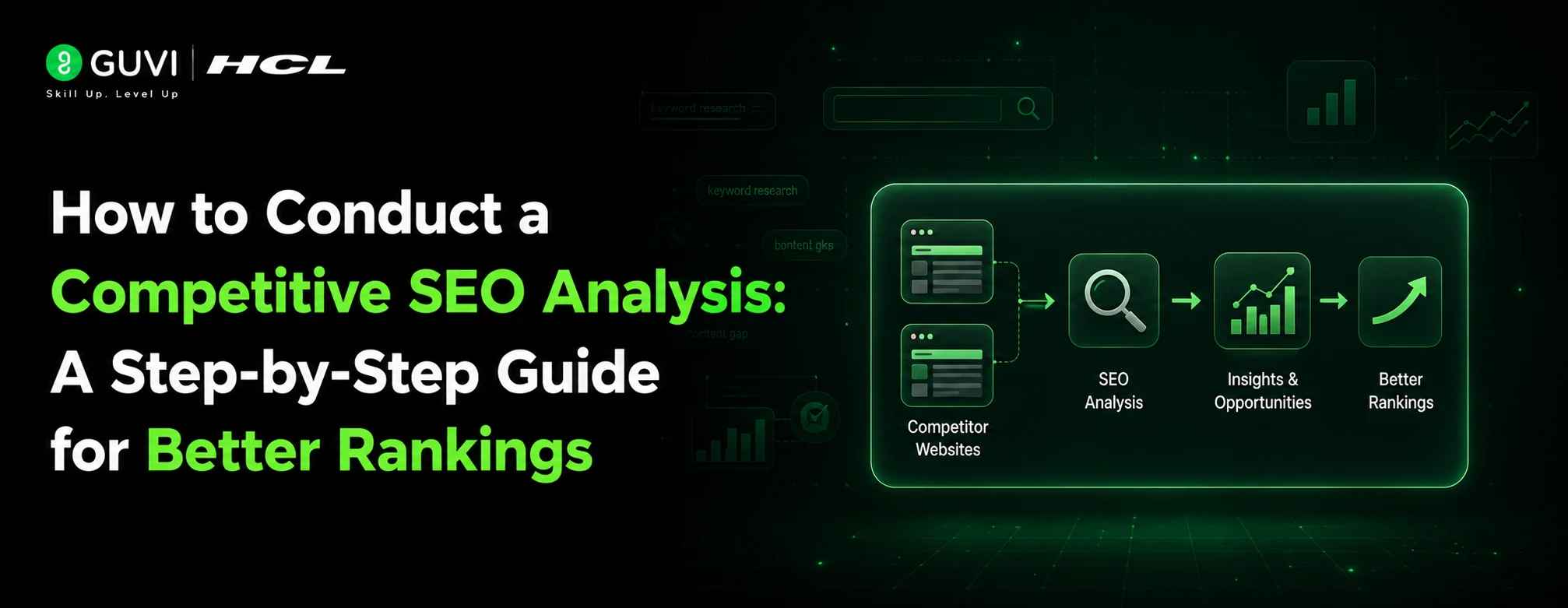
How to Conduct a Competitive SEO Analysis: A Step-by-Step Guide for Better Rankings in 2026
Jul 22, 2026 5 Min Read 306 Views
(Last Updated)
Table of contents
- TL;DR
- Introduction
- What Is Competitive SEO Analysis?
- Why Does It Matter?
- Why Is Competitive SEO Analysis Important?
- Key Benefits Of Competitive SEO Analysis
- How to Conduct a Competitive SEO Analysis?
- Step 1: Identify Your SEO Competitors
- Example
- Step 2: Perform Competitor Keyword Analysis
- Step 3: Analyze Competitor Content
- Step 4: Perform a Backlink Analysis
- Step 5: Conduct an SEO Audit
- Step 6: Compare Your SEO Strategy
- Best Tools for Competitive SEO Analysis
- Real-World Example Of Competitive SEO Analysis
- Common Mistakes to Avoid When Conducting Competitive SEO Analysis
- Copying Competitors Instead of Improving
- Ignoring Search Intent
- Focusing Only on Keywords
- Overlooking Technical SEO
- Performing Competitive SEO Analysis Only Once
- Build Practical SEO Skills with HCL GUVI
- Final Words
- Frequently Asked Questions (FAQs)
- What is Competitive SEO Analysis?
- How often should I perform a Competitive SEO Analysis?
- What is the difference between an SEO Audit and a Competitive SEO Analysis?
- Which tools are best for SEO Competitor Analysis?
- What is Competitor Keyword Analysis?
- Can small businesses benefit from Competitive SEO Analysis?
- How does Competitive SEO Analysis improve an SEO Strategy?
- What are the biggest mistakes during SEO Competitor Analysis?
TL;DR
- A competitive SEO analysis is the process of studying the websites already ranking for your target keywords to understand why they rank, then using those insights to build a stronger content and technical strategy of your own.
- It involves identifying your real search competitors (who are often different from your business competitors), comparing keyword rankings, auditing backlink profiles, spotting content gaps, and benchmarking technical SEO health.
- When done properly, a competitive SEO analysis turns guesswork into a prioritized action list: which keywords to target first, which content to build, and which technical fixes will move the needle the fastest.
Introduction
More than 68% of all online experiences begin with a search engine, making organic search one of the most valuable acquisition channels for businesses. Yet many websites struggle to rank because they focus only on their own SEO efforts instead of understanding what successful competitors are doing.
That’s where Competitive SEO Analysis becomes essential. Rather than guessing which keywords to target or what content to create, you can learn from competitors already ranking on the first page of Google. This helps you uncover keyword opportunities, identify content gaps, improve technical performance, and build a smarter SEO strategy.
In this guide, you’ll learn exactly how to perform a Competitive SEO Analysis step by step, the tools professionals use, and practical techniques you can apply immediately to improve your website’s search visibility.
What Is Competitive SEO Analysis?
Competitive SEO Analysis is the process of evaluating your competitors’ organic search performance to understand why they rank well and identify opportunities to improve your own SEO strategy.
It involves analyzing their keywords, content, backlinks, technical SEO, website structure, and overall search visibility.
Unlike a traditional SEO Audit, which focuses only on your own website, a Competitive SEO Analysis compares your website against competitors to reveal strengths, weaknesses, and untapped opportunities.
If you’re aiming to build a career in SEO, explore the essential skills required to become an SEO Specialist before diving into advanced competitor research.
Why Does It Matter?
A Competitive SEO Analysis helps you:
- Discover high-performing keywords.
- Identify content gaps.
- Analyze backlink opportunities.
- Improve website architecture.
- Benchmark your SEO performance.
- Prioritize SEO activities with higher ROI.
India had 1.03 billion internet users as of late 2025, at a 70.0% penetration rate, according to DataReportal’s Digital 2026 India report. That scale is exactly why organic search has become such a crowded, competitive channel and why an SEO competitor analysis is no longer optional for brands trying to rank.
Why Is Competitive SEO Analysis Important?
Ignoring your competitors means missing valuable insights already proven to work in your industry.
According to industry studies:
- Nearly 53% of all website traffic comes from organic search.
- The top three Google search results receive more than 50% of all clicks.
- Businesses publishing content based on keyword research consistently generate significantly more organic traffic than those relying on assumptions.
A Competitive SEO Analysis helps you make informed decisions instead of relying on trial and error.
Key Benefits Of Competitive SEO Analysis
| Benefit | Business Impact |
| Better keyword targeting | Higher rankings |
| Content gap analysis | More organic traffic |
| Backlink analysis | Improved domain authority |
| Technical benchmarking | Better user experience |
| Competitor monitoring | Smarter SEO Strategy |
How to Conduct a Competitive SEO Analysis?
Step 1: Identify Your SEO Competitors
Your business competitors and SEO competitors are not always the same. An SEO competitor is any website competing for the same keywords in Google Search.
How to Find Them
- Search your target keywords.
- Use Google Search results.
- Analyze SERP competitors.
- Use tools like Semrush, Ahrefs, or Moz.
- Compare websites with similar domain authority.
Example
Suppose you run a digital marketing blog.
Your SEO competitors may include:
These websites compete for the same informational keywords, even if they don’t offer identical services.
Step 2: Perform Competitor Keyword Analysis
Competitor Keyword Analysis helps you discover which keywords drive traffic to competing websites.
Instead of starting from scratch, you can identify:
- High-volume keywords
- Low-competition opportunities
- Long-tail keywords
- Informational search queries
- Commercial intent keywords
Questions to Ask
- Which keywords generate the most traffic?
- Which pages rank highest?
- Which keywords have low competition?
- Are competitors targeting featured snippets?
- Which keyword gaps exist?
Popular tools include:
- Semrush Keyword Gap
- Ahrefs Site Explorer
- Google Search Console
- Google Keyword Planner
Competitor research becomes far more effective when you know how to identify and optimize the right keywords. Our detailed guide on how to optimize keywords for SEO explains keyword intent, placement strategies, and best practices to improve your search rankings.
Many SEO professionals discover 30-50% of their new keyword opportunities through competitor keyword research rather than traditional keyword brainstorming.
Step 3: Analyze Competitor Content
Content is often the biggest reason competitors outrank your pages. A thorough Competitive SEO Analysis should evaluate not only what competitors publish but also how they structure, update, and optimize their content.
Review These Content Factors
- Content depth and comprehensiveness
- Search intent alignment
- Keyword placement
- Heading hierarchy (H2-H4)
- Internal linking
- Images, videos, and infographics
- Readability and user experience
- Freshness of content
Content Gap Analysis Checklist
| Analyze | Questions to Ask |
| Topic Coverage | Are competitors covering topics you’re missing? |
| Content Length | Is your content comprehensive enough? |
| Search Intent | Does the page answer the user’s query? |
| Media | Are competitors using visuals effectively? |
| Internal Links | Are related pages interconnected? |
Pro Tip: Don’t copy competitor content. Instead, identify what’s missing and create a more comprehensive, up-to-date, and user-focused resource.
Step 4: Perform a Backlink Analysis
Backlinks remain one of Google’s strongest ranking signals. Analyzing competitor backlinks helps you discover websites that are already linking to similar content within your niche.
Evaluate
- Referring domains
- High-authority backlinks
- Broken backlink opportunities
- Guest posting websites
- Resource pages
- Digital PR mentions
Questions to Ask
- Which websites link to multiple competitors?
- Are there industry directories worth joining?
- Which pages attract the most backlinks?
- Can you create better content to earn similar links?
Step 5: Conduct an SEO Audit
A Competitive SEO Analysis is incomplete without comparing technical performance. Even excellent content may struggle to rank if the website has technical issues.
SEO Audit Checklist
| Technical Area | Why It Matters |
| Core Web Vitals | Improves user experience |
| Page Speed | Reduces bounce rate |
| Mobile Friendliness | Essential for mobile-first indexing |
| HTTPS | Builds trust and security |
| Crawlability | Helps search engines discover pages |
| XML Sitemap | Improves indexing |
| Robots.txt | Controls crawler access |
| Structured Data | Enables rich results |
| Internal Linking | Distributes page authority |
Step 6: Compare Your SEO Strategy
Once you’ve gathered competitor insights, compare them with your own website.
Benchmark Areas
| SEO Factor | Your Site | Competitor |
| Organic Traffic | Compare monthly visits | Higher or lower? |
| Keyword Rankings | Top-performing keywords | Missing opportunities? |
| Content Quality | Coverage and freshness | More comprehensive? |
| Domain Authority | Authority score | Competitive gap? |
| Backlinks | Referring domains | Additional opportunities? |
This comparison helps prioritize improvements that can deliver the greatest SEO impact.

Best Tools for Competitive SEO Analysis
| Tool | Best For |
| Semrush | Keyword Gap, Backlinks, Traffic Analysis |
| Ahrefs | Competitor Keyword Analysis & Link Research |
| Google Search Console | Website Performance |
| Google Keyword Planner | Keyword Discovery |
| Screaming Frog | Technical SEO Audit |
| Google PageSpeed Insights | Website Speed Analysis |
Choose tools based on your budget and business goals. Even combining free Google tools with one premium SEO platform can provide valuable competitive insights.
AI-powered SEO platforms are transforming the way marketers conduct keyword research, optimize content, and perform technical audits. Explore our detailed guide on the best AI tools for SEO that can help streamline competitor analysis and improve productivity.
Real-World Example Of Competitive SEO Analysis
An online fitness brand targeting the keyword “home workout plan.”
After conducting a Competitive SEO Analysis, the marketing team discovers that the top-ranking competitors:
- Include downloadable workout PDFs.
- Answer frequently asked questions within the article.
- Add instructional videos.
- Update content every few months.
- Earn backlinks from health and fitness publications.
Instead of publishing another generic article, the brand creates a comprehensive guide featuring a 30-day workout plan, video demonstrations, printable resources, and expert nutrition tips.
Within a few months, the improved content begins ranking for multiple long-tail keywords and attracts backlinks from wellness blogs.
This example highlights how analyzing competitors can inspire better content rather than simply replicating existing pages.
Websites that regularly refresh high-performing content often maintain stronger search visibility than those that publish new articles without updating existing pages. Regular content updates signal relevance to both users and search engines.
Common Mistakes to Avoid When Conducting Competitive SEO Analysis
Even experienced marketers can make mistakes during SEO Competitor Analysis. Avoid these common pitfalls:
1. Copying Competitors Instead of Improving
Use competitor insights as inspiration, not as a blueprint. Focus on creating more valuable and original content.
2. Ignoring Search Intent
Ranking pages succeed because they satisfy user intent. Simply targeting the same keywords without addressing user needs rarely delivers long-term results.
3. Focusing Only on Keywords
Effective SEO goes beyond keyword placement. Technical optimization, user experience, content quality, and backlinks all contribute to rankings.
4. Overlooking Technical SEO
Slow-loading pages, broken links, and indexing issues can prevent high-quality content from reaching its ranking potential.
5. Performing Competitive SEO Analysis Only Once
Search results evolve continuously. Revisit competitor strategies every few months to identify new opportunities and maintain your competitive edge.
Build Practical SEO Skills with HCL GUVI
Understanding Competitive SEO Analysis is only one part of becoming an effective digital marketer.
To confidently apply concepts like keyword research, SEO audits, content marketing, Google Analytics, and performance marketing in real-world projects, structured hands-on learning can make a significant difference.
If you’re planning a career in digital marketing or want to strengthen your practical SEO skills, the HCL GUVI Digital Marketing Course offers project-based learning, industry-relevant tools, and mentor guidance to help you build job-ready expertise while working on real business scenarios.
Final Words
A Competitive SEO Analysis is one of the most effective ways to improve your website’s search performance without relying on guesswork. By evaluating your competitors’ keywords, content, backlinks, technical SEO, and overall SEO strategy, you gain actionable insights that help you create better content, target the right audience, and strengthen your search visibility.
Remember that SEO is an ongoing process rather than a one-time task. Regularly monitoring competitors, updating your content, and refining your SEO strategy will help you stay ahead of algorithm updates and changing user behavior. Start with one competitor today, document your findings, and turn those insights into measurable improvements for your website.
Frequently Asked Questions (FAQs)
1. What is Competitive SEO Analysis?
Competitive SEO Analysis is the process of comparing your website with competitors to identify opportunities for improving keyword rankings, content quality, backlinks, technical SEO, and overall organic search performance.
2. How often should I perform a Competitive SEO Analysis?
For most websites, conducting a Competitive SEO Analysis every three to six months is sufficient. However, highly competitive industries may benefit from monthly monitoring to keep up with ranking changes and emerging competitors.
3. What is the difference between an SEO Audit and a Competitive SEO Analysis?
An SEO Audit evaluates your own website for technical, on-page, and performance issues, while a Competitive SEO Analysis compares your website against competitors to uncover ranking opportunities, keyword gaps, and strategic improvements.
4. Which tools are best for SEO Competitor Analysis?
Popular tools include Semrush, Ahrefs, Moz, Google Search Console, Screaming Frog, and Google Keyword Planner. Each tool provides unique insights into keyword rankings, backlinks, technical SEO, and competitor performance.
5. What is Competitor Keyword Analysis?
Competitor Keyword Analysis is the process of identifying the keywords your competitors rank for and evaluating which ones can help improve your own SEO strategy. It helps uncover new content ideas, keyword gaps, and high-value search opportunities.
6. Can small businesses benefit from Competitive SEO Analysis?
Absolutely. Small businesses can use Competitive SEO Analysis to identify niche keyword opportunities, create more relevant content, and compete effectively without requiring the largest marketing budget.
7. How does Competitive SEO Analysis improve an SEO Strategy?
Competitive SEO Analysis provides data-driven insights that help prioritize keyword targeting, content creation, technical improvements, and backlink acquisition. This results in a more focused and effective SEO Strategy.
8. What are the biggest mistakes during SEO Competitor Analysis?
Common mistakes include copying competitors instead of improving upon their content, ignoring search intent, focusing only on keywords, overlooking technical SEO, and failing to monitor competitors regularly.
Success Stories

About the Author
Hashmithaa
Hi, I’m Hashmithaa — a content writer with a love for words. Writing isn’t just what I do; it’s how I connect, communicate, and create meaning in a noisy digital world. And if my words help someone make a better decision, learn something new, or feel more confident, then I’ve done my job well.
View all posts by Hashmithaa
Connect with me @











Did you enjoy this article?