


Business Analytics Articles
Using Claude for Personalized Content at Scale
How to Use Claude for YouTube Script writing


Get In Touch For Details! Request More Information
What is Marketing Analytics? A Beginner’s Guide to Metrics, Tools, and Career Scope
Aug 04, 2026 5 Min Read 322 Views
(Last Updated)
Table of contents
- TL;DR Summary
- Introduction
- What is Marketing Analytics?
- Why Marketing Analytics Matters for Businesses
- How Does Marketing Analytics Work?
- Step 1: Collect Marketing Data
- Step 2: Track the Right Marketing Metrics
- Step 4: Take Action
- Key Marketing Metrics and KPIs You Should Track
- Marketing Analytics Tools Beginners Should Know
- Marketing Analytics vs Digital Marketing Analytics
- How Businesses Use Marketing Analytics in Practice
- Retail and eCommerce Campaign Optimization
- EdTech Lead Quality Analysis
- SaaS Product Growth
- Common Mistakes in Marketing Analytics
- Tracking Too Many Vanity Metrics
- Ignoring Data Quality
- Looking at Channels Separately
- Reporting Without Action
- Wrapping Up
- Frequently Asked Questions
- What is marketing analytics in simple words?
- Why is marketing analytics important?
- What are the main types of marketing analytics?
- What is the difference between marketing analytics and digital marketing analytics?
- Which marketing analytics tools should beginners learn?
- What are the most important marketing KPIs?
- Is marketing analytics a good career?
- Do I need coding for marketing analytics?
TL;DR Summary
Marketing analytics is the process of collecting, measuring, and analyzing marketing data to understand what works, what does not, and where to invest next. It helps businesses track customer behavior, campaign performance, marketing KPIs, conversion rates, and ROI across channels like SEO, paid ads, email, social media, and websites. For learners, it is a powerful career skill because modern marketing teams need people who can convert raw data into practical business decisions.
Introduction
Marketing analytics helps businesses stop guessing and start making smarter marketing decisions.
If you have ever wondered why one ad brings leads while another burns budget, marketing data analysis gives you the answer. In simple terms, it connects customer actions, campaign analytics, and business outcomes so teams can improve ROI. That is why marketing analytics is now a must-have skill for digital marketers, business analysts, founders, and growth teams.
What is Marketing Analytics?
Marketing analytics is the practice of using data to measure, analyze, and improve marketing performance. It helps businesses understand customer behavior, track marketing metrics, compare channels, and decide which campaigns deserve more budget.
At its core, marketing analytics answers three questions:
- Who is responding to your marketing?
- Which channels are driving results?
- What should you improve next?
For example, an eCommerce brand may use marketing analytics to check whether Instagram ads, Google Search ads, or email campaigns bring the highest revenue. Instead of relying on opinions, the team uses data to decide where to spend.
Why Marketing Analytics Matters for Businesses
Marketing teams today are expected to prove impact, not just run campaigns. Every dollar spent on ads, content, SEO, email, or social media needs to connect back to leads, sales, retention, or customer growth.
This is where marketing analytics becomes valuable. It helps businesses understand which campaigns are performing well, which channels are wasting budget, and which customer segments are most likely to convert.
For example, Gartner reported that marketing budgets dropped significantly from pre-pandemic levels to an average of 7.8% of company revenue in 2026 . That means marketers have less room for guesswork and more pressure to show measurable ROI. Paid media also accounted for 27.9% of marketing budgets, making campaign analytics essential for deciding where money should go.
Marketing analytics helps teams:
- Reduce wasted ad spend
- Improve lead quality
- Understand customer journeys
- Personalize campaigns
- Forecast demand
- Report marketing KPIs to leadership
A business may have great content, strong ads, and a busy social media calendar. But without analytics, it cannot clearly see which activity creates revenue.
In fact, HubSpot’s 2026 State of Marketing report found that measuring marketing ROI remains one of the biggest challenges for marketers. This is why businesses increasingly need professionals who can connect marketing data analysis with practical decision-making.
How Does Marketing Analytics Work?
Marketing analytics works by collecting data from different marketing channels, cleaning it, analyzing patterns, and turning the findings into decisions. The goal is not just to create dashboards, but to improve action.
Step 1: Collect Marketing Data
Data usually comes from websites, ad platforms, CRM systems, email tools, social media platforms, and sales reports.
Google Analytics 4, for example, lets businesses understand traffic sources, user behavior, events, and conversion performance across channels.
Step 2: Track the Right Marketing Metrics
Not every number matters equally. A post may get thousands of likes but produce zero leads, while a low-traffic landing page may bring high-quality customers.
That is why useful marketing metrics should always connect to a business goal, such as awareness, lead generation, sales, retention, or revenue growth.
| Marketing Metric | What It Measures | How It Helps |
| Website Visitors | The number of people visiting your website from search, ads, social media, email, or referrals. | Helps you understand whether your marketing is generating enough attention and traffic. |
| Conversion Rate | The percentage of visitors who complete a desired action, such as signing up, booking a demo, or making a purchase. | Shows whether your landing pages, offers, and campaigns are persuasive enough. |
| Cost per Lead | The amount spent to generate one lead from a campaign or channel. | Helps compare whether platforms like Google Ads, LinkedIn, Meta, or email are bringing leads at a reasonable cost. |
| Customer Acquisition Cost | The total marketing and sales cost required to acquire one paying customer. | Helps businesses understand whether their growth is profitable or too expensive to sustain. |
| Return on Ad Spend | The revenue earned for every dollar spent on advertising. | Helps marketers decide which paid campaigns deserve more budget and which ones need improvement. |
| Email Open Rate | The percentage of people who open your email campaign. | Helps evaluate whether your subject lines, sender name, timing, and audience targeting are attracting attention. |
| Lead-to-Customer Ratio | The percentage of leads that eventually become paying customers. | Helps marketing and sales teams understand lead quality and identify where prospects drop off. |
| Customer Lifetime Value | The total revenue a customer may bring throughout their relationship with the business. | Helps decide how much you can afford to spend on acquiring and retaining customers. |
Step 3: Analyze Patterns
Marketing data analysis helps you identify what is working.
For example, if LinkedIn ads bring fewer leads but those leads convert into higher-value customers, LinkedIn may still be a better channel than a cheaper platform.
Step 4: Take Action
The final step is decision-making.
A marketer may pause low-performing ads, increase budget for high-converting campaigns, improve landing pages, or create audience segments using customer analytics.
Key Marketing Metrics and KPIs You Should Track
Marketing KPIs show whether marketing activities are moving the business forward. Beginners often track too many metrics, so start with the ones linked to revenue and customer behavior.
| Marketing Metric | What It Measures | Why It Matters |
| Conversion Rate | Percentage of users taking action | Shows landing page and campaign effectiveness |
| CAC | Cost to acquire one customer | Helps control marketing spend |
| ROAS | Revenue earned per ad spend | Measures paid campaign profitability |
| CTR | Clicks compared to impressions | Shows ad or content relevance |
| Customer Lifetime Value | Revenue from one customer over time | Helps decide acquisition budget |
| Lead Quality | How likely leads are to buy | Improves sales and marketing alignment |
A strong analytics habit is to connect every metric to a business question. For example, “Which campaign generated the most qualified leads?” is more useful than “How many people saw the ad?”
Marketing Analytics Tools Beginners Should Know
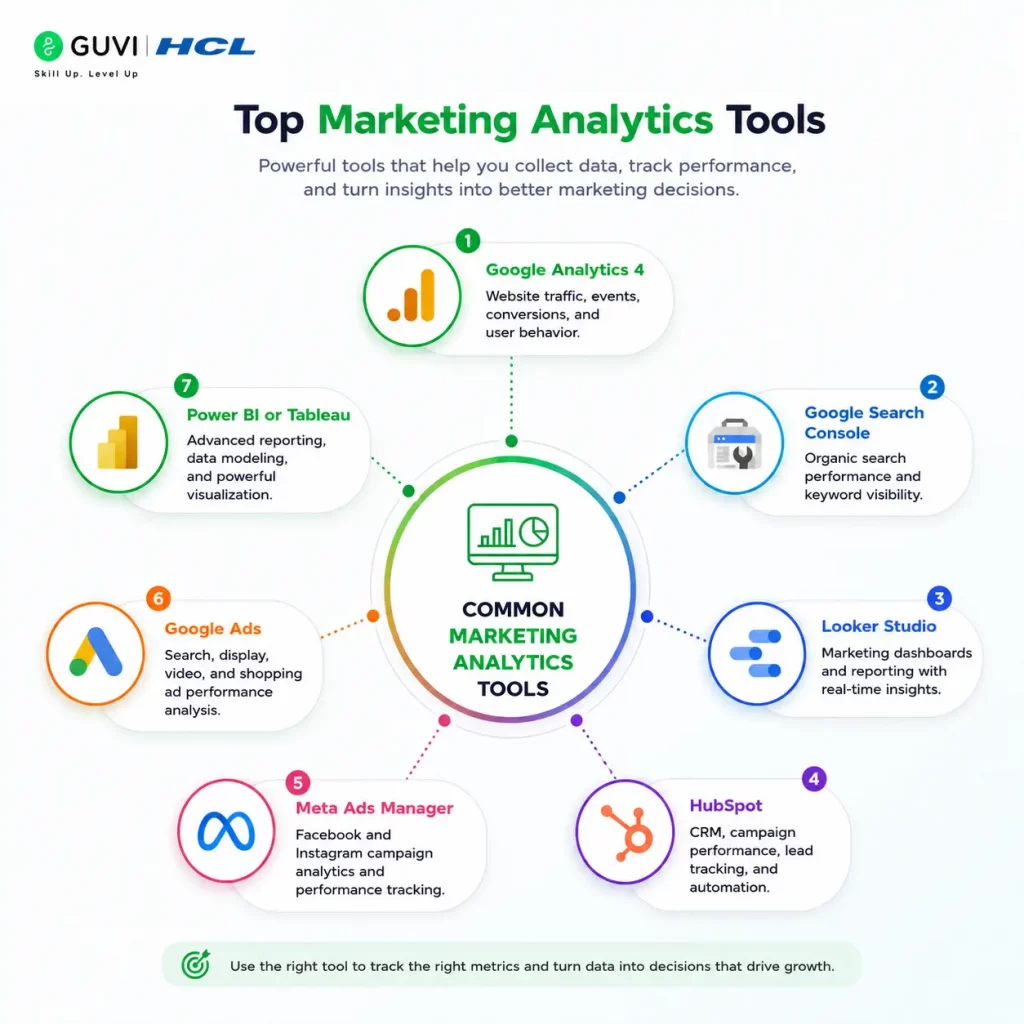
Marketing analytics tools help you collect, visualize, and interpret data faster. You do not need to master every tool at once, but you should understand what each tool is used for.
HubSpot’s 2026 report also highlights data and analytics as a must-have marketing skill, especially because teams need people who can turn data into business results and actionable advice.
Marketing Analytics vs Digital Marketing Analytics
Marketing analytics and digital marketing analytics are closely related, but they are not exactly the same.
| Factor | Marketing Analytics | Digital Marketing Analytics |
| Scope | Covers online and offline marketing | Focuses mainly on digital channels |
| Data Sources | CRM, sales, events, surveys, ads, website | Website, SEO, email, social, paid ads |
| Main Use | Business-wide marketing decisions | Digital campaign optimization |
| Example | Measuring total campaign ROI | Measuring Google Ads conversion rate |
| Users | Marketing leaders, analysts, business teams | Digital marketers, SEO, PPC, social teams |
Digital marketing analytics is a part of marketing analytics. If marketing analytics is the full map, digital marketing analytics is the online route inside that map.

As you start working with tools like GA4, Looker Studio, Google Ads, and customer analytics dashboards, the real advantage comes from knowing how to connect marketing data with business decisions. To build that practical bridge, you can explore HCL GUVI’s Business Analytics & Digital Marketing 5-day Email Course, as a starting point, and get introduced to how analytics, campaigns, and performance marketing work together in real business scenarios.
How Businesses Use Marketing Analytics in Practice
Marketing analytics becomes powerful when it solves real business problems. It is not just about dashboards or reports. It is about helping teams decide what to improve next.
The demand for this skill is also growing. The U.S. Bureau of Labor Statistics projects employment for market research analysts and marketing specialists to grow 7% from 2024 to 2034, faster than the average for all occupations. That growth reflects how important customer analytics, campaign analytics, and data-backed decision-making have become across industries.
Retail and eCommerce Campaign Optimization
An online fashion store can use campaign analytics to compare Google Shopping ads, Instagram reels, and abandoned cart emails.
If email retargeting brings the highest conversion rate, the brand can invest more in segmented email journeys instead of only running new customer ads.
EdTech Lead Quality Analysis
An EdTech company can use customer analytics to understand which users are more likely to enroll in a course.
For example, users who attend a webinar, download a syllabus, and revisit the pricing page may be scored as high-intent leads. The sales team can then prioritize them.
SaaS Product Growth
A SaaS company can analyze free trial users and identify which actions predict paid conversion.
If users who invite a teammate within the first three days convert better, the marketing team can build onboarding campaigns around that behavior.
Also Read : Business Analytics Guide To Growth
A “like” on a campaign can feel exciting, but analytics often reveals a funny truth: the quietest customers sometimes spend the most. That is why smart marketers do not just chase applause; they track actions, conversions, and revenue.
Common Mistakes in Marketing Analytics
1. Tracking Too Many Vanity Metrics
Many beginners focus heavily on likes, impressions, or followers because these numbers are easy to see. The problem is that they may not show business impact.
The fix is to connect every metric to a goal. Track conversions, qualified leads, acquisition cost, and revenue contribution along with engagement.
2. Ignoring Data Quality
Marketing reports can become misleading when tracking codes are broken, duplicate leads exist, or campaign URLs are not tagged properly. Poor data leads to poor decisions.
Before analyzing, check whether your data sources are clean. Use consistent UTM parameters, remove duplicates, and validate conversion events regularly.
3. Looking at Channels Separately
A customer may discover your brand through LinkedIn, return through Google, and finally convert through email. If you judge only the last channel, you may miss the full journey.
Use attribution reports and customer journey analysis to understand how different touchpoints work together.
4. Reporting Without Action
A dashboard is not useful if it only shows numbers. Marketing analytics should guide what to change next.
For every report, add one recommendation. For example, “Increase search ad budget by 15% because cost per qualified lead is 30% lower than social ads.”
If you want to move from basic reporting to business decision-making, learning analytics, SQL, dashboards, and stakeholder communication can give you a strong edge. HCL GUVI’s AI-Powered Business Analyst Course can help you build these practical skills through a structured, project-based learning path. Plus, you get access to an expert faculty and a network of 1000+ hiring partners, along with placement assistance.
Wrapping Up
Marketing analytics is no longer optional for modern marketing teams. It helps businesses understand customers, measure campaign performance, improve marketing KPIs, and make better budget decisions. For learners, it is also a career-building skill because companies need professionals who can combine marketing thinking with data analysis. Start by learning core metrics, practice with Google Analytics 4, build simple dashboards, and analyze real campaign data. The more you connect data to business outcomes, the more valuable you become.
Frequently Asked Questions
What is marketing analytics in simple words?
Marketing analytics means using data to understand and improve marketing performance. It helps you see which campaigns, channels, and customer actions lead to results.
Why is marketing analytics important?
Marketing analytics is important because it helps businesses measure ROI, reduce wasted spend, and make decisions based on evidence instead of guesswork.
What are the main types of marketing analytics?
The main types are descriptive analytics, diagnostic analytics, predictive analytics, and prescriptive analytics. Together, they explain what happened, why it happened, what may happen next, and what action to take.
What is the difference between marketing analytics and digital marketing analytics?
Marketing analytics covers both online and offline marketing performance. Digital marketing analytics focuses specifically on online channels like SEO, paid ads, email, websites, and social media.
Which marketing analytics tools should beginners learn?
Beginners can start with Google Analytics 4, Google Search Console, Looker Studio, Excel, Google Ads, Meta Ads Manager, and a CRM tool like HubSpot.
What are the most important marketing KPIs?
Important marketing KPIs include conversion rate, cost per lead, customer acquisition cost, return on ad spend, customer lifetime value, and lead quality.
Is marketing analytics a good career?
Yes, marketing analytics is a strong career option because businesses need data-driven marketers who can measure performance and improve revenue outcomes.
Do I need coding for marketing analytics?
You do not need advanced coding to start. Excel, GA4, dashboards, and basic SQL are enough for beginner-level roles, while Python can help in advanced analysis.
Success Stories













Did you enjoy this article?