


Career Articles
Capgemini Exceller Syllabus 2026: Complete Topics and Exam Pattern - Best Guide
Capgemini Exceller Interview Questions 2026: Coding, Technical, HR, and AI Prep - Best Guide
Capgemini Exceller Recruitment Process for Freshers 2026 - Best Guide
Deloitte NLA Recruitment Process: The Best Guide for Freshers 2026


Get In Touch For Details! Request More Information
How to Change Careers With No Experience: A Practical Career Change Guide
Jul 13, 2026 6 Min Read 440 Views
(Last Updated)
Table of contents
- TL;DR Summary
- Introduction
- Why Career Change Is More Common Than Ever
- What Does It Mean to Change Your Career With No Experience?
- Step-by-Step Career Change Guide
- Step 1: Choose One Target Role
- Step 2: Map Transferable Skills
- Step 3: Learn Only Role-Relevant Skills
- Step 4: Build Proof of Work
- Step 5: Rewrite Your Resume for the New Role
- Step 6: Network Before Applying
- How to Switch Industries Without Starting From Zero
- Skills That Help Across Industries
- Traditional Career Change vs Skills-Based Career Change
- Career Change in Action: How Beginners Can Reposition Their Background
- Example 1: Commerce Graduate to Data Analyst
- Example 2: Mechanical Engineer to Full Stack Developer
- Benefits of Changing Careers
- Common Mistakes to Avoid
- Mistake 1: Learning Without a Target Role
- Mistake 2: Applying With an Old Resume
- Mistake 3: Hiding Your Career Change
- Mistake 4: Waiting Until You Feel Fully Ready
- Mistake 5: Ignoring Networking
- Wrapping Up
- Frequently Asked Questions
- Can I change careers with no experience?
- What is the best way to switch industries?
- Is a career change after graduation possible?
- How long does a career transition take?
- What should I put on my resume if I have no experience?
- Which fields are easier for beginners to enter?
- Do I need another degree to change careers?
- What are the most useful career transition tips?
TL;DR Summary
To change careers with no experience, start by choosing one target role, mapping your transferable skills, learning only the skills required for that role, and building 2–3 proof-based projects before applying. You do not need a perfect background to switch industry; you need role clarity, visible skills, a tailored resume, and networking. This Career Change Guide gives you a practical roadmap for career change after graduation, early-career switches, and mid-career transitions without wasting time on random courses.
Introduction
The smartest path to change careers with no experience requires not to “start over,” but to reposition what you already know into a role employers actually hire for. Career transitions are rising because industries are changing faster than degrees and job titles can keep up.
The World Economic Forum estimates that structural labour-market transformation could affect 22% of today’s jobs by 2030, creating 170 million jobs while displacing 92 million roles. It also reports that 39% of existing worker skills may change or become outdated between 2025 and 2030.
This guide shows you how to choose a new field, build relevant skills, create proof of work, and apply with confidence even when your resume does not yet show direct experience.
Why Career Change Is More Common Than Ever
A career change is no longer seen as a risky exception. It is becoming a normal response to automation, AI adoption, salary shifts, burnout, and better opportunities in emerging fields.
Employers are also becoming more skills-focused. The World Economic Forum reports that 63% of employers see skill gaps as a major barrier to business transformation, while 85% plan to prioritize workforce upskilling.
LinkedIn’s 2025 Workplace Learning Report says 84% of employees agree that learning adds purpose to their work. That means learning is not just a resume booster; it can directly improve motivation during a career transition.
What Does It Mean to Change Your Career With No Experience?
To change your career with no experience means moving into a new role or industry without direct professional work history in that field, by using transferable skills, structured learning, portfolio projects, internships, freelance work, or entry-level opportunities to prove job readiness.
For example, a commerce graduate can move into data analytics by learning Excel, SQL, Power BI, and business reporting. A mechanical engineer can switch industry into product design, EV technology, or full-stack development by building role-specific projects.
The goal is not to convince employers with enthusiasm alone. The goal is to reduce hiring risk by showing evidence.
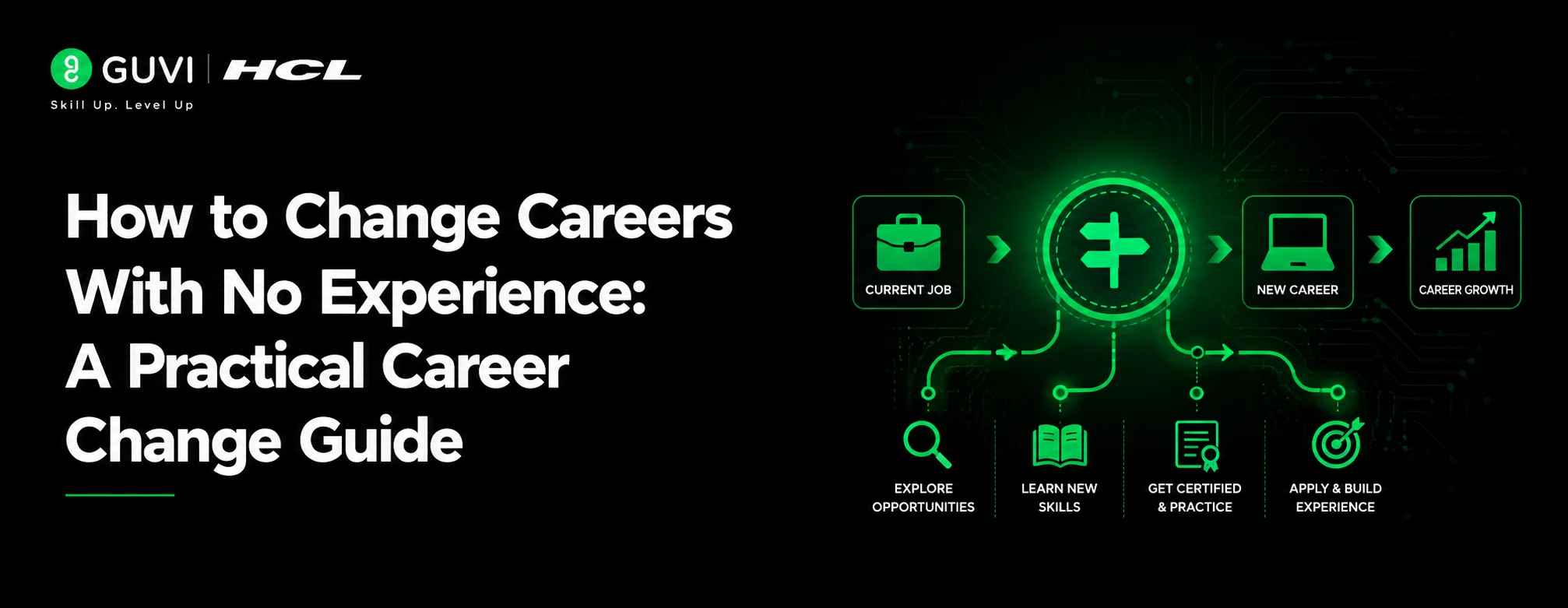
Step-by-Step Career Change Guide
A successful career transition needs structure. Random learning usually leads to confusion, but a role-first roadmap helps you move faster.
Step 1: Choose One Target Role
Do not begin with “I want to enter tech” or “I want a better job.” That is too broad and can make your learning direction unclear.
Choose one role, such as:
- Data Analyst
- Full Stack Developer
- UI/UX Designer
- Digital Marketer
- Business Analyst
- AI/ML Associate
- DevOps Engineer
Once you pick a role, study 20–30 job descriptions. Note repeated tools, skills, projects, and responsibilities.
This helps you understand what companies actually expect. Instead of learning randomly, you start preparing for the exact skills that can create a real career change.
Step 2: Map Transferable Skills
You may have no direct experience, but you are rarely starting from zero.
| Existing Background | Transferable Skills | Possible New Career |
| Sales | Communication, CRM, persuasion | Business Development, Product Marketing |
| Teaching | Explanation, planning, mentoring | Instructional Design, EdTech, L&D |
| Engineering | Logic, systems thinking, problem-solving | Data, Software, Product Design |
| Commerce | Excel, reporting, numbers | Data Analytics, Finance Analytics |
| Design interest | Visual thinking, empathy | UI/UX Design |
Table Caption: Transferable skills can help you switch industry without treating your previous education or work as wasted effort.
Mapping these skills helps you position your past experience better. It also shows recruiters that your previous background supports your new career direction instead of looking unrelated.
Step 3: Learn Only Role-Relevant Skills
One of the best career transition tips is to avoid learning everything.
For data analytics, start with Excel, SQL, visualization, and one project. For web development, start with HTML, CSS, JavaScript, React, Node.js, and Git. For UI/UX, start with user research, wireframes, Figma, usability testing, and case studies.
This focused learning approach saves time and prevents overwhelm. It also helps you reach interview-ready confidence faster because every skill you learn has a clear connection to the role.
Step 4: Build Proof of Work
When you lack experience, your portfolio becomes your experience.
Build 2–3 simple but complete projects:
- A sales dashboard using Excel or Power BI
- A personal finance tracker using React
- A food delivery app UI case study in Figma
- A customer churn analysis using Python
- A landing page for a small business
Each project should explain the problem, tools used, process, output, and business impact.
This creates visible proof that you can apply what you learned. Employers may overlook the lack of formal experience when your projects show practical thinking, tool knowledge, and problem-solving ability.
Step 5: Rewrite Your Resume for the New Role
Your old resume should not look like an apology for changing careers.
Use this structure:
- Career summary focused on target role
- Transferable skills
- Relevant tools
- Portfolio projects
- Certifications or training
- Previous experience reframed around outcomes
For example, instead of writing “Handled customer calls,” write “Analyzed recurring customer issues and documented patterns to improve resolution quality.”
This small change improves how recruiters understand your experience. The first version sounds task-based, while the second version shows analysis, ownership, and business impact, which are some of the qualities that matter across industries.
Step 6: Network Before Applying
Cold applications work better when people already know your intent.
Start with:
- LinkedIn posts about your learning journey
- Commenting on industry discussions
- Asking professionals for 15-minute guidance
- Joining role-specific communities
- Sharing weekly project progress
This is especially useful for career change after graduation, where you may not yet have strong work experience.
Networking creates visibility before opportunities appear. When people see your learning progress consistently, they are more likely to refer you, guide you, or remember you when a beginner-friendly role opens up.
How to Switch Industries Without Starting From Zero
To switch industries successfully, you need to understand what stays useful and what must be rebuilt.
For example, if you are moving from mechanical engineering to data analytics, your analytical thinking remains valuable. But you still need SQL, dashboards, statistics basics, and business storytelling.
Skills That Help Across Industries
| Skill | Why It Matters |
| Communication | Helps you explain ideas clearly |
| Problem-solving | Shows you can handle ambiguity |
| Data interpretation | Useful in almost every modern role |
| Collaboration | Required in cross-functional teams |
| Adaptability | Important when industries change fast |
Table Caption: These cross-industry skills make it easier to change your career with no experience because they reduce the learning gap.
Traditional Career Change vs Skills-Based Career Change
| Factor | Traditional Career Change | Skills-Based Career Change |
| Main focus | Degree or past title | Current skills and projects |
| Speed | Slower | Faster if focused |
| Proof | Years of experience | Portfolio, tasks, internships |
| Best for | Regulated fields | Tech, design, analytics, marketing |
| Risk | High if unclear | Lower with role-specific proof |
Career Change in Action: How Beginners Can Reposition Their Background
Career change becomes easier to understand when you see how people from different backgrounds can reposition themselves. The examples below show how skills, projects, and resume language can turn an unrelated profile into a more relevant one.
These examples are not about pretending to have experience. They are about presenting your existing strengths in a way that matches the new role.
Example 1: Commerce Graduate to Data Analyst
A B.Com graduate wants to change careers after graduation but has no analytics job experience. Instead of applying immediately, they build three projects: a retail sales dashboard, a customer segmentation report, and an expense analysis dashboard.

Now their resume does not say “fresher only.” It says they can clean data, analyze trends, create dashboards, and explain business insights.
Writing it this way changes the recruiter’s perception. The candidate is no longer just asking for a chance; they are showing evidence that they can already perform beginner-level analytics tasks.
Example 2: Mechanical Engineer to Full Stack Developer
A mechanical engineer wants to switch industry into software development. They learn JavaScript, React, Node.js, MongoDB, and Git.
They build a service booking app, a portfolio website, and an inventory management project. During interviews, they connect engineering problem-solving with software logic. That makes the transition believable.
This repositioning matters because it connects the old background to the new role. Instead of saying “I want to move into software,” the candidate can say, “My engineering background helped me build structured problem-solving skills, and I have applied them through full stack projects.”
Benefits of Changing Careers
Salary depends on your target role, skill level, location, and portfolio quality. However, switching into high-demand fields can improve long-term growth when done strategically.
The U.S. Bureau of Labor Statistics projects total employment to grow by 5.2 million jobs from 2024 to 2034, mainly driven by healthcare and social assistance. For tech-aligned roles, the World Economic Forum lists Big Data Specialists, Fintech Engineers, AI and Machine Learning Specialists, and Software and Application Developers among the fastest-growing roles by percentage.
| Career Path | Beginner-Friendly Entry Route | Long-Term Benefit |
| Data Analytics | Excel, SQL, Power BI projects | Business decision-making roles |
| Full Stack Development | Web apps and GitHub portfolio | Product and software careers |
| UI/UX Design | Figma case studies | Design and product roles |
| AI/ML | Python, ML projects, math basics | Emerging AI-focused roles |
| DevOps | Linux, cloud, CI/CD basics | Infrastructure and automation roles |
Common Mistakes to Avoid
Career changers usually fail because of unclear positioning, not lack of potential.
Avoiding these mistakes can help you save months of confusion. More importantly, it can make your career transition look intentional rather than desperate or random.
Mistake 1: Learning Without a Target Role
Fix this by choosing one role before buying courses or watching tutorials.
Without a target role, you may keep jumping between skills like Python, design, marketing, and cloud without building depth in any one area. A clear role helps you decide what to learn first, what to ignore, and what kind of projects to build.
Mistake 2: Applying With an Old Resume
Fix this by rewriting your resume around your new role, tools, and projects.
If your resume only highlights your previous field, recruiters may not understand why you are applying for the new role. A role-focused resume helps them connect your transferable skills, learning, and portfolio to the job description.
Mistake 3: Hiding Your Career Change
Fix this by explaining your transition clearly: “I am moving from X to Y because my skills in A and B align with this role.”
Trying to hide your career switch can make your profile look confusing. A clear explanation shows maturity, self-awareness, and direction, which are valuable qualities in entry-level and transition candidates.
Mistake 4: Waiting Until You Feel Fully Ready
Fix this by applying once you have basic skills and 2–3 strong projects.
Many beginners delay applications because they feel they need one more course or one more certificate. In reality, feedback from interviews and applications can help you improve faster than endless preparation.
Mistake 5: Ignoring Networking
Fix this by sharing your learning publicly and asking for feedback from people already in the industry.
Networking is not only about asking for jobs. It helps you understand hiring expectations, discover hidden opportunities, and get practical advice from people who have already made similar transitions.
Wrapping Up
You can change careers with no experience if you stop treating experience as only a job title and start building visible proof. Pick one role, map your transferable skills, learn the exact tools required, create projects, and apply with a tailored resume. The best career change strategy is not speed alone; it is clarity plus consistency. Start small, build proof every week, and position yourself as someone who is already doing the work, not just hoping for a chance.
If you want a guided way to build job-ready skills, explore HCL GUVI’s Career Programs in areas like Data Science, AI & Machine Learning, MERN Full Stack, UI/UX Design, DevOps & Cloud, VLSI, and Product Management. HCL GUVI’s Zen Class page lists live, expert-led programs across beginner and professional tracks, with featured programs in Data Science, AI, Web Development, Design, Analytics, Deployment, and more. Plus, you get to learn with mentorship from industry experts, build practical projects, and gain access to 1000+ hiring partners, opening doors to better career opportunities as you make your transition with confidence!
Frequently Asked Questions
1. Can I change careers with no experience?
Yes. You can change your career with no experience by building role-specific skills, creating portfolio projects, networking, and applying for entry-level, internship, freelance, or trainee roles.
2. What is the best way to switch industries?
The best way to switch industries is to choose one target role, identify transferable skills, learn missing tools, and create proof of work that matches real job descriptions.
3. Is a career change after graduation possible?
Yes. Career change after graduation is common because many graduates discover their interests after college. Start with internships, projects, certifications, and beginner-friendly roles.
4. How long does a career transition take?
A focused career transition can take 3–9 months depending on the role, your current skill level, portfolio quality, and consistency.
5. What should I put on my resume if I have no experience?
Add a role-focused summary, transferable skills, tools, projects, certifications, internships, freelance work, and measurable outcomes from past academic or work experience.
6. Which fields are easier for beginners to enter?
Data analytics, web development, UI/UX design, digital marketing, business analysis, and software testing are often beginner-friendly because skills in these fields can be demonstrated through projects.
7. Do I need another degree to change careers?
Not always. Many modern roles value skills, projects, certifications, and problem-solving ability. However, regulated careers like medicine, law, or clinical roles may require formal degrees.
8. What are the most useful career transition tips?
Choose one role, avoid random learning, build proof of work, tailor your resume, network consistently, and explain your career change with confidence.
Success Stories








Did you enjoy this article?