


Academics Articles
TCS NQT Eligibility Criteria 2026: Age Limit, Graduation Criteria & Who Can Apply
TCS NQT Coding Questions: Examples, Patterns & Practice Guide
TCS NQT Exam 2026 Pattern : Preparation Strategy, Tips & More


Get In Touch For Details! Request More Information
Subject to Choose in Class 11 for Software Engineering? Complete Guide 2026
Jul 13, 2026 5 Min Read 34073 Views
(Last Updated)
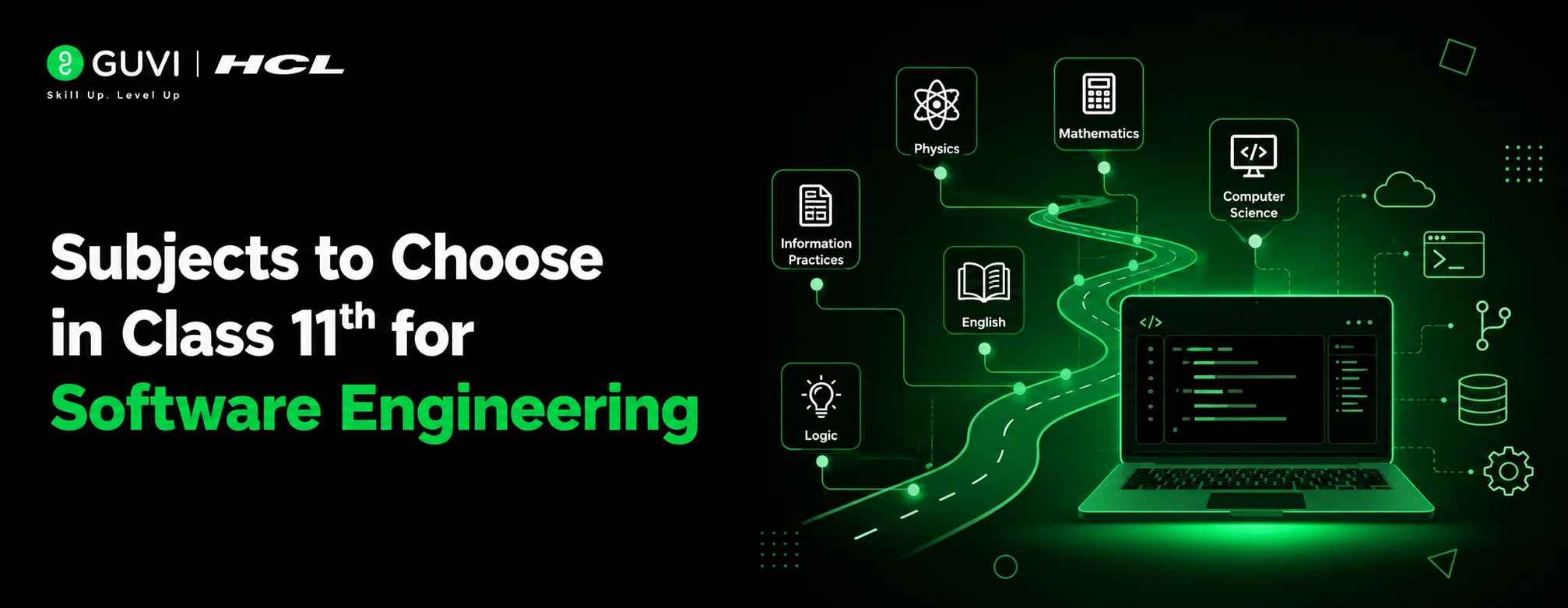
Subjects to Choose in Class 11th for Software Engineering play a crucial role in shaping your future career. Choosing the right combination in Class 11 not only builds a strong foundation in coding and problem-solving but also keeps you eligible for engineering entrance exams and admission to top colleges.
For most aspiring software engineers, the ideal combination is Physics, Chemistry, Mathematics, and Computer Science (PCM + CS), along with English. This subject mix offers the best balance between academic eligibility and the technical skills needed for a career in software engineering.
Table of contents
- TL;DR Summary
- Why Your Class 11 Subject Choice Matters for Software Engineering
- Best Combination of Subjects to Choose in Class 11th for Software Engineering
- Is Maths Compulsory for Software Engineering? Truth vs Myth Explained
- Can Commerce or Arts Students Become Software Developers?
- Subject Combination for Software Engineering: Career Path, Difficulty & Top Colleges
- Class 11 to Software Engineer Roadmap: Step-by-Step Guide (2026)
- Step 1: Class 11–12 — Pick your subjects wisely
- Step 2: Learn one programming language early
- Step 3: Choose your degree route
- Step 4: Build real projects, not just theory
- Step 5: Learn Data Structures & Algorithms (DSA)
- Step 6: Do internships early
- Step 7: Apply, interview, and keep learning
- Common Mistakes Students Make
- Conclusion
- FAQs
- What subjects should I take in Class 11 for software engineering?
- Can I become a software engineer without Maths in Class 11?
- Is Computer Science compulsory for software engineering in Class 11?
- Can Commerce students switch to software engineering later?
- Does Class 11 subject choice affect my software engineering salary later?
TL;DR Summary
- Best stream: Science (PCM — Physics, Chemistry, Maths) is the most direct path; Computer Science as an elective gives you a head start.
- Maths is non-negotiable for most engineering entrance exams (JEE Main, BITSAT, state CETs), even though a handful of newer universities now accept PCB or Commerce with bridge courses.
- Add Computer Science in Class 11–12 if your school offers it — it’s the single highest-leverage elective for this career.
- English stays compulsory across almost every CBSE/ISC/State board combination and matters more than students expect for technical communication.
- Subject choice is a launchpad, not a life sentence — commerce and arts students do become developers, just via a longer, self-taught route.
Why Your Class 11 Subject Choice Matters for Software Engineering
Picking Class 11 subjects feels like a huge decision at 15 or 16 years old — and honestly, it kind of is.
The real question every student asks: “Will the wrong subject choice close the door to becoming a software engineer?”
Short answer: Not entirely — but it will make your path longer.
💡 Pro Tip: Think of Class 11–12 subjects as the fastest lane to software engineering, not the only lane. The fastest lane still saves you 1–2 years of catch-up work later.
Here’s what typically happens:
- Students who choose PCM + Computer Science usually enter engineering coding courses with far less programming anxiety, since they’ve already built a foundation.
- Students who choose PCM without CS can still catch up — but only if that extra time is used deliberately, through platforms like Scratch, Python basics, or CS50.
The takeaway: Subject choice determines your starting line, not your finish line.
Planning to become a software engineer? Build a strong foundation in computer fundamentals before you start coding with HCL GUVI’s Basics of Computer Course. Learn essential computing concepts, networking, cybersecurity, and programming basics through beginner-friendly lessons and practical examples—start your tech journey with confidence and get future-ready from day one!
Best Combination of Subjects to Choose in Class 11th for Software Engineering
The best subject combination for software engineering in Class 11 is:
Physics + Chemistry + Mathematics + Computer Science + English
This combination is sometimes called “PCM with CS” or “PCM-CS.”
Here’s why each subject earns its place:
- Mathematics — Trains you in algorithms, logic, discrete structures, and the abstract reasoning coding actually runs on.
- Computer Science — Direct exposure to programming (usually Python, sometimes Java or C++), basic data structures, and database fundamentals.
- Physics — Required for most engineering entrance exams (JEE Main, JEE Advanced, BITSAT, state CETs) and useful for understanding hardware- and systems-level concepts later.
- Chemistry — Mostly a formality in the Science stream’s eligibility criteria; it rarely comes up again once you’re in a CS or IT program.
- English — Compulsory in nearly every board, and genuinely useful — technical writing, documentation, and client communication are underrated software engineering skills.
According to the National Testing Agency (NTA), the JEE Main eligibility criteria require Physics and Mathematics as compulsory subjects, along with one of Chemistry, Biotechnology, Biology, or a Vocational Subject in Class 12. [Source: National Testing Agency, JEE Main Information Bulletin]
If you’re in Class 11 or about to start, it’s the perfect time to begin your coding journey. Learn one of the world’s most widely used and beginner-friendly programming languages with HCL GUVI’s JavaScript Beginners Course and master the fundamentals of JavaScript to build dynamic and interactive websites and applications.

Is Maths Compulsory for Software Engineering? Truth vs Myth Explained
The myth: You need to be a maths genius — acing calculus and complex equations — to become a software engineer.
The truth: For most software engineering jobs (web development, app development, backend/frontend roles, QA), you need logical reasoning, not advanced maths. What you actually use daily is closer to Class 9–10 level maths, applied through code.
Where advanced maths genuinely matters:
- Machine Learning / AI / Data Science — linear algebra, probability, statistics, calculus
- Game development — geometry, trigonometry, vectors, matrices
- Cryptography, competitive programming — discrete maths, number theory
- Core CS research — mathematical maturity for complexity analysis and proofs
Where it barely matters: Building websites, apps, most SaaS products, and junior-to-mid developer roles — the maths ceiling here is low. What matters more is logical structuring: breaking a big problem into small steps.
The part nobody tells you: Logical thinking and mathematical ability are related but not identical. A commerce or arts student with no calculus background can still excel at logic-heavy coding, because coding logic is closer to puzzle-solving than to solving equations. That’s why non-Maths students crack coding interviews every year.
Bottom line: Maths isn’t compulsory for software engineering as a whole — it’s compulsory for specific specializations. Don’t let “bad at maths” alone scare you away. But for AI/ML or core CS research, real mathematical strength is non-negotiable.
Can Commerce or Arts Students Become Software Developers?
Yes — and this surprises a lot of people. Software development or engineering isn’t legally or academically restricted to PCM students.
Companies hiring developers care about one thing above all: whether you can code and solve problems. Nobody in a job interview asks what stream you took in Class 11.
Here’s the real picture:
Commerce students (even without Maths) and Arts students can absolutely become software developers. Thousands do it every year through routes like:
- BCA (Bachelor of Computer Applications) — open to Commerce and Arts students in most colleges, no PCM required
- BSc in Computer Science / IT — some universities accept Commerce/Arts with basic Maths eligibility (check specific college criteria)
- Self-taught + certifications — full-stack development, data structures, and DSA can be learned outside a formal CS degree
- Coding bootcamps — intensive 3–9 month programs that take non-CS backgrounds straight into job-ready roles
- BBA + coding skills — increasingly common for students who want tech + business hybrid roles (product management, tech consulting)
Where it gets harder:
The one door that stays mostly shut is the traditional B.Tech/B.E. route, since most engineering colleges require Physics, Chemistry, and Maths (PCM) at the +2 level for eligibility — this is a college admission rule, not a coding-ability rule.
If your goal is specifically a B.Tech in Computer Science, PCM is the standard requirement.
The Reality: Your stream decides which doors are open on paper. Your actual coding skill decides whether you get hired.
Commerce and Arts students who put in consistent effort with programming languages, projects, and a strong portfolio compete for the same developer jobs as B.Tech graduates — recruiters increasingly care more about GitHub projects and problem-solving ability than the degree on paper.
Subject Combination for Software Engineering: Career Path, Difficulty & Top Colleges
Here’s how the subject combinations compare when it comes to software engineering careers:
| Subject Combination | Career Path | Difficulty | Best Colleges |
| PCM + Computer Science | B.Tech/BE (CSE, IT) → SDE, Full-Stack Dev, ML Engineer | High (JEE/entrance-level competition) | IITs, NITs, BITS Pilani, IIITs |
| PCM (without CS) | B.Tech/BE (CSE, IT) — but starts coding from scratch in college | High | IITs, NITs, BITS Pilani, state engineering colleges |
| PCB (Biology instead of CS) | BCA, BSc IT (rarely B.Tech, since Maths eligibility is usually missing) | Moderate–High (needs bridge course in Maths) | Christ University, Symbiosis, private BCA colleges |
| Commerce (with Maths) | BCA, BSc CS, BBA + coding, B.Tech (if Maths eligibility met) | Moderate | Christ University, NMIMS, Loyola College, SRCC (for BBA-tech hybrid) |
| Commerce (without Maths) | BCA, BSc IT, coding bootcamps, self-taught + certifications | Moderate | Symbiosis, Christ University, IGNOU, private BCA colleges |
| Arts (Humanities) | BCA (limited colleges), BSc IT (case-by-case), coding bootcamps, self-taught | High (fewer formal degree options, more self-driven effort) | IGNOU, Amity, select private universities offering BCA to Arts students |
The pattern is clear — PCM with Computer Science keeps every door open with minimal friction, while Commerce and Arts students still have real, working paths, though with more self-driven effort and fewer traditional B.Tech options.
Class 11 to Software Engineer Roadmap: Step-by-Step Guide (2026)
Here’s exactly what the journey looks like, step by step:
Step 1: Class 11–12 — Pick your subjects wisely
PCM + Computer Science is the fastest route, but Commerce or Arts won’t shut the door. Use these two years to also start basic coding on the side — even 30 minutes a day adds up.
Step 2: Learn one programming language early
Don’t wait for college. Pick Python or JavaScript in Class 11 itself and get comfortable with basic logic — loops, conditions, functions. This alone puts you ahead of 90% of first-year college students.
Step 3: Choose your degree route
B.Tech/BE (Computer Science) if you did PCM, or BCA/BSc IT if you didn’t. Both can lead to the same developer job — the degree name matters far less than what you build during it.
Step 4: Build real projects, not just theory
Marks in college exams rarely impress recruiters. A few solid projects — a website, an app, a small tool that solves a real problem — matter more than a high GPA alone.
Step 5: Learn Data Structures & Algorithms (DSA)
This is where most people get filtered out in interviews. Start DSA seriously by your 2nd year of college — it’s the actual skill tested at most product-based companies.
Step 6: Do internships early
Even unpaid or small-company internships in 2nd–3rd year teach you things no classroom does — real codebases, real deadlines, real bugs.
Step 7: Apply, interview, and keep learning
By the final year, apply for internships/jobs with a solid GitHub profile, 2–3 strong projects, and DSA practice under your belt. Software engineering isn’t a one-time finish line — you keep learning after you’re hired too.
Common Mistakes Students Make
- Dropping Maths too early because “I’ll just learn to code, I don’t need calculus.” Entrance exams don’t care about that logic.
- Choosing Biology “just in case” for a medical backup, which unintentionally blocks the engineering entrance route entirely.
- Ignoring Computer Science because it “seems hard,” then struggling with programming fundamentals in college with zero prior exposure.
- Picking subjects based on friend groups rather than the actual entrance exam or degree eligibility requirements.
Conclusion
Choosing Class 11 subjects for software engineering isn’t about guessing — it’s about matching your subject combination to the entrance route you actually want to walk.
If engineering colleges through JEE or state CETs are the goal, PCM with Computer Science is the combination that keeps every door open. If you’re coming from Commerce or Arts, the road is longer but far from closed — BCA and self-taught routes have produced plenty of working developers.
FAQs
1. What subjects should I take in Class 11 for software engineering?
Take Physics, Chemistry, Mathematics, and Computer Science (PCM + CS) for the most direct path into engineering colleges and programming careers.
2. Can I become a software engineer without Maths in Class 11?
Yes, through routes like BCA or self-taught development, but you’ll be blocked from JEE, BITSAT, and most state engineering entrance exams.
3. Is Computer Science compulsory for software engineering in Class 11?
No, it’s not compulsory, but it gives you a significant head start in programming compared to students who only take PCM.
4. Can Commerce students switch to software engineering later?
Yes, primarily through BCA programs, self-taught coding paths, or bootcamps, though it typically requires additional self-study to fill in any gaps in Maths fundamentals.
5. Does Class 11 subject choice affect my software engineering salary later?
No direct evidence supports this — hiring and salary in software engineering are driven far more by skills, portfolio, and experience than by Class 11 subject history.
Success Stories










Did you enjoy this article?