


Career Articles
Accountant vs Data Analyst Salary in India After Switching Careers - Best Guide
Finance Managers: Could Data Science Be Your Next Career Move?
Insurance Claims Executive to Data Analyst: Is It a Good Switch?
Banking Executive (Loans, KYC) to Data Analyst: Skills and Career Path


Get In Touch For Details! Request More Information
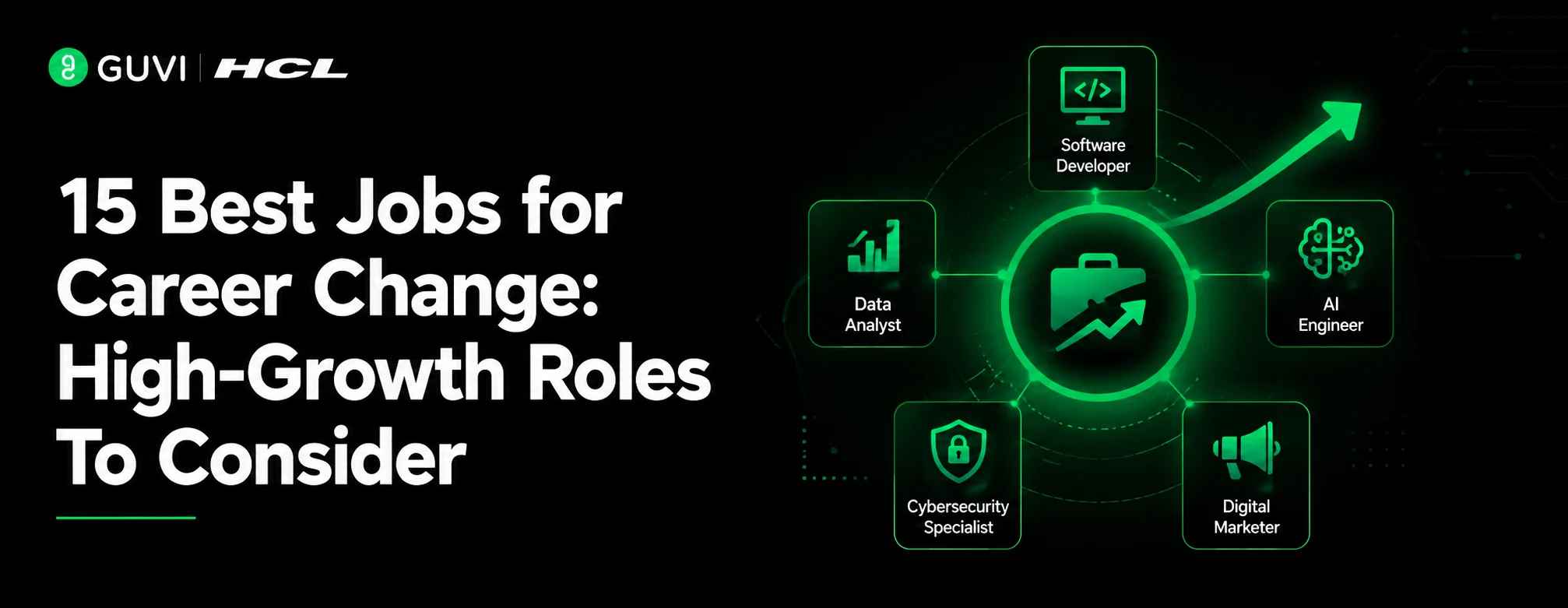
15 Best Jobs for Career Change: High-Growth Roles To Consider in 2026
Jul 13, 2026 8 Min Read 970 Views
(Last Updated)
Table of contents
- TL;DR Summary
- Introduction
- What Are the Best Jobs for Career Change?
- Why Career Change in Jobs Is Growing in 2026
- Best 15 Jobs for Career Change
- Full Stack Developer
- Data Analyst
- Data Scientist
- AI/ML Engineer
- Cybersecurity Analyst
- UI/UX Designer
- Digital Marketing Specialist
- Product Manager
- Business Analyst
- Project Manager
- Cloud Engineer
- DevOps Engineer
- QA Automation Tester
- Technical Writer
- Business and Marketing Analytics Specialist
- Which Career Change Job Fits You?
- How To Choose the Right New Career Option
- Match the Role With Your Existing Strengths
- Check Demand, Salary, and Entry Path
- Build Before You Apply
- Roadmap for a Mid-Career Switch
- Step 1: Pick One Target Role
- Step 2: Learn the Core Tools
- Step 3: Build 3 Portfolio Projects
- Step 4: Rewrite Your Resume for Transferable Skills
- Step 5: Apply Consistently
- Career Switch Scenarios: How Professionals Can Move Into New Roles
- Scenario 1: Operations Executive to Data Analyst
- Scenario 2: Graphic Designer to UI/UX Designer
- Scenario 3: Teacher or Trainer to Technical Writer
- Scenario 4: Sales Professional to Product Manager
- Scenario 5: HR Professional to Business Analyst
- Common Mistakes To Avoid During a Career Transition
- Mistake 1: Choosing a Role Only for Salary
- Mistake 2: Learning Without Building Projects
- Mistake 3: Applying With an Old Resume
- Mistake 4: Trying Too Many Skills at Once
- Mistake 5: Waiting Until You Feel Completely Ready
- Wrapping Up
- Frequently Asked Questions
- What are the best jobs for career change in 2026?
- Which jobs are easiest to make a switch for beginners?
- Is a mid-career switch possible without a tech degree?
- How long does a career transition usually take?
- Which new career options have strong salary potential?
- How do I choose the right career change job?
- Do I need certifications for a career change in jobs?
- Can HCL GUVI help with a career transition?
TL;DR Summary
The best jobs for career change in 2026 are roles that value transferable skills, practical projects, and fast upskilling over only traditional degrees. Strong options include full stack developer, data analyst, AI/ML engineer, cybersecurity analyst, UI/UX designer, digital marketer, product manager, business analyst, project manager, cloud engineer, and technical writer. For a successful career transition, choose a role that matches your current strengths, build job-ready projects, learn tools used by companies, and apply with a portfolio instead of waiting to feel “fully ready.”
Introduction
The best jobs for career change are no longer limited to people with computer science degrees or years of industry experience. In 2026, employers are increasingly hiring for demonstrable skills, projects, problem-solving ability, and adaptability.
That shift matters because career change is now normal. The World Economic Forum reports that 22% of jobs may be disrupted by 2030, with 170 million new roles created and 92 million displaced, leading to a net gain of 78 million jobs globally.
So, if you are planning a mid-career switch, the smartest move is not to “start from zero.” It is to map your existing strengths to high-demand jobs and build the missing skills strategically.
What Are the Best Jobs for Career Change?
Before choosing a new role, it is important to understand what makes a job suitable for career switchers. The right role should let you use your past experience while giving you a realistic path to build new skills.
Best Jobs for career change are roles that allow professionals from non-linear backgrounds to enter through skills, certifications, portfolios, internships, freelance projects, or domain experience rather than only a fixed degree path.
These jobs usually share four traits:
- They have growing market demand.
- They reward practical problem-solving.
- They allow portfolio-based hiring.
- They use transferable skills like communication, analysis, design thinking, customer understanding, or project coordination.
Also Read : Best Tech Jobs for Career Switchers
Why Career Change in Jobs Is Growing in 2026
Career change in jobs is growing because industries are being reshaped by AI, automation, cloud, cybersecurity, analytics, and digital products. Companies now need professionals who can learn fast, solve practical problems, and work across functions.
In India, AI-related hiring in IT rose 16% year-on-year in June 2026, while overall IT hiring declined 3%, showing that companies are prioritizing specialized digital skills over broad hiring.
The U.S. Bureau of Labor Statistics also projects software developer, QA analyst, and tester employment to grow 15% from 2024 to 2034, with about 129,200 openings each year.
Data scientist employment is projected to grow 34% from 2024 to 2034, making it one of the strongest new career options for analytical professionals.
Best 15 Jobs for Career Change
The best role for you depends on your current background, comfort with technology, learning timeline, and long-term career goals. You can consider switching to the following jobs as they offer strong demand, practical entry paths, and room for growth.
1. Full Stack Developer
Full stack development is one of the best jobs for career change because it has clear learning paths, visible project outcomes, and strong demand across startups, IT companies, SaaS firms, and enterprise teams.
You will work on front-end interfaces, back-end logic, databases, APIs, and deployment. This role is a good fit if you enjoy building things from scratch and want a career where your portfolio can directly prove your skills.
Best for: Teachers, engineers, support executives, freshers, and non-tech professionals with logical thinking.
Skills to learn: HTML, CSS, JavaScript, React, Node.js, MongoDB, Git, REST APIs.
2. Data Analyst
A data analyst turns raw data into business insights. This is a practical career transition option for people from finance, operations, sales, marketing, HR, or business backgrounds.
You will create reports, dashboards, and insights that help companies make better decisions. If you already work with Excel, reports, customer data, or business numbers, this can be one of the smoothest new career options to explore.
Best for: Professionals who enjoy numbers, Excel, reporting, and decision-making.
Skills to learn: Excel, SQL, Power BI, Python basics, statistics, dashboards.
3. Data Scientist
Data science is a strong mid-career switch option if you enjoy analysis, prediction, experimentation, and problem-solving. Data scientists build models that support forecasting, personalization, fraud detection, and automation.
This role usually needs deeper learning than data analytics, but it also offers strong long-term growth. It is especially suitable if you are comfortable with math, statistics, coding, and solving open-ended business problems.
Best for: Analysts, engineers, researchers, finance professionals, and math-friendly learners.
Skills to learn: Python, SQL, statistics, machine learning, data visualization.
4. AI/ML Engineer
AI/ML engineering is ideal for learners who want to build intelligent systems, recommendation engines, chatbots, automation workflows, and predictive models.
As more companies adopt AI tools, this role is becoming valuable across healthcare, finance, edtech, retail, and SaaS. It is a strong option for tech professionals who want to move into future-focused, high-growth work.
Best for: Software developers, data professionals, engineers, and tech upskillers.
Skills to learn: Python, machine learning, deep learning, NLP, GenAI tools, MLOps basics.
5. Cybersecurity Analyst
Cybersecurity is one of the most resilient jobs to make a switch into because every digital business needs protection from attacks, fraud, and data breaches.
You will monitor systems, detect threats, investigate suspicious activity, and help companies reduce security risks. This role is a good fit if you are detail-oriented, curious, and interested in problem-solving under pressure.
Best for: IT support professionals, network engineers, system admins, and detail-oriented learners.
Skills to learn: Networking, Linux, security tools, threat detection, SIEM, risk assessment.
6. UI/UX Designer
UI/UX design is a great new career option for people with creativity, empathy, research ability, and visual thinking. You design user-friendly apps, websites, dashboards, and digital journeys.
The role is not only about making screens look attractive. It is about understanding users, reducing friction, and helping businesses improve product experiences through better design decisions.
Best for: Graphic designers, architects, marketers, teachers, and creative professionals.
Skills to learn: Figma, wireframing, user research, prototyping, usability testing.
7. Digital Marketing Specialist
Digital marketing suits professionals who understand communication, customer behavior, content, campaigns, and analytics. It offers entry through projects, internships, freelance work, and certifications.
You can specialize in SEO, paid ads, content marketing, email campaigns, or social media strategy. This makes it a flexible career transition option for people who want a mix of creativity, analytics, and business impact.
Best for: Writers, sales professionals, business graduates, creators, and entrepreneurs.
Skills to learn: SEO, Google Ads, Meta Ads, content marketing, email marketing, analytics.
8. Product Manager
Product management is a powerful mid-career switch for people who understand customers, business goals, technology teams, and market problems.
A product manager decides what to build, why it matters, and how it should create value for users and the business. This role is especially useful for professionals who already have experience in sales, marketing, business analysis, consulting, or software teams.
Best for: Business analysts, developers, marketers, founders, consultants, and domain experts.
Skills to learn: Product strategy, user research, roadmapping, analytics, stakeholder management.
9. Business Analyst
A business analyst bridges business problems and technical solutions. This is one of the best jobs for career change if you already have domain knowledge in banking, healthcare, logistics, retail, or operations.
You will gather requirements, document workflows, identify process gaps, and help technical teams build the right solutions. It is a strong option if you enjoy communication, analysis, and structured problem-solving.
Best for: Operations, finance, HR, sales, and domain professionals.
Skills to learn: Requirement gathering, SQL, Excel, process mapping, documentation, dashboards.
10. Project Manager
Project management rewards organization, communication, planning, and team coordination. It is suitable for professionals who have already managed tasks, people, vendors, or timelines.
You will plan work, track progress, manage risks, coordinate teams, and ensure projects are delivered on time. This role is especially suitable for experienced professionals who want to move into leadership roles.
Best for: Team leads, coordinators, operations managers, and experienced professionals.
Skills to learn: Agile, Scrum, Jira, risk tracking, stakeholder communication.
11. Cloud Engineer
Cloud engineers help companies deploy, scale, and manage applications on cloud platforms. This role is strong for IT professionals and system administrators planning a career transition.
As more businesses move to cloud infrastructure, demand is growing for professionals who understand platforms like AWS, Azure, and Google Cloud. This role is a good fit if you enjoy systems, infrastructure, automation, and troubleshooting.
Best for: IT support, networking, DevOps beginners, and infrastructure professionals.
Skills to learn: AWS, Azure, Linux, Docker, CI/CD, cloud security basics.
12. DevOps Engineer
DevOps combines development, automation, deployment, monitoring, and operations. It is a high-impact role for people who like systems, speed, and reliability.
You will help teams release software faster and with fewer errors by automating workflows and improving deployment pipelines. This is a strong mid-career switch option for developers, testers, and IT professionals who want to move into modern engineering practices.
Best for: Developers, testers, system admins, and cloud learners.
Skills to learn: Linux, Git, Docker, Kubernetes, Jenkins, cloud platforms.
13. QA Automation Tester
QA automation is beginner-friendly compared to many advanced tech roles and can be a smart entry point into software careers.
You will test applications, identify bugs, write automation scripts, and help teams improve product quality. This role is ideal if you are detail-oriented and want to enter tech without starting with heavy full stack development.
Best for: Manual testers, support professionals, detail-oriented beginners.
Skills to learn: Selenium, Java/Python basics, API testing, test cases, automation frameworks.
14. Technical Writer
Technical writing is a practical career change job for people who can simplify complex ideas. You create documentation, product guides, API references, tutorials, and help articles.
This role is valuable because companies need clear documentation for users, developers, customers, and internal teams. It is a strong option for teachers, writers, support professionals, and anyone who enjoys explaining things clearly.
Best for: Writers, teachers, developers, support teams, and subject-matter experts.
Skills to learn: Documentation tools, Markdown, API basics, product understanding, editing.
15. Business and Marketing Analytics Specialist
This role combines marketing, business thinking, and data analytics. It is ideal for professionals who want analytics without going too deep into advanced machine learning.
You will analyze customer behavior, campaign performance, sales funnels, website traffic, and marketing ROI. This is a strong new career option for marketers, sales professionals, and business graduates who want to become more data-driven.
Best for: Marketers, sales professionals, business graduates, and analysts.
Skills to learn: Excel, SQL, Power BI, Google Analytics, campaign metrics.
Which Career Change Job Fits You?
Use this section to compare learning curve, portfolio needs, and role fit before shortlisting your best career transition path.
| Career Option | Best For | Core Skills | Learning Curve | Portfolio Needed |
| Full Stack Developer | Logical thinkers | JavaScript, React, Node.js | Medium | Yes |
| Data Analyst | Business/data users | SQL, Excel, Power BI | Low-Medium | Yes |
| Data Scientist | Analytical learners | Python, ML, statistics | High | Yes |
| AI/ML Engineer | Tech upskillers | ML, NLP, GenAI | High | Yes |
| Cybersecurity Analyst | IT/security learners | Networking, SIEM, Linux | Medium | Yes |
| UI/UX Designer | Creative professionals | Figma, research, prototyping | Medium | Yes |
| Digital Marketer | Communication-driven learners | SEO, ads, analytics | Low-Medium | Yes |
| Product Manager | Business-tech bridge roles | Strategy, analytics, roadmap | Medium | Case studies |
| Business Analyst | Domain professionals | Requirements, SQL, documentation | Low-Medium | Helpful |
| Project Manager | Coordinators/leads | Agile, planning, Jira | Medium | Helpful |
| Cloud Engineer | IT professionals | AWS, Linux, Docker | Medium-High | Yes |
| DevOps Engineer | Developers/admins | CI/CD, Kubernetes, cloud | High | Yes |
| QA Automation Tester | Detail-oriented learners | Selenium, testing, APIs | Medium | Yes |
| Technical Writer | Writers/teachers | Docs, APIs, editing | Low-Medium | Yes |
| Marketing Analyst | Marketers/business grads | SQL, dashboards, analytics | Medium | Yes |

How To Choose the Right New Career Option
Choosing the right role is not about chasing the trendiest job title. It is about finding the overlap between your strengths, market demand, learning capacity, and the kind of work you can see yourself doing every day.
Match the Role With Your Existing Strengths
Your best career change job is not always the highest-paying one. It is the role where your past experience becomes an advantage.
For example, a sales professional may transition well into product management or digital marketing. A finance executive may move into data analytics. A teacher may become a technical writer, instructional designer, or UI/UX researcher.
Check Demand, Salary, and Entry Path
Before choosing, evaluate three things:
- Are companies hiring for this role?
- Can you build proof of skill within 3–6 months?
- Does the role match your preferred work style?
Build Before You Apply
For modern career transition, a portfolio is your proof. Build dashboards, websites, case studies, automation scripts, UX redesigns, or marketing campaign reports.
Roadmap for a Mid-Career Switch
A successful mid-career switch works best when you follow a structured path instead of randomly collecting courses. The goal is to move from confusion to clarity, then from learning to visible proof of skill.
Step 1: Pick One Target Role
Avoid learning “a little bit of everything.” Choose one role from the list and study job descriptions for that role.
Step 2: Learn the Core Tools
Focus on tools that appear repeatedly in job descriptions. For example, SQL and Power BI for data analyst roles, or React and Node.js for full stack development.
Step 3: Build 3 Portfolio Projects
Create practical projects that solve real problems. A data analyst can build a sales dashboard. A UI/UX designer can redesign a food delivery checkout flow. A full stack developer can build a job tracker app.
Step 4: Rewrite Your Resume for Transferable Skills
Do not hide your previous experience. Reframe it. Highlight problem-solving, stakeholder communication, reporting, process improvement, domain knowledge, and measurable outcomes.
Step 5: Apply Consistently
Apply to internships, apprenticeships, entry-level roles, freelance gigs, and returnship programs. Career transition improves when learning and applications happen together.
Check Out : Career Change at 25 : Is it Too Late?
Career Switch Scenarios: How Professionals Can Move Into New Roles
Career change becomes easier when you can see how your existing skills connect to a future role. These short scenarios show how different professionals can reposition their background for practical career transition.
Scenario 1: Operations Executive to Data Analyst
An operations executive already works with reports, timelines, vendor delays, inventory, and process gaps. By learning Excel, SQL, and Power BI, they can move into data analytics with projects like delivery delay dashboards or cost-tracking reports.
This transition works well because they already understand business operations; they only need to add data tools and visualization skills.
Scenario 2: Graphic Designer to UI/UX Designer
A graphic designer already understands layout, color, hierarchy, and visual communication. By adding user research, wireframing, Figma prototyping, and usability testing, they can move into UI/UX design.
A strong portfolio project could be a redesigned checkout flow, mobile app onboarding screen, or e-commerce product page with clear design reasoning.
Scenario 3: Teacher or Trainer to Technical Writer
Teachers and trainers are good at simplifying complex ideas, which is exactly what technical writing requires. By learning documentation tools, Markdown, and basic software concepts, they can create guides, tutorials, FAQs, and product help articles.
A sample portfolio can include a beginner-friendly technical guide, API explanation, or software onboarding document.
Scenario 4: Sales Professional to Product Manager
A sales professional understands customer pain points, objections, competitor comparisons, and buying behavior. These insights are valuable in product management, where user needs and business goals must be translated into product decisions.
They can build case studies around feature prioritization, user personas, onboarding improvements, or product teardown analysis.
Scenario 5: HR Professional to Business Analyst
An HR professional already works with processes, documentation, employee data, and stakeholder communication. By learning requirement gathering, process mapping, Excel, and SQL basics, they can transition into business analysis.
A relevant project could be improving an employee onboarding workflow or digitizing a leave management process.
Did You Know?
HCL GUVI’s Zen Class page lists featured career programs such as Data Science, Intel AIML, Gen AI Software Development, MERN Full Stack, UI/UX Design, Business and Marketing Analytics, AIML, and DevOps & Cloud.
Common Mistakes To Avoid During a Career Transition
Many career switchers struggle because they try to move too fast without a clear direction. Avoid these common mistakes to make your career transition smoother, more focused, and easier to explain to recruiters.
Mistake 1: Choosing a Role Only for Salary
Salary matters, but it should not be your only filter. A high-paying role can still feel frustrating if the daily work does not match your strengths, interests, or learning style.
Before choosing, check whether you enjoy the core tasks of the role. For example, full stack development requires consistent coding, while product management requires communication, prioritization, and handling ambiguity.
Mistake 2: Learning Without Building Projects
Courses help you understand concepts, but projects prove that you can apply them. Recruiters are more likely to trust your career transition when they can see dashboards, websites, case studies, documentation samples, or campaign reports.
Even two or three strong projects can make your profile more convincing. Focus on projects that solve practical problems related to your target role.
Mistake 3: Applying With an Old Resume
Your old resume may highlight your previous responsibilities, but it may not show why you fit your new role. This creates a gap between what you have done and what recruiters are looking for.
Rewrite your resume around transferable skills, relevant tools, portfolio projects, and keywords from target job descriptions. Your resume should clearly connect your past experience to your new career option.
Mistake 4: Trying Too Many Skills at Once
Learning too many tools at the same time can slow down your progress. It may also make your profile look scattered instead of focused.
Pick one target role and follow one roadmap for the first few months. Once you build confidence and complete 2–3 projects, you can expand into advanced tools or related skills.
Mistake 5: Waiting Until You Feel Completely Ready
Many learners delay applications because they feel they need to master everything first. In reality, most jobs require strong fundamentals, practical projects, and a willingness to keep learning.
Start applying once you have basic skills, a few projects, and a clear transition story. Interviews and rejections will also help you understand what to improve next.
Wrapping Up
The best jobs for career change in 2026 are skill-first, project-driven, and open to learners from diverse backgrounds. Whether you choose data analytics, full stack development, AI/ML, cybersecurity, UI/UX, product management, or digital marketing, the key is to connect your past experience with future-ready skills. Start with one target role, learn the right tools, build a portfolio, and apply consistently. A successful mid-career switch is not about starting over; it is about repositioning your experience for better opportunities.
The right mentorship can shorten the gap between “I want to switch” and “I know what to build next.” A structured program can also help you stay consistent with projects, tools, and career preparation.
If you are serious about moving from planning to action, explore HCL GUVI’s Career Programs to build practical projects, learn industry tools, and prepare for roles like Data Science, Full Stack Development, AI/ML, UI/UX, DevOps, and Business Analytics.
Frequently Asked Questions
1. What are the best jobs for career change in 2026?
The best jobs for career change include data analyst, full stack developer, AI/ML engineer, cybersecurity analyst, UI/UX designer, digital marketer, product manager, business analyst, project manager, and cloud engineer.
2. Which jobs are easiest to make a switch for beginners?
Data analyst, digital marketing specialist, UI/UX designer, QA tester, business analyst, and technical writer are relatively beginner-friendly because they allow portfolio-based entry.
3. Is a mid-career switch possible without a tech degree?
Yes. Many tech and digital roles value practical skills, projects, certifications, and domain knowledge. A non-tech background can become an advantage in roles like business analysis, product management, UX research, and data analytics.
4. How long does a career transition usually take?
A focused career transition can take 3–9 months depending on the role, your starting point, learning consistency, and portfolio quality.
5. Which new career options have strong salary potential?
Data science, AI/ML, cybersecurity, cloud engineering, DevOps, full stack development, and product management generally offer strong salary potential as skills and experience grow.
6. How do I choose the right career change job?
Choose based on your existing strengths, preferred work style, market demand, learning curve, and ability to build proof of skill through projects.
7. Do I need certifications for a career change in jobs?
Certifications help, but they work best when paired with projects. Employers want to see whether you can apply what you learned.
8. Can HCL GUVI help with a career transition?
Yes. HCL GUVI offers career-focused programs in areas such as Data Science, AI, Web Development, Design, Analytics, Deployment, and more through its Zen Class programs.
Success Stories










Did you enjoy this article?