


Artificial Intelligence and Machine Learning Articles
Dropout Regularization in Neural Networks
Federated Learning: Training Models Without Centralizing Data
Attention Mechanism Explained: The Building Block of Transformers


Get In Touch For Details! Request More Information
Claude for HIPAA-Compliant Healthcare Workflows
Aug 17, 2026 3 Min Read 326 Views
(Last Updated)
Claude can assist healthcare professionals with documentation, administrative tasks, data analysis, and clinical content generation when used within a properly governed environment. However, HIPAA compliance is determined by the complete workflow—including security controls, policies, and infrastructure—not by the AI tool alone.
Healthcare organizations should treat AI as one component of a broader compliance program that protects patient privacy and safeguards protected health information (PHI).
Table of contents
- TL;DR Summary
- What Is Claude for HIPAA-Compliant Healthcare Workflows?
- Why Is HIPAA Compliance Important When Using AI?
- How Can Claude Support Healthcare Workflows?
- What Security Practices Support HIPAA Compliance?
- Common Mistakes to Avoid
- Best Practices for Using Claude in Healthcare
- Key Takeaways
- Conclusion
- FAQs
- Can Claude be used for HIPAA-compliant workflows?
- Can I enter patient information into Claude?
- Can Claude replace healthcare professionals?
- What security measures are important when using AI in healthcare?
- Why is human oversight necessary?
TL;DR Summary
- HIPAA compliance depends on how Claude is deployed and managed—not just the AI model itself.
- Healthcare organizations should implement strong security controls before using AI with protected health information (PHI).
- Data minimization, access controls, and auditing are essential for compliant workflows.
- Always verify current vendor compliance documentation before processing sensitive healthcare data.
- AI should support clinical workflows, not replace professional medical judgment.
Want to build AI and machine learning solutions for real-world healthcare, automation, and enterprise applications? Explore HCL GUVI’s Artificial Intelligence & Machine Learning Course, where you’ll learn machine learning, deep learning, NLP, MLOps, and responsible AI through hands-on projects designed for industry use cases.
What Is Claude for HIPAA-Compliant Healthcare Workflows?
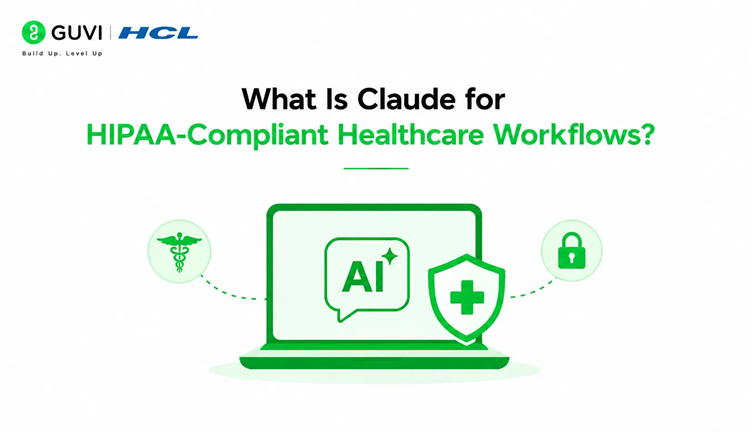
Even when an AI platform provides enterprise-grade security features, healthcare organizations are still responsible for ensuring their overall workflows comply with HIPAA. This includes implementing appropriate administrative, technical, and physical safeguards, protecting protected health information (PHI), and ensuring that AI is used in a manner that meets all applicable regulatory and privacy requirements.
Read More: Building AI agents for healthcare and life sciences
Why Is HIPAA Compliance Important When Using AI?
Healthcare organizations handle highly sensitive patient information every day. Any misuse or unauthorized disclosure of PHI can lead to legal consequences, financial penalties, and loss of patient trust.
Using AI responsibly helps organizations:
- Protect patient privacy. Strong safeguards reduce the risk of exposing confidential medical information.
- Support regulatory compliance. Following HIPAA requirements helps organizations meet legal obligations.
- Improve operational efficiency. AI can automate repetitive administrative tasks while maintaining appropriate security controls.
- Build patient trust. Responsible AI adoption demonstrates a commitment to protecting sensitive healthcare data.
Data Point: Healthcare remains one of the most heavily regulated industries, making security, auditing, and access management critical when introducing AI into clinical or administrative workflows.
How Can Claude Support Healthcare Workflows?
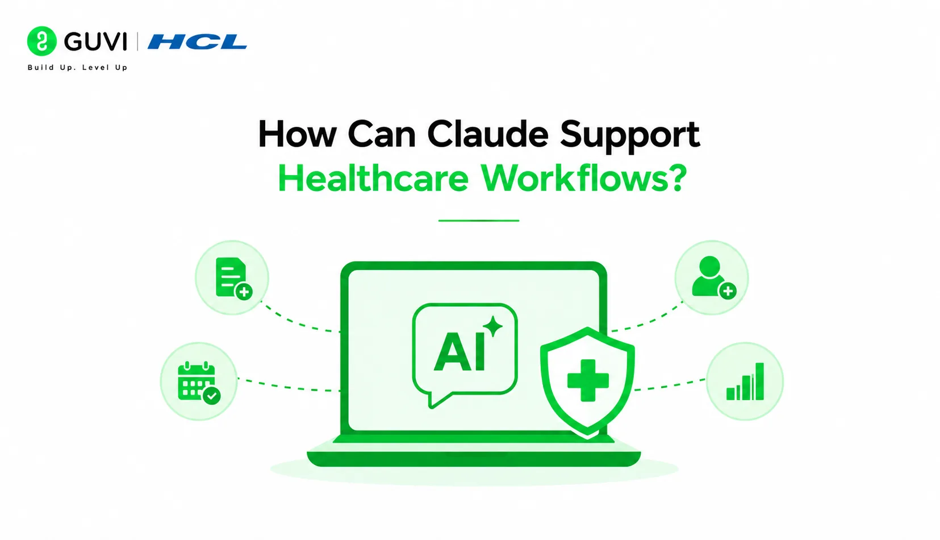
Claude can improve productivity across several non-diagnostic and administrative healthcare tasks when used appropriately.
Common use cases include:
- Drafting clinical documentation.
- Summarizing medical literature.
- Creating patient education materials.
- Assisting with administrative communication.
- Organizing healthcare policies and procedures.
These tasks can reduce manual workload while allowing healthcare professionals to review and validate the final output.
Best Practice: Always ensure a qualified healthcare professional reviews AI-generated content before it becomes part of patient care or official medical records.
Want to build AI and machine learning solutions for real-world healthcare, automation, and enterprise applications? Explore HCL GUVI’s Artificial Intelligence & Machine Learning Course, where you’ll learn machine learning, deep learning, NLP, MLOps, and responsible AI through hands-on projects designed for industry use cases.
What Security Practices Support HIPAA Compliance?
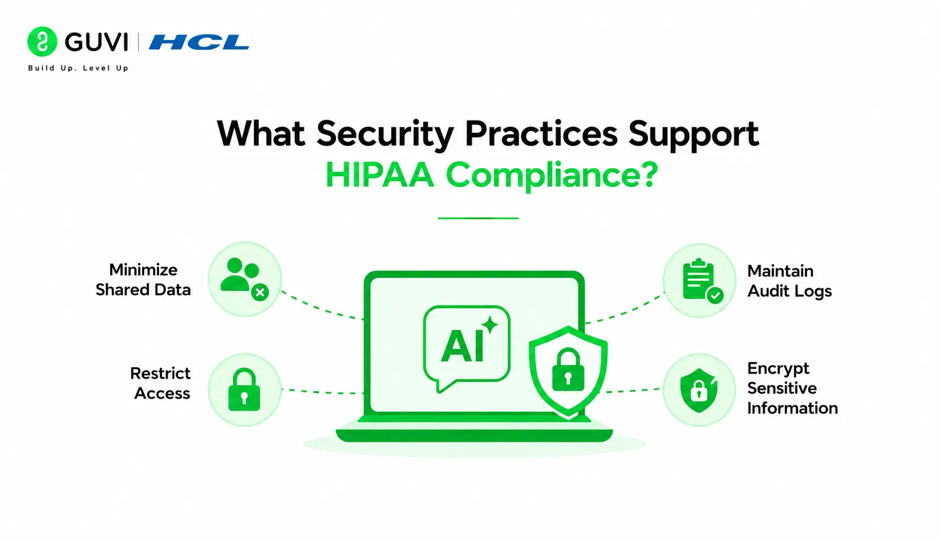
Organizations should implement multiple layers of protection when integrating AI into healthcare workflows.
Important practices include:

- Minimize Shared Data
Only provide the information necessary to complete the task. Removing unnecessary identifiers reduces privacy risks.
- Restrict Access
Use role-based access controls so only authorized personnel can interact with systems handling PHI.
- Maintain Audit Logs
Track AI usage, user activity, and system access to support compliance reviews and security investigations.
- Encrypt Sensitive Information
Protect healthcare data both during transmission and while stored using strong encryption methods.
Warning: Do not assume that every AI deployment is automatically suitable for processing PHI. Verify security features, contractual requirements, and compliance documentation before using sensitive healthcare data.
Common Mistakes to Avoid
Healthcare organizations should avoid practices that could compromise patient privacy.
Some common mistakes include:
- Uploading patient records without proper authorization.
- Sharing unnecessary personal identifiers.
- Skipping human review of AI-generated content.
- Ignoring organizational AI governance policies.
- Assuming compliance without verifying vendor capabilities.
Preventing these mistakes helps reduce security and compliance risks.
Pro Tip: Create internal guidelines that define which healthcare tasks can safely use AI and which require traditional workflows.
Best Practices for Using Claude in Healthcare
Successful AI adoption requires both technical safeguards and organizational policies.
Some recommended practices include:
- Verify current vendor compliance documentation before deployment.
- Train employees on responsible AI usage.
- Establish approval workflows for AI-generated content.
- Regularly review access permissions and audit logs.
- Keep AI usage aligned with organizational compliance policies.
These practices help organizations balance innovation with patient privacy and regulatory requirements.
Key Takeaways
- HIPAA compliance depends on the complete healthcare workflow, not solely on the AI tool.
- Claude can support documentation, administrative tasks, and content creation when used responsibly.
- Data minimization and strong access controls are essential.
- Human oversight remains critical for healthcare decisions.
- Organizations should verify current compliance documentation before processing PHI.
- Responsible governance is the foundation of secure AI adoption in healthcare.
Conclusion
AI has the potential to improve efficiency across many healthcare workflows, from documentation to administrative support. However, successful adoption requires careful planning, appropriate security controls, and ongoing compliance with HIPAA requirements.
Healthcare organizations should approach AI as a tool that enhances existing processes rather than replacing established privacy and security practices. By combining strong governance with responsible AI usage, organizations can improve productivity while protecting sensitive patient information.
FAQs
Can Claude be used for HIPAA-compliant workflows?
Yes, but HIPAA compliance depends on the overall deployment, security controls, and organizational processes—not just the AI model. Organizations should verify current vendor documentation before using PHI.
Can I enter patient information into Claude?
Only if your organization’s approved deployment, contractual agreements, and security controls permit it. Never assume a general-purpose AI interface is appropriate for PHI.
Can Claude replace healthcare professionals?
No. Claude can assist with administrative and documentation tasks, but clinical decisions should always be made by qualified healthcare professionals.
What security measures are important when using AI in healthcare?
Data minimization, encryption, access controls, audit logging, and human review are among the most important safeguards for healthcare AI workflows.
Why is human oversight necessary?
AI-generated content can contain errors or omissions, so qualified professionals should always review outputs before they influence patient care or become part of medical records.
Success Stories

About the Author
Vishalini Devarajan
An Aerospace Engineer turned content writer, I focus on making complex concepts easy to understand through well-structured, reader-friendly blogs. Whether it’s a technical topic or a non-technical one, I love creating content that is clear, engaging, and impactful.
View all posts by Vishalini Devarajan
Connect with me @











Did you enjoy this article?