


Career Articles
LLM Skills Everyone Should Know in 2026 - Best Guide
How to Change Careers With No Experience: A Practical Career Change Guide
15 Best Jobs for Career Change: High-Growth Roles To Consider in 2026
ATS Friendly Resume: How to Beat Applicant Tracking Systems in 2026


Get In Touch For Details! Request More Information
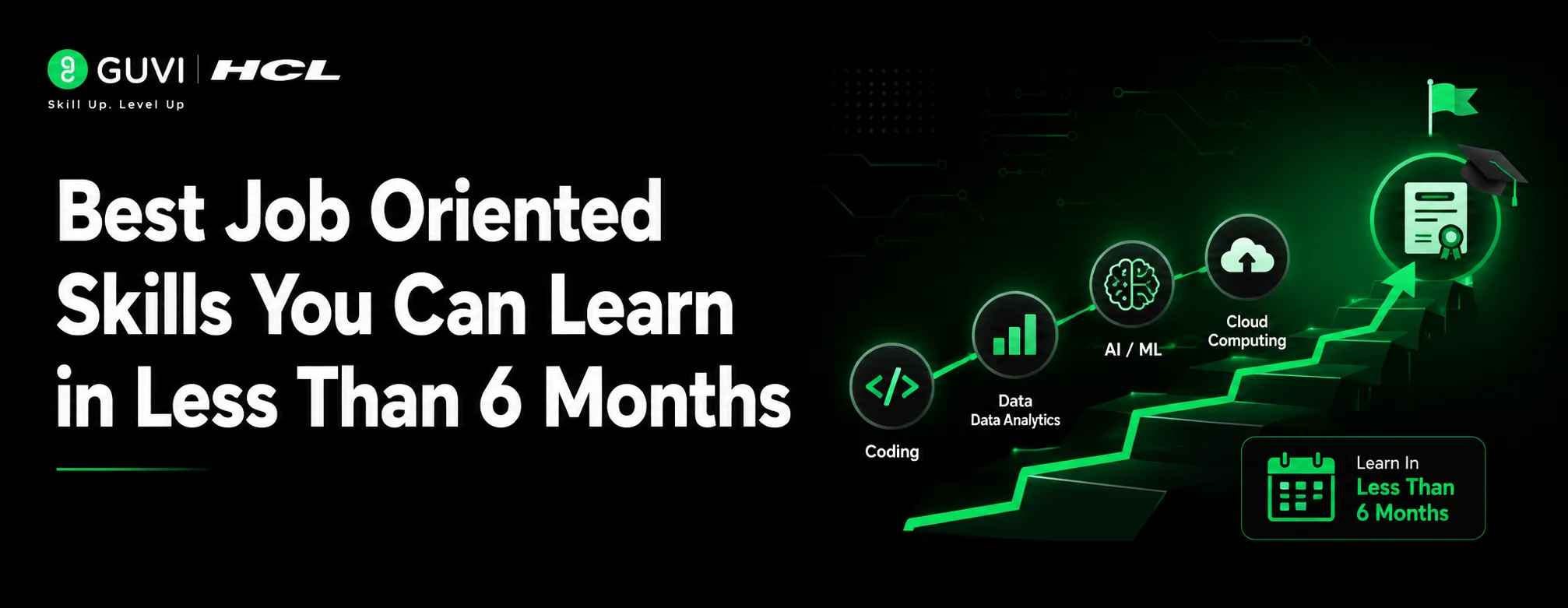
Best Job Oriented Skills You Can Learn in Less Than 6 Months
Jul 13, 2026 5 Min Read 26 Views
(Last Updated)
Table of contents
- TL;DR Summary
- Introduction
- What Are Job Oriented Skills?
- Why Job Oriented Skills Matter
- Why Learn Job Oriented Skills in 2026?
- Best Job Oriented Skills to Learn in Less Than 6 Months
- Data Analytics
- Full Stack Development
- Digital Marketing
- UI/UX Design
- AI Tools and Prompt Engineering
- Cybersecurity Fundamentals
- Cloud Computing Basics
- Comparison Table: Skills, Roles, and Learning Time
- 6-Month Roadmap to Build Job-Ready Skills
- Month 1: Choose One Career Direction
- Month 2–3: Learn Tools and Fundamentals
- Month 4: Build Portfolio Projects
- Month 5: Practice Interview and Workplace Tasks
- Month 6: Apply, Improve, Repeat
- Practical Use Cases of Job-Oriented Skills
- Example 1: Data Analytics in Retail
- Example 2: Digital Marketing in EdTech
- Example 3: UI/UX in FinTech
- Common Mistakes to Avoid
- Learning Too Many Skills at Once
- Watching Tutorials Without Building
- Ignoring Communication Skills
- Waiting Too Long to Apply
- Collecting Certificates Without Proof
- Wrapping Up
- Frequently Asked Questions
- What are the best job oriented skills to learn in 6 months?
- Can I get a job after learning a skill for 6 months?
- Which high income skills are beginner-friendly?
- Are job-ready skills better than degrees?
- Which job oriented skills are best for non-technical students?
- How do I choose the right career skills?
- How many projects should I build before applying?
- Are AI skills necessary for every career?
TL;DR Summary
Job oriented skills are practical, employer-relevant abilities that help you become ready for specific roles such as Data Analyst, Full Stack Developer, Digital Marketer, UI/UX Designer, Cloud Associate, Cybersecurity Analyst, or AI Tools Specialist. The best skills to learn in 6 months are those that combine strong market demand, hands-on projects, portfolio proof, and interview readiness. Start with one career path, follow a weekly roadmap, build 2–3 projects, and apply consistently before waiting to feel “perfectly ready.”
Introduction
Hiring has changed. Employers are no longer impressed by certificates alone; they want proof that you can solve real problems.
That is why job oriented skills matter. They help you move from “I know the basics” to “I can build, analyze, design, automate, or market something useful.”
According to the World Economic Forum data, employers expect 39% of workers’ core skills to change by 2030, which means learning once and stopping is no longer safe for your career.
In simple terms, job oriented skills are practical skills that prepare you for a specific job role by combining tools, concepts, projects, workplace thinking, and interview readiness. These skills are valuable because they directly connect learning with employability, salary growth, freelancing, internships, or career switching.
What Are Job Oriented Skills?
Job oriented skills are role-focused skills that help you perform tasks required in real jobs.
For example, learning Excel formulas is useful. But learning Excel, SQL, dashboards, business metrics, and case-study presentation together makes you job-ready for data analyst roles.
Why Job Oriented Skills Matter
They help you:
- Build a portfolio instead of only a resume
- Apply for entry-level or internship roles faster
- Show proof of work during interviews
- Move toward high income skills with structured practice
- Reduce confusion by following one clear career path
Why Learn Job Oriented Skills in 2026?
The job market is moving towards practical ability, AI readiness, and specialized skills.
LinkedIn reports that about 70% of skills used in most jobs are expected to change between 2015 and 2030, with AI acting as a major driver.
NASSCOM’s data also highlights India’s AI talent gap, with demand already exceeding available talent and projected demand crossing 1 million professionals by 2026.
If you can explain a skill to a friend without using fancy terms, you probably understand it better than you think. Clear explanation is a hidden career skill that helps in interviews, meetings, and teamwork.
Best Job Oriented Skills to Learn in Less Than 6 Months
Let’s look at beginner-friendly and in-demand skills that can help you build job readiness within a focused timeline.
1. Data Analytics
Data analytics is one of the best skills to learn in 6 months because every industry works with data.
You learn Excel, SQL, Power BI or Tableau, Python basics, and business reporting.
What You Can Build
- Sales dashboard for an eCommerce brand
- Customer churn analysis for a telecom company
- Marketing campaign performance report
- HR attrition dashboard
Best For : Freshers, commerce graduates, engineers, MBA students, and working professionals who enjoy problem-solving.
2. Full Stack Development
Full stack development teaches you how to build websites and applications from front end to back end.
You typically learn HTML, CSS, JavaScript, React, Node.js, databases, APIs, Git, and deployment.
Why It Is Job-Oriented
Companies need developers who can build, debug, deploy, and maintain products. A strong GitHub profile and 2–3 projects can make your skills visible.
3. Digital Marketing
Digital marketing is a strong career skill for learners who prefer creativity, analytics, and business growth.
You learn SEO, Google Ads, Meta Ads, content marketing, email marketing, analytics, and conversion basics.
Real Use Case : A small D2C skincare brand can use SEO blogs, Instagram ads, influencer content, and retargeting campaigns to increase product sales.

4. UI/UX Design
UI/UX design helps you create user-friendly digital products.
You learn user research, wireframing, Figma, prototyping, design systems, usability testing, and portfolio case studies.
Best For: Creative learners, psychology graduates, visual designers, product enthusiasts, and career switchers.
5. AI Tools and Prompt Engineering
AI tools are now becoming a workplace skill across roles.
You can learn how to use ChatGPT, Gemini, Copilot, automation tools, AI research workflows, prompt writing, and AI-assisted productivity.
6. Cybersecurity Fundamentals
Cybersecurity is one of the most important in-demand skills because every digital business must protect its systems.
You can start with networking basics, Linux, security concepts, threat analysis, OWASP Top 10, and beginner labs.
7. Cloud Computing Basics
Cloud computing helps you understand how modern applications are hosted, scaled, and managed.
Start with AWS, Azure, or Google Cloud basics, then learn storage, compute, networking, deployment, and monitoring.
Also Read: Top Technologies to Learn in 2026
Comparison Table: Skills, Roles, and Learning Time
The following table gives you a quick side-by-side view of each skill, its career fit, tools, and estimated learning duration.
| Skill | Beginner-Friendly? | Possible Roles | Tools to Learn | Learning Time |
| Data Analytics | Yes | Data Analyst, BI Intern | Excel, SQL, Power BI, Python | 4–6 months |
| Full Stack Development | Moderate | Frontend Developer, Full Stack Intern | React, Node.js, MongoDB, Git | 5–6 months |
| Digital Marketing | Yes | SEO Executive, PPC Associate | GA4, Google Ads, Meta Ads, SEMrush | 3–5 months |
| UI/UX Design | Yes | UI Designer, UX Intern | Figma, FigJam, Adobe XD | 4–6 months |
| AI Tools | Yes | AI Productivity Associate, Automation Intern | ChatGPT, Copilot, Zapier | 2–4 months |
| Cybersecurity | Moderate | SOC Intern, Security Analyst Trainee | Linux, Wireshark, Burp Suite | 5–6 months |
| Cloud Computing | Moderate | Cloud Support Associate | AWS, Azure, Docker basics | 4–6 months |
6-Month Roadmap to Build Job-Ready Skills
Here’s a practical month-by-month plan to help you move from beginner learning to portfolio-based job preparation.
Month 1: Choose One Career Direction
Do not try to learn everything.
Pick one path based on your interest:
- Like numbers? Choose data analytics.
- Like building apps? Choose full stack.
- Like business growth? Choose digital marketing.
- Like design and users? Choose UI/UX.
- Like systems and security? Choose cloud or cybersecurity.
Month 2–3: Learn Tools and Fundamentals
Focus on core tools used in real jobs.
For example, a data learner should not only watch Python tutorials. They should practice Excel cleaning, SQL queries, dashboards, and business interpretation.
Month 4: Build Portfolio Projects
Your portfolio should answer one question: “Can this person do the work?”
Build:
- 2 practical projects
- 1 case study
- 1 resume-ready GitHub, Behance, or portfolio page
Month 5: Practice Interview and Workplace Tasks
Start mock interviews early.
Prepare for:
- Tool-based questions
- Scenario-based tasks
- Resume explanations
- Project walkthroughs
- Communication rounds
Month 6: Apply, Improve, Repeat
Apply to internships, fresher roles, freelance gigs, and apprenticeships.
Track every application. Improve your resume every week based on responses.
Practical Use Cases of Job-Oriented Skills
Next, the following examples show how job-ready skills are used in actual business scenarios across different industries.
Example 1: Data Analytics in Retail
A retail company like Reliance Retail or DMart can use data analytics to identify which products sell fastest during festive seasons.
A beginner project can analyze sales by region, product category, discount, and customer segment.
Example 2: Digital Marketing in EdTech
An EdTech company can use SEO blogs, YouTube videos, Google Ads, and WhatsApp funnels to generate course leads.
A learner can build a sample campaign for an online Python course and measure clicks, leads, and conversion rate.
Example 3: UI/UX in FinTech
A FinTech app like PhonePe or Paytm needs simple onboarding, secure payment flows, and clear error messages.
A UI/UX learner can redesign a payment failure screen and explain how the new design reduces confusion.
Common Mistakes to Avoid
Finally, here is a helpful next step if you prefer structured learning over scattered tutorials and random resources.
1. Learning Too Many Skills at Once
Trying data, coding, AI, marketing, and design together creates confusion.
Choose one primary skill and one support skill.
2. Watching Tutorials Without Building
Tutorials feel productive, but projects prove ability.
After every module, create something small.
3. Ignoring Communication Skills
Job-ready skills are not only technical.
You must explain your work clearly in interviews, emails, standups, and presentations.
4. Waiting Too Long to Apply
You do not need to master everything before applying.
Once you have two projects and a clear resume, start applying.
5. Collecting Certificates Without Proof
Certificates help, but portfolios create trust.
Employers want to see what you can do with what you learned.
Wrapping Up
Job oriented skills are the fastest way to make your learning useful, visible, and career-focused. In less than six months, you can build strong foundations in data analytics, full stack development, digital marketing, UI/UX, AI tools, cloud, or cybersecurity.
The smartest approach is simple: choose one skill, follow a roadmap, build projects, get feedback, and apply consistently. In 2026, the advantage belongs to learners who can show proof of work, adapt to AI-driven changes, and keep improving their career skills.
If you want structured learning instead of scattered tutorials, explore HCL GUVI’s career-focused courses that help you build practical projects, strengthen job-ready skills, and learn with a clearer path toward employability.
Frequently Asked Questions
1. What are the best job oriented skills to learn in 6 months?
The best job oriented skills to learn in 6 months include data analytics, full stack development, digital marketing, UI/UX design, AI tools, cloud computing, and cybersecurity fundamentals.
2. Can I get a job after learning a skill for 6 months?
Yes, you can apply for internships, fresher roles, freelance projects, and trainee positions if you build projects, practice interviews, and create a strong portfolio.
3. Which high income skills are beginner-friendly?
Data analytics, digital marketing, UI/UX design, and AI tools are beginner-friendly high income skills because they do not always require a computer science degree.
4. Are job-ready skills better than degrees?
Degrees are valuable, but job-ready skills show employers that you can perform real tasks. The best combination is a degree plus practical projects, tools, and problem-solving ability.
5. Which job oriented skills are best for non-technical students?
Non-technical students can start with digital marketing, data analytics, UI/UX design, business analytics, content marketing, and AI productivity tools.
6. How do I choose the right career skills?
Choose based on your interest, learning style, and target role. If you enjoy logic, choose analytics or coding. If you enjoy creativity, choose design or marketing.
7. How many projects should I build before applying?
Build at least two strong projects and one detailed case study. Your projects should show the problem, tools used, process, result, and learning.
8. Are AI skills necessary for every career?
AI skills are becoming useful across most careers. You do not need to become an AI engineer, but you should know how to use AI tools responsibly to improve productivity.
Success Stories







Did you enjoy this article?