


Python Articles
Freelancing as a Python Developer: Getting Your First Client
Common Python Mistakes Beginners Make And How to Fix Them
Python Best Practices: Writing Clean, Maintainable Code Like a Pro
How to Build a Python Developer Portfolio That Gets You Hired


Get In Touch For Details! Request More Information
How to Swap Two Numbers in Python: 5 Easy Methods
Jul 08, 2026 3 Min Read 266 Views
(Last Updated)
Swapping two numbers is one of the first concepts beginners learn in Python. It helps build a strong understanding of variables, assignments, and program flow. Whether you’re learning Python fundamentals, preparing for coding interviews, or improving problem-solving skills, mastering variable swapping is essential. To strengthen your Python knowledge further, explore HCL GUVI’s Python Course and gain hands-on experience through practical projects.
Table of contents
- TL;DR Summary
- What Does Swapping Two Numbers Mean in Python?
- Why Is Swapping Variables Important?
- Key Benefits
- Method 1: Swap Using a Temporary Variable
- Example
- Advantages
- Limitation
- Method 2: Swap Using Multiple Assignments
- Example
- How It Works
- Advantages
- Method 3: Swap Using Arithmetic Operators
- Example
- Advantages
- Limitation
- Method 4: Swap Using Bitwise XOR
- Example
- Advantages
- Limitation
- Method 5: Swap Using Tuple Unpacking
- Example
- Advantages
- Limitation
- Common Python Functions Used in Swapping Programs
- How Sorting Algorithms Use Variable Swapping
- Real-World Example: Employee Salary Sorting System
- Output
- Common Mistakes Beginners Make
- Which Swapping Method Should You Use?
- Conclusion
- FAQs
- What is swapping in Python?
- Which is the best method to swap two numbers in Python?
- Can I swap variables without a temporary variable?
- Why is swapping important in programming?
- Is XOR swapping useful in Python?
- What is tuple unpacking?
- Is variable swapping asked in coding interviews?
TL;DR Summary
- Learn how to swap two numbers in Python using simple and beginner-friendly methods.
- Explore multiple techniques, including temporary variables, tuple unpacking, arithmetic operators, and bitwise XOR.
- Understand why variable swapping is an essential Python programming concept used in coding interviews and algorithm design.
- Discover the most Pythonic way to swap variables using multiple assignment without a temporary variable.
- Build a stronger foundation in Python programming while learning techniques used in sorting algorithms, data processing, and software development.
What Does Swapping Two Numbers Mean in Python?
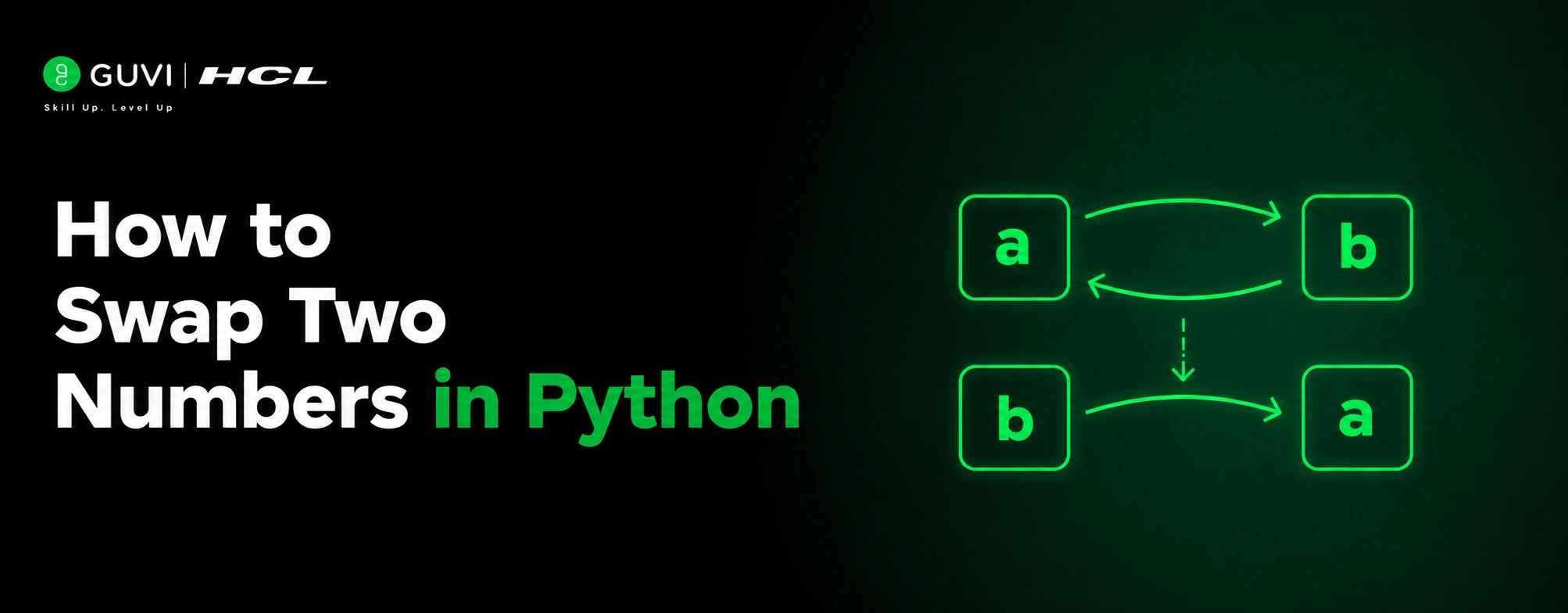
Swapping two numbers means exchanging the values stored in two variables.
a = 10
b = 20
| Variable | Before Swapping | After Swapping |
| a | 10 | 20 |
| b | 20 | 10 |
The goal is to exchange the values without losing any data during the process. Swapping variables is commonly used in sorting algorithms, data manipulation tasks, and programming logic.
Why Is Swapping Variables Important?
Swapping variables plays an important role in programming because many algorithms need values to be rearranged during execution.
Key Benefits
- Helps understand variable assignment
- Improves logical thinking
- Used in sorting algorithms
- Common in coding interviews
- Supports data manipulation tasks
- Builds strong programming fundamentals
Understanding swapping techniques makes it easier to learn more complex programming concepts later.
Method 1: Swap Using a Temporary Variable
The temporary variable method is the most traditional approach.
Example
a = 10
b = 20
temp = a
a = b
b = temp
print(a, b)
How It Works
- Store the value of a in a temporary variable.
- Assign the value of b to a.
- Assign the stored value from temp to b.
Advantages
- Easy to understand
- Beginner-friendly
- Works in most programming languages
Limitation
Requires an extra variable
This method is ideal for beginners learning programming concepts.
Method 2: Swap Using Multiple Assignments
Python provides a simpler way to swap variables.
Example
a = 10
b = 20
a, b = b, a
print(a, b)
How It Works
Python automatically packs and unpacks tuples in the background.
Advantages
- Short and clean
- No temporary variable needed
- Most Pythonic approach
This is the preferred method for most Python developers.
Method 3: Swap Using Arithmetic Operators
You can swap values using arithmetic operations.
Example
a = 10
b = 20
a = a + b
b = a – b
a = a – b
print(a, b)
Advantages
- No extra variable required
- Shows arithmetic operations
Limitation
- Less readable
- Can be confusing for beginners
This method works but is rarely used in modern Python development.
Method 4: Swap Using Bitwise XOR
Bitwise operators can also be used to swap values.
Example
a = 10
b = 20
a = a ^ b
b = a ^ b
a = a ^ b
print(a, b)
Advantages
- No temporary variable needed
- Useful for understanding bitwise operations
Limitation
- Difficult to understand
- Not beginner-friendly
This method is mostly used for teaching purposes.
Method 5: Swap Using Tuple Unpacking
Tuple unpacking is closely related to multiple assignment and is one of Python’s most powerful features.
Example
a = 10
b = 20
(a, b) = (b, a)
print(a, b)
Advantages
- Simple syntax
- Highly readable
- Efficient
Limitation
Less intuitive for learners coming from programming languages that require a temporary variable for swapping.
Tuple unpacking is widely used in modern Python applications.
Understanding swapping techniques makes it easier to learn more complex programming concepts later. If you’re looking to strengthen your Python fundamentals and gain hands-on coding experience, explore HCL GUVI’s Python Course, which covers variables, operators, functions, data structures, and real-world Python projects.
Python’s multiple assignment feature lets you swap the values of two variables without using a temporary variable. For example,
a, b = b, a exchanges the values of a and b in a single statement. This concise syntax makes Python code shorter, cleaner, and more readable than equivalent implementations in many other programming languages.
Common Python Functions Used in Swapping Programs
| Function | Purpose |
| print() | Displays values and results on the screen. |
| input() | Accepts input from the user. |
| int() | Converts user input into an integer. |
| type() | Checks the data type of a variable. |
| help() | Displays information about Python functions and modules. |
These commands help beginners grasp how Python programs are executed and managed.

Want to build a stronger foundation in Python programming? Download HCL GUVI’s free Python eBook and explore practical coding concepts with hands-on examples and exercises.
How Sorting Algorithms Use Variable Swapping
Variable swapping is one of the core operations used in sorting algorithms. During the sorting process, elements are repeatedly exchanged to move them into the correct position. This helps organize data efficiently and makes it easier to search, analyze, and process information.
Real-World Example: Employee Salary Sorting System
Many business applications need to sort records before displaying reports or dashboards. The example below uses swapping to arrange employee salaries in ascending order.
| employees = [ [“Harini”, 45000], [“Rahul”, 65000], [“Priya”, 52000], [“Arun”, 40000], [“Karthik”, 58000] ] n = len(employees) for i in range(n): for j in range(0, n – i – 1): if employees[j][1] > employees[j + 1][1]: employees[j], employees[j + 1] = employees[j + 1], employees[j] print(“Employees sorted by salary:”) for employee in employees: print(employee[0], “-“, employee[1]) |
Output
Employees sorted by salary:
| Arun – 40000 Harini – 45000 Priya – 52000 Karthik – 58000 Rahul – 65000 |
In this example, swapping is used repeatedly to move employee records into the correct order. Similar techniques are used in payroll systems, reporting dashboards, analytics platforms, and database applications, where data must be sorted before being displayed.
Common Mistakes Beginners Make
Mistake 1: Forgetting the Temporary Variable
Some beginners overwrite a value before storing it.
Mistake 2: Incorrect Assignment Order
Changing the sequence of assignments can yield incorrect results.
Mistake 3: Confusing Assignment with Comparison
Using == instead of = can create errors.
Mistake 4: Using Complex Methods Too Early
Advanced techniques like XOR swapping can confuse beginners.
Avoiding these mistakes helps build confidence while learning Python.
Which Swapping Method Should You Use?
Quick Recommendation
| Goal | Recommended Method |
| Learning programming fundamentals | Temporary Variable |
| Writing clean Python code | Multiple Assignment |
| Understanding arithmetic logic | Arithmetic Method |
| Learning bitwise operations | XOR Method |
| Professional Python development | Tuple Unpacking |
For most Python developers, multiple assignment is the best choice because it combines simplicity, readability, and efficiency.
Conclusion
Learning how to swap two numbers in Python is a simple yet crucial programming skill. It introduces fundamental concepts such as variables, assignments, and program logic while preparing learners for more advanced topics. From temporary variables to Python’s elegant multiple assignment feature, there are various approaches for exchanging values. Understanding these techniques helps build stronger programming foundations and enhances problem-solving skills across many Python applications.
FAQs
1. What is swapping in Python?
Swapping means exchanging the values stored in two variables.
2. Which is the best method to swap two numbers in Python?
Multiple assignment is generally regarded as the best and most Pythonic method.
3. Can I swap variables without a temporary variable?
Yes. Python supports multiple assignment and tuple unpacking for this purpose.
4. Why is swapping important in programming?
Swapping is commonly used in sorting algorithms, data processing, and software development.
5. Is XOR swapping useful in Python?
It works but is mainly used for learning and is rarely seen in production code.
6. What is tuple unpacking?
Tuple unpacking allows multiple variables to be assigned values at the same time.
7. Is variable swapping asked in coding interviews?
Yes. Swapping variables is a common beginner-level interview question that tests understanding of assignments and logic.
Success Stories

About the Author
Vishalini Devarajan
An Aerospace Engineer turned content writer, I focus on making complex concepts easy to understand through well-structured, reader-friendly blogs. Whether it’s a technical topic or a non-technical one, I love creating content that is clear, engaging, and impactful.
View all posts by Vishalini Devarajan
Connect with me @














Did you enjoy this article?