


Digital Marketing Articles
AI Content Marketing: How AI Reshapes Marketing in 2026 Best Guide
Social Media Manager Roles and Responsibilities: 12 Essential Duties for Success


Get In Touch For Details! Request More Information
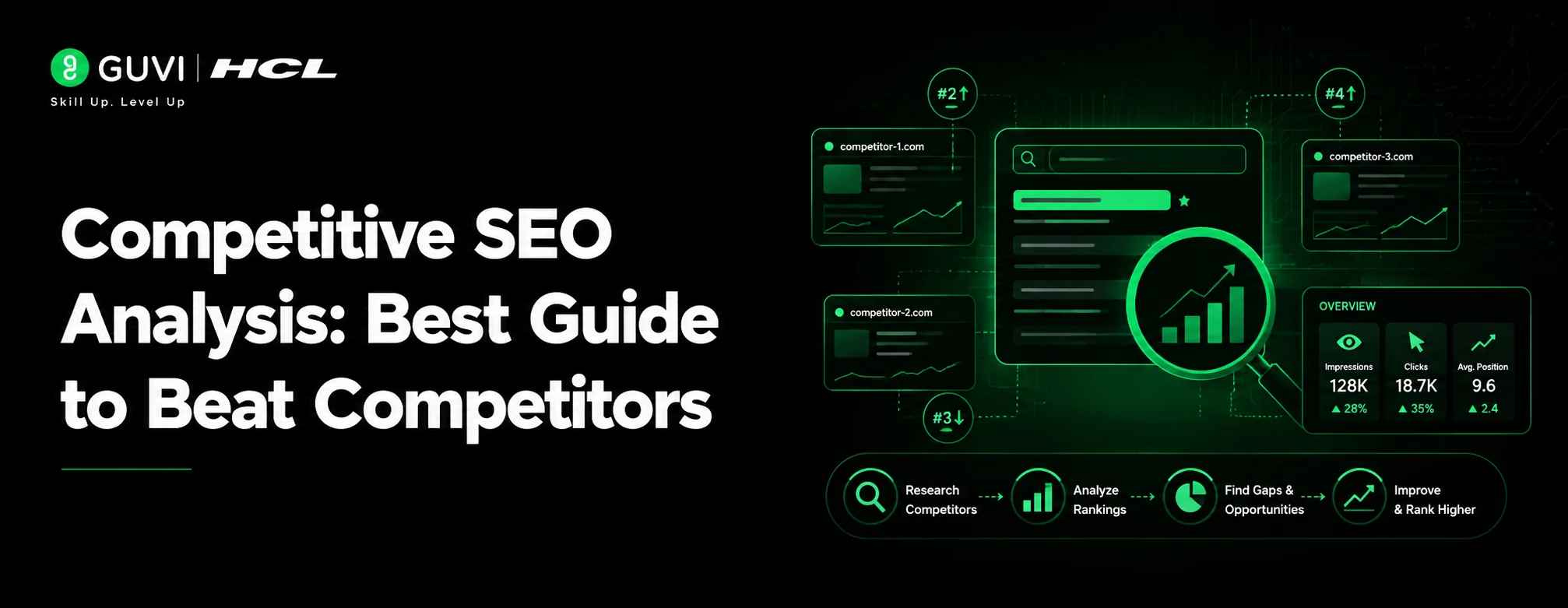
Competitive SEO Analysis: Best 2026 Guide to Beat Competitors
Jul 13, 2026 8 Min Read 41 Views
(Last Updated)
Table of contents
- TL;DR Summary
- What Is Competitive SEO Analysis?
- Competitive SEO Analysis vs Normal Competitor Research
- Why Is Competitive SEO Analysis Important in 2026?
- It Shows What Is Already Working
- It Helps You Find Keyword Gaps
- It Helps You Improve Content Quality
- It Helps You Plan Backlinks and Authority
- It Helps You Track AI Search Visibility
- What Should You Analyze in a Competitive SEO Analysis?
- How to Conduct a Competitive SEO Analysis Step by Step
- Step 1: Identify Your Real SEO Competitors
- What to Record
- Step 2: Analyze Competitor Keywords
- Example
- Step 3: Study Search Intent and SERP Format
- Step 4: Analyze Competitor Content Quality
- What to Improve
- Step 5: Run a Content Gap Analysis
- Simple Content Gap Template
- Step 6: Analyze Competitor Backlinks
- What to Do With This Data
- Step 7: Review Technical SEO and User Experience
- Step 8: Check AI Overview and GEO Visibility
- Step 9: Turn Insights Into an SEO Action Plan
- Example Action Plan
- Competitive SEO Analysis Checklist
- Best Tools for Competitive SEO Analysis
- Real-World Example of Competitive SEO Analysis
- Common Mistakes to Avoid While Doing Competitive SEO Analysis
- Confusing Business Competitors With SEO Competitors
- Copying Competitor Content
- Looking Only at Search Volume
- Ignoring AI Overview Visibility
- Collecting Data Without an Action Plan
- Build Digital Marketing Skills With HCL GUVI
- Conclusion
- FAQS
- What is Competitive SEO Analysis?
- Why is Competitive SEO Analysis important?
- How do I find my SEO competitors?
- What should I include in an SEO competitor analysis?
- What is a keyword gap analysis?
- What is content gap analysis in SEO?
- Which tools are best for Competitive SEO Analysis?
- How often should I do Competitive SEO Analysis?
- Should Competitive SEO Analysis include AI Overviews?
- Is Competitive SEO Analysis useful for beginners?
TL;DR Summary
Competitive SEO Analysis is the process of studying websites that rank for your target keywords so you can understand their strengths, weaknesses, content gaps, backlinks, technical SEO, and AI search visibility. To conduct one, identify your SEO competitors, compare keyword rankings, analyze top pages, review content quality, check backlinks, audit technical SEO, study SERP features, and track Google AI Overview visibility. The goal is not to copy competitors. The goal is to find opportunities to create better, more useful, and more trustworthy content that can rank in Google and appear in AI-generated answers.
Competitive SEO Analysis helps you understand why some websites rank above you and what you can do better. It is useful for bloggers, business owners, SEO learners, digital marketers, content writers, and agencies that want to improve organic visibility.
The search landscape in 2026 is not limited to ten blue links. You also need to study AI Overviews, featured snippets, Reddit results, YouTube results, local packs, and competitor brand mentions.
This guide explains the full process in a beginner-friendly way so you can turn competitor data into a clear SEO action plan.
What Is Competitive SEO Analysis?
Competitive SEO Analysis is the process of studying your organic search competitors to understand how they get traffic, rankings, links, and visibility.
Your SEO competitors are not always your business competitors. They are the websites ranking for the same keywords you want to rank for.
For example, if you sell a digital marketing course, your SEO competitors may include:
- Course platforms
- Marketing blogs
- YouTube educators
- SEO tool websites
- Career websites
- AI answer sources
- Forums like Reddit or Quora
Ahrefs explains that SEO competitor analysis helps you study competitor strategies, find strengths and weaknesses, and understand what SEO tasks to prioritize. This is useful because ranking is not only about publishing content; it is about publishing content that is better aligned with search intent than competing pages.
Competitive SEO Analysis vs Normal Competitor Research
Normal competitor research looks at pricing, products, offers, and business positioning.
Competitive SEO Analysis focuses on visibility in search engines and AI search platforms
| Factor | Normal Competitor Research | Competitive SEO Analysis |
| Main Focus | Business strategy | Search visibility |
| Looks At | Pricing, offers, customers | Keywords, content, backlinks, SERPs |
| Goal | Understand market competition | Improve organic rankings |
| Tools Used | Market research, surveys | SEO tools, SERP analysis, Search Console |
| Example | Compare course pricing | Compare ranking pages and content gaps |
Both are useful, but they answer different questions.
Why Is Competitive SEO Analysis Important in 2026?
Competitive SEO Analysis is important in 2026 because Google results are more crowded, AI Overviews answer many queries directly, and users now discover brands through search engines, YouTube, Reddit, ChatGPT, Gemini, and Perplexity.
You need to know where competitors are visible and why they are being trusted.
BrightEdge reported that AI Overviews appeared in over 11% of Google queries one year after launch, while Google still maintained over 90% search market share. This shows that traditional SEO and AI search visibility now need to work together.
It Shows What Is Already Working
Competitor analysis helps you see what content formats Google rewards.
You can check whether the top-ranking pages use:
- Step-by-step guides
- Comparison tables
- Templates
- Videos
- FAQ sections
- Tools
- Statistics
- Case studies
- Long-form tutorials
This helps you avoid guessing.
It Helps You Find Keyword Gaps
A keyword gap is a keyword your competitor ranks for but you do not.
For example, if your competitor ranks for “SEO audit checklist,” “technical SEO audit,” and “content gap analysis,” but your site does not, those may become content opportunities.
Keyword gaps help you expand your topical authority.
It Helps You Improve Content Quality
A good analysis shows what competitors cover and what they miss.
You may find that competitors explain keyword gaps well but ignore AI Overview optimization. That gap becomes your opportunity.
Google’s guidance says SEO is useful when it is applied to people-first content rather than search-engine-first content. That means your goal should be to create something more helpful, not just longer.

It Helps You Plan Backlinks and Authority
Backlinks still matter because they help search engines understand trust, authority, and relevance.
A backlink gap analysis shows which websites link to your competitors but not to you.
This helps you plan outreach, guest posts, PR mentions, resource page links, and content assets that can naturally earn links.
It Helps You Track AI Search Visibility
In 2026, SEO competitor research should include AI visibility.
Semrush notes that modern competitor analysis now needs to study AI Overviews, AI Mode, ChatGPT, Perplexity, and other AI search platforms, not only organic search results.
This matters because a competitor may not only outrank you on Google. They may also be cited by AI tools when users ask questions.
What Should You Analyze in a Competitive SEO Analysis?
A good Competitive SEO Analysis should cover keywords, content, backlinks, technical SEO, SERP features, user intent, and AI search visibility.
Do not collect random data. Focus on data that helps you make decisions.
| Area to Analyze | What to Check | Why It Matters |
| SEO Competitors | Who ranks for your target keywords | Shows who you actually compete with |
| Keywords | Ranking keywords, missing keywords, intent | Helps find content opportunities |
| Content | H2s, depth, examples, freshness, FAQs | Shows how to make better content |
| Backlinks | Referring domains, link quality, anchor text | Helps improve authority |
| Technical SEO | Page speed, indexing, crawl issues, schema | Helps search engines access pages |
| SERP Features | Featured snippets, videos, People Also Ask | Helps optimize format |
| AI Visibility | AI Overview citations, ChatGPT/Perplexity mentions | Helps improve GEO presence |
| User Experience | Readability, layout, mobile experience | Helps engagement and conversions |
This table can also become your working checklist when analyzing competitors.
How to Conduct a Competitive SEO Analysis Step by Step
A Competitive SEO Analysis should follow a clear process. If you jump directly into tools, you may collect too much data and still not know what to do.
Use this step-by-step process.
Step 1: Identify Your Real SEO Competitors
Start by searching your main keywords on Google.
Your SEO competitors are the websites ranking for the same terms, even if they do not sell the same product.
For example, if your target keyword is “digital marketing course,” your competitors may include:
- Training institutes
- Career blogs
- Review websites
- YouTube videos
- Course marketplaces
- Listicle blogs
- Reddit threads
Screaming Frog also notes that SEO competitors may not be the same as direct business competitors because they may simply compete for the same search phrases.
What to Record
Create a simple spreadsheet with:
- Competitor URL
- Ranking keyword
- Page type
- Search position
- Content format
- Notes on why it ranks
Start with 5–10 competitors. More than that can become confusing for beginners.
Step 2: Analyze Competitor Keywords
Next, study which keywords your competitors rank for.
You can use tools like Semrush, Ahrefs, SE Ranking, Ubersuggest, Google Keyword Planner, or free SERP checks.
Look for:
- Keywords they rank for but you do not
- Keywords where they rank in the top 3
- Long-tail keywords
- Low-difficulty opportunities
- High-intent keywords
- AI Overview-triggering queries
- FAQ-style keywords
Semrush recommends keyword gap analysis to identify missing keywords and group them into topic clusters.
Example
If a competitor ranks for:
- SEO competitor analysis
- competitor keyword analysis
- content gap analysis
- backlink gap analysis
- technical SEO audit checklist
You should not write five disconnected blogs immediately.
First, group them into clusters:
- SEO audit topics
- Competitor analysis topics
- Content gap topics
- Link-building topics
- Technical SEO topics
This helps you build topical authority.
Once you find keyword gaps, learning how to optimize keywords for SEO will help you place them naturally in titles, headings, content, and FAQs.
Step 3: Study Search Intent and SERP Format
Search intent tells you what the user really wants.
Before writing or updating content, check the SERP manually.
Ask:
- Are ranking pages guides, listicles, tools, or templates?
- Is Google showing videos?
- Is there an AI Overview?
- Are there people who also ask questions?
- Are Reddit or Quora threads ranking?
- Are competitors using tables or checklists?
- Are pages beginner-friendly or expert-heavy?
If most top-ranking pages are step-by-step guides, your page should also provide a clear process.
If Google shows templates or tools, add a checklist or downloadable format.
Step 4: Analyze Competitor Content Quality
Now open the top-ranking pages and study the content.
Do not copy their structure. Instead, identify what they cover and what they miss.
Check:
- H1 and H2 structure
- Introduction clarity
- TL;DR or quick answer
- Examples
- Tables
- Visuals
- FAQs
- Statistics
- External sources
- Internal links
- CTA placement
- Last updated date
- Author credibility
Google’s helpful content guidance recommends creating reliable, people-first content that satisfies users, not content made only for search engines.
What to Improve
Your content can beat competitors if it has:
- A clearer definition
- More practical examples
- Better step-by-step flow
- Updated 2026 context
- Better tables
- Original insights
- Stronger FAQs
- More credible sources
- Cleaner formatting
This is how you create value instead of repeating what already exists.
Step 5: Run a Content Gap Analysis
Content gap analysis means finding useful topics your competitors cover but you have not covered yet.
It also means finding useful details that competitors missed.
For example, if competitors cover “keyword gap” but not “AI Overview visibility gap,” that is a content gap.
You can find content gaps by checking:
- Missing H2 topics
- Missing FAQs
- Missing examples
- Missing statistics
- Missing templates
- Missing beginner explanations
- Missing updated trends
- Missing internal links
- Missing schema
Simple Content Gap Template
| Competitor Page | Topics Covered | Topics Missing | HCL GUVI Improvement |
| Competitor A | Keywords, backlinks | AI visibility, checklist | Add AI Overview and GEO section |
| Competitor B | Technical audit | Beginner examples | Add simple SEO learner workflow |
| Competitor C | Tool-based guide | Free method | Add free + paid tools |
This makes your content plan more actionable.
Step 6: Analyze Competitor Backlinks
Backlinks show which websites trust or reference your competitors.
A backlink gap analysis helps you find websites that link to competitors but not to you.
Check:
- Referring domains
- Link quality
- Anchor text
- Linked pages
- Content types that earn links
- Guest posts
- PR mentions
- Resource pages
- Tool mentions
AgencyAnalytics explains that competitor backlink analysis helps identify link-building opportunities by evaluating the quantity and quality of backlinks pointing to competitor websites.
Understanding how to build quality backlinks can help you turn backlink gap analysis into a practical link-building plan.
What to Do With This Data
Do not try to copy every backlink.
Look for patterns.
For example:
- Are competitors earning links from listicles?
- Are they getting links from industry reports?
- Are they mentioned in tools or templates?
- Are guides earning more links than product pages?
This helps you decide what link-worthy content to build.
Step 7: Review Technical SEO and User Experience
A competitor may rank better because their page is technically stronger.
Check technical signals such as:
- Page speed
- Mobile experience
- Indexability
- Internal links
- Broken links
- Schema markup
- URL structure
- Image optimization
- Core Web Vitals
- Content freshness
Technical SEO matters because even good content can struggle if search engines cannot crawl, understand, or load the page properly.
You can use tools like:
- Google Search Console
- PageSpeed Insights
- Screaming Frog SEO Spider
- Ahrefs Site Audit
- Semrush Site Audit
A beginner does not need to audit everything deeply on day one. Start with indexing, speed, mobile usability, titles, meta descriptions, and broken links.
Step 8: Check AI Overview and GEO Visibility
In 2026, competitive SEO analysis should include Generative Engine Optimization, or GEO.
This means checking whether your competitors appear in AI-generated answers.
Search your target keyword on:
- Google AI Overview
- Google AI Mode, where available
- ChatGPT
- Perplexity
- Gemini
- YouTube
Record:
- Which brands are mentioned
- Which pages are cited
- What answer format AI gives
- Whether competitors use clear definitions
- Whether competitors have FAQs
- Whether competitors cite trusted sources
- Whether competitors include examples or tables
Using the right AI tools for SEO can help you check AI visibility, generate content briefs, analyze SERPs, and improve optimization workflows.
A 2026 academic study of 11,500 real-user queries found that Google AI Overviews were generated for 51.5% of representative queries in the dataset. This shows why modern Competitive SEO Analysis should check both traditional rankings and AI-generated answers.
Step 9: Turn Insights Into an SEO Action Plan
The final step is not reporting. It is action.
After competitor analysis, create a prioritized action plan.
Group actions into:
- Quick wins
- Content updates
- New content ideas
- Technical fixes
- Link-building opportunities
- AI Overview optimization
- Internal linking improvements
Example Action Plan
| Priority | Finding | Action |
| High | Competitors rank with step-by-step guides | Add clearer process and checklist |
| High | Competitor has better FAQs | Add direct FAQ answers and schema |
| Medium | Competitor has more backlinks | Create link-worthy template or report |
| Medium | Competitor appears in AI Overview | Add TL;DR, examples, citations, and structured answers |
| Low | Competitor has better visuals | Add infographic or workflow diagram |
A good action plan should tell you what to do next, not just what competitors are doing.
Competitive SEO Analysis Checklist
Use this checklist whenever you analyze a competitor page.
| Task | Done |
| Identify 5–10 SEO competitors | ☐ |
| Separate direct competitors from organic competitors | ☐ |
| Check ranking keywords | ☐ |
| Find keyword gaps | ☐ |
| Group keywords into topic clusters | ☐ |
| Study search intent | ☐ |
| Review top-ranking page formats | ☐ |
| Analyze H2/H3 structure | ☐ |
| Check content freshness | ☐ |
| Review examples, tables, and FAQs | ☐ |
| Check backlink profile | ☐ |
| Find backlink gaps | ☐ |
| Review technical SEO basics | ☐ |
| Check AI Overview presence | ☐ |
| Test ChatGPT, Gemini, and Perplexity mentions | ☐ |
| Create SEO action plan | ☐ |
Best Tools for Competitive SEO Analysis
You can conduct a Competitive SEO Analysis using both free and paid tools.
Do not worry if you do not have access to every premium tool. Start with free tools and upgrade when you need deeper data.
| Tool | Free/Paid | Best For |
| Google Search | Free | SERP analysis and competitor discovery |
| Google Search Console | Free | Your own rankings, clicks, and queries |
| Google Keyword Planner | Free | Keyword ideas and search volume estimates |
| PageSpeed Insights | Free | Page speed and Core Web Vitals |
| Screaming Frog | Free/Paid | Technical SEO crawling |
| Ahrefs | Paid | Keywords, backlinks, competing pages |
| Semrush | Paid | Keyword gap, traffic, backlinks, AI visibility |
| SE Ranking | Paid | Competitor tracking and keyword research |
| Ubersuggest | Free/Paid | Beginner keyword and competitor research |
| ChatGPT/Gemini/Perplexity | Free/Paid | AI visibility and prompt testing |
Use tools to support decisions. Do not depend on one tool blindly because traffic and keyword numbers are estimates.
You can also explore these SEO tools for digital marketing to choose the right tools for keyword research, competitor tracking, backlinks, and technical audits.
Real-World Example of Competitive SEO Analysis
Imagine a Chennai-based digital marketing training institute wants to rank for “digital marketing course for beginners.”
The team searches Google and finds that competitors ranking on page one include course platforms, career blogs, YouTube videos, and training institutes.
After analyzing the top pages, they find that competitors include:
- Course duration
- Skills covered
- Career outcomes
- Fees
- Certification details
- FAQs
- Student reviews
But many competitors miss:
- Beginner learning roadmap
- Free tools to practice
- AI tools used in digital marketing
- Real campaign examples
- Portfolio project ideas
- Local job relevance
- AI Overview-friendly quick answer
So the institute updates its page with a better TL;DR, beginner roadmap, tool list, project examples, salary context, student FAQs, and internal links to SEO, content marketing, and analytics blogs.
That is how competitor research becomes an actionable SEO strategy.
If you are learning SEO practically, these SEO project ideas can help you build portfolio-worthy work using competitor analysis, keyword research, and content optimization.
BrightEdge reported that AI search still accounted for less than 1% of referral traffic in 2025, while organic search continued to deliver the majority of conversions. This means businesses should combine traditional SEO with AI visibility optimization instead of replacing SEO.
Common Mistakes to Avoid While Doing Competitive SEO Analysis
1. Confusing Business Competitors With SEO Competitors
Your business competitor may not be your SEO competitor.
Fix it by checking who ranks for your target keywords, not only who sells similar products.
2. Copying Competitor Content
Copying headings, examples, or structure can weaken your originality.
Fix it by using competitor research to find gaps, then create a more useful and original page.
3. Looking Only at Search Volume
High search volume does not always mean high business value.
Fix it by checking intent, relevance, conversion potential, and audience fit.
4. Ignoring AI Overview Visibility
Many beginners check only organic rankings.
Fix it by checking whether competitors appear in AI Overviews, ChatGPT, Perplexity, Gemini, and answer-style snippets.
5. Collecting Data Without an Action Plan
A long spreadsheet is not useful unless it leads to action.
Fix it by converting findings into clear next steps: update content, build new pages, improve technical SEO, add schema, or earn backlinks.
If you want to learn SEO in a structured way, you can also explore these SEO courses with certificate before choosing your learning path.
You can also follow a digital marketing career roadmap to understand how SEO, content, analytics, paid ads, and campaign strategy connect in real roles.
Build Digital Marketing Skills With HCL GUVI
Competitive SEO Analysis is a practical digital marketing skill because it helps you understand keywords, content gaps, search intent, backlinks, technical SEO, and AI visibility.
If you want to build job-ready digital marketing skills, HCL GUVI’s Digital Marketing Career Program can help you learn SEO, content strategy, website analytics, paid marketing, social media, and campaign performance through practical learning.
You can use these skills to plan SEO campaigns, improve website visibility, analyze competitors, and build stronger digital marketing strategies.
Conclusion
Competitive SEO Analysis helps you understand why competitors rank, where they are visible, and what you can do better. In 2026, this process should include keywords, content gaps, backlinks, technical SEO, SERP features, AI Overviews, and AI search mentions. The goal is not to copy competitors but to build a stronger, more useful SEO strategy. Start with 5–10 competitors, record meaningful insights, and turn your findings into a clear action plan. When done regularly, competitor analysis can improve rankings, content quality, authority, and digital marketing performance.
FAQS
1. What is Competitive SEO Analysis?
Competitive SEO Analysis is the process of studying websites that rank for your target keywords. It helps you understand their keywords, content, backlinks, technical SEO, and search visibility.
2. Why is Competitive SEO Analysis important?
Competitive SEO Analysis is important because it shows what is already working in your niche. It helps you find keyword gaps, content gaps, backlink opportunities, and ranking weaknesses.
3. How do I find my SEO competitors?
Search your target keywords on Google and note the websites that appear repeatedly. Your SEO competitors may include blogs, tools, marketplaces, YouTube videos, forums, or websites outside your direct business category.
4. What should I include in an SEO competitor analysis?
Include competitor keywords, top pages, content structure, backlinks, technical SEO, SERP features, user intent, AI Overview visibility, and content gaps. Then convert the findings into an action plan.
5. What is a keyword gap analysis?
Keyword gap analysis means finding keywords your competitors rank for but you do not. These keywords can help you plan new content or update existing pages.
6. What is content gap analysis in SEO?
Content gap analysis means finding topics, questions, examples, or formats that competitors cover but your page does not. It also includes finding areas competitors missed that you can cover better.
7. Which tools are best for Competitive SEO Analysis?
Useful tools include Google Search, Google Search Console, PageSpeed Insights, Screaming Frog, Ahrefs, Semrush, SE Ranking, Ubersuggest, ChatGPT, Gemini, and Perplexity. Beginners can start with free tools before using paid platforms.
8. How often should I do Competitive SEO Analysis?
You should do Competitive SEO Analysis before launching a major SEO campaign, after ranking drops, during content updates, after major Google updates, and at least once every quarter for important pages.
9. Should Competitive SEO Analysis include AI Overviews?
Yes. In 2026, competitor analysis should include AI Overviews, ChatGPT, Gemini, and Perplexity because users now discover answers and brands through AI-generated responses.
10. Is Competitive SEO Analysis useful for beginners?
Yes, beginners can use Competitive SEO Analysis to understand search intent, learn content structure, find keyword opportunities, and build better SEO strategies. Start with manual SERP analysis and a simple spreadsheet.
Success Stories

About the Author
Reemsha Khan
Always been a storyteller at heart. Now, I turn complex topics into simple, easy-to-understand stories through content. Hope you find it helpful.
View all posts by Reemsha Khan
Connect with me @










Did you enjoy this article?