


Python Articles
Freelancing as a Python Developer: Getting Your First Client
Common Python Mistakes Beginners Make And How to Fix Them
Python Best Practices: Writing Clean, Maintainable Code Like a Pro
How to Build a Python Developer Portfolio That Gets You Hired


Get In Touch For Details! Request More Information
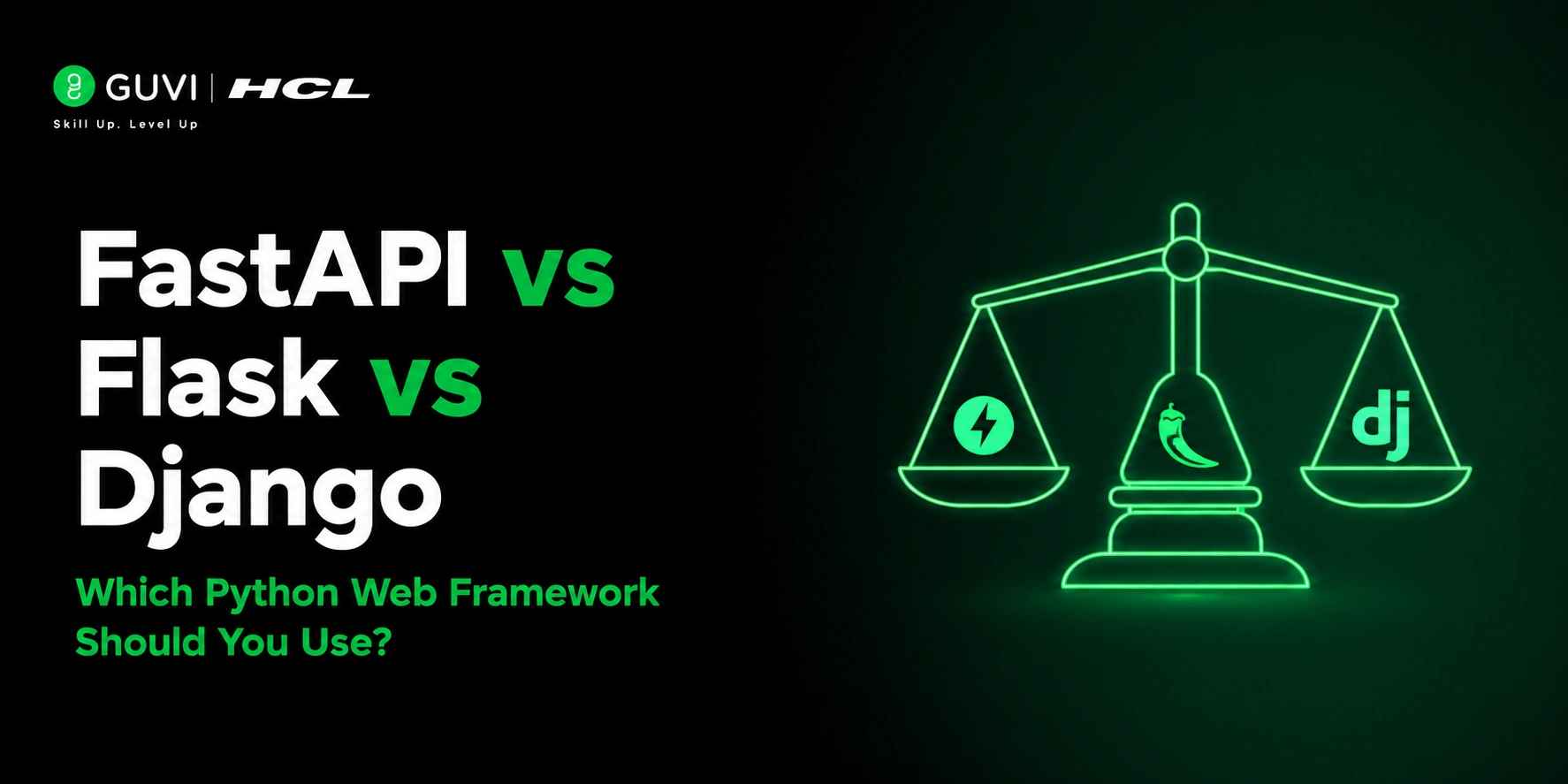
FastAPI vs Flask vs Django: A No-Nonsense Comparison for 2026
Jul 08, 2026 4 Min Read 353 Views
(Last Updated)
Python remains one of the most popular programming languages for backend development, AI applications, automation, and cloud computing. As organizations continue to build modern web services and scalable software systems, understanding FastAPI vs Flask vs Django helps developers select the right framework for their needs. Learners can gain practical backend development skills through HCL GUVI’s Python Course.
Table of contents
- TL;DR Summary
- What Are Python Web Frameworks?
- What Is FastAPI?
- What Is Flask?
- What Is Django?
- FastAPI vs Flask vs Django: Key Differences
- FastAPI vs Flask vs Django Performance Comparison
- FastAPI vs Flask vs Django for AI and Modern Cloud Applications
- When Should You Choose FastAPI?
- When Should You Choose Flask?
- When Should You Choose Django?
- Which Framework Should You Choose in 2026?
- Conclusion
- FAQs
- Which is better: FastAPI, Flask, or Django?
- Is FastAPI faster than Flask and Django?
- Is Flask still relevant in 2026?
- Why is FastAPI popular for AI applications?
- Can Django be used for APIs?
- Which framework should beginners learn first?
- Which Python framework has the best career opportunities?
TL;DR Summary
- FastAPI vs Flask vs Django is a comparison of Python’s three most popular backend frameworks, each designed for different development needs.
- FastAPI is the best choice for modern APIs, AI applications, microservices, and high-performance asynchronous workloads.
- Flask is ideal for lightweight applications, rapid prototyping, and projects that require maximum flexibility.
- Django is best suited for enterprise applications, SaaS platforms, content management systems, and projects requiring built-in features.
- For most API-first projects in 2026, FastAPI is the recommended framework due to its performance, scalability, and developer-friendly features.
What Are Python Web Frameworks?
Python web frameworks offer ready-made tools and libraries that make web application development easier. Rather than manually addressing routing, request processing, authentication, database communication, and security, developers can use frameworks that already handle these tasks.
Frameworks shorten development time, improve maintainability, and help teams follow established best practices. Among the many Python frameworks today, Django, Flask, and FastAPI are the most popular choices for modern backend development.
To better understand Python web development and the technologies behind modern web applications, explore this comprehensive guide.
What Is FastAPI?
FastAPI is a modern Python framework designed specifically for building APIs. Created by Sebastián Ramírez in 2018, it quickly became popular due to its high performance, built-in validation, and excellent developer experience.
FastAPI is built on Starlette for web functionality and Pydantic for data validation. One of its biggest benefits is automatic API documentation generation using OpenAPI and Swagger UI. Developers can create APIs and receive interactive documentation immediately, without extra configuration.
The framework is also asynchronous by default, allowing it to handle many concurrent requests efficiently. This makes FastAPI especially popular for AI applications, machine learning APIs, real-time systems, and microservices.
What Is Flask?
Flask is a lightweight Python microframework created by Armin Ronacher in 2010. Unlike Django, Flask has a minimalist philosophy and provides only the basic tools needed for web development.
Since Flask includes very few built-in features, developers have complete control over application architecture. You can select your preferred database layer, authentication method, and extra libraries based on project needs.
This flexibility makes Flask a favorite for prototypes, internal tools, small APIs, and custom applications where developers want total architectural freedom. Although FastAPI has gained popularity for modern APIs, Flask remains widely used and respected within the Python community.
What Is Django?
Django is a full-stack Python framework first released in 2005. It follows a “batteries included” philosophy, which means many essential features are integrated into the framework.
Django includes an ORM, an authentication system, an administrative dashboard, security features, migration tools, form handling, and caching support. These built-in capabilities let developers build complex applications faster than assembling multiple third-party components.
Due to its maturity and structure, Django is commonly used for enterprise applications, content management systems, SaaS platforms, marketplaces, and large-scale business software.
FastAPI has become a popular choice for building the API layer of modern AI applications, including LLM-powered apps, AI agents, retrieval-augmented generation (RAG) systems, and vector database integrations. Its asynchronous architecture, automatic request validation with Pydantic, and high performance make it well suited for AI workloads that involve multiple concurrent requests to external models, databases, and cloud services.
FastAPI vs Flask vs Django: Key Differences
| Feature | FastAPI | Flask | Django |
| Framework Type | API Framework | Microframework | Full Stack Framework |
| Performance | Very High | High | Good |
| Async Support | Native | Limited | Supported |
| Auto API Documentation | Yes | No | No |
| ORM Included | No | No | Yes |
| Admin Dashboard | No | No | Yes |
| Learning Curve | Moderate | Easy | Moderate |
| Best Use Case | APIs, AI Apps | Small Apps | Enterprise Apps |
| Development Speed | Fast | Flexible | Very Fast for Large Projects |
| Architecture Style | API First | Minimalist | Batteries Included |
Understanding framework differences is only part of the journey. Download HCL GUVI’s free Python eBook to learn the concepts that power modern Python development.
FastAPI vs Flask vs Django Performance Comparison
Performance comparisons often dominate framework discussions, but they can be misleading. The performance of a real-world application depends heavily on databases, caching strategies, infrastructure, and code quality.
FastAPI generally performs best in asynchronous workloads because it relies on ASGI and non-blocking request handling. This allows it to process numerous concurrent requests efficiently, making it ideal for APIs, AI systems, and microservices.
Flask performs well for lightweight applications but may require more effort when scaling highly concurrent workloads.

Django may not always win benchmark contests, but its performance is sufficient for most enterprise applications. In many production environments, architecture fit matters far more than benchmark rankings.
FastAPI vs Flask vs Django for AI and Modern Cloud Applications
The rise of AI has changed backend development needs significantly. Modern applications often communicate with LLMs, vector databases, external APIs, and streaming services. These tasks benefit from asynchronous execution and efficient concurrency management.
FastAPI has become the go-to framework for these situations because it was designed with asynchronous programming in mind.
AI agents, RAG systems, recommendation engines, and real-time analytics platforms frequently use FastAPI as their backend layer.
Flask can still support AI projects, especially small prototypes.
Django is useful when AI features need integration into larger enterprise platforms that require authentication, dashboards, and complex business logic.
When Should You Choose FastAPI?
- Building AI applications or LLM-powered systems.
- Developing API-first products.
- Creating microservice architectures.
- Handling large numbers of concurrent requests.
- Requiring automatic API documentation.
- Developing cloud-native applications.
When Should You Choose Flask?
- Building lightweight applications.
- Creating rapid prototypes.
- Developing internal business tools.
- Requiring maximum architectural flexibility.
- Learning backend development basics.
- Building small to medium-sized APIs.
When Should You Choose Django?
- Building SaaS platforms.
- Creating enterprise applications.
- Developing marketplaces and CMS platforms.
- Requiring a built-in admin dashboard.
- Managing complex relational databases.
- Scaling large business applications.
Whether you choose FastAPI, Flask, or Django, a strong foundation in Python remains essential. HCL GUVI’s Python Course helps learners develop practical programming skills through real-world projects and structured learning.
Which Framework Should You Choose in 2026?
There is no single winner in the FastAPI vs Flask vs Django discussion. The best choice depends on your project goals.
If you are building modern APIs, AI services, or microservices, FastAPI is usually the strongest option.
If you want complete flexibility with minimal overhead, Flask remains an excellent choice.
If you need a structured framework with many built-in features, Django continues to lead in enterprise development.
A simple guide can help:
- API-first applications → FastAPI
- Lightweight applications → Flask
- Full business platforms → Django
Conclusion
The FastAPI vs Flask vs Django discussion is not about picking a single winner. Each framework excels in different situations.
FastAPI has become the preferred choice for modern APIs, AI applications, and cloud-native development due to its asynchronous design and strong developer experience.
Flask still offers unmatched flexibility for smaller projects and custom architectures.
Django remains the enterprise powerhouse, providing built-in tools that significantly reduce development time for large applications.
Before choosing a framework, consider the type of application you are making, your team’s expertise, and long-term maintenance needs. Selecting a framework that fits your workload will always be more valuable than chasing benchmark numbers.
FAQs
1. Which is better: FastAPI, Flask, or Django?
There is no single best framework. FastAPI is best for APIs, Flask is ideal for lightweight projects, and Django excels in enterprise applications.
2. Is FastAPI faster than Flask and Django?
For asynchronous API workloads, FastAPI usually delivers higher performance and handles concurrency better.
3. Is Flask still relevant in 2026?
Yes. Flask is still widely used for prototypes, lightweight applications, and custom backend services.
4. Why is FastAPI popular for AI applications?
Its asynchronous design, schema validation, and API-first approach make it well-suited for AI systems and LLM integrations.
5. Can Django be used for APIs?
Yes. Django can be paired with Django REST Framework to build effective APIs alongside traditional web applications.
6. Which framework should beginners learn first?
Many beginners start with Django because it offers a complete development experience, while Flask is also beginner-friendly for learning backend basics.
7. Which Python framework has the best career opportunities?
Django remains strong in enterprise hiring, while demand for FastAPI is rapidly growing in AI, cloud, and modern backend engineering roles.
Success Stories

About the Author
Vishalini Devarajan
An Aerospace Engineer turned content writer, I focus on making complex concepts easy to understand through well-structured, reader-friendly blogs. Whether it’s a technical topic or a non-technical one, I love creating content that is clear, engaging, and impactful.
View all posts by Vishalini Devarajan
Connect with me @






Did you enjoy this article?