


Career Articles
Capgemini Exceller Assessment 2026: Complete Framework - Best Guide
Deloitte Syllabus 2026: Latest NLA Assessment & Exam Syllabus
Cognizant GenC Elevate Interview Questions and Answers for Freshers - Best Guide
Cognizant GenC Elevate Communication Assessment: Test Pattern and Preparation - Best Guide


Get In Touch For Details! Request More Information

Tech Interview Prep in 30 Days: A Study Plan
Sep 24, 2026 5 Min Read 452 Views
(Last Updated)
Most people prep for tech interviews the wrong way. They open a problem list, work through problems in random order, get stuck, feel bad, and repeat. After two weeks of that, they either feel falsely confident because they solved a few easy ones, or genuinely demoralised because the mediums feel impossible. Neither state is useful.
What actually works is treating the 30 days like a sprint with a real structure: a week of foundations, a week of patterns, a week of applied practice, and a final week of simulation. This blog lays that out in a way you can actually follow.
Table of contents
- TL;DR Summary
- What 30 Days Actually Gets You
- Week 1: Get the Foundations Right
- What to Cover
- How to Study It
- Week 2: Learn the Patterns, Not the Problems
- The Core Patterns
- How to Study Them
- 💡 Did You Know?
- Week 3: Apply It Under Real Conditions
- System Design Basics
- Mock Interviews
- Week 4: Simulate, Review, and Close Gaps
- Common Mistakes That Derail 30-Day Prep
- Conclusion
- FAQs
- Is 30 days enough to prepare for a tech interview?
- How many LeetCode problems should I solve in 30 days?
- Should I study system design even for junior roles?
- What is the best resource for algorithm patterns?
- How do I stay consistent over 30 days?
- What if I run out of time and skip a week?
- How important are behavioural questions?
TL;DR Summary
- Thirty days is enough time to go from scattered and anxious to genuinely prepared for a tech interview if you stop trying to cover everything and start treating the prep like a structured project.
- The plan here is not about grinding 300 LeetCode problems.
- It is about learning to recognise patterns, building a system design vocabulary, and getting enough reps under real conditions that the interview itself stops feeling like a test and starts feeling like a conversation you have had before.
Want to accelerate your career in tech with structured guidance, hands-on projects, and real-world mentorship? Explore HCL GUVI’s career accelerator courses built for learners who want to move fast and build things that actually work.
What 30 Days Actually Gets You
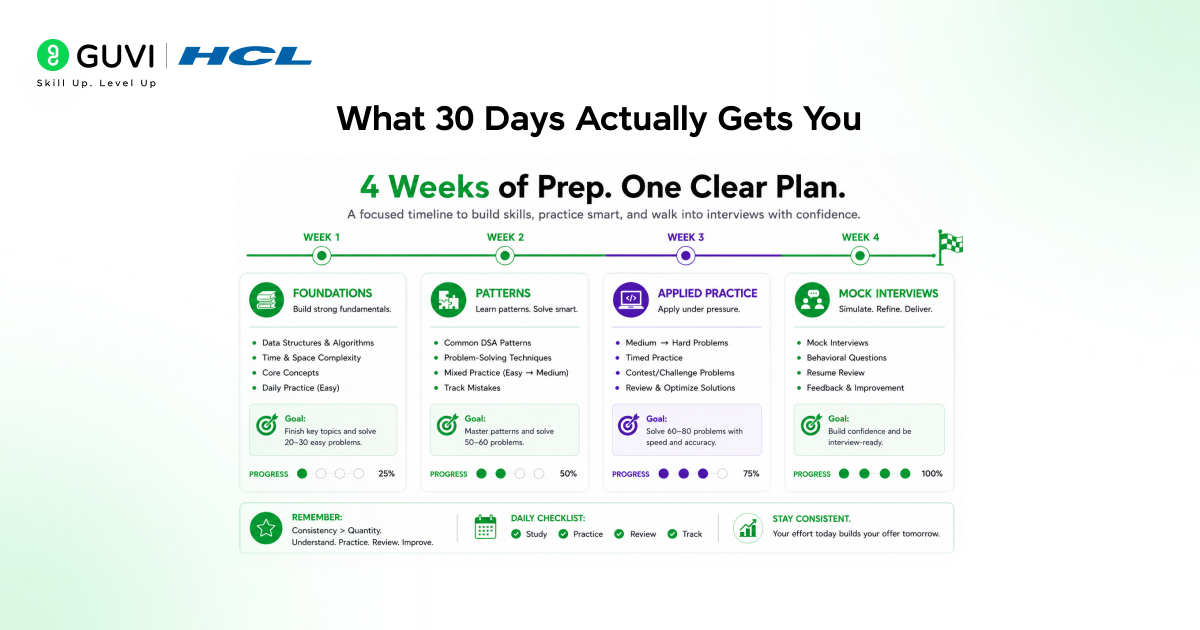
Let’s be honest about what 30 days can and cannot do. It cannot make you an expert in every data structure ever invented. It cannot guarantee you crack a FAANG interview if you are starting from zero coding experience.
What it can do is take someone who already codes but has not thought deliberately about algorithms and interviews, and get them to a place where they can handle most standard problem types, speak clearly about trade-offs, and stay calm under pressure.
The goal of the 30 days is not to finish a problem list. The goal is to build three things:
- Pattern recognition: the ability to look at a new problem and know which category of approach it likely belongs to
- Communication habits: the ability to think out loud in a structured way while you are solving
- Pressure tolerance: having enough reps under timed, observed conditions that the real interview does not feel like a completely unfamiliar situation
None of those three things comes from just reading solutions. They come from doing problems, reviewing what you got wrong, and doing mock interviews. That is what this plan is built around.
Read More: How to Build a Portfolio That Gets You Hired
Want to accelerate your career in tech with structured guidance, hands-on projects, and real-world mentorship? Explore HCL GUVI’s career accelerator courses built for learners who want to move fast and build things that actually work.
Week 1: Get the Foundations Right
Before patterns, before system design, before anything else, you need the core data structures cold. Not just “I know what a hash map is” but “I can implement one from scratch and tell you exactly when to reach for it.”
What to Cover
- Arrays and strings: two-pointer, sliding window, prefix sums
- Hash maps and sets: frequency counting, lookups in O(1)
- Stacks and queues: when LIFO vs FIFO matters, monotonic stacks
- Linked lists: reversal, detecting cycles, merging
- Trees: BFS, DFS, recursive and iterative traversals
How to Study It
Two easy problems a day. Not medium, not hard easy. The point is not to feel clever; it is to get the mechanics automatic. After each problem, before you look at any solution, write down in plain English what approach you used and why. This habit is what transfers to the real interview, where you have to explain yourself as you go.
Use one resource per topic and go deep, not wide. A single good course or textbook chapter on trees beats skimming three different ones. You want the mental model solid, not a surface familiarity with several explanations.
Explore: Adobe Interview Experience
Week 2: Learn the Patterns, Not the Problems
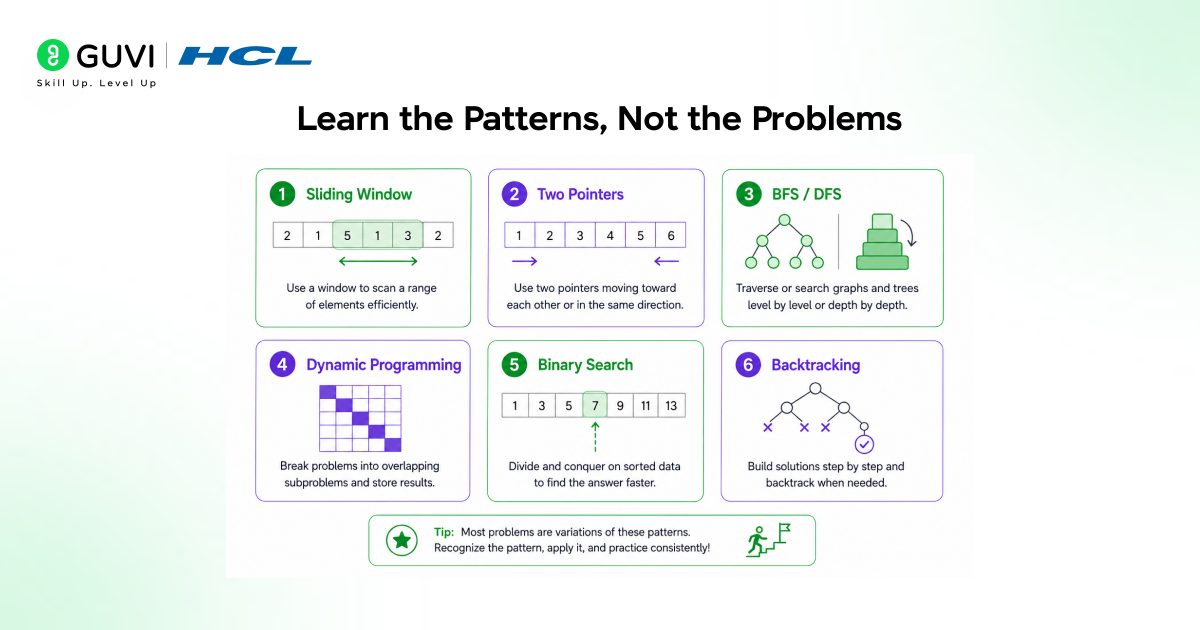
Most coding interview problems are not unique. They are variations on a small set of patterns. Once you can recognise the pattern, the problem mostly solves itself. This is the week you learn to see those patterns.
The Core Patterns
- Sliding window: anything involving a subarray or substring with a constraint on size or sum
- Two pointers: sorted arrays, finding pairs, in-place operations
- BFS/DFS: trees, graphs, anything that involves exploring neighbours or levels
- Binary search: not just sorted arrays any problem where you can binary search on the answer
- Dynamic programming: problems with overlapping subproblems and optimal substructure; start with 1D DP before 2D
- Backtracking: generating combinations, permutations, constraint satisfaction
How to Study Them
Pick one pattern per day. Do two medium problems that use that pattern. Then, crucially, find one problem you did this week that you can now see uses the same pattern; connecting old problems to new frameworks is what builds real recognition rather than surface memorisation.
💡 Did You Know?
Research on expert performance consistently shows that what distinguishes strong problem-solvers is not simply higher intelligence, but their ability to chunk information—grouping individual pieces of information into meaningful, recognizable patterns that can be recalled quickly.
This is why deliberate pattern practice is so effective for coding interviews. Instead of memorizing solutions to individual problems, experienced candidates learn to recognize common algorithmic patterns such as two pointers, sliding window, dynamic programming, graphs, and backtracking, allowing them to apply the right approach to unfamiliar questions.
- Focus on identifying problem patterns rather than memorizing answers
- Build mental models that transfer across multiple questions
- Recognize recurring algorithmic techniques quickly
- Develop faster and more confident problem-solving skills
Week 3: Apply It Under Real Conditions
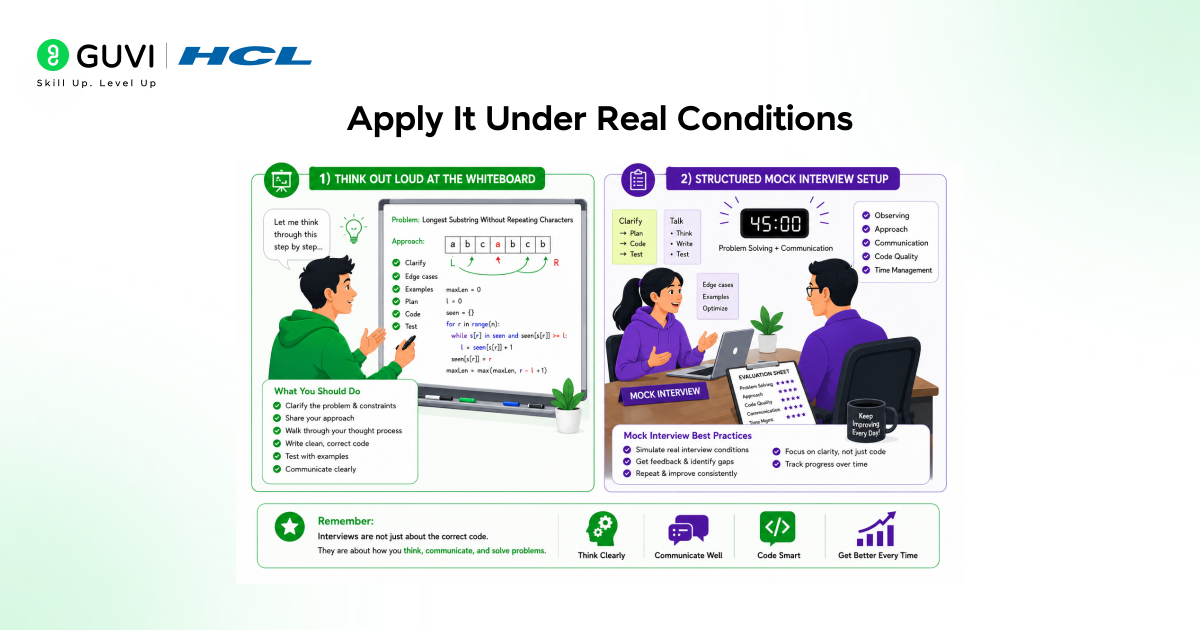
Solving problems alone in your own time is not the same as performing under observation with a clock running. Week 3 is where you close that gap. The two things to add this week are system design and mock interviews.

System Design Basics
You do not need to become a distributed systems architect in a week. You need to be able to walk through a system design question “design a URL shortener,” “design a notification service” with a clear structure. The structure that works:
- Clarify requirements: what scale, what features, what constraints?
- Estimate: rough numbers on users, requests per second, storage
- Define the API: what does the interface look like?
- Data model: what gets stored and how?
- High-level components: walk through the architecture
- Deep dive: go deeper on the one or two components the interviewer cares about
Practice this structure with two or three questions. The goal is to have an automatic framework so you are never staring blankly at a blank whiteboard.
Mock Interviews
This is the part most people skip and the part that matters most. You need to sit in front of another person not just solve problems in silence and practice explaining your thinking out loud. Use a friend, a peer from a study group, Pramp, or Interviewing.io. Do at least three mock interviews this week. It will feel uncomfortable. That discomfort is the point.
| Week | Focus | Daily Goal |
| Week 1 | Data structures & fundamentals | 2 easy problems + revise one core concept |
| Week 2 | Algorithms & patterns | 2 medium problems + identify pattern used |
| Week 3 | System design basics + mock interviews | 1 medium problem + 1 system design question |
| Week 4 | Full-length mock interviews + gap fill | 1 timed mock session + review weak areas |
Week 4: Simulate, Review, and Close Gaps
The last week is not for learning new material. It is for consolidating what you have built and getting as close to real interview conditions as possible.
Do a full-length timed mock interview every other day. Review every problem you got wrong this month and redo it cold. Make a short list of the three pattern types where you are still shaky and do two more problems in each.
On the non-mock days, revisit your behavioural answers: tell me about a time you disagreed with a decision, tell me about a project you led, tell me about a time something went wrong. These questions come in every interview, and the answers need to be practised, not improvised.
Common Mistakes That Derail 30-Day Prep
1. Solving problems without reviewing them: Getting to an answer and moving on immediately is the fastest way to not improve. The review — what was my approach, what was the optimal approach, what pattern does this belong to — is where the actual learning happens.
2. Skipping mock interviews until the last week: Communication under observation is a separate skill from problem-solving alone. If you only practise the latter, the former will fail you even when you know the answer.
3. Treating LeetCode hard problems as the target: Most standard software engineering interviews, outside of a handful of companies, do not rely heavily on hard LeetCode problems. Solid mediums, clean communication, and good system design thinking will get you further than being able to solve a hard problem silently.
Conclusion
Thirty days is a real constraint and it is enough if you use it deliberately. Week one is foundations. Week two is patterns. Week three is applying under pressure. Week four is simulation and consolidation. The thing that will make or break it is not which problems you choose but whether you actually do the mock interviews, actually review what you got wrong, and actually practise communicating as you solve. Most people skip at least one of those three.
FAQs
Is 30 days enough to prepare for a tech interview?
For most standard software engineering roles, yes if you already code and are willing to put in two to three focused hours per day. For senior roles at top-tier companies, 30 days is a good foundation but you may need longer.
How many LeetCode problems should I solve in 30 days?
Quality over quantity. Sixty to eighty problems, properly reviewed, will serve you better than 200 solved and forgotten. Focus on recognising patterns, not hitting a number.
Should I study system design even for junior roles?
A basic understanding of system design how to break down a problem, what trade-offs look like helps even in junior interviews. Depth expectations are much lower, but having no vocabulary for it at all can hurt you.
What is the best resource for algorithm patterns?
Grokking the Coding Interview, Neetcode’s roadmap, and the CSES problem set are all solid. Pick one and go deep rather than bouncing between resources.
How do I stay consistent over 30 days?
Treat it like a job. Fixed hours, fixed location, a plan for each day written the night before. Consistency comes from structure, not motivation.
What if I run out of time and skip a week?
Prioritise mock interviews above everything else if you are short on time. Communication under pressure is the most underpractised skill and the one that shows up most directly in the real interview.
How important are behavioural questions?
At most companies, behavioural rounds carry equal or greater weight than technical ones for mid and senior roles. Do not treat them as an afterthought. Prepare your four or five core stories and know them well.
Success Stories

About the Author
Vishalini Devarajan
An Aerospace Engineer turned content writer, I focus on making complex concepts easy to understand through well-structured, reader-friendly blogs. Whether it’s a technical topic or a non-technical one, I love creating content that is clear, engaging, and impactful.
View all posts by Vishalini Devarajan
Connect with me @











Did you enjoy this article?