


Career Articles
Capgemini Exceller Assessment 2026: Complete Framework - Best Guide
Deloitte Syllabus 2026: Latest NLA Assessment & Exam Syllabus
Cognizant GenC Elevate Interview Questions and Answers for Freshers - Best Guide
Cognizant GenC Elevate Communication Assessment: Test Pattern and Preparation - Best Guide


Get In Touch For Details! Request More Information
Mentorship in Tech: Find a Mentor That Works
Sep 24, 2026 4 Min Read 359 Views
(Last Updated)
A lot of career advice in tech is about skills: learn this framework, get that certification, build a portfolio. What gets talked about less is how much of early career momentum comes from people from someone who has seen the terrain before you and is willing to tell you where the traps are. Mentorship in tech is not a soft, optional extra.
It is one of the fastest ways to compress years of trial and error into months of directed progress. The problem is that most people either never look for a mentor, or they look in the wrong places and give up. This blog is about fixing that.
Table of contents
- TL;DR Summary
- What Is a Mentor, Actually?
- Where to Actually Find a Mentor
- Your Own Company First
- Tech Communities and Open Source
- LinkedIn and Cold Outreach
- Conferences, Meetups, and Hackathons
- Making the Relationship Actually Work
- Come Prepared Every Time
- Update Them Without Prompting
- Do Not Monopolize Them
- Common Mistakes People Make with Mentorship
- Conclusion
- FAQ
- How do I find a mentor in tech as a beginner?
- How often should I meet with my mentor?
- What should I talk about in a mentoring session?
- Is it okay to have more than one mentor?
- What if my mentor stops responding?
- Do I need to pay for a mentor?
TL;DR Summary
- Finding a mentorship in tech is not about luck; it is about being specific, being prepared, and making it easy for someone to say yes.
- The best mentors are not always the most famous engineers in your feed; they are the people one or two steps ahead of you who still remember what it felt like to not know the things you don’t know yet.
- This blog covers where to find them, how to reach out without being awkward, and what to do once the relationship starts.
Want to accelerate your career in tech with structured guidance, hands-on projects, and real-world mentorship? Explore HCL GUVI’s career accelerator courses built for learners who want to move fast and build things that actually work.
What Is a Mentor, Actually?
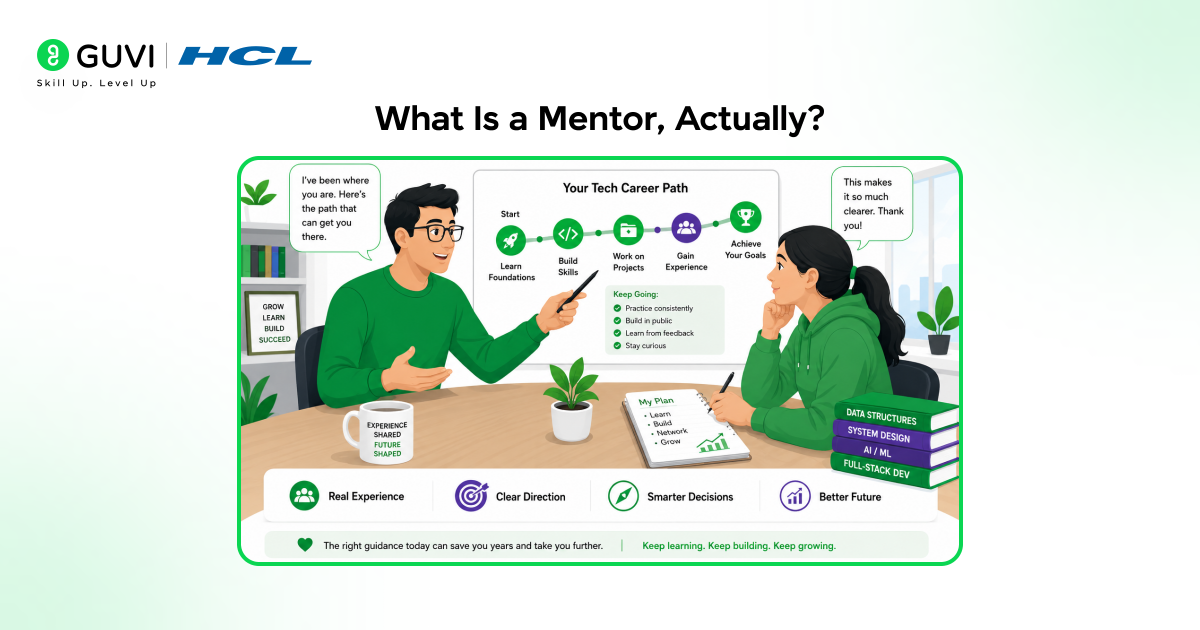
The word gets thrown around loosely, so it is worth being precise. A mentor is someone with more experience in an area you want to grow in, who is willing to share that experience in a structured or semi-structured way over time. That is it.
They are not a therapist, a job placement service, or a homework-checking service. What they offer is context: they have seen what works and what doesn’t, and they can help you interpret your own situation through that lens.
In tech specifically, mentors tend to help with things like:
- Navigating the gap between what you learned and what the job actually requires
- Understanding how to grow inside a company or team
- Making better decisions at career crossroads (should I take this role? should I switch stacks?)
- Getting honest feedback on your work that colleagues might not give you directly
What they are not: a replacement for doing the work. Mentorship accelerates the learning you are already doing. It does not substitute for it.
Read More: How to Build a Portfolio That Gets You Hired
Want to accelerate your career in tech with structured guidance, hands-on projects, and real-world mentorship? Explore HCL GUVI’s career accelerator courses built for learners who want to move fast and build things that actually work.
Where to Actually Find a Mentor
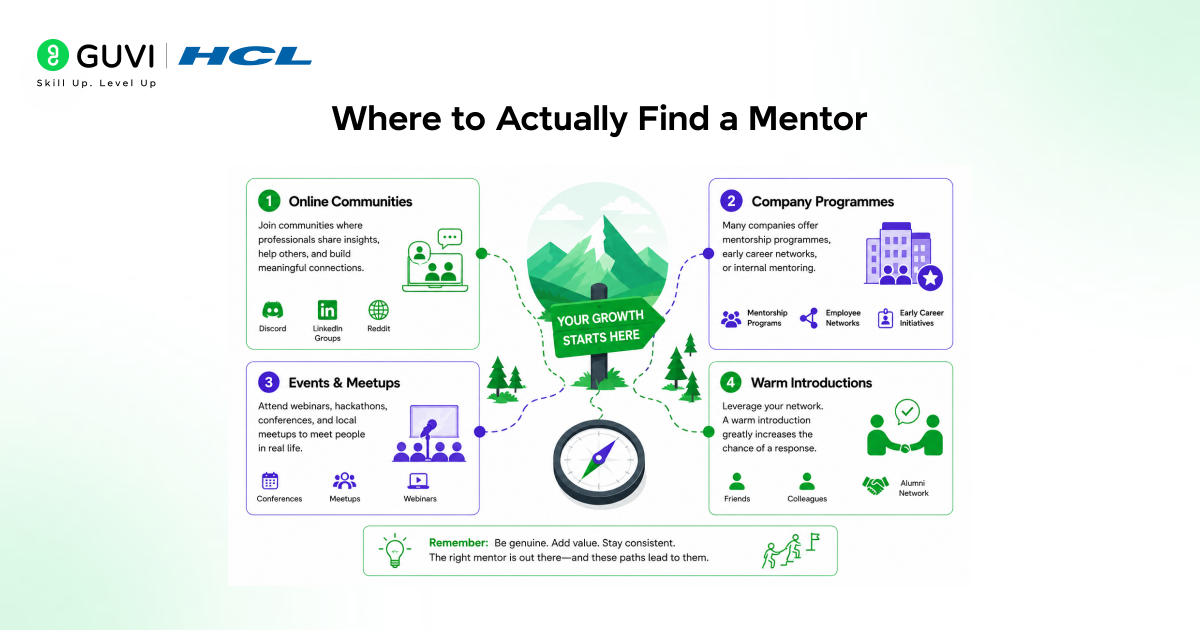
Most people wait to be assigned a mentor or hope one appears naturally. A few practical paths that actually work:
Your Own Company First
If you are employed, start here. Many companies have formal mentorship programmes you may not have signed up for. But even without a programme, senior engineers and team leads are often open to informal mentoring relationships with junior colleagues, especially if you make the ask low-friction and specific.
Tech Communities and Open Source
Communities like Dev.to, Hashnode, Discord servers for specific technologies, and open source projects on GitHub are full of people who are genuinely interested in helping others learn. Contribution is the best introduction:
LinkedIn and Cold Outreach
Cold outreach works, but only when it is specific. A message that says “hi, I admire your work, would you be my mentor?” fails almost every time. A message that references something specific they built or wrote, explains briefly who you are and what you are working on, and asks for a single 20-minute conversation almost always gets a reply.
Conferences, Meetups, and Hackathons
In-person events are underleveraged. The density of experienced people who are voluntarily showing up to share knowledge is high, and conversations happen naturally. The goal is not to pitch someone immediately .
| Approach | Best For | Key Tip |
| Cold outreach (LinkedIn/email) | Finding mentors outside your network | Personalise every message — reference their specific work |
| Community & events | Meeting peers and informal guides | Consistency matters; show up regularly, not just once |
| Internal mentorship programmes | Structured guidance at your company | Apply early; slots fill fast and matching takes time |
| Warm introductions | High-trust connections quickly | Ask for specific intros, not general permission to network |
Making the Relationship Actually Work
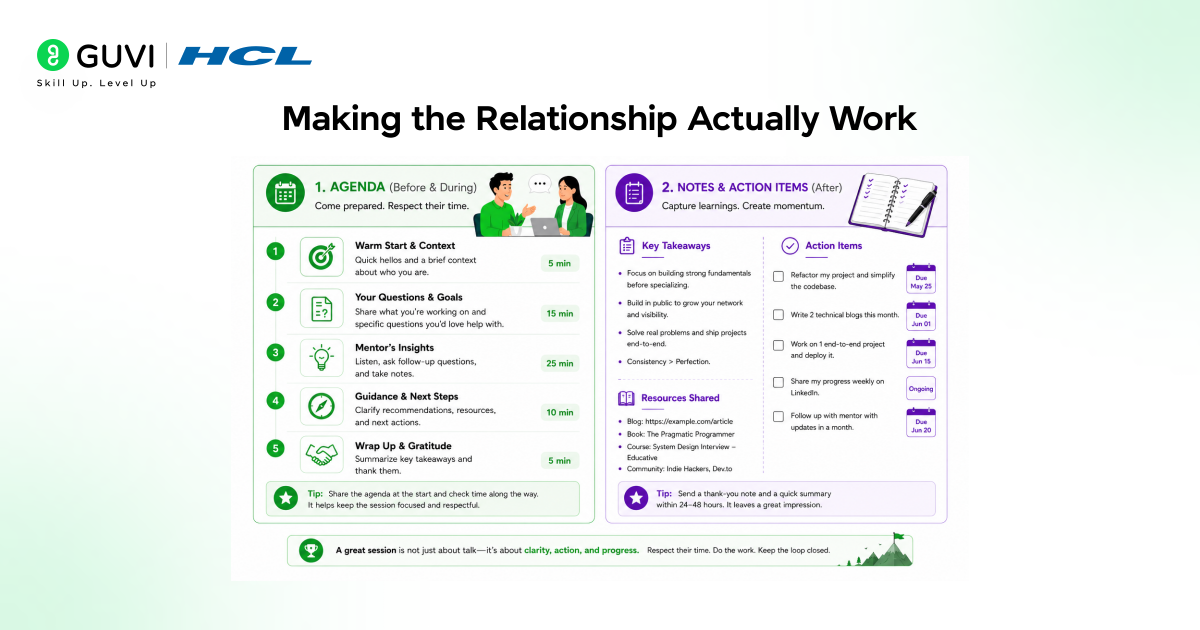
Getting a mentor to say yes is the beginning, not the win. Most mentoring relationships that fizzle out do so because the mentee does not own the structure. Treat it like a project: you are the project manager.

Come Prepared Every Time
Before every conversation, write down the two or three specific questions or problems you want to discuss. Share them with your mentor beforehand if possible. This is the single biggest factor in whether sessions feel valuable or not for both people. A mentor who leaves a call feeling like they helped with something concrete will show up again.
Close Every Session with an Action
What will you try, change, or build before the next conversation? State it out loud, write it down, and follow up on it. This turns advice into evidence that the relationship is moving something forward which is what keeps a good mentor invested.
Update Them Without Prompting
When something works, tell them. When it does not, tell them. Mentors who hear nothing assume the relationship has run its course. Regular short updates even a two-line message maintain the connection and show that their time actually mattered.
Do Not Monopolize Them
Respect their time aggressively. If you agreed to meet monthly, do not quietly escalate to weekly. If you said 30 minutes, end at 30 minutes. The mentors worth having are busy. Demonstrating that you are someone who respects constraints is part of building a relationship they want to maintain.
Common Mistakes People Make with Mentorship
1. Looking for a mentor before knowing what you need: Vague goals produce vague guidance. Before you reach out to anyone, know what specific problem you want help with. “I want career advice” is not a problem. “I don’t know whether to go deep on backend or move into platform engineering” is one.
2. Only looking upward: The most useful mentors are often peers who are 12–18 months ahead of you, not 10 years. The gap is small enough that they remember what it was like, and close enough that their context is still relevant to where you are. Peer mentors are underrated.
3. Treating the mentor as a decision-maker: A mentor can offer perspective. They cannot and should not be making your career decisions for you. Use their input to think more clearly, not to outsource your judgment.
Conclusion
Mentorship in tech is not mysterious. It is specific: know what you need, find someone who has navigated it, make a clear and low-pressure ask, and then own the relationship once it starts. The engineers who grow fastest are almost always the ones who figured out how to learn from people, not just documentation. You do not need a formal programme, an impressive network, or a warm introduction. You need a clear problem, a real message, and the willingness to follow through. Start with one conversation. The rest builds from there.
FAQ
How do I find a mentor in tech as a beginner?
Start with communities, open source projects, and internal company programmes before going to cold outreach. The clearer you are about what you need help with, the easier it is to find someone whose experience matches.
How often should I meet with my mentor?
Monthly is the most common cadence that works. It is frequent enough to maintain momentum and infrequent enough to give you time to actually do the work between sessions.
What should I talk about in a mentoring session?
Come with two or three specific questions or problems. Avoid vague asks. The more concrete the problem, the more useful the guidance you will get.
Is it okay to have more than one mentor?
Yes, it is encouraged. Different mentors cover different domains. A technical guide, a career guide, and a peer learning alongside you serve different purposes and do not conflict.
What if my mentor stops responding?
It happens. Experienced people get busy. Follow up once after a week of silence, acknowledge that they are probably swamped, and make it easy for them to re-engage.
Do I need to pay for a mentor?
Not usually. Most meaningful mentoring relationships in tech are informal and unpaid. Paid coaching services exist and can be valuable for specific goals, but they are not a substitute for genuine peer or near-peer mentorship.
Success Stories

About the Author
Vishalini Devarajan
An Aerospace Engineer turned content writer, I focus on making complex concepts easy to understand through well-structured, reader-friendly blogs. Whether it’s a technical topic or a non-technical one, I love creating content that is clear, engaging, and impactful.
View all posts by Vishalini Devarajan
Connect with me @











Did you enjoy this article?