


Software Automation & Testing Articles
How to Use Claude for A/B Testing Content Variations
Load Testing Your Application with k6: A Practical Introduction
Cypress Component Testing Tutorial: Test Your UI in a Real Browser, Not a Fake One
Manual Tester Roles and Responsibilities: 12 Important Duties for Career Growth


Get In Touch For Details! Request More Information

Skills Required to Become a Successful Performance Testing Engineer
Sep 02, 2026 4 Min Read 453 Views
(Last Updated)
Software that crashes under load doesn’t just lose users, it loses revenue, trust, and sometimes entire deals. That’s the gap Performance Testing Engineers close. They’re the ones who simulate the chaos before it happens, stress-testing systems with thousands of virtual users, watching CPUs spike, and catching the bottleneck that would otherwise surface only after launch day.
If you’re considering this career path or hiring for the role, here’s exactly what separates a good performance tester from a great one.
Table of contents
- TL;DR
- Who is a Performance Testing Engineer?
- Technical Skills of a Performance Testing Engineer
- Soft Skills of a Performance Testing Engineer
- Performance Testing Tools Every Engineer Should Know
- How to Build Performance Testing Engineer Skills
- Here is a practical learning path:
- Important Performance Metrics to Track
- Conclusion
- FAQs
- Do I need a development background to become a Performance Testing Engineer?
- Which tool should I learn first: JMeter or LoadRunner?
- How is performance testing different from functional testing?
- What’s the biggest mistake beginners make in this field?
- Is cloud knowledge really necessary for this role?
TL;DR
- A Performance Testing Engineer checks how applications behave under real-world traffic, peak loads, sudden spikes, long usage periods, and high-volume conditions.
- The role requires strong knowledge of load testing tools like JMeter, LoadRunner, Gatling, BlazeMeter, and k6 to simulate users and measure system limits.
- Core technical skills include scripting, system architecture, database diagnostics, API testing, cloud platforms, DevOps workflows, and performance metric analysis.
- Strong soft skills such as analytical thinking, communication, adaptability, and business awareness help convert performance data into clear improvement actions.
Who is a Performance Testing Engineer?
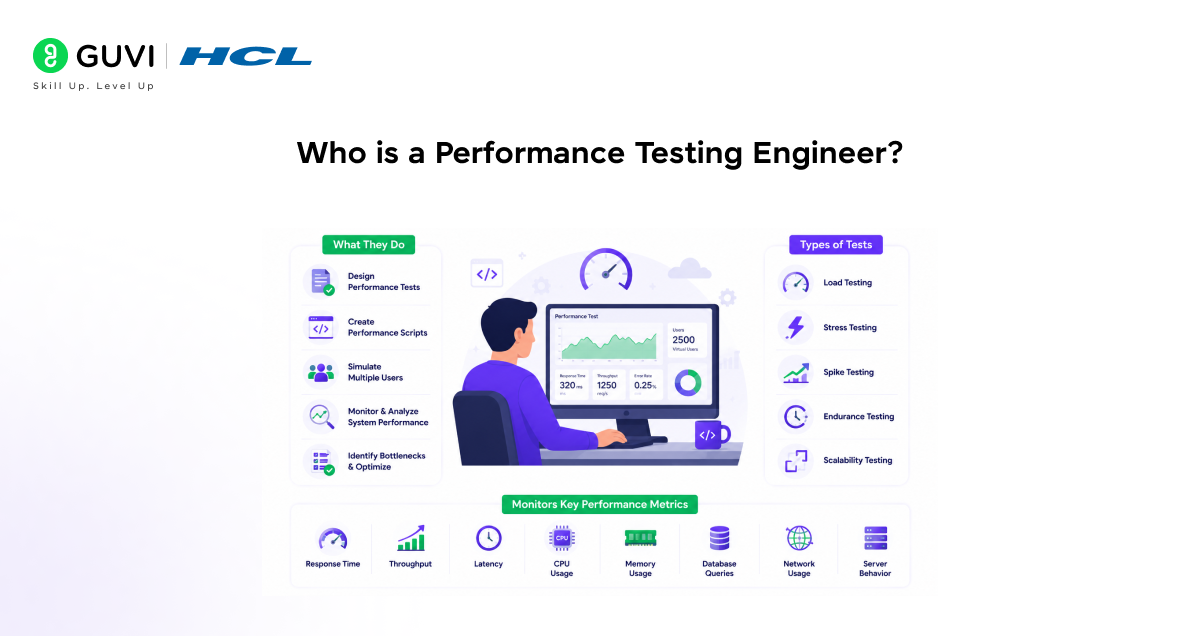
A Performance Testing Engineer evaluates how applications behave under real-world and peak-load conditions by designing load, stress, spike, endurance, and scalability tests. The role involves creating performance scripts, simulating concurrent users, monitoring response time, throughput, latency, CPU, memory, database queries, network usage, and server behavior.
Technical Skills of a Performance Testing Engineer
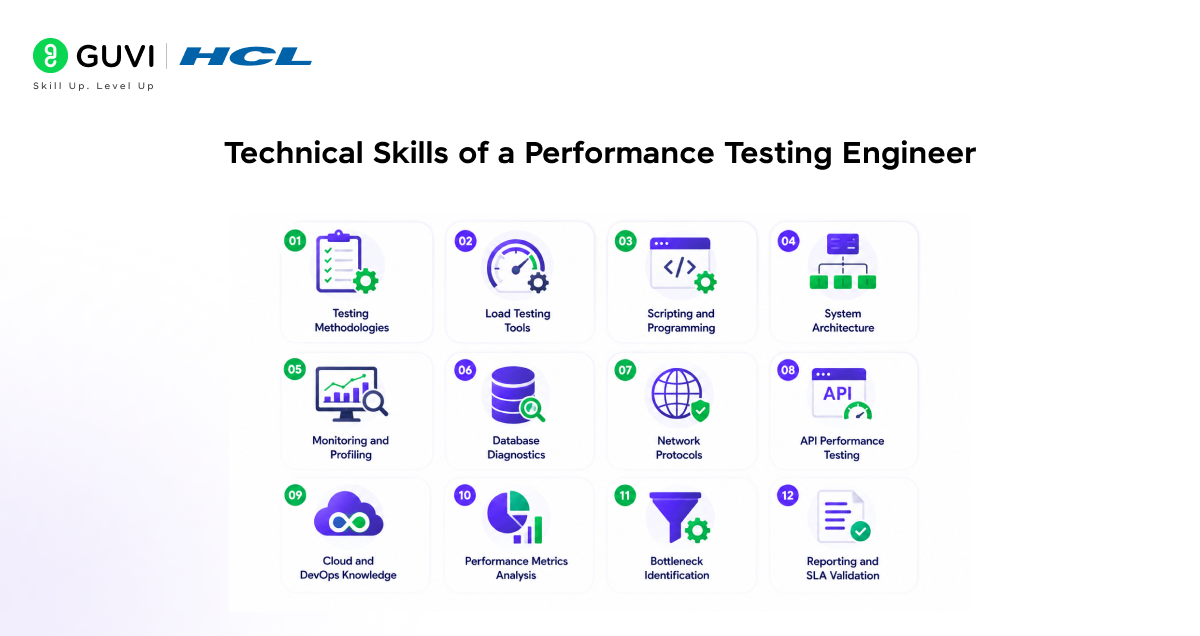
- Testing Methodologies: Deep understanding of non-functional testing types such as load testing, stress testing, spike testing, endurance testing, volume testing, scalability testing, and capacity testing.
- Load Testing Tools: Proficiency in industry-standard tools like Apache JMeter, Micro Focus LoadRunner, Gatling, BlazeMeter, and k6 to simulate concurrent users and measure system behavior.
- Scripting and Programming: Ability to customize test scripts, handle dynamic values, automate execution, and manage test logic using Java, Python, JavaScript, Groovy, or Shell scripting.
- System Architecture: Understanding of web servers, application servers, database tiers, caching layers, CDNs, queues, load balancers, and cloud-based infrastructure.
- Monitoring and Profiling: Capability to analyze infrastructure health using tools like Grafana, Kibana, Dynatrace, New Relic, DataDog, AppDynamics, PerfMon, Linux top, vmstat, and iostat.
- Database Diagnostics: Knowledge of SQL queries, indexing, execution plans, slow queries, connection pools, locks, wait times, and query optimization techniques.
- Network Protocols: Understanding of HTTP, HTTPS, TCP/IP, DNS, REST, SOAP, and WebSocket, along with the impact of latency, bandwidth, and packet loss on user experience.
- API Performance Testing: Ability to test REST APIs, SOAP services, microservices, authentication flows, request payloads, response times, error rates, and throughput under load.
- Cloud and DevOps Knowledge: Familiarity with AWS, Azure, GCP, Docker, Kubernetes, CI/CD pipelines, Jenkins, Git, and cloud monitoring services for performance validation.
- Performance Metrics Analysis: Ability to analyze response time, throughput, hits per second, transactions per second, error rate, CPU usage, memory usage, disk I/O, network usage, and garbage collection.
- Bottleneck Identification: Capability to detect performance issues across application code, database queries, servers, APIs, network layers, and infrastructure components.
- Reporting and SLA Validation: Ability to compare test results with SLA targets and prepare clear reports with observations, risks, bottlenecks, and performance improvement recommendations.
- The average salary for a Performance Testing Engineer is approximately ₹8,00,000 per year in India.
Soft Skills of a Performance Testing Engineer
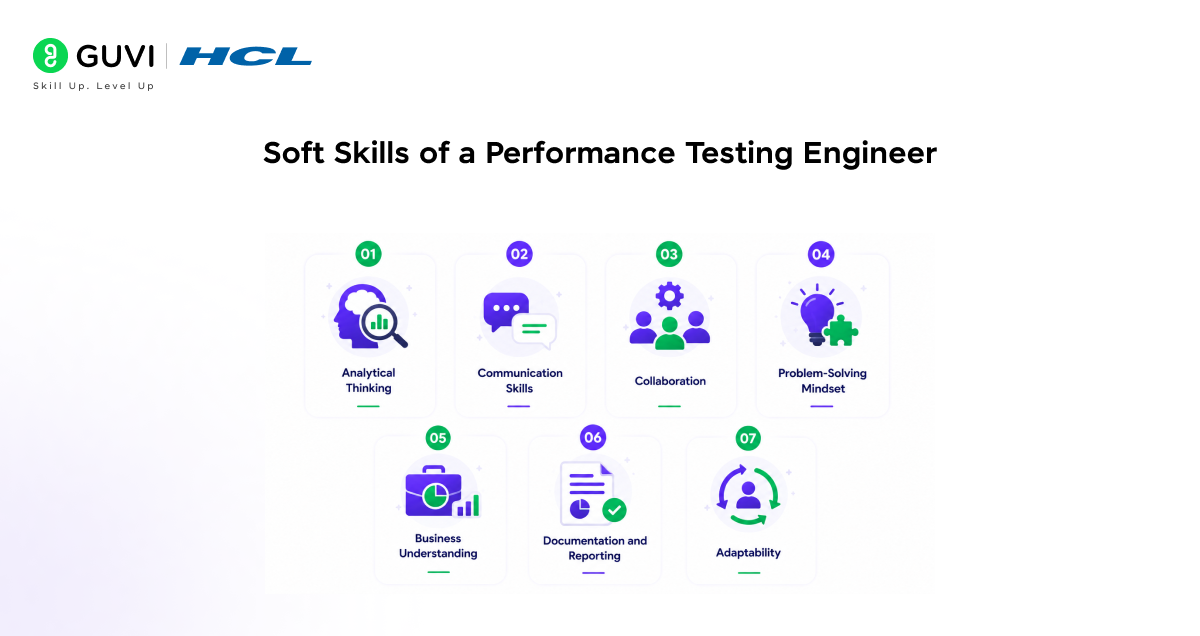
- Analytical Thinking: Proficiency to study performance trends, response times, server metrics, logs, and error patterns to identify the actual cause of system slowdowns.
- Communication Skills: Capacity to explain complex performance issues, bottlenecks, risks, and test results in a clear way for developers, DevOps teams, managers, and clients.
- Collaboration: Understanding of how to work with QA engineers, developers, database administrators, infrastructure teams, and product owners to resolve performance issues faster.
- Problem-Solving Mindset: Ability to investigate bottlenecks across application, database, server, network, and cloud layers and suggest practical improvements.
- Business Understanding: Awareness of how slow response times, downtime, poor scalability, and failed transactions affect user experience, revenue, SLAs, and customer trust.
- Documentation & Reporting: Capability to prepare clear test plans, execution summaries, defect reports, bottleneck analysis, and final performance reports.
- Adaptability: Willingness to learn new tools, cloud platforms, APIs, architectures, monitoring practices, and performance testing approaches as systems evolve.
- A single performance bottleneck can crash an application during peak traffic, even when every feature works perfectly in normal testing.
Performance Testing Tools Every Engineer Should Know
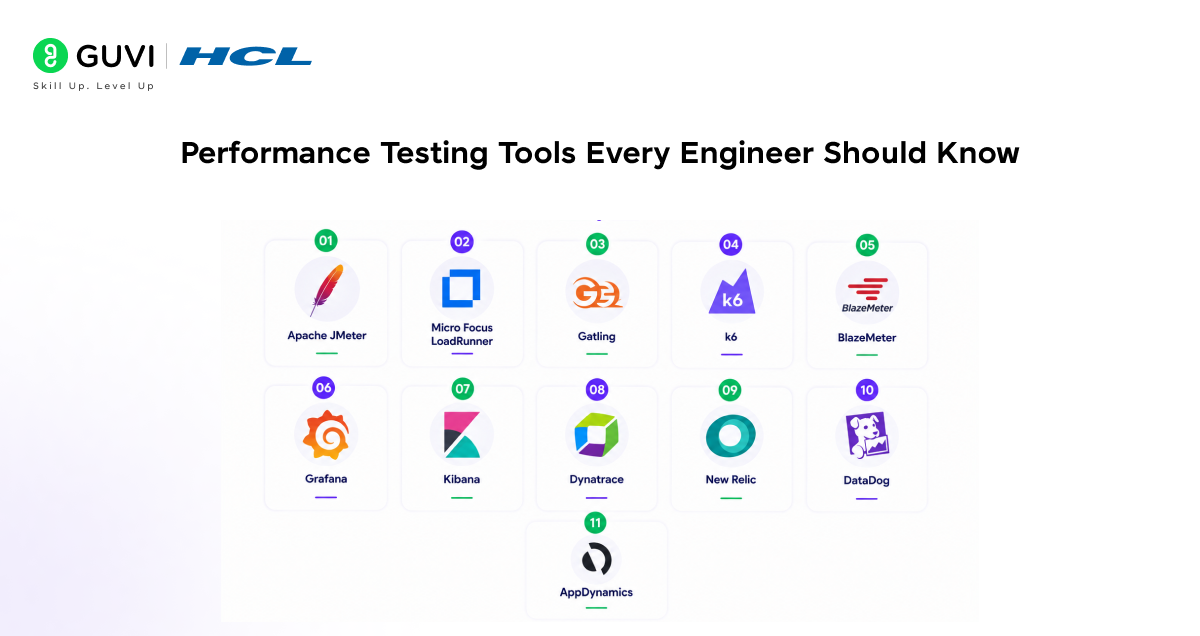
Performance testing tools help engineers simulate traffic, measure system behavior, monitor infrastructure, and identify bottlenecks before production failure.
- Apache JMeter: Open-source tool used for load testing web applications, APIs, databases, and services.
- Micro Focus LoadRunner: Enterprise-grade performance testing tool used for complex systems and large-scale test environments.
- Gatling: Developer-friendly load testing tool known for high-performance scripting and detailed reports.
- k6: Modern performance testing tool useful for API load testing, automation, and DevOps workflows.
- BlazeMeter: Cloud-based performance testing platform that extends JMeter and supports large-scale test execution.
- Grafana and Kibana: Dashboarding and log analysis tools used to visualize performance metrics and system behavior.
- Dynatrace, New Relic, DataDog, and AppDynamics: APM tools used to trace application performance, monitor infrastructure, and find production-level bottlenecks.
Build strong automation and testing expertise with HCL GUVI’s Advanced Selenium with Java Course. Learn performance-oriented testing skills, automation frameworks, and real-world QA practices through hands-on training designed for aspiring performance testing and software testing engineers.

How to Build Performance Testing Engineer Skills
Building performance testing engineer skills requires a mix of testing fundamentals, scripting practice, infrastructure knowledge, and hands-on tool experience. Beginners can start with non-functional testing concepts and Apache JMeter, then move toward API testing, SQL diagnostics, cloud monitoring, CI/CD integration, and advanced performance analysis.
Here is a practical learning path:
Step 1: Learn Non-Functional Testing Basics: Understand load testing, stress testing, spike testing, endurance testing, scalability testing, and capacity planning.
Step 2: Master One Load Testing Tool: Start with Apache JMeter or k6 to create test plans, simulate users, add assertions, handle correlations, and analyze results.
Step 3: Learn Scripting: Build working knowledge of Java, Python, JavaScript, Groovy, or Shell scripting to customize test logic and automate test execution.
Step 4: Understand System Architecture: Study how web servers, application servers, databases, caches, queues, load balancers, CDNs, and cloud services work together.
Step 5: Practice Monitoring and Analysis: Use Grafana, Kibana, Dynatrace, New Relic, DataDog, AppDynamics, PerfMon, top, vmstat, and iostat to connect test results with system behavior.
Important Performance Metrics to Track
- Response Time: Measures how long the application takes to respond to a user request.
- Throughput: Shows how many requests, transactions, or operations the system processes within a specific time.
- Latency: Measures delay between request initiation and response delivery.
- Error Rate: Tracks failed requests, timeout errors, server errors, and transaction failures.
- CPU Usage: Shows how heavily the processor is being used during load conditions.
- Memory Usage: Helps identify memory leaks, heap issues, garbage collection problems, and resource exhaustion.
- Disk I/O: Measures how fast the system reads and writes data during heavy operations.
- Network Usage: Tracks bandwidth, packet loss, DNS delays, and communication issues.
- Transactions Per Second: Measures how many business transactions the system completes under load.
Conclusion
Performance testing isn’t just about running JMeter scripts and waiting for a report to generate. It’s about understanding how every layer of a system, from the database to the CDN, behaves when real users show up in real numbers. The engineers who thrive in this role combine technical depth across tools, scripting, and infrastructure with the analytical instincts to spot a problem before it becomes an outage. Build both, and you won’t just test performance, you’ll protect it.
FAQs
Do I need a development background to become a Performance Testing Engineer?
Not strictly, but scripting knowledge in Java, Python, or JavaScript helps significantly when customizing test scripts or handling dynamic data during load tests.
Which tool should I learn first: JMeter or LoadRunner?
JMeter is open-source, widely used, and a great starting point. LoadRunner is more enterprise-focused and often required in larger organizations, so learning both gives you flexibility.
How is performance testing different from functional testing?
Functional testing checks if a feature works correctly. Performance testing checks if it still works correctly, and fast, when hundreds or thousands of users hit it at once.
What’s the biggest mistake beginners make in this field?
Focusing only on running tests and ignoring analysis. Anyone can trigger a load test, but identifying why response times spike, whether it’s a slow query, a memory leak, or a network bottleneck, is where real value lies.
Is cloud knowledge really necessary for this role?
Increasingly, yes. Most modern applications run on AWS, Azure, or GCP, so understanding how cloud infrastructure scales (or doesn’t) under load is now a core part of the job, not a bonus skill.
Success Stories

About the Author
Vaishali
I'm a seasoned writer with four years of experience across technical, non-technical, and just about every genre or niche you can imagine. Adaptable and curious, I enjoy exploring new topics and making information engaging and easy to understand. Fueled by a steady stream of tea, I approach each project with creativity, reliability, and genuine enthusiasm for storytelling.
View all posts by Vaishali
Connect with me @















Did you enjoy this article?