


Python Articles
Go vs Python for Forward Deployed Engineering Workloads
Python for Forward Deployed Engineers: What You Actually Need to Know
Freelancing as a Python Developer: Getting Your First Client


Get In Touch For Details! Request More Information
LlamaIndex vs LangChain: Choosing the Right Python AI Framework
Aug 17, 2026 4 Min Read 641 Views
(Last Updated)
Large Language Models (LLMs) have transformed the way developers build intelligent applications. From AI chatbots and document assistants to enterprise search systems, modern applications increasingly rely on frameworks that simplify development and improve scalability.
Two of the most popular frameworks in this space are LlamaIndex and LangChain. While both help developers build AI-powered solutions, they serve different purposes and offer unique strengths.
In this LlamaIndex vs LangChain comparison, you’ll learn how each framework works, its key differences, and when to choose one over the other.
Table of contents
- TL;DR Summary
- What Is LlamaIndex?
- Key Features of LlamaIndex
- What Is LangChain?
- Key Features of LangChain
- Building a Simple RAG Application with LlamaIndex and LangChain
- Step 1: Install the Required Libraries
- Step 2: Load Your Documents
- Step 3: Create an Index
- Step 4: Query Your Data
- LlamaIndex vs LangChain: Key Differences
- Real-World Applications of LlamaIndex and LangChain
- Example: Internal Company Knowledge Assistant
- Key Takeaways
- What To Do Next
- Conclusion
- FAQs
- What is the difference between LlamaIndex and LangChain?
- Is LlamaIndex better for RAG applications?
- Is LangChain suitable for beginners?
- Can LlamaIndex and LangChain work together?
- Which framework should I learn first?
- Do both frameworks support vector databases?
- Are LlamaIndex and LangChain still relevant in 2026?
TL;DR Summary
- LlamaIndex vs LangChain is a common comparison for developers building AI-powered applications with Python.
- LlamaIndex specializes in data retrieval, indexing, and Retrieval-Augmented Generation (RAG) systems.
- LangChain focuses on AI workflows, chains, agents, memory, and tool integrations.
- Both frameworks help developers build applications powered by Large Language Models (LLMs).
- LlamaIndex is often preferred for document search, knowledge assistants, and RAG applications.
- LangChain is commonly used for AI agents, workflow automation, and multi-step reasoning systems.
- Understanding the differences between LlamaIndex and LangChain can help you choose the right framework for your AI project.
For learners interested in exploring advanced AI concepts beyond this comparison, HCL GUVI’s AI & Machine Learning Course provides hands-on experience with machine learning, generative AI, LLM development, and real-world AI applications.
Data Point: According to the Stack Overflow Developer Survey, Python remains one of the most widely used programming languages and continues to be a leading choice for AI and machine learning development.
Source: https://survey.stackoverflow.co/
LlamaIndex vs LangChain
LlamaIndex and LangChain are popular frameworks for building AI applications, but they serve different primary purposes. LlamaIndex is designed to connect large language models (LLMs) with external data sources through efficient indexing, retrieval, and Retrieval-Augmented Generation (RAG) pipelines. LangChain, on the other hand, focuses on creating complex AI workflows, chains, agents, and tool integrations that enable advanced reasoning and automation. If your main goal is building RAG applications that retrieve and use external knowledge, LlamaIndex is often the more specialized choice. For applications that require multi-step workflows, autonomous agents, or extensive integrations, LangChain provides greater flexibility. In practice, many modern AI systems combine both frameworks to leverage the strengths of each.
What Is LlamaIndex?
LlamaIndex is an open-source framework that helps developers connect large language models with external data sources such as documents, databases, APIs, and knowledge repositories.
Instead of relying only on an LLM’s built-in knowledge, LlamaIndex retrieves relevant information from external sources before generating responses. This makes it especially useful for applications that require accurate, up-to-date, and domain-specific information.
Key Features of LlamaIndex
- Data ingestion from multiple sources
- Document indexing and retrieval
- Retrieval-Augmented Generation (RAG)
- Vector database integration
- Knowledge-based AI application development
LlamaIndex is widely used in projects where AI systems need to search, retrieve, and understand information stored across multiple documents and databases. By connecting large language models to external knowledge sources, it helps applications deliver more accurate, context-aware responses while working with constantly changing data.
What Is LangChain?
LangChain is an open-source framework designed to simplify the development of applications powered by large language models.
It provides tools for creating chains, workflows, AI agents, memory systems, and integrations with external APIs and tools. Rather than focusing primarily on retrieval, LangChain helps coordinate how different AI components work together.
Key Features of LangChain
- Workflow orchestration
- AI agent development
- Tool and API integration
- Memory management
- Multi-step reasoning support
Data Point: Retrieval-Augmented Generation (RAG) has become a common approach for improving AI response quality by combining language models with external knowledge sources.
If you’re new to AI development, GUVI’s AI eBook can help you strengthen the fundamentals needed to understand LLMs, prompt engineering, vector databases, and modern AI application development with confidence.
Building a Simple RAG Application with LlamaIndex and LangChain
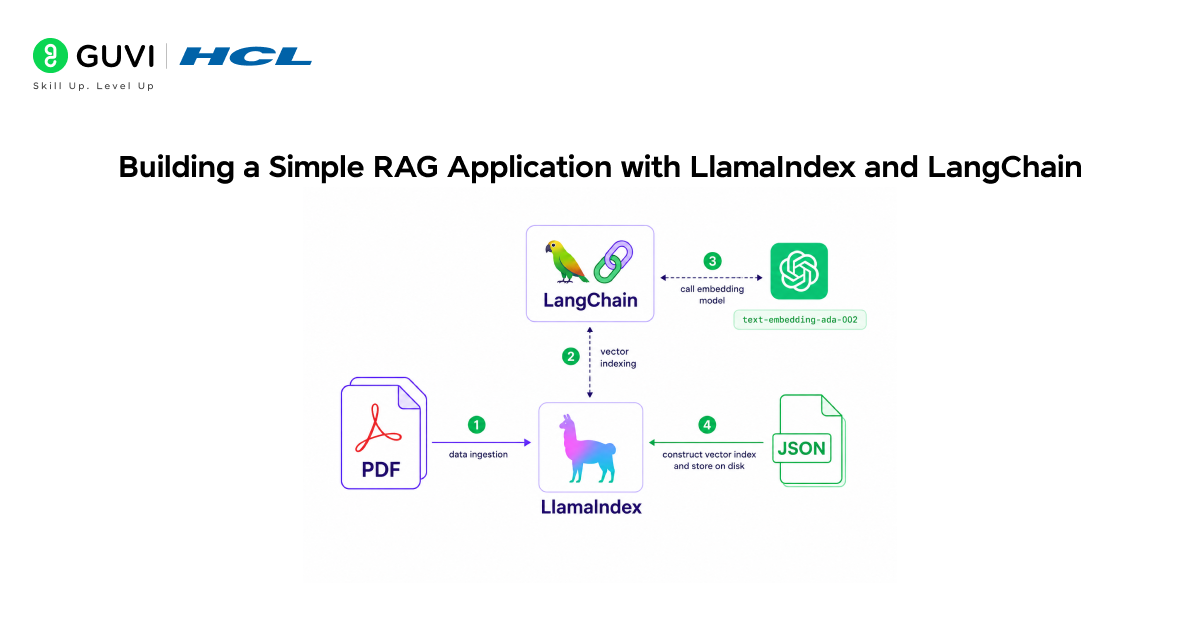
A simple Retrieval-Augmented Generation (RAG) application combines document retrieval with a language model to generate context-aware responses.
Step 1: Install the Required Libraries
pip install llama-index langchain openaiStep 2: Load Your Documents
from llama_index.core import SimpleDirectoryReader

documents = SimpleDirectoryReader("data").load_data()
Step 3: Create an Index
from llama_index.core import VectorStoreIndex

index = VectorStoreIndex.from_documents(documents)

query_engine = index.as_query_engine()
Step 4: Query Your Data
response = query_engine.query(

   "What are the key findings in the report?"

)

print(response)
⚠️ Warning

Even advanced AI systems depend on high-quality source data. Poorly structured, incomplete, or outdated documents can reduce retrieval accuracy and affect generated responses.
LlamaIndex vs LangChain: Key Differences
| Feature | LlamaIndex | LangChain |
| Primary Focus | Data retrieval and RAG | Workflow orchestration |
| Learning Curve | Easier for retrieval projects | Broader feature set |
| Indexing | Advanced | Moderate |
| AI Agents | Limited focus | Core capability |
| Multi-Step Workflows | Moderate | Excellent |
| Data Connectors | Strong | Strong |
| Best Use Case | Knowledge assistants | AI agents and automation |
| Flexibility | Specialized | Highly flexible |
Mastering frameworks like LlamaIndex and LangChain is often the first step toward building advanced AI-powered applications. If you’d like to progress from beginner projects to industry-level AI solutions, HCL GUVI’s AI & Machine Learning Course offers structured learning, practical projects, and real-world use cases designed to help you develop job-ready AI skills.
Real-World Applications of LlamaIndex and LangChain
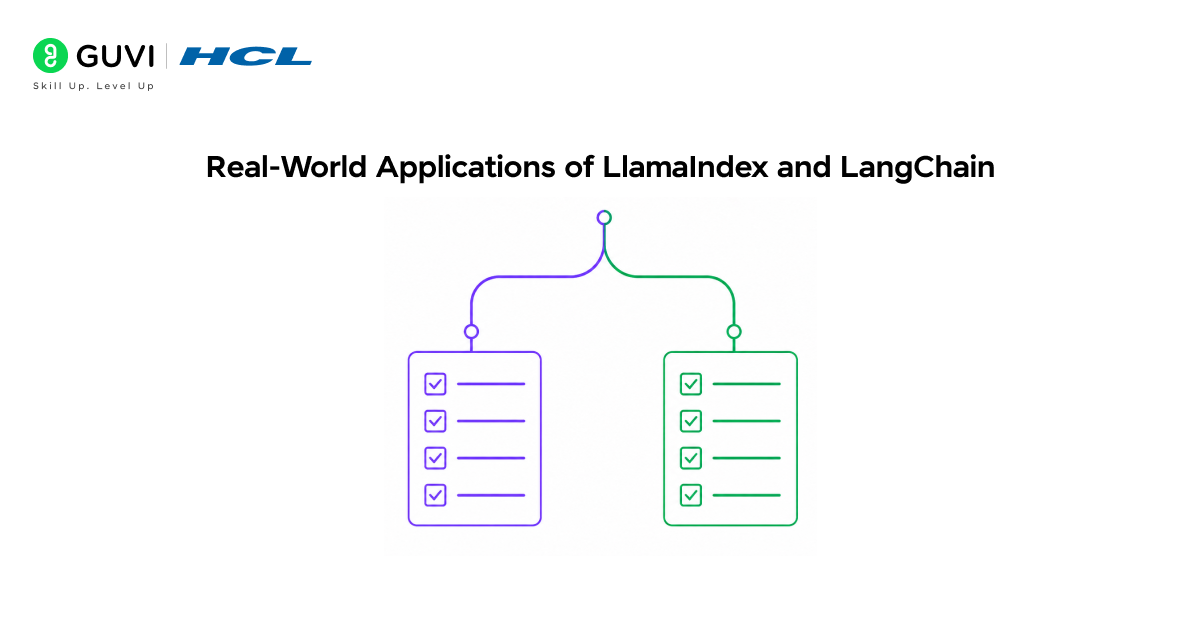
Example: Internal Company Knowledge Assistant
Imagine a company storing thousands of policies, contracts, reports, and training documents.
Instead of manually searching through files, employees can ask:
“What is our remote work policy?”
The system retrieves relevant information from the company’s knowledge base and generates context-aware responses, helping employees find answers quickly without searching through multiple documents.
Customer Support Automation
Businesses use AI assistants to answer customer questions using product documentation, FAQs, and support knowledge bases.
AI Agents
Organizations build autonomous agents that interact with APIs, databases, and external tools to automate repetitive tasks.
Document Intelligence
Companies analyze contracts, research papers, and reports to extract valuable insights and support decision-making.
✅ Best Practice
Choose your framework based on project requirements rather than popularity. Retrieval-focused applications often benefit from LlamaIndex, while workflow-heavy applications frequently benefit from LangChain.
Key Takeaways
- LlamaIndex specializes in data retrieval and RAG applications.
- LangChain focuses on workflows, chains, agents, and orchestration.
- Both frameworks support modern LLM development.
- Many AI applications use both technologies together.
- The best framework depends on your project’s goals and architecture.
What To Do Next
After learning about LlamaIndex and LangChain, explore:
- Retrieval-Augmented Generation (RAG)
- Vector databases
- AI agents
- Prompt engineering
- Enterprise AI applications
To see a practical implementation, explore our guide on Building a LangChain Agent for LLM in Python, which demonstrates how AI agents can reason, use tools, and complete tasks autonomously.
Conclusion
LlamaIndex and LangChain are powerful frameworks that simplify AI application development in different ways. LlamaIndex excels at connecting language models with external knowledge sources, making it ideal for retrieval-focused systems and RAG applications. LangChain shines when building workflows, AI agents, and automation-driven solutions.
Rather than viewing them as competing technologies, many developers use them together to create intelligent applications that combine powerful retrieval capabilities with advanced workflow orchestration. Understanding the strengths of each framework will help you choose the right solution for your next AI project.
FAQs
1. What is the difference between LlamaIndex and LangChain?
LlamaIndex focuses on retrieval and indexing, while LangChain focuses on workflows, agents, and tool orchestration.
2. Is LlamaIndex better for RAG applications?
Yes. LlamaIndex was specifically designed to simplify indexing, retrieval, and Retrieval-Augmented Generation workflows.
3. Is LangChain suitable for beginners?
Yes. However, its broader feature set may create a slightly steeper learning curve compared to LlamaIndex.
4. Can LlamaIndex and LangChain work together?
Yes. Many production AI systems use LlamaIndex for retrieval and LangChain for workflow management and orchestration.
5. Which framework should I learn first?
If your focus is RAG applications, start with LlamaIndex. If you’re interested in AI agents and workflow automation, LangChain is a great starting point.
6. Do both frameworks support vector databases?
Yes. Both frameworks support integrations with vector databases commonly used for semantic search and retrieval systems.
7. Are LlamaIndex and LangChain still relevant in 2026?
Yes. Both frameworks remain widely used for building AI assistants, enterprise search systems, RAG applications, and autonomous AI agents.
Success Stories

About the Author
Vishalini Devarajan
An Aerospace Engineer turned content writer, I focus on making complex concepts easy to understand through well-structured, reader-friendly blogs. Whether it’s a technical topic or a non-technical one, I love creating content that is clear, engaging, and impactful.
View all posts by Vishalini Devarajan
Connect with me @






Did you enjoy this article?