


Internet of Things Articles
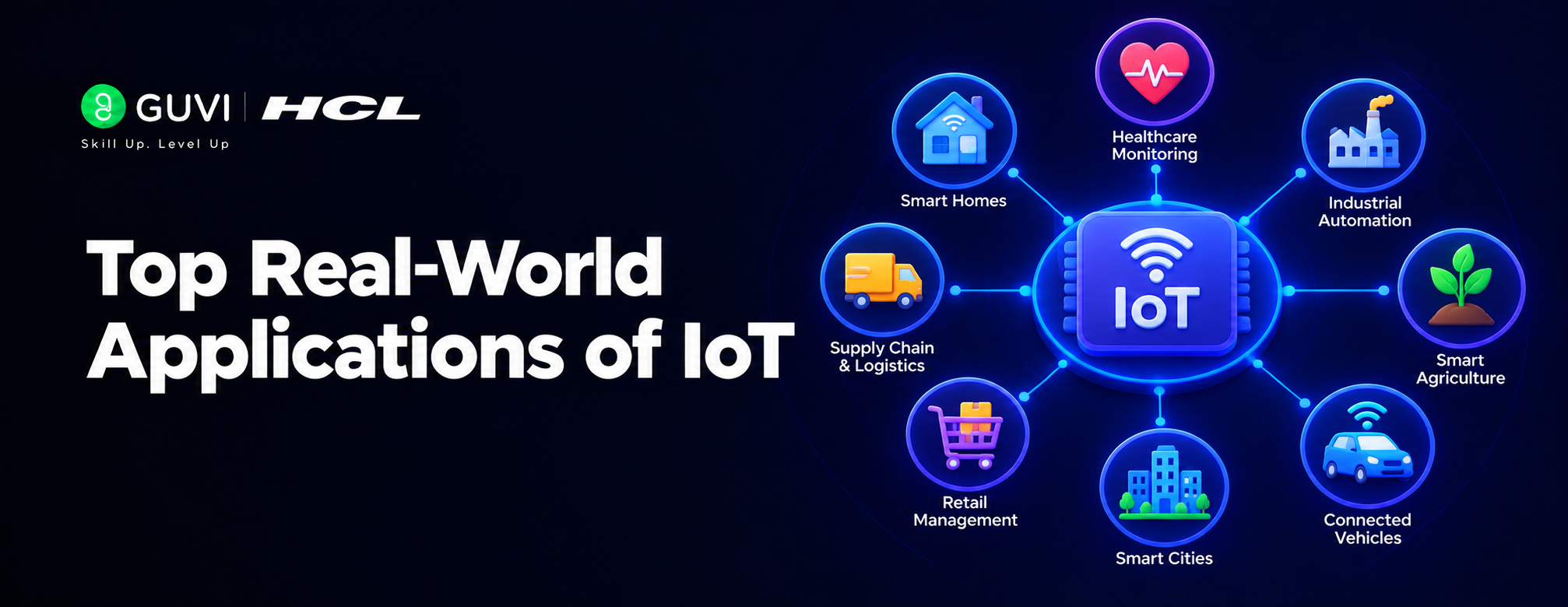
Top Real-World Applications of IoT (2026 Guide)
AI in IoT (Internet of Things) Explained
What is IoT? A Comprehensive Guide [2026]
Top 35 IoT Solutions Architect Interview Questions and Answers


Get In Touch For Details! Request More Information
What is IoT Architecture Explained: Layers, Components, and How It Works
Aug 19, 2026 6 Min Read 1239 Views
(Last Updated)
Your smartwatch, smart AC, and factory alerts all work because connected devices collect data and trigger actions. The whole system is defined by IoT architecture. It links sensors and actuators to networks and cloud services so physical events become automated, data-driven responses.
IoT covers simple home sensors to industrial machines; its layered architecture (device, edge, cloud, application) standardizes communication, data processing, and decision points. That structure enables scale and reliability across billions of devices.
In this article, you will get a clear, beginner-friendly breakdown of what IoT architecture is, what its key components are, how its layers work together, what communication protocols are used, and why this architecture matters in the real world today.
Table of contents
- TL;DR
- The Key Components of an IoT System
- The Four Core Layers of IoT Architecture
- Layer 1: The Perception Layer
- Layer 2: The Network Layer
- Layer 3: The Processing Layer (Edge Computing)
- Layer 4: The Application Layer (Cloud and User Interface)
- Communication Protocols: The Language IoT Devices Speak
- Security in IoT Architecture: Why Identity Is Everything
- Real-World Applications of IoT Architecture
- The Biggest Mistakes to Avoid When Building IoT Architecture
- CONCLUSION
- FAQs
- Q: Which IoT protocol should I pick for battery‑powered sensors?
- Q: When should I process data at the edge versus in the cloud?
- Q: How do I secure legacy IoT devices that can’t run modern crypto?
- Q: What’s the role of gateways in IoT architecture?
- Q: How do I choose storage between a data lake and a data warehouse for IoT data?
TL;DR
- IoT architecture is the layered blueprint that connects sensors/actuators to gateways, edge processing, cloud services, and user applications so physical events become data‑driven actions.
- Four core layers: Perception (devices), Network (connectivity), Processing/Edge (local filtering, real‑time actions), and Application/Cloud (storage, analytics, UI).
- Use lightweight protocols at the edge (MQTT, CoAP) and more robust messaging in the core (AMQP); choose protocols to match device power and reliability needs.
- Security must be identity‑first (mutual TLS, hardware keys, zero‑trust, least privilege), not perimeter‑only; gateways and segmentation protect legacy devices.
- Practical design rules: push time‑sensitive logic to the edge, instrument data for analytics/ML in the cloud, segment networks, and design user interfaces that surface relevant, actionable insights.
What Is IoT Architecture?
IoT (Internet of Things) architecture is a structured framework that defines how physical devices, sensors, networks, and software systems interact to collect, transmit, process, and utilize data. It acts as the blueprint for IoT systems, specifying how data flows from connected devices through communication networks to cloud or edge computing platforms, and finally to applications that generate insights or actions. A well-designed IoT architecture ensures scalability, reliability, security, and efficient data processing, enabling smart systems such as smart homes, industrial automation, and connected healthcare solutions.
Take your IoT knowledge further with HCL GUVI’s Essentials of IoT course. Gain practical experience in IoT systems, from sensors and connectivity to real-world applications.
The Key Components of an IoT System
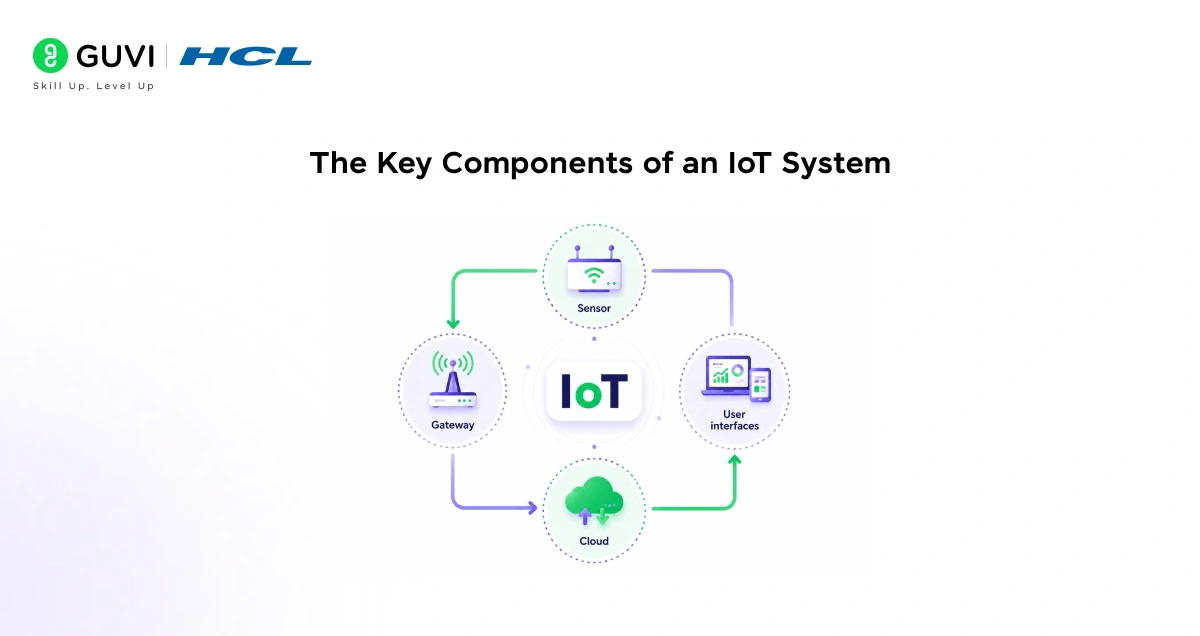
- Sensors, actuators, and gateways
Sensors capture real-world signals, such as temperature, motion, humidity, heart rate and actuators perform physical actions like switching lights, opening locks, or changing a thermostat setting. Together they form the edge where the physical world meets software (examples: Nest thermostat, smart locks).
Gateways sit between those devices and the rest of the system: they aggregate local data, translate protocols, perform edge processing (compression, filtering, basic analytics), and forward secure traffic to backend services (examples: Zigbee/Z-Wave hubs, AWS IoT Greengrass, Azure IoT Edge).
- Data storage and organization
Collected data first lands in storage optimized for scale and flexibility. A data lake holds raw, unstructured telemetry for later processing and reanalysis, while a data warehouse stores cleaned, structured data optimized for queries and reporting.
This separation lets teams retain high-fidelity historical data without sacrificing the fast, reliable analytics needed for operational dashboards and business intelligence.
- Analytics and ML for insights
Analytics layers and machine learning models turn stored telemetry into actionable insights. Descriptive analytics summarize device behavior and health, anomaly detection flags unusual activity, and predictive models (for example, predictive maintenance) forecast failures or recommend optimizations. These models close the loop by informing automated actions or surfacing prioritized alerts for operators.
- User-facing applications
Applications are the human interface to the system: mobile apps, web dashboards, management portals, and alerts that let homeowners, operators, and managers view status, control devices, and act on insights.
Well-designed apps reflect the underlying architecture, showing timely, relevant data, enabling safe control, and translating complex analytics into clear recommendations for users.
The Four Core Layers of IoT Architecture
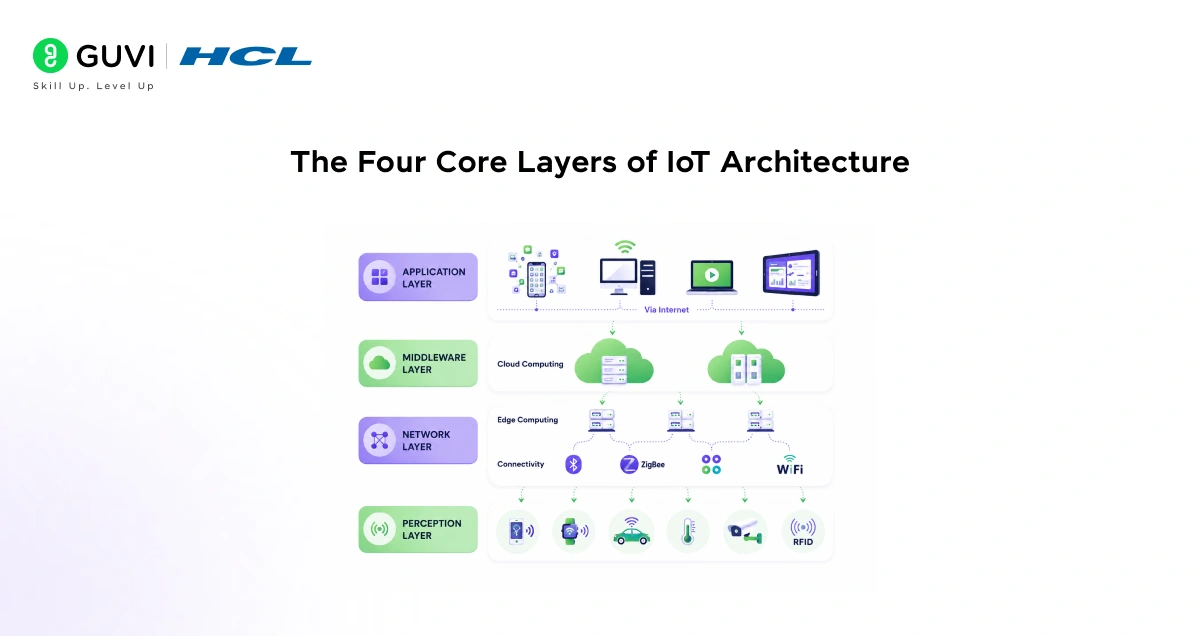
The most widely used model for understanding IoT architecture divides the system into four layers. Each layer has a specific role, and data flows upward from one layer to the next.
Layer 1: The Perception Layer
- This is the ground floor of the entire system. The perception layer contains all the physical devices, the sensors that measure and observe the real world, and the actuators that respond to it. This layer is where data originates.
- A temperature sensor picking up readings every few seconds, an occupancy sensor detecting whether a room is empty, and a camera recording footage in a retail store, all live in the perception layer.
- The most important design consideration at this layer is trustworthiness. A device with weak security firmware or no clear update pathway creates vulnerabilities that cannot be fixed further up the stack.
- Many real-world IoT deployments inherit a mixture of modern and legacy devices bought at different times by different teams, and the architecture at this layer must be able to handle that reality rather than assume a perfectly clean, uniform device estate.
Layer 2: The Network Layer
- Once data is collected, it needs to travel somewhere. That is the job of the network layer, which moves data from devices to gateways and eventually to processing systems. This layer covers everything related to connectivity, wireless protocols like WiFi, Bluetooth, and Zigbee, wired connections, and the rules that govern which systems can communicate with which other systems.
- A strong network layer does three things reliably. It keeps devices connected without constant manual maintenance.
- It correctly segments different types of traffic so that a guest WiFi network, for example, never shares a trust boundary with a hospital’s patient monitoring system.
- And it supports the right mix of communication protocols for the variety of devices in the estate, because a battery-powered room sensor and a back-office analytics server have very different connectivity needs.
Layer 3: The Processing Layer (Edge Computing)
- Before data moves all the way to a central cloud system, it often passes through an intermediate processing stage at the network’s edge, physically close to where the data was collected. This is the edge computing layer, and its job is to filter, process, and act on data locally when speed or bandwidth matters.
- Think of it this way: if a smart door lock needs to decide whether to let someone in, it cannot afford to wait for a round-trip signal to a server halfway around the world. That decision needs to happen in milliseconds, locally.
- Edge gateways handle this by processing time-sensitive events on site and sending only summaries or meaningful alerts to the central cloud, rather than every raw data point. This reduces network congestion significantly.
- According to industry research, edge-enabled architectures can cut bandwidth consumption by up to 60%, which matters enormously when hundreds of devices are generating data simultaneously.
Layer 4: The Application Layer (Cloud and User Interface)
- The final layer is where data is stored long-term, analyzed deeply, and presented to users through dashboards, apps, and business tools.
- The cloud processing part of this layer handles workloads that benefit from centralization, comparing data across multiple buildings or locations, identifying trends over weeks or months, and connecting IoT events to other business systems like customer relationship management tools or service management platforms.
- The user-facing part of this layer is equally important. If the dashboards and applications are confusing or overloaded with irrelevant data, the entire value of the IoT system collapses at the last mile.
- The best application layer shows each type of user exactly what they need: a facilities manager sees operational summaries, a network engineer sees device health and traffic data, and a retail manager sees foot traffic patterns without burying any of them in raw technical noise.
Edge computing is transforming how IoT systems handle data by processing information closer to the source instead of sending everything to the cloud. This approach can significantly reduce latency and bandwidth usage—studies suggest that edge processing can cut upstream data transmission by up to ~60% compared to raw telemetry streaming. In real-world IoT architectures, systems rarely rely on a single protocol. Instead, they combine multiple technologies such as Zigbee, Z-Wave, and Bluetooth for local device communication, MQTT for lightweight telemetry messaging, and HTTP or AMQP for backend integrations. This layered, hybrid approach allows IoT ecosystems to remain scalable, efficient, and resilient across diverse environments and use cases.

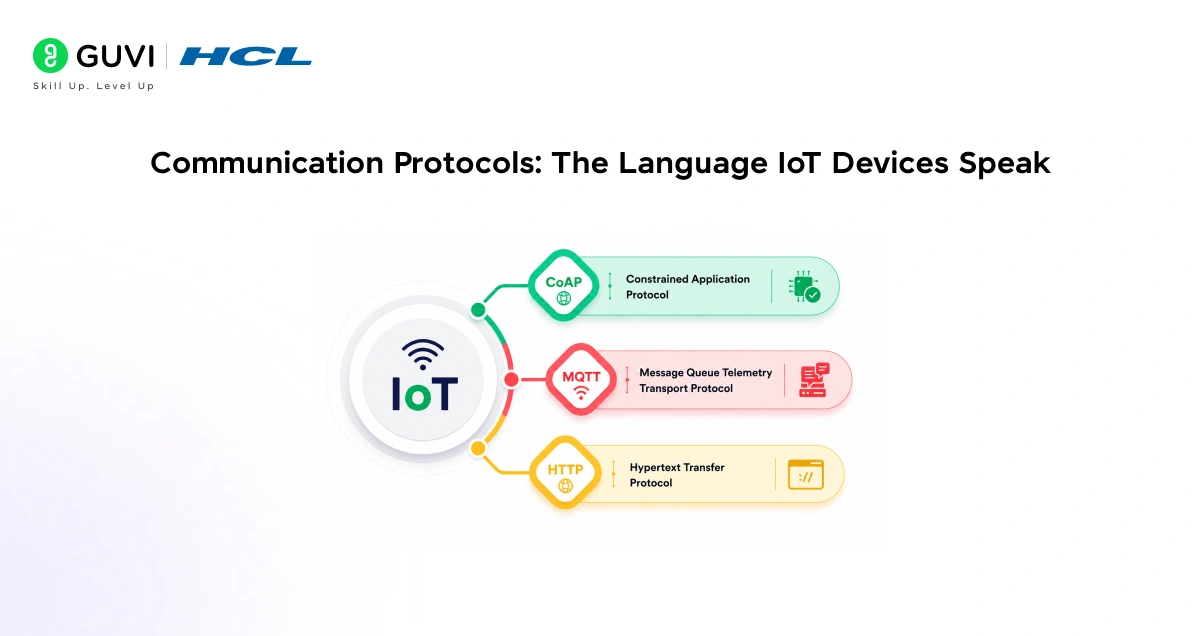
Communication Protocols: The Language IoT Devices Speak
- Match protocol to device constraints
Choose protocols that align with device capabilities and power budgets. MQTT works well for devices that send small payloads frequently over constrained networks, while CoAP is better for extremely low-memory, low-power sensors that need minimal overhead. Picking a protocol unsuited to your devices often causes battery drain or connection issues that quietly degrade the system.
- Use heavier protocols where reliability and governance matter
Reserve more feature-rich, queue-based protocols like AMQP for server-to-server integrations and backend workflows. When IoT events must trigger durable business processes for example creating tickets, updating CRMs, or coordinating multi-step automations AMQP’s reliability and delivery semantics make integrations easier to operate and govern.
- Avoid one-size-fits-all uniformity
Don’t force a single protocol across every layer. A mixed approach o lightweight protocols at the edge for efficient device communication and more robust messaging in the core for enterprise systems, keeps gateways uncluttered and reduces translation overhead. This pragmatic layering prevents fragile integrations and scales more predictably as the estate grows.
Security in IoT Architecture: Why Identity Is Everything
- Why perimeter security fails for IoT
- IoT environments are heterogeneous and dynamic: devices move, contractors come and go, and departments add their own hardware.
- A single trusted network boundary breaks down because guest, staff, and machine traffic share physical infrastructure.
- Relying on “inside = trusted” creates blind spots and unsafe implicit trust.
- Use identity-based security
- Authenticate every connection: verify device identity, authentication method, and allowed targets before granting access.
- Apply context-aware checks (device type, posture, time, location) to adjust permissions in real time.
- Treat identity as the new perimeter.
- Apply strong and compensating authentication
- Strong methods for modern devices: mutual TLS certificates, hardware-backed keys, or single sign-on.
- Compensating controls for legacy devices: network isolation, strict ACLs, and tight rate/port restrictions.
- Monitor legacy endpoints closely for anomalous behavior.
- Follow zero-trust and least-privilege principles
- Default to deny and grant the minimum necessary access for each device and user.
- Ensure access can be revoked quickly when posture or context changes.
- Continuously log and evaluate connections so policy decisions are driven by observed behavior, not assumptions.
Real-World Applications of IoT Architecture
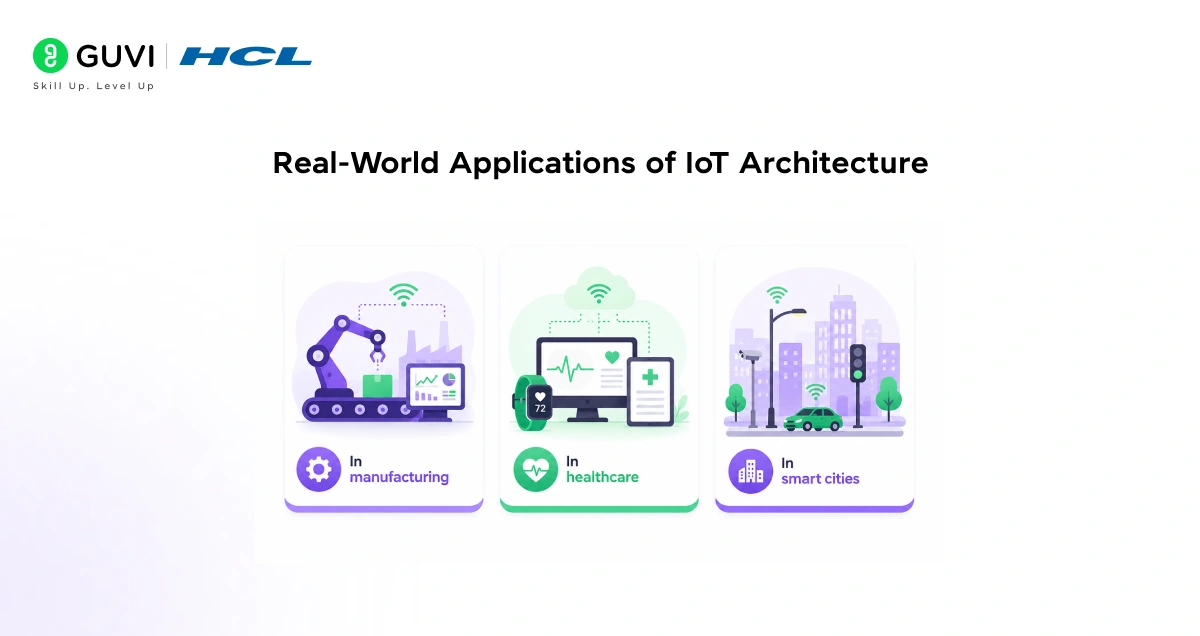
The value of a well-designed IoT architecture becomes most visible in the industries that rely on it most heavily.
In smart homes, IoT architecture connects thermostats, lighting systems, smart speakers, security cameras, and door locks into a single coordinated ecosystem. Each device sits in the perception layer, communicates over the home’s network layer, and is managed through a central application like a smartphone app or voice assistant.
- In manufacturing
IoT architecture powers predictive maintenance systems that monitor machine vibration, temperature, and performance metrics in real time. Edge processing handles the time-sensitive analysis of individual machine behavior, while cloud systems aggregate data across an entire factory floor to identify systemic patterns that no single machine-level analysis could reveal.
- In healthcare
IoT architecture must handle an especially complex mix of devices — patient monitoring equipment, medical imaging systems, HVAC controls, staff devices, and visitor networks while keeping each of those streams completely isolated from one another for both safety and compliance reasons. The network layer and identity model at the core of the architecture carry enormous responsibility in this environment.
You just explored IoT architecture, its layers, components, and how everything works together to power connected devices. Take it further with HCL GUVI’s Essentials of IoT course and build hands-on skills in IoT systems. Learn sensor integration, connectivity, and real-world IoT applications from the ground up.
- In smart cities,
IoT architecture connects traffic management systems, public lighting, air quality monitors, waste management sensors, and emergency response networks into a coordinated urban intelligence system that can respond to real-world conditions in real time.
Read more about IoT applications; check out Top and Effective Real-World Applications of IoT
The Biggest Mistakes to Avoid When Building IoT Architecture
Understanding what can go wrong is just as valuable as understanding what to do right.
- The most common mistake is treating IoT devices as simple network attachments with no dedicated architecture behind them.
- Teams add sensors to an existing network without defining segmentation, protocols, or identity policies, and then wonder why security incidents or performance problems appear months later.
- Another common mistake is going cloud-only, without any edge processing layer. Sending every raw data point from every device to a central cloud system is expensive, slow for time-sensitive decisions, and creates unnecessary congestion.
- The edge layer is not optional in any serious IoT deployment; it is where the architecture earns its keep in operational environments.
- Finally, many teams underestimate the importance of the application layer. A technically sound IoT backend that delivers its insights through a confusing dashboard will be ignored by the people who were supposed to benefit from it.
- The architecture’s output needs to be as carefully designed as the infrastructure beneath it.
CONCLUSION
IoT architecture is a living operating model, not a one-time diagram it must evolve with your device fleet, use cases, and security threats. Strong designs use clear layers, protocol choices based on device needs, edge processing for fast decisions and clean data flows, and identity-based access controls.
If you’re new to IoT, learn the four layers: their responsibilities, what moves between them, and common failure modes. That mental model applies to smart-home projects, embedded/cloud career paths, and understanding any connected system.
FAQs
Q: Which IoT protocol should I pick for battery‑powered sensors?
A: Prefer extremely lightweight protocols such as CoAP or MQTT-SN over low‑power radios (BLE, LoRaWAN, Zigbee). They minimize overhead and preserve battery life. Use MQTT when you need publish/subscribe with reliable delivery; use CoAP for constrained REST‑style interactions.
Q: When should I process data at the edge versus in the cloud?
A: Process at the edge when decisions must be real‑time (milliseconds), when bandwidth is limited, or for privacy reasons. Send to the cloud for cross‑site aggregation, long‑term storage, heavy analytics/ML training, and centralized reporting.
Q: How do I secure legacy IoT devices that can’t run modern crypto?
A: Compensating controls: place legacy devices on tightly segmented networks, restrict allowed endpoints and ports, use gateway proxies to enforce authentication/authorization, apply strict ACLs and rate limits, and monitor traffic for anomalies to detect compromise early.
Q: What’s the role of gateways in IoT architecture?
A: Gateways aggregate local device traffic, translate protocols, perform edge processing (filtering, aggregation, basic analytics), cache data during connectivity outages, and provide a secure bridge to cloud services, reducing load on networks and central systems.
Q: How do I choose storage between a data lake and a data warehouse for IoT data?
A: Use a data lake to store raw, high-volume telemetry for replay, model training, and ad‑hoc analysis. Use a data warehouse (or curated OLAP store) for cleaned, structured data that powers dashboards, BI queries, and operational reports. Many architectures ingest raw data into a lake and ETL the important slices into a warehouse.
Success Stories

About the Author
Vishalini Devarajan
An Aerospace Engineer turned content writer, I focus on making complex concepts easy to understand through well-structured, reader-friendly blogs. Whether it’s a technical topic or a non-technical one, I love creating content that is clear, engaging, and impactful.
View all posts by Vishalini Devarajan
Connect with me @









Did you enjoy this article?