


Product Management Articles
Enterprise Product Management: Unique Challenges, Skills & Strategy
B2B vs B2C Product Management: Key Differences, Skills, Strategy & Career Scope
Working with Engineers as a Product Manager: A Practical Guide


Get In Touch For Details! Request More Information
What Is a Minimum Viable Product (MVP)?
Sep 13, 2026 1 Min Read 560 Views
(Last Updated)
Every successful product started somewhere and in most cases, that somewhere was far simpler than the finished version you see today. Dropbox launched as a two-minute demo video. Airbnb began with air mattresses and a basic website. Twitter started as an internal SMS tool. What these products had in common was a deliberate decision to launch small, learn fast, and build only what mattered.
That deliberate decision has a name: the minimum viable product, or MVP. It is one of the most widely used concepts in modern product management, startup strategy, and software development and one of the most frequently misunderstood.
This guide explains exactly what a minimum viable product MVP is, why it matters, how to build one correctly, and the mistakes that cause most MVPs to fail before they have a chance to teach you anything.
Table of contents
- TL;DR
- Why the Minimum Viable Product MVP Matters
- Breaking Down the Three Words: Minimum, Viable, Product
- Minimum
- Viable
- Product
- Types of Minimum Viable Product
- Landing Page MVP
- Concierge MVP
- Wizard of Oz MVP
- Single-Feature MVP
- Piecemeal MVP
- How to Build a Minimum Viable Product MVP
- Step 1: Identify the Core Problem
- Step 2: State Your Riskiest Assumption
- Step 3: Choose the Right MVP Type
- Step 4: Define Success Metrics Before You Build
- Step 5: Build, Ship, and Get It in Front of Real Users
- Step 6: Measure, Learn, and Decide
- Common Minimum Viable Product MVP Mistakes
- Conclusion
- FAQs
- What is a minimum viable product MVP in simple terms?
- What is the difference between an MVP and a prototype?
- How long should it take to build an MVP?
- Can an MVP be a non-technical product?
- How do you know when an MVP has succeeded?
TL;DR
- An MVP is the smallest product you can ship that delivers real value and generates real learning.
- It is built to test a core assumption not to impress investors or win design awards.
- The goal is to learn what users actually want before committing full engineering resources.
- A successful MVP teaches you something actionable even if that learning is that your assumption was wrong.
- MVPs are not permanently minimal they evolve as learning accumulates and validated features are added.
What Is a Minimum Viable Product (MVP)?
A Minimum Viable Product (MVP) is the simplest version of a product that delivers enough value to early users while enabling teams to gather meaningful feedback and validate core business assumptions. Popularized by Eric Ries in The Lean Startup, the MVP approach focuses on learning rather than building a fully featured product. Unlike a prototype or beta version, an MVP is a functional, shippable product containing only the essential features required to test whether the product solves a real problem for real users. By minimizing unnecessary development effort, organizations can reduce risk, accelerate learning, and make data-driven decisions about future product investments.
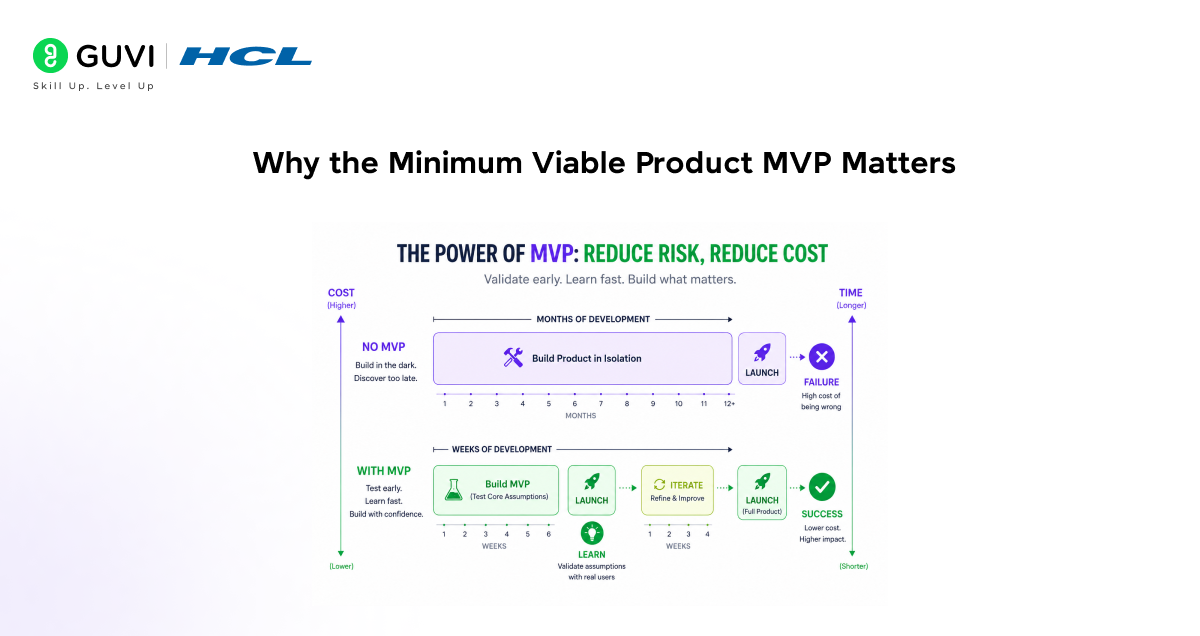
Building a product is expensive. Engineering time, design resources, and opportunity cost add up quickly and most of that investment is wasted if the product does not solve a problem users actually care about.
The minimum viable product MVP exists to answer the most important question in product development as early and cheaply as possible: is anyone willing to pay for this, use this, or change their behaviour because of this?
Here is why the MVP approach is foundational to modern product thinking:
- It reduces the cost of being wrong. Discovering that your assumptions are incorrect after six months of development is devastating. Discovering it after two weeks with an MVP is a competitive advantage.
- It gets real data faster. User interviews and surveys tell you what people say they want. An MVP tells you what they actually do a far more reliable signal.
- It focuses the team. Without an MVP discipline, feature lists expand indefinitely. The MVP forces a hard question before every decision: is this necessary to test our core assumption?
- It builds momentum. Shipping something even something small creates real user feedback, which energizes teams and gives investors something concrete to evaluate.
- \It prevents over-engineering. Teams that build MVPs avoid the trap of perfecting features users never asked for. Architecture and polish come after validation, not before.
Breaking Down the Three Words: Minimum, Viable, Product
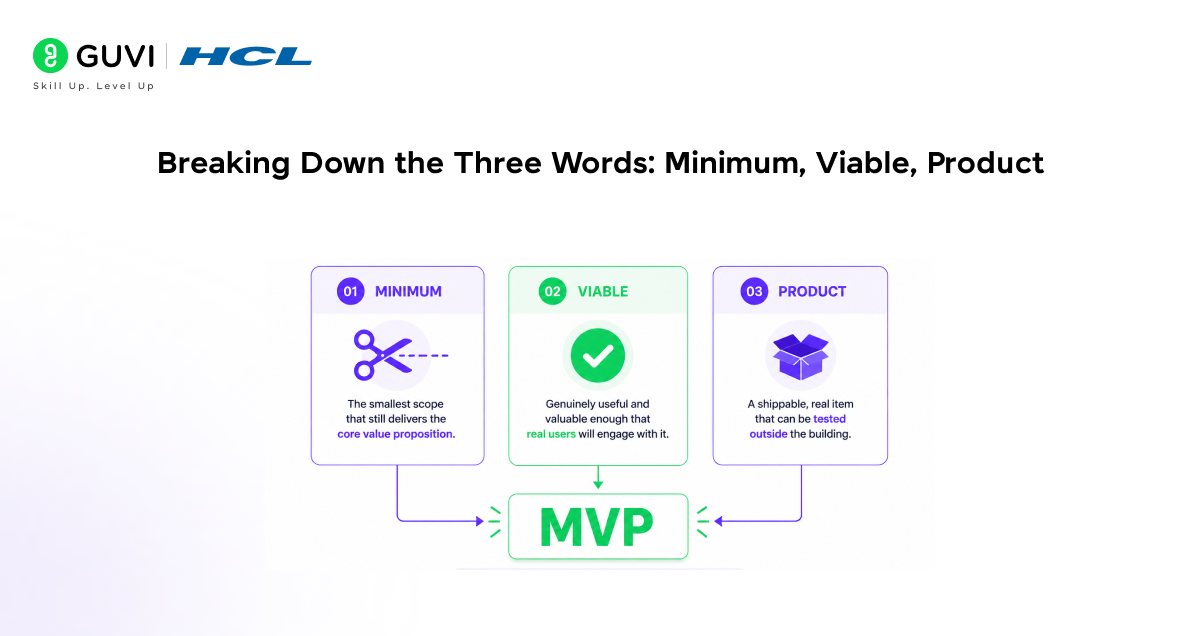
The most common MVP mistakes come from misunderstanding what the three words actually mean. Each carries equal weight and removing any one of them produces the wrong output.
Minimum
Minimum does not mean broken, unfinished, or embarrassing. It means the smallest scope that still delivers the core value proposition. Every feature that is not essential to testing your primary assumption is eliminated not deferred, eliminated until the assumption is validated.
The practical question is: what is the one thing this product must do to prove that users want it? Everything else is optional at this stage.
Viable
Viable is the word most teams get wrong. An MVP must be genuinely useful. It must deliver enough value that a real user not a friend, not a beta tester doing you a favour — will choose to use it and tell you something meaningful about it.
A product that is so stripped down it cannot perform its core function is not an MVP. It is a prototype. Prototypes are valuable, but they are not the same thing. Viability is the line between the two.
Product
Product means it is real. It is shipped, not demoed. It is used by actual users outside a controlled environment, not observed in a lab. The product criterion is what generates authentic behavioural data — the only kind of data that reliably predicts whether a product will succeed at scale.
Types of Minimum Viable Product
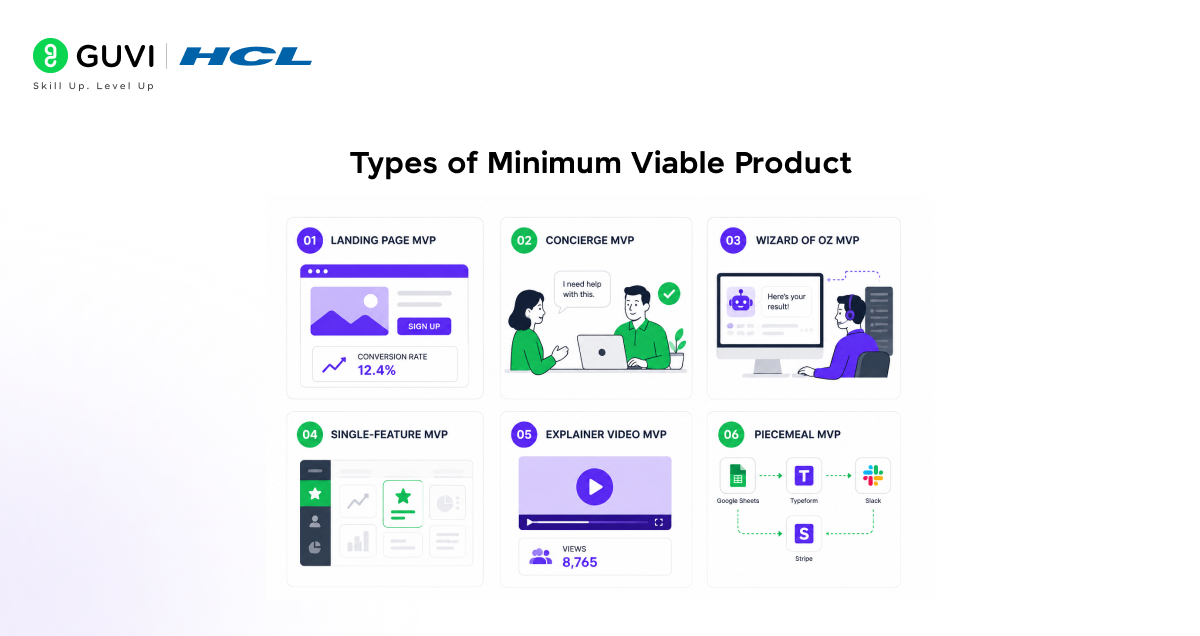
Not all MVPs are software products. The right MVP format depends on the assumption you are testing, the resources available, and the speed at which you need answers.
1. Landing Page MVP
A single page that describes the product’s value proposition and invites users to sign up, pre-order, or express interest before the product is built. Dropbox’s famous explainer video is a classic example: it described the product, drove sign-ups, and validated demand without a single line of production code.
• Best for: validating demand before building.
• Key metric: sign-up or conversion rate.
2. Concierge MVP
Instead of automating the product’s core function, a human delivers it manually to early users. This approach tests whether users value the outcome not whether the technology that will eventually deliver it can be built.
• Best for: service-heavy products and marketplaces.
• Key metric: repeat usage and willingness to pay.
3. Wizard of Oz MVP
Similar to the concierge approach, but the user-facing interface looks like a real product. Behind the scenes, a human is performing the operations. Users believe they are interacting with automated technology.
• Best for: testing AI, automation, or complex back-end functionality.
• Key metric: user satisfaction and task completion.
4. Single-Feature MVP
A real, functioning product that does exactly one thing the most important thing and does it well. All other features are removed or deferred. Slack launched this way: a real-time messaging tool with no bots, no integrations, and no workflow automation.
• Best for: software products with a clear core value proposition.
• Key metric: daily active usage and retention.
5. Piecemeal MVP
An MVP built entirely from existing tools, combining third-party software, manual processes, and off-the-shelf platforms to deliver the core experience without building custom technology. Airbnb initially used Craigslist as a distribution channel, not its own platform.
• Best for: marketplaces, platforms, and multi-sided products.
• Key metric: successful transactions and user return rate.
The term Minimum Viable Product (MVP) was first coined by Frank Robinson in 2001 and later popularized by :contentReference[oaicite:0]{index=0} through his influential book The Lean Startup (2011). Ries described an MVP as the version of a product that enables teams to gain the maximum amount of validated learning about customers with the least amount of effort. One of the most frequently cited MVP success stories is :contentReference[oaicite:1]{index=1}, whose founder initially tested demand by posting photos of shoes from local stores online and purchasing them only after customers placed orders. This simple experiment validated customer interest before investing heavily in inventory and infrastructure, demonstrating the core MVP principle of learning before scaling.

How to Build a Minimum Viable Product MVP
Building an MVP is a disciplined process, not a permission slip to ship something unfinished. These are the steps that separate MVPs that generate genuine learning from those that simply ship early and learn nothing.
Step 1: Identify the Core Problem
Before writing a single line of code or designing a single screen, articulate the problem your product solves as clearly as possible. Who has this problem? How often do they experience it? How are they solving it today? What does the cost of not solving it look like for them?
If you cannot answer these questions from user research, the MVP process has not started yet. Start here.
Step 2: State Your Riskiest Assumption
Every product is built on assumptions. The job of an MVP is to test the riskiest one the assumption whose failure would make everything else irrelevant. This is almost always a question about whether users value the core outcome, not about whether the technology can be built.
Write the assumption down as a falsifiable statement: “We believe that [user type] will [do this specific thing] because [reason].” The MVP is designed to prove or disprove that statement.
Step 3: Choose the Right MVP Type
Match the MVP format to the assumption you are testing. If you are testing demand, a landing page MVP is faster and cheaper than a functional product. If you are testing whether users will complete a complex workflow, a concierge or Wizard of Oz approach may be more appropriate.
The cheapest test that generates a credible answer is always the right choice.
Step 4: Define Success Metrics Before You Build
Decide what success looks like before the MVP launches not after. Post-hoc rationalization is the enemy of learning. If you define metrics after seeing the results, you will almost always find a way to interpret the data as confirming your assumption.
Common MVP metrics include: sign-up conversion rate, activation rate (users who complete the core action), retention rate (users who return), and revenue or willingness-to-pay signals.
Step 5: Build, Ship, and Get It in Front of Real Users
Build only what is necessary to test the assumption. Ship it to real users — not friends, not colleagues, not sympathetic early supporters. The feedback that matters comes from people who have no personal motivation to be kind about your product.
Speed matters here. An MVP that takes six months to build has already undermined its own purpose.
Step 6: Measure, Learn, and Decide
Once the MVP is in users’ hands, measure the metrics you defined in Step 4. Then make one of three decisions:
- Persevere: the assumption is validated; continue building on this foundation.
- Pivot: the assumption was wrong, but the research revealed a different problem worth solving.
- Stop: the data shows no viable path forward; redirect resources to a better opportunity.
Common Minimum Viable Product MVP Mistakes
Understanding what an MVP is not is just as important as understanding what it is. These are the most expensive mistakes teams make:
- Building too many features. The most common MVP mistake. Adding features ‘just in case’ defeats the purpose. Every additional feature delays learning and increases the cost of being wrong.
- Not defining success metrics upfront. Without pre-defined metrics, any result can be interpreted as success. Define what ‘the assumption is validated’ looks like in numbers before you build.
- Testing with the wrong users. Internal teams, friends, and family are not representative users. They know too much about the product and care too much about the team to give honest feedback.
- Treating the MVP as the final product. An MVP is a learning tool, not a finished product. Teams that fail to plan for the iteration that follows the MVP miss its entire purpose.
- Ignoring negative feedback. Negative feedback from early users is the most valuable signal an MVP can generate. Teams that filter it out in favour of positive signals waste the learning opportunity entirely.
To learn more on how to become a Product Manager, enroll in IIM Indore’s 8-month Certificate Programme in Product Management (CP PM). This comprehensive program helps you develop the skills and confidence to build, launch, and scale products that drive growth and innovation in today’s AI-powered economy, equipping you with industry-relevant expertise to excel in strategic product leadership roles.
Conclusion
A Minimum Viable Product (MVP) is not about building a low-quality product it is about testing whether a real customer need exists with the least amount of effort and cost. By focusing only on essential features, teams can gather real user feedback and reduce the risk of investing in the wrong solution.
Whether for a startup, a new product line, or a feature launch, the MVP approach remains the same: identify the biggest assumption, build the simplest solution to test it, release it to real users, and learn from the results. This cycle of validated learning helps teams make smarter product decisions and build products that truly meet user needs.
FAQs
1. What is a minimum viable product MVP in simple terms?
An MVP is the simplest version of a product you can ship to real users that still delivers genuine value and generates meaningful feedback. It is built to test one core assumption: whether people want what you are building before you invest in building it all.
2. What is the difference between an MVP and a prototype?
A prototype is an internal tool used to explore and communicate ideas it may not function at all. An MVP is a real, functional product shipped to actual external users to gather authentic behavioural data. Prototypes answer internal design questions; MVPs answer market questions.
3. How long should it take to build an MVP?
There is no fixed timeline, but speed is the point. Most startup MVPs are built in two to twelve weeks depending on the product type. If an MVP takes longer than three months, the scope has likely grown beyond what is minimum revisit the core assumption and cut aggressively.
4. Can an MVP be a non-technical product?
Yes. Many of the most instructive MVPs are non-technical landing pages, concierge services, Wizard of Oz experiences, or even a simple email sequence. The format should match the assumption being tested, not the team’s default preference for building software.
5. How do you know when an MVP has succeeded?
An MVP succeeds when it generates a clear, actionable answer to the assumption it was built to test even if that answer is ‘no.’ Success is not about user acquisition or revenue at the MVP stage; it is about validated learning that informs the next product decision with real evidence.
Success Stories

About the Author
Vishalini Devarajan
An Aerospace Engineer turned content writer, I focus on making complex concepts easy to understand through well-structured, reader-friendly blogs. Whether it’s a technical topic or a non-technical one, I love creating content that is clear, engaging, and impactful.
View all posts by Vishalini Devarajan
Connect with me @







Did you enjoy this article?