


Product Management Articles
Enterprise Product Management: Unique Challenges, Skills & Strategy
B2B vs B2C Product Management: Key Differences, Skills, Strategy & Career Scope
Working with Engineers as a Product Manager: A Practical Guide


Get In Touch For Details! Request More Information
Design Thinking in Product Management: A Guide
Aug 30, 2026 6 Min Read 626 Views
(Last Updated)
The best products are not built by the teams with the biggest budgets or the most engineers; they are built by the teams that understand their users most deeply. That understanding is what design thinking in product management is designed to unlock.
Design thinking is a structured, human-centred problem-solving framework that places user needs at the heart of every product decision. For product managers, it provides a repeatable process to move from a vague problem to a validated, user-approved solution without relying on guesswork or intuition alone.
This guide covers what design thinking is, how each stage applies to product management, how it fits into your existing workflows, and the practical techniques that separate PMs who talk about empathy from those who systematically build it into every product decision they make.
Table of contents
- TL;DR
- Why Design Thinking Matters for Product Managers
- The Five Stages of Design Thinking in Product Management
- Stage 1: Empathize: Understand Before You Assume
- Stage 2: Define: Frame the Right Problem
- Stage 3: Ideate Expand Before You Narrow
- Stage 4: Prototype: Make Ideas Tangible
- Stage 5: Test Learn Before You Build
- Design Thinking and Agile: How They Work Together
- Best practices for design thinking in product management
- Design Thinking in Product Management: Real-World Application
- Conclusion
- FAQs
- What is design thinking in product management?
- How does design thinking differ from traditional product development?
- Can design thinking and Agile be used together?
- How long does a design thinking process take for a product manager?
- What tools do product managers use for design thinking?
TL;DR
- Design thinking gives product managers a structured way to solve user problems before building solutions.
- The five stages Empathize, Define, Ideate, Prototype, Test form an iterative loop, not a one-way process.
- It replaces assumption-driven roadmaps with insight-driven ones.
- Design thinking works alongside Agile, Lean, and Jobs-to-be-Done; it is complementary, not competing.
- The goal is not creative brainstorming for its own sake; it is de-risking product decisions before they become expensive mistakes.
What Is Design Thinking in Product Management?
Design thinking in product management is a human-centered, iterative problem-solving methodology that helps product teams identify and solve real user problems before investing in full-scale development. Popularized by Stanford’s d.school and IDEO, the framework consists of five stages: Empathize, Define, Ideate, Prototype, and Test. By focusing on deep user understanding, creative solution generation, rapid prototyping, and continuous validation, design thinking enables product managers to reduce risk, improve product-market fit, and build products that deliver meaningful value to users.
Your path to product leadership starts here. Explore IIM Indore’s 8-month Certificate Programme in Product Management (CP PM) and learn how to build products that drive innovation and business growth.
Why Design Thinking Matters for Product Managers
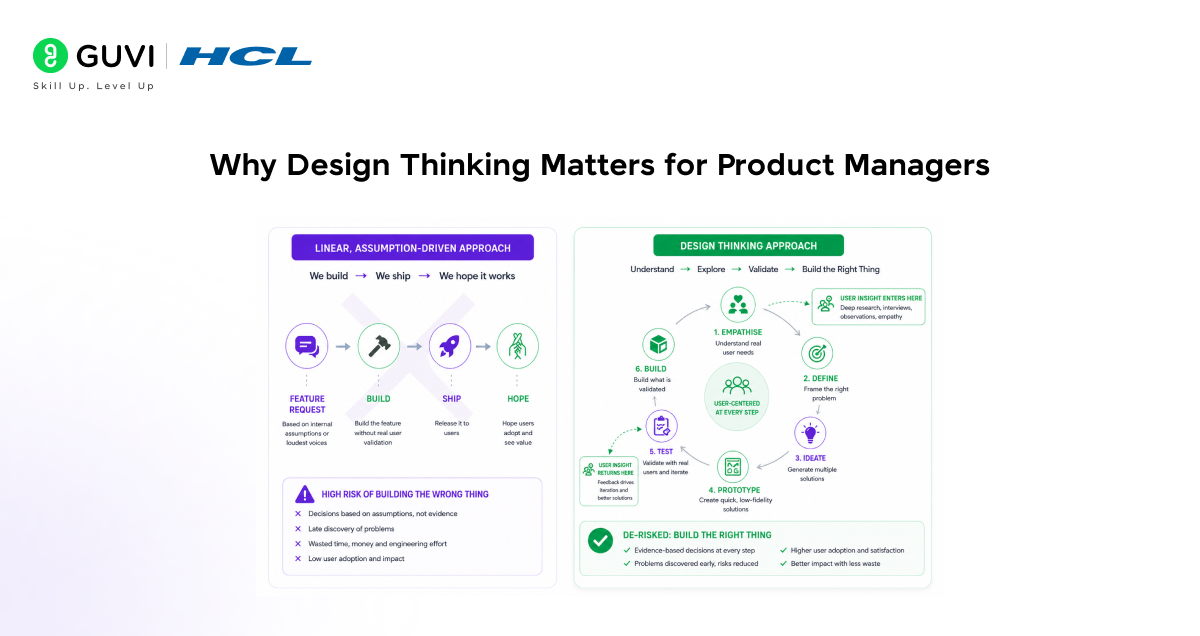
Most product failures are not engineering failures; they are insight failures. Teams build the wrong thing because they solved the wrong problem, or the right problem for the wrong user.
Design thinking addresses this at the source. By investing time in understanding users before writing a single line of code, product managers dramatically reduce the cost of being wrong.
Here is why it matters specifically for PMs:
- It aligns teams around the user, not opinions. When decisions are grounded in user research, stakeholder debates shift from ‘what I think’ to ‘what we observed’.
- It surfaces problems worth solving. Many feature requests address symptoms, not root causes. Design thinking’s Define stage forces PMs to articulate the real underlying problem.
- It reduces the cost of failure. Testing a paper prototype with five users costs hours, not sprints. Design thinking front-loads discovery so engineering effort is spent on validated ideas.
- It breaks internal bias. PMs are not their users. Structured empathy-building through interviews, observation, and journey mapping corrects the assumptions that internal teams inevitably carry.
- It drives innovation, not just iteration. The Ideate stage deliberately expands the solution space beyond the obvious, uncovering approaches that incremental roadmap thinking would never surface.
The Five Stages of Design Thinking in Product Management
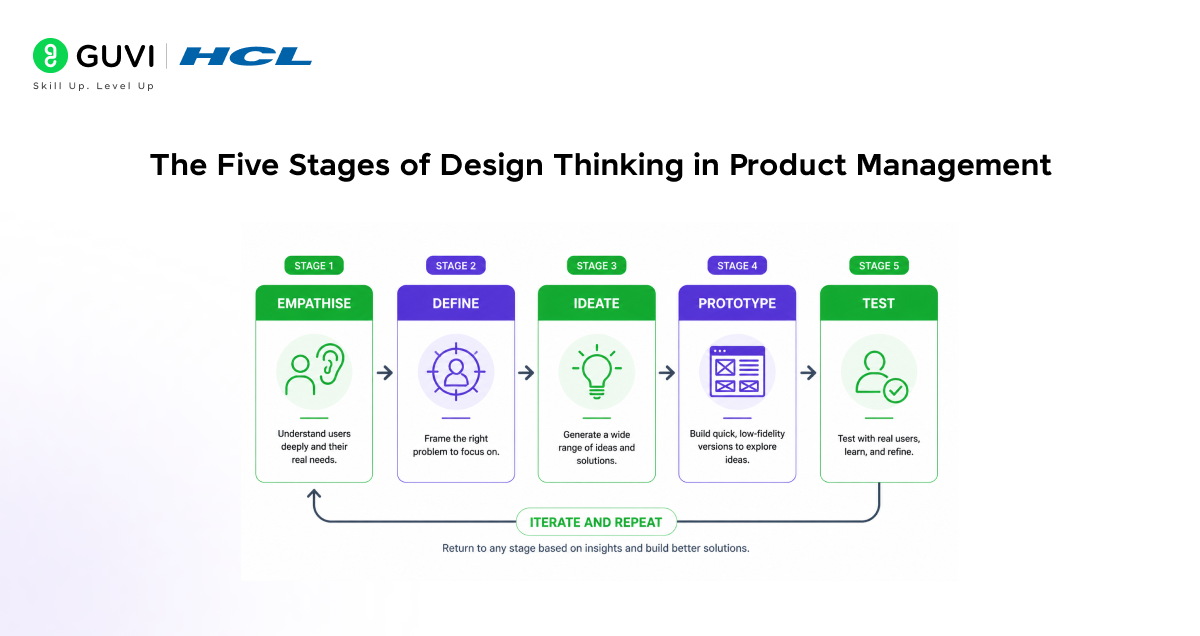
Design thinking is often illustrated as a linear sequence, but experienced product managers treat it as a loop. Insights from the Test stage frequently send teams back to Define or even Empathize. Here is how each stage applies in practice.
Stage 1: Empathize: Understand Before You Assume
Empathy is the foundation of design thinking in product management. Before defining problems or generating solutions, PMs must develop a genuine, evidence-based understanding of the people they are building for.
This is not the same as reading analytics dashboards. Quantitative data tells you what users do; empathy research tells you why they do it, what they feel, and what they wish were different.
Key empathy-building techniques for product managers:
- User interviews: open-ended, non-leading conversations that reveal motivations, frustrations, and mental models.
- Contextual observation: watching users interact with your product or a competitor’s product in their real environment.
- Empathy mapping: a structured template capturing what users say, think, feel, and do.
- Customer support review mining: existing tickets, reviews, and NPS verbatims for unfiltered user language.
- Diary studies: asking users to log their experiences over time, capturing context that a single interview misses.
Stage 2: Define: Frame the Right Problem
The Define stage is where research becomes direction. The goal is to synthesize everything learned during Empathize into a single, actionable problem statement often called a Point of View (POV) statement.
A well-written POV statement follows this structure:
[User] needs [need] because [insight].
For example: “Busy working parents need a way to track their household spending in under two minutes a day because they value financial awareness but cannot commit to time-intensive budgeting tools.”
This stage is where many product teams cut corners and pay for it later. Jumping to solutions before clearly defining the problem is the single most common cause of building products nobody uses.
Tools used in the Define stage:
- Affinity mapping: grouping research findings into themes to identify patterns across users.
- Jobs-to-be-Done framing: articulating the underlying job a user is hiring the product to do.
- How Might We (HMW) questions reframing problems as open-ended questions that invite creative solutions.
Stage 3: Ideate Expand Before You Narrow
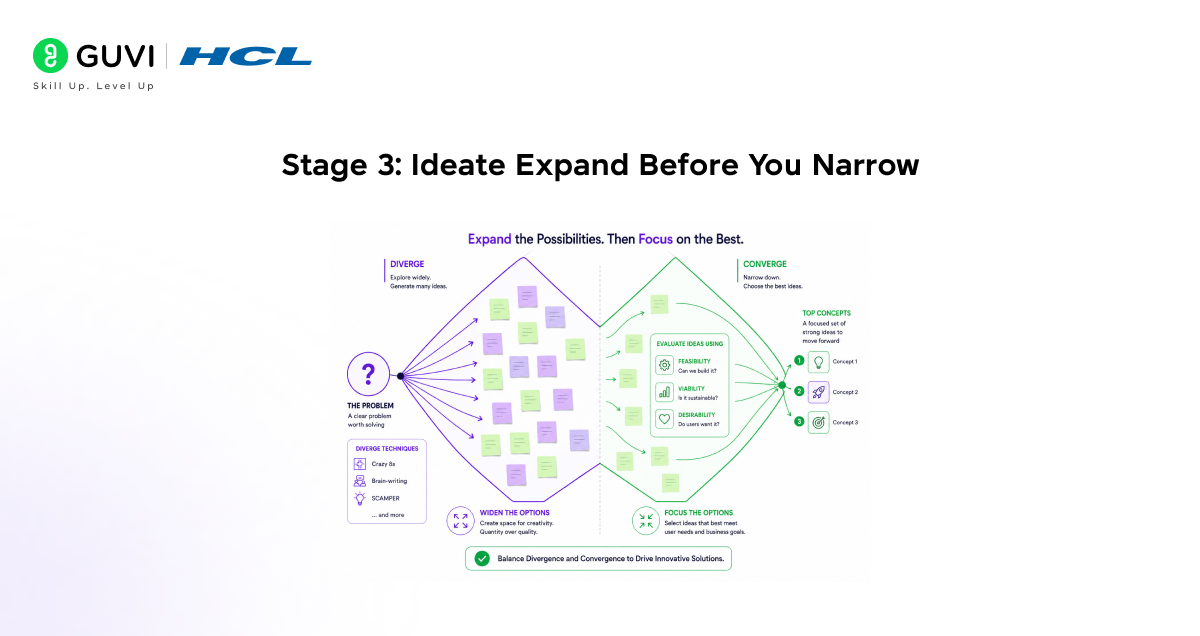
Ideation is not a free-for-all brainstorm. It is a structured process of deliberately expanding the solution space before narrowing it to ensure that the team is not just gravitating toward the first idea that sounds reasonable.
The discipline here is to separate generating ideas from evaluating them. Premature judgment kills creative momentum. The best PM-led ideation sessions make the rules explicit: volume before quality, and all ideas are valid during generation.
Effective ideation techniques for product managers:
- Crazy 8s: each person sketches eight ideas in eight minutes, forcing rapid quantity over polish.
- Brain-writing: participants write ideas silently before sharing, preventing the loudest voice from dominating the session.
- SCAMPER: a structured checklist (Substitute, Combine, Adapt, Modify, Put to other use, Eliminate, Reverse) applied to existing solutions to generate variants.
- Analogous inspiration: looking at how other industries solve structurally similar problems to import fresh approaches.
Once ideas are generated, PMs evaluate them against three criteria: desirability (do users want it?), feasibility (can it be built?), and viability (does it work for the business?). Ideas that score well on all three move forward.
Stage 4: Prototype: Make Ideas Tangible
A prototype is not a finished product; it is the cheapest possible representation of an idea that can be tested with a real user. The purpose is to make abstract concepts concrete enough to get meaningful feedback.
Product managers should champion low-fidelity prototyping early. The instinct to build polished mockups before testing is expensive and counterproductive users respond to the core concept, not the visual finish.
Prototype types, from lowest to highest fidelity:
- Paper sketches: hand-drawn screen flows that take minutes to create and can be tested in the same afternoon.
- Clickable wireframes: low-fidelity digital prototypes built in tools like Figma, Balsamiq, or Marvel that simulate navigation without visual design.
- Role-playing: acting out a service or workflow with the team to test logic before any digital work begins.
- Wizard of Oz prototypes: a human manually performs what will eventually be automated, allowing the user experience to be tested before the back-end exists.
The modern concept of Design Thinking was popularized as a structured, teachable innovation methodology by David Kelley, founder of :contentReference[oaicite:0]{index=0} and a professor at :contentReference[oaicite:1]{index=1}. Through IDEO’s human-centered approach to problem-solving, Design Thinking became a powerful framework for creating products, services, and experiences that better meet user needs. IDEO’s influence extends to some of the most iconic technology products of the modern era, including contributions to the development of Apple’s early commercial mouse. Today, Design Thinking is taught in universities and used by organizations worldwide to drive innovation by emphasizing empathy, rapid prototyping, experimentation, and continuous user feedback.

Stage 5: Test Learn Before You Build
Testing in design thinking is not QA. It is a structured learning exercise exposing prototypes to real users and observing what works, what confuses, and what is simply wrong.
The goal is not to validate that the team’s idea is good. It is to find out where it fails while the cost of fixing it is still low. PMs who treat user testing as a box-ticking exercise miss its real value.
Best practices for the Test stage:
- Test with five to eight users per round, enough to identify patterns without over-investing in a single prototype version.
- Use task-based testing: give users a specific goal and observe how they attempt to achieve it, without guiding them.
- Capture observations, not interpretations; note exactly what users say and do before concluding.
- Run multiple short testing rounds rather than one large one; each round informs the next prototype.
- Share findings with the full team, not just a summary, but actual footage or direct quotes where possible.
Design Thinking and Agile: How They Work Together
A common misconception is that design thinking and Agile are alternatives. They are not; they are complementary. Design thinking operates at the front of the product lifecycle, ensuring that what goes into the Agile backlog is worth building. Agile then delivers it efficiently.
The dual-track model makes this concrete: a Discovery Track runs design thinking activities in parallel with a Delivery Track running Agile sprints. Validated concepts from the discovery track feed the delivery track as ready-to-build stories, reducing the risk of sprint work that users later reject.
How design thinking strengthens Agile product management:
- It reduces backlog bloat; only validated, user-backed ideas make it into sprint planning.
- It gives user stories real depth: “As a user, I want…” stories backed by empathy research are far more actionable than those written from internal assumption.
- It prevents the Agile anti-pattern of shipping fast and wrong: speed without direction is just expensive failure delivered quickly.
- It aligns cross-functional teams: designers, engineers, and PMs who have participated in empathy research share a common understanding of the user problem.
To learn more about how to become a Product Manager, enrol in IIM Indore’s 8-month Certificate Programme in Product Management (CP PM). This comprehensive program helps you develop the skills and confidence to build, launch, and scale products that drive growth and innovation in today’s AI-powered economy, equipping you with industry-relevant expertise to excel in strategic product leadership roles.
Best practices for design thinking in product management
Successful design thinking in product management starts with deep user empathy. Product managers should regularly engage with customers through interviews, surveys, usability studies, and feedback sessions to understand real pain points rather than relying on assumptions.
Another key best practice is to embrace rapid experimentation. Instead of investing heavily in fully developed solutions, teams should create simple prototypes, test them with users, and use the feedback to refine ideas. This reduces risk and ensures product decisions are backed by evidence.
Finally, design thinking works best when it is collaborative and iterative. Product managers should involve designers, engineers, stakeholders, and customers throughout the process. Continuous testing, learning, and improvement help teams build products that align with both user needs and business objectives.
Design Thinking in Product Management: Real-World Application
Design thinking is not reserved for product launches or major redesigns. Experienced product managers apply it across the full range of their day-to-day responsibilities:
- Reducing churn: Instead of guessing why users leave, run empathy interviews with churned customers to identify the exact point where the product stopped delivering value.
- Redesigning onboarding: Map the new user journey, identify moments of confusion through observation, prototype simplified flows, and test them with users before committing to a redesign sprint.
- Prioritizing the roadmap: Frame competing feature requests as problem statements and evaluate them against user research to determine which problems are most acute and most widespread.
- 0-to-1 product development: When building from scratch, design thinking provides the entire front-end discovery process, replacing guesswork with a structured path from insight to concept to validated prototype.
- Stakeholder alignment: Sharing empathy research findings, quotes, observations, and journey maps with executives and engineering leads builds shared understanding that no roadmap slide deck can match.
Conclusion
Design thinking is a user-centric approach that helps product managers solve the right problems through empathy, research, and continuous learning. Instead of relying on assumptions, it focuses on understanding real user needs and creating solutions that deliver meaningful value.
The five stages Empathize, Define, Ideate, Prototype, and Test form an iterative process that teams revisit as they gather new insights. When combined with Agile practices, design thinking enables product managers to build, refine, and launch products that better meet user expectations and business goals.
FAQs
1. What is design thinking in product management?
Design thinking in product management is a five-stage, human-centred framework Empathize, Define, Ideate, Prototype, Test that helps product managers identify real user problems and validate solutions before committing engineering resources. It ensures product decisions are grounded in user insight rather than internal assumption.
2. How does design thinking differ from traditional product development?
Traditional product development often starts with a solution, a feature request or a business requirement and builds toward it. Design thinking starts with the user problem, validates it through research, and only then generates and tests solutions. This reversal dramatically reduces the risk of building something users do not want.
3. Can design thinking and Agile be used together?
Yes, they are complementary. Design thinking handles discovery (understanding the problem and validating concepts), while Agile handles delivery (building and shipping validated ideas efficiently). The dual-track model runs them in parallel, ensuring the Agile backlog is always stocked with user-backed, de-risked work.
4. How long does a design thinking process take for a product manager?
It depends on the scope. A focused design thinking sprint covering Empathize through Test can be completed in five days using a Google Design Sprint structure. For larger product challenges, discovery may run over several weeks with multiple testing rounds before a validated concept enters development.
5. What tools do product managers use for design thinking?
Common tools include Figma and Balsamiq for prototyping, Miro or Mural for affinity mapping and ideation workshops, Dovetail or Notion for synthesizing user research, Maze or UserTesting for remote usability testing, and simple pen-and-paper sketches for early-stage concept exploration.
Success Stories

About the Author
Vishalini Devarajan
An Aerospace Engineer turned content writer, I focus on making complex concepts easy to understand through well-structured, reader-friendly blogs. Whether it’s a technical topic or a non-technical one, I love creating content that is clear, engaging, and impactful.
View all posts by Vishalini Devarajan
Connect with me @









Did you enjoy this article?