


Artificial Intelligence and Machine Learning Articles
Multi-Turn Conversation Management with Claude API
How to Stream Claude Responses with the API


Get In Touch For Details! Request More Information

AdaBoost in Machine Learning: A Complete Beginner’s Guide
Jul 18, 2026 8 Min Read 239 Views
(Last Updated)
Imagine a student who reviews a multiple-choice test by spending extra time on the questions they got wrong, drilling those weak spots until they improve. AdaBoost uses the same idea in machine learning: it trains models sequentially, and after each round it increases the weight of misclassified examples so subsequent models focus on the hardest cases.
Rather than treating every training example equally, AdaBoost builds a strong classifier by combining many weak learners (often simple decision stumps) with weighted votes. Each learner corrects the mistakes of its predecessors, and the final weighted ensemble achieves high accuracy while concentrating learning effort where it’s most needed.
In this article, we will walk through everything you need to know about AdaBoost in machine learning: the core idea behind adaptive boosting, what decision stumps are, how the weight update formula works, how to implement it in Python using scikit-learn, how it compares to bagging and other boosting methods, and where it is applied in real-world problems.
Table of contents
- TL;DR
- The Origins of AdaBoost
- What Are Weak Classifiers and Decision Stumps of Adaboost?
- How AdaBoost Works: The Core Mechanism
- Implementing AdaBoost in Scikit-Learn
- Tracking Performance Across Boosting Rounds of Adaboost
- Key Parameters of AdaBoostClassifier
- AdaBoost vs. Bagging: The Fundamental Difference
- Advantages of AdaBoost
- Limitations of AdaBoost
- Real-World Applications of AdaBoost
- Wrapping Up
- FAQ
- Q: When should I choose AdaBoost over bagging or Random Forest?
- Q: How do n_estimators and learning_rate interact?
- Q: Is AdaBoost robust to noisy labels and outliers?
- Q: What base estimator should I use?
- Q: Which algorithm variant should I pick: SAMME or SAMME? R?
TL;DR
- AdaBoost (Adaptive Boosting) sequentially trains weak learners (typically decision stumps), increasing weights on previously misclassified examples so later learners focus on hard cases.
- Each weak learner receives a weight (alpha) based on its weighted error; final predictions are a weighted vote of all learners.
- AdaBoost reduces bias by turning many weak models into one strong classifier but is sensitive to noisy labels and outliers.
- Key hyperparameters: n_estimators (number of rounds) and learning_rate (shrinkage of each learner’s contribution); lower learning_rate often needs more estimators.
- Use AdaBoost when you want to improve underfitting weak learners; prefer bagging/Random Forest when your base model overfits and you need variance reduction.
What Is AdaBoost in Machine Learning?
AdaBoost (Adaptive Boosting) is an ensemble machine learning algorithm that combines multiple weak classifiers to form a strong classifier. It works by training models sequentially, where each new model pays more attention to the data points that previous models misclassified. The final prediction is made through a weighted vote, where more accurate models have a greater influence on the outcome. This approach significantly improves accuracy and is commonly used for classification problems.
The Origins of AdaBoost
- AdaBoost, which stands for Adaptive Boosting, is a supervised ensemble learning algorithm that was the very first boosting algorithm used in practice.
- It was developed by Freund and Schapire back in 1995. In a nutshell, Adaptive Boosting helps to reduce the error of any classification learning algorithm by sequentially turning many weak classifiers into one strong classifier.
- AdaBoost effectively reduces bias and variance, making it useful for classification tasks, but it can be sensitive to noisy data and outliers.
- The idea of boosting came from a theoretical question in machine learning: is it possible to combine many models that each perform only slightly better than random guessing into a single model that performs arbitrarily well?
- AdaBoost was the first practical algorithm that answered this question with a definitive yes, and its elegance and effectiveness made it one of the most widely cited algorithms in the history of machine learning.
What Are Weak Classifiers and Decision Stumps of Adaboost?
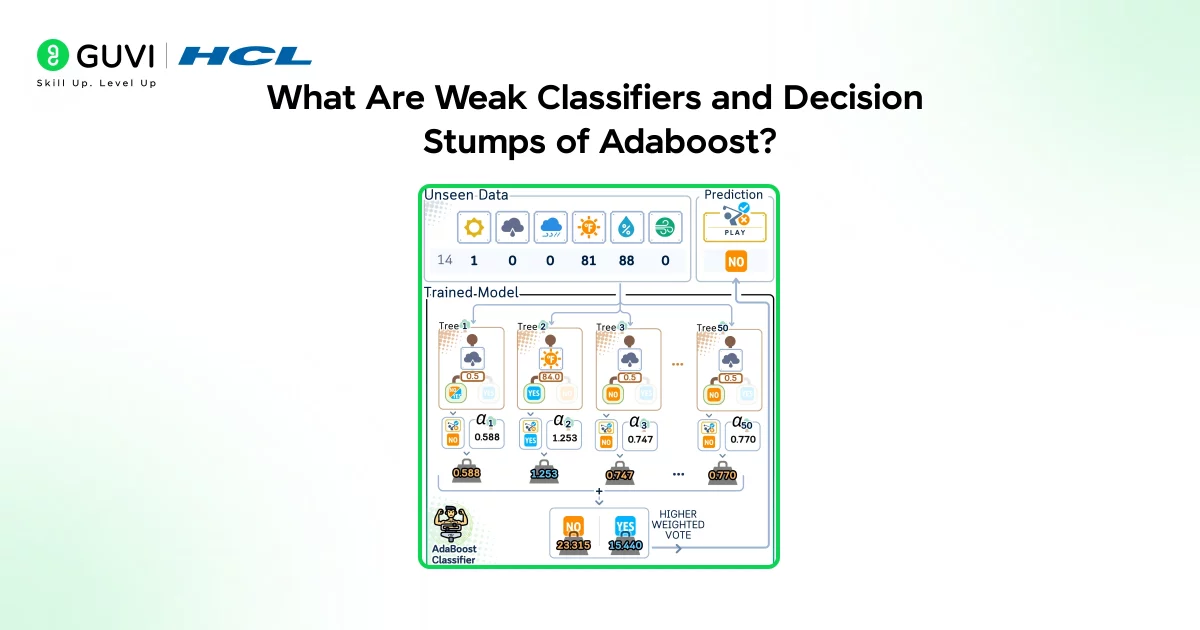
- The building blocks of AdaBoost are called weak classifiers. A weak classifier is a model that performs only slightly better than random guessing. It does not need to be good, just marginally better than chance.
- Stumps alone are not a good way to make decisions. A full-grown tree combines the decisions from all variables to predict the target value. A stump, on the other hand, can only use one variable to make a decision.
- A decision stump is a decision tree with just one split: one root node and two leaf nodes. It asks exactly one yes-or-no question about one feature, and based on the answer, it predicts one class or the other.
- By itself, a stump is almost useless for complex problems. But as AdaBoost shows, combining 50 or 100 of these stumps through adaptive weighting produces a remarkably powerful classifier.
- An AdaBoost classifier makes predictions by using many simple decision trees, usually 50 to 100. Each tree, called a stump, focuses on one important feature. Each stump makes just one split, and they are trained sequentially, adjusting weights along the way.
- The simplicity of decision stumps is actually an advantage in the boosting framework. Because stumps underfit, they have low variance.
- AdaBoost’s sequential weighting mechanism compensates for its high bias by directing each stump’s attention to the parts of the problem that previous stumps handled poorly.

How AdaBoost Works: The Core Mechanism
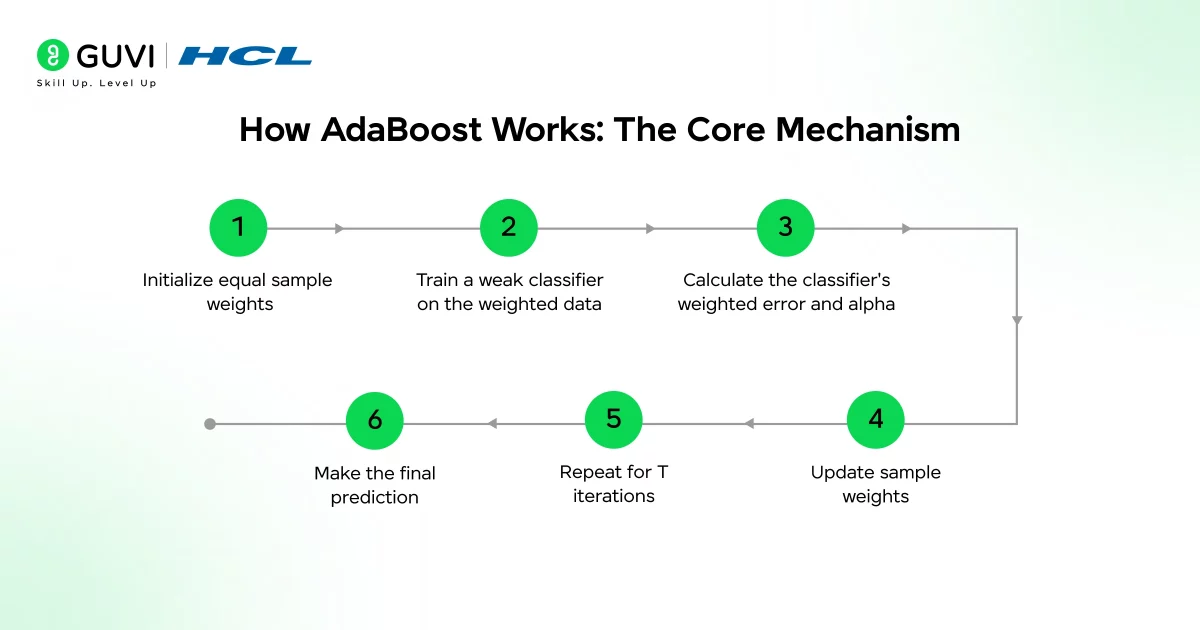
The algorithm follows a clear iterative process. Understanding each step is essential for knowing why the final ensemble works so well.
Step 1: Initialize equal sample weights. At the start, every training example is given the same weight of 1/N, where N is the total number of training samples. Initially, each data point has the same weight 1/N because there is no reason to give different weights at the beginning.
Step 2: Train a weak classifier on the weighted data. The first decision stump is trained on the training set, taking the current sample weights into account. It tries to find the single feature and threshold that best separates the classes when weighted misclassification error is minimized.
The algorithm finds the weak learner that maximizes the Gini Gain, alternatively minimizing the error of misclassified instances, and calculates the weighted error of the weak learner as the sum of the sample weights of the misclassified samples.
Step 3: Calculate the classifier’s weighted error and alpha. The weighted error epsilon is calculated as the sum of the weights of all misclassified examples. Epsilon is just the ratio of the sum of weights for misclassified samples to the total sum of weights for all samples. In other words, epsilon is just the misclassification percentage based on the weights of samples.
Alpha, the importance or “amount of say” assigned to this stump, is then calculated from epsilon using the formula:
alpha = 0.5 × log((1 – epsilon) / epsilon)
When there is no misclassification, the total error is 0, so the amount of say alpha will be a large number. When the classifier predicts half right and half wrong, the total error is 0.5, and the importance of the classifier will be 0. If all the samples have been incorrectly classified, then the error will be very high, and hence the alpha value will be a negative integer.
This formula has a beautiful property: the better the stump, the more say it gets in the final vote. A stump that is no better than random guessing gets zero say. A stump that is perfect gets a very large positive alpha.
Step 4: Update sample weights. The weights of misclassified examples are increased so the next stump is forced to focus on them. The weights of correctly classified examples are decreased. For incorrectly classified records: since alpha is positive, e to the power alpha is greater than 1, so the weight increases.
For correctly classified records, the weight decreases. After the update, the weights will no longer sum to 1, so we divide every weight by the sum of the new weights to normalize them.
Step 5: Repeat for T iterations. Steps 2 through 4 repeat for however many stumps you have set. Each new stump faces a reweighted dataset where the previously hard examples are more prominent.
Step 6: Make the final prediction. For prediction, every stump predicts positive 1 or negative 1. Each prediction is multiplied by that stump’s alpha. All of these are summed up. If the result is positive, we predict Class 1. If negative, Class -1. This ensures that the smart stumps with high alpha count more than the weaker stumps.
Implementing AdaBoost in Scikit-Learn
Scikit-learn’s AdaBoostClassifier makes implementation clean and straightforward:
import numpy as np
from sklearn.ensemble import AdaBoostClassifier
from sklearn.tree import DecisionTreeClassifier
from sklearn.datasets import make_classification
from sklearn.model_selection import train_test_split
from sklearn.metrics import accuracy_score, classification_report
# Generate classification dataset
X, y = make_classification(
n_samples=1000, n_features=20,
n_informative=15, n_redundant=5,
random_state=42
)
X_train, X_test, y_train, y_test = train_test_split(
X, y, test_size=0.2, random_state=42
)
# Single decision stump (baseline)
stump = DecisionTreeClassifier(max_depth=1, random_state=42)
stump.fit(X_train, y_train)
stump_acc = accuracy_score(y_test, stump.predict(X_test))
print(f”Single Decision Stump Accuracy: {stump_acc:.4f}”)
# AdaBoost with decision stumps
ada_clf = AdaBoostClassifier(
estimator=DecisionTreeClassifier(max_depth=1),
n_estimators=100, # number of weak classifiers
learning_rate=1.0, # contribution of each classifier
algorithm=’SAMME’, # algorithm variant
random_state=42
)
ada_clf.fit(X_train, y_train)
ada_pred = ada_clf.predict(X_test)
ada_acc = accuracy_score(y_test, ada_pred)
print(f”AdaBoost Accuracy: {ada_acc:.4f}”)
print(f”\nDetailed Report:”)
print(classification_report(y_test, ada_pred))
# Accessing individual estimator weights
print(f”\nFirst 5 estimator weights (alpha values):”)
print(ada_clf.estimator_weights_[:5].round(3))
The estimator_weights_ attribute gives you the alpha value assigned to each stump, letting you see exactly how much say each one gets in the final vote. Early stumps with low error get high weights. Later stumps that struggle with the hardest examples often get lower weights.
Tracking Performance Across Boosting Rounds of Adaboost
One of the most instructive things you can do with AdaBoost is visualize how accuracy improves as more stumps are added:
import matplotlib
matplotlib.use(‘Agg’)
import matplotlib.pyplot as plt
from sklearn.ensemble import AdaBoostClassifier
from sklearn.tree import DecisionTreeClassifier
from sklearn.datasets import make_classification
from sklearn.model_selection import train_test_split
from sklearn.metrics import accuracy_score
X, y = make_classification(n_samples=1000, n_features=20,
n_informative=15, random_state=42)
X_train, X_test, y_train, y_test = train_test_split(
X, y, test_size=0.2, random_state=42
)
ada = AdaBoostClassifier(
estimator=DecisionTreeClassifier(max_depth=1),
n_estimators=200, random_state=42, algorithm=’SAMME’
)
ada.fit(X_train, y_train)
# Collect accuracy at each boosting step
train_scores = []
test_scores = []
for train_pred, test_pred in zip(
ada.staged_predict(X_train),
ada.staged_predict(X_test)
):
train_scores.append(accuracy_score(y_train, train_pred))
test_scores.append(accuracy_score(y_test, test_pred))
plt.figure(figsize=(10, 5))
plt.plot(train_scores, label=’Train Accuracy’, color=’blue’)
plt.plot(test_scores, label=’Test Accuracy’, color=’orange’)
plt.xlabel(‘Number of Estimators’)
plt.ylabel(‘Accuracy’)
plt.title(‘AdaBoost: Accuracy vs Number of Estimators’)
plt.legend()
plt.tight_layout()
plt.savefig(‘adaboost_accuracy.png’, dpi=150)
print(“Plot saved. Final test accuracy:”, f”{test_scores[-1]:.4f}”)
The staged_predict method returns predictions at each boosting step, letting you see exactly how the model improves as stumps are added. Typically, test accuracy improves quickly at first and then plateaus, and in some cases begins to drop if too many estimators are added to noisy data.
AdaBoost, introduced by Freund and Schapire (1995), was one of the first practical boosting algorithms and showed that many weak learners—each only slightly better than random guessing—can be combined into a strong, highly accurate ensemble model. One of its most famous real-world applications is the Viola–Jones face detection system, which used AdaBoost to select and weight thousands of simple visual features. This enabled efficient and real-time face detection on early 2000s hardware, marking a major milestone in practical computer vision and demonstrating the power of ensemble learning in real-world AI systems.
Key Parameters of AdaBoostClassifier
Understanding the main parameters helps you tune AdaBoost effectively for your dataset.
- n_estimators is the number of weak classifiers to build. More estimators means more boosting rounds and generally better performance, up to a point. Beyond a certain number, adding more estimators can cause overfitting on noisy data. A typical starting range is 50 to 200.
- Learning_rate controls how much each classifier’s contribution is shrunk before being added to the ensemble. Lowering the learning rate means each weak classifier contributes less, which generally requires more estimators to achieve the same effect but can improve generalization. There is a trade-off between learning rate and n_estimators. A common practice is to reduce the learning rate and increase n_estimators together.
- The estimator specifies the base weak learner. The default is a decision stump with max_depth=1, which works well in most cases. You can use deeper trees, but AdaBoost typically works best with very simple base estimators.
- The algorithm can be SAMME or SAMME. R. SAMME.R uses probability estimates rather than class predictions and generally converges faster and achieves better performance when the base estimator can predict class probabilities. SAMME is the discrete version that works with any classifier.
AdaBoost vs. Bagging: The Fundamental Difference
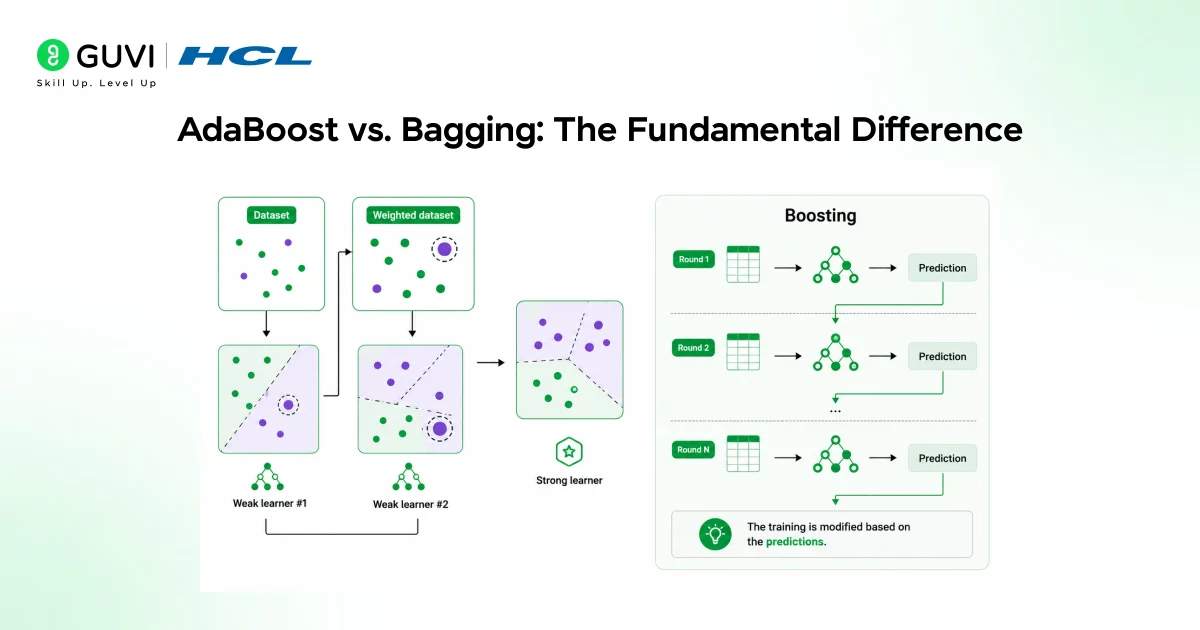
- Unlike Random Forest, which makes many trees at once, AdaBoost starts with a single simple tree and identifies the instances it misclassifies. It then builds new trees to fix those errors, learning from its mistakes and getting better with each step.
- The core distinction is the relationship between models. In bagging, all models are trained independently and in parallel on random subsets of the data.
- No model knows about the mistakes of any other. In AdaBoost, models are trained sequentially, and each new model is directly shaped by the failures of the previous ones.
- Bagging reduces variance and is great for high-variance models like decision trees. It helps prevent overfitting and is less sensitive to outliers because errors are averaged across models.
- AdaBoost reduces bias, making weak models stronger, but it can sometimes overfit if not carefully tuned. It is more sensitive to outliers because it tries harder to correct errors, including noisy data.
- Use bagging when your model already overfits, and you need to reduce variance. Use AdaBoost when your model underfits, and you need to reduce bias by iteratively improving on hard examples.
Advantages of AdaBoost
- AdaBoost rarely requires feature scaling, which is a practical convenience compared to distance-based algorithms. Lesser preprocessing is required, as you do not need to scale the independent variables.
- The sequential weighting mechanism means AdaBoost focuses its learning capacity exactly where it is most needed, on the hardest examples. This results in a model that generalizes well without requiring complex feature engineering.
- AdaBoost is also flexible in terms of the base estimator. While decision stumps are the most common choice, you can use any weak learner that supports sample weighting, making the framework broadly applicable.
Limitations of AdaBoost
- AdaBoost can be sensitive to noisy data and outliers since it will magnify their influence if they cause repeated errors. On clean data, AdaBoost can substantially improve performance over any of the individual learners alone.
- If a data point is mislabeled or is a genuine outlier, AdaBoost will keep assigning it higher and higher weights because it keeps getting misclassified.
- Eventually, this outlier dominates the training and forces subsequent stumps to waste their capacity trying to classify an impossible case. This is the most significant practical weakness of AdaBoost compared to other ensemble methods.
- AdaBoost can be sensitive to noisy data and outliers since it will focus heavily on misclassified samples. Computational cost is also a consideration because each weak learner must be trained sequentially, which means it cannot be parallelized as efficiently as bagging methods.
- The sequential nature of AdaBoost also means it cannot be parallelized as easily as bagging. Each stump depends on the weights produced by all previous stumps, so stumps must be trained one after another rather than simultaneously.
Real-World Applications of AdaBoost
- AdaBoost is used in image classification to increase classification accuracy and reduce overfitting by combining results from multiple classifiers. In natural language processing, it combines predictions from multiple language models to improve text classification and sentiment analysis tasks.
- Face detection is perhaps the most historically significant application of AdaBoost. The Viola-Jones face detection algorithm, introduced in 2001 and used in cameras for over a decade, used AdaBoost to select the most informative features from thousands of candidates and combine them into a cascade of classifiers that could detect faces in real time on 2001 hardware. This was a remarkable engineering achievement directly enabled by AdaBoost’s ability to identify the most discriminating weak classifiers.
- Medical diagnosis is another application where AdaBoost’s ability to focus on hard-to-classify cases is particularly valuable. A misclassified patient is exactly the kind of difficult case that subsequent classifiers should pay more attention to, which maps naturally to how clinicians think about differential diagnosis.
If you’re serious about mastering AdaBoost in machine learning, understanding boosting, weak learners, weighted training, and how AdaBoost improves classification accuracy step by step, don’t miss the chance to enroll in HCL GUVI’s Artificial Intelligence & Machine Learning Course, co-designed by Intel.
Wrapping Up
AdaBoost remains one of the most elegant and instructive algorithms in machine learning. The core idea is surprisingly simple: train a sequence of weak classifiers, make the next one pay more attention to the mistakes of the previous ones, and combine them all through a weighted vote where better classifiers get more say.
This adaptive process of focusing on hard examples and rewarding accurate classifiers transforms a collection of barely-useful stumps into a powerful, well-calibrated ensemble. Understanding AdaBoost also deepens your understanding of the entire landscape of ensemble methods. Once you understand why boosting focuses sequentially on hard examples while bagging trains in parallel on random subsets.
The motivations behind Gradient Boosting, XGBoost, and LightGBM all become much clearer. AdaBoost is where modern gradient boosting begins, and for any serious machine learning practitioner, understanding it from the ground up is time genuinely well spent.
FAQ
Q: When should I choose AdaBoost over bagging or Random Forest?
A: Choose AdaBoost when your base learner underfits (high bias) and you want to sequentially correct errors. Use bagging/Random Forest for high‑variance learners that overfit and when you prefer parallel training.
Q: How do n_estimators and learning_rate interact?
A: They trade off. Lower learning_rate reduces each learner’s impact and usually requires more n_estimators to reach similar performance, often improving generalization but increasing training time.
Q: Is AdaBoost robust to noisy labels and outliers?
A: No, AdaBoost increases weights on misclassified examples, so mislabeled or extreme outliers can receive undue focus and degrade performance. Consider robust boosting variants or clean your labels first.
Q: What base estimator should I use?
A: Decision stumps (max_depth=1 trees) are the classic choice and often work well. You can use slightly deeper trees, but very strong base learners may reduce the benefit of boosting.
Q: Which algorithm variant should I pick: SAMME or SAMME? R?
A: Use SAMME.R when your base estimator can output class probabilities SAMME.R typically converges faster and yields better performance. Use SAMME when only hard class predictions are available.
Success Stories

About the Author
Vishalini Devarajan
An Aerospace Engineer turned content writer, I focus on making complex concepts easy to understand through well-structured, reader-friendly blogs. Whether it’s a technical topic or a non-technical one, I love creating content that is clear, engaging, and impactful.
View all posts by Vishalini Devarajan
Connect with me @












Did you enjoy this article?