


Uncategorised Articles
Claude for Language Learning: Practice Conversations
How Teachers Use Claude to Create Lesson Plans


Get In Touch For Details! Request More Information

Feature Extraction: Turning Data Into Insights
Jul 15, 2026 6 Min Read 295 Views
(Last Updated)
Imagine trying to identify a person in a crowd by describing every single pixel of their photograph. You would need millions of numbers representing colors and positions. But if you simply describe their height, hair color, and clothing, you capture the essential information in just a few characteristics. This is exactly what feature extraction does for artificial intelligence.
Feature extraction transforms raw data into a smaller set of meaningful characteristics that machine learning algorithms can actually use. Raw data like images, audio files, or text documents contain enormous amounts of information, most of it irrelevant or redundant. Feature extraction identifies and keeps only the important parts that help solve your specific problem.
Without feature extraction, machine learning would be impossible for most real-world problems.
This guide explains what feature extraction is, why it is essential, and how to apply it to your own data problems.
Table of contents
- Quick TL;DR Summary
- Why Raw Data Cannot Be Used Directly
- How Feature Extraction Works: The Core Process
- Step 1: Start with high-dimensional raw data
- Step 2: Identify relevant characteristics for your task
- Step 3: Apply transformation to extract those characteristics
- Step 4: Create compact feature representation
- Step 5: Feed features into machine learning models
- Types of Feature Extraction Techniques
- Feature Extraction for Different Data Types
- How to Implement Feature Extraction: Step-by-Step Process
- Step 1: Understand Your Data and Problem
- Step 2: Start With Simple Baseline Features
- Step 3: Apply Domain-Specific Feature Engineering
- Step 4: Use Dimensionality Reduction When Needed
- Step 5: Implement Automated Feature Learning
- Step 6: Validate Features Improve Performance
- Step 7: Optimize Feature Extraction for Production
- Real-World Applications of Feature Extraction
- Conclusion
- FAQs
- What is the difference between feature extraction and feature selection?
- When should I use PCA for feature extraction?
- How do I know how many features to extract?
- Can deep learning completely replace manual feature extraction?
- What are the most common mistakes in feature extraction?
Quick TL;DR Summary
- This guide explains what feature extraction is and how it transforms raw data into meaningful representations that machine learning models can effectively use.
- You will learn why feature extraction is essential for reducing dimensionality, improving model performance, and making machine learning computationally feasible.
- The guide covers different feature extraction techniques including manual feature engineering, Principal Component Analysis (PCA), and automated deep learning approaches.
- Step-by-step instructions show you how to extract features from images, text, and other data types for real-world machine learning applications.
- You will understand when to use different feature extraction methods and how to evaluate whether your extracted features actually capture useful information.
What Is Feature Extraction?
Feature extraction is the process of transforming raw data into a smaller set of meaningful and informative characteristics, known as features, that capture the most important patterns needed for a machine learning task. By reducing irrelevant or redundant information, feature extraction helps improve model efficiency, reduce computational complexity, and enhance predictive performance. It is widely used in areas such as image processing, natural language processing, speech recognition, and data mining.
Why Raw Data Cannot Be Used Directly
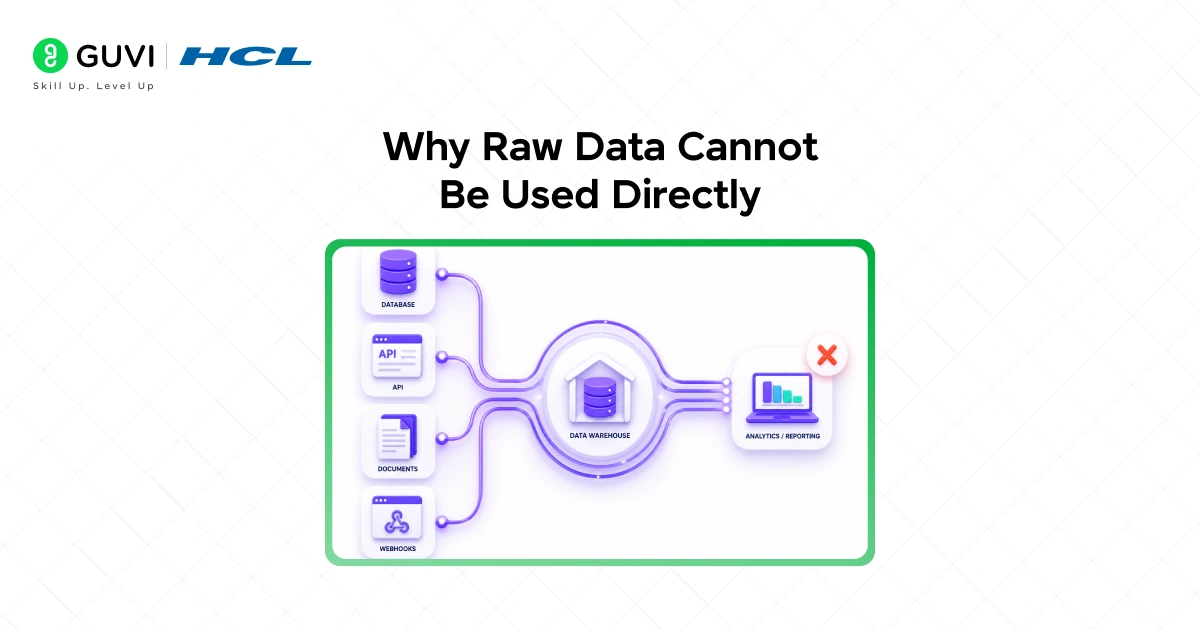
- Raw data contains too many dimensions
A single color image that is 1000×1000 pixels contains three million individual values. Training a machine learning model on three million input features is computationally impossible for most applications. Feature extraction reduces this to hundreds or thousands of meaningful features.
- Most information in raw data is noise
Raw sensor data, audio recordings, and text documents contain measurement errors, background noise, and irrelevant details. Feature extraction filters out noise and extracts only the relevant signal, improving model accuracy.
- Raw data does not highlight what matters
Individual pixel brightness values tell you nothing meaningful about what object is in an image. Raw data is too low-level. Features represent higher-level concepts like edges, shapes, textures, or topics that actually correlate with what you are trying to predict.
- Curse of dimensionality makes learning impossible
As the number of dimensions increases, the amount of data needed to learn reliable patterns grows exponentially. With millions of raw input dimensions, you would need impossibly large datasets. Feature extraction reduces dimensions to levels where learning is actually possible.
- Computational cost becomes prohibitive
Training models on high-dimensional raw data requires enormous memory and processing time. Feature extraction makes training and prediction fast enough for practical use by working with compact feature representations instead of massive raw data.
Read More: Introduction To Machine Learning: A Comprehensive Guide

How Feature Extraction Works: The Core Process

Step 1: Start with high-dimensional raw data
You begin with your original data in its raw form. This might be images as pixel arrays, audio as waveform samples, text as character sequences, or sensor readings as time series. This raw data typically has hundreds, thousands, or even millions of dimensions.
Step 2: Identify relevant characteristics for your task
Determine what aspects of the data actually matter for your specific problem. For face recognition, facial features matter but background details do not. For spam detection, certain word patterns matter but most words do not. This step requires understanding both your data and your problem.
Step 3: Apply transformation to extract those characteristics
Use mathematical transformations to compute features that capture the relevant characteristics. This might mean detecting edges in images, counting word frequencies in text, or extracting statistical properties from time series. The transformation produces a feature vector with far fewer dimensions than the raw data.
Step 4: Create compact feature representation
The output is a feature vector, a list of numbers where each number represents a specific characteristic. A feature vector might have 100 or 1000 dimensions instead of the millions in raw data. This compact representation contains the essential information while discarding redundant details.
Step 5: Feed features into machine learning models
[In-article image 3: The infographic should depict the heading title. Have an illustration depicting the below 5 types as creative icons representing them]
Machine learning algorithms work on the extracted features instead of raw data. The reduced dimensionality makes training faster and requires less data. The meaningful features make patterns easier to learn.
Before the rise of deep learning, feature extraction in fields like computer vision was almost entirely a manual process. Researchers spent years designing handcrafted features such as SIFT, SURF, and HOG to capture edges, textures, shapes, and other visual patterns that machine learning algorithms could use. Modern deep neural networks revolutionized this process by automatically learning useful features directly from raw data during training. However, handcrafted feature engineering remains valuable in applications with limited data, strict computational constraints, or requirements for greater interpretability, proving that traditional techniques still have an important place alongside deep learning.
Types of Feature Extraction Techniques
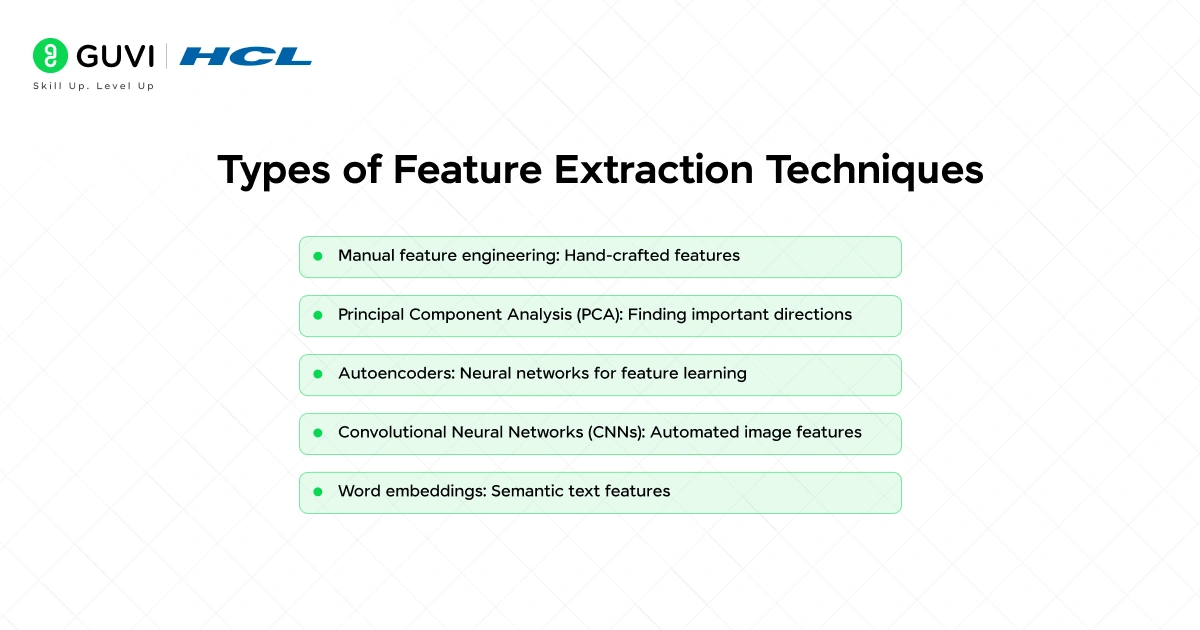
- Manual feature engineering: Hand-crafted features
Manual feature engineering involves humans deciding which characteristics to extract based on domain knowledge. For images, you might extract color histograms, edge directions, or texture patterns. For text, you might count word frequencies or identify specific keywords. This approach requires expertise but produces interpretable features.
- Principal Component Analysis (PCA): Finding important directions
PCA is a dimensionality reduction technique that finds the directions of maximum variance in your data. It transforms your original features into a smaller set of uncorrelated components ordered by importance. You keep the top components that capture most of the variance and discard the rest.
- Autoencoders: Neural networks for feature learning
Autoencoders are neural networks trained to compress data into a lower-dimensional representation then reconstruct the original data. The compressed middle layer becomes your feature vector. The network learns to preserve the most important information during compression.
- Convolutional Neural Networks (CNNs): Automated image features
CNNs learn hierarchical features from images through multiple layers. Early layers detect simple patterns like edges. Deep layers recognize object parts and whole objects. You can use any layer’s outputs as features for other tasks. CNN features dramatically outperform hand-crafted image features for most vision tasks.
- Word embeddings: Semantic text features
Word embeddings like Word2Vec and GloVe transform words into dense vector representations where semantically similar words have similar vectors. These embeddings capture word meaning and relationships in a compact numerical form, replacing sparse encodings with rich semantic representations.
Feature Extraction for Different Data Types
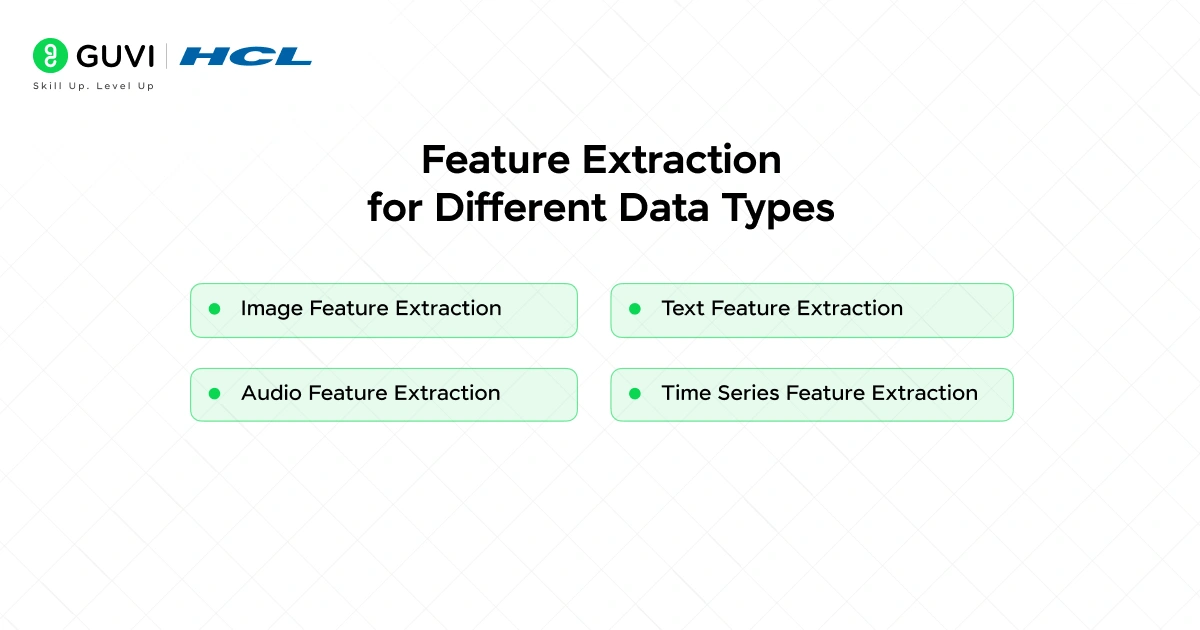
- Image Feature Extraction
For images, hand-crafted approaches include color histograms, edge detection, texture descriptors, and shape features. For learned features, use pre-trained CNNs like ResNet or VGG. Feed your images through the network and extract activations from intermediate layers. Early layers give low-level features like edges. Deep layers give high-level features like object parts.
- Text Feature Extraction
For text, the simplest approach is bag-of-words, counting how often each word appears. TF-IDF weights words by how distinctive they are. For semantic understanding, use word embeddings that represent words as dense vectors. For more sophisticated approaches, use transformer models like BERT that generate context-aware embeddings.
- Audio Feature Extraction
For audio, extract spectral features by converting the waveform to the frequency domain. MFCCs are standard for speech recognition. Spectrograms represent how frequency content changes over time. For deep learning approaches, train CNNs on spectrograms or use recurrent networks on raw waveforms.
- Time Series Feature Extraction
For time series, extract statistical features including mean, variance, and trends over windows. Frequency domain features from Fourier transforms reveal periodic patterns. For deep learning, use LSTMs or transformers that automatically learn temporal features from raw sequences.
The ImageNet Large Scale Visual Recognition Challenge (ILSVRC) played a pivotal role in demonstrating the power of automatic feature learning. Before deep learning became dominant, top-performing computer vision systems relied heavily on carefully engineered, hand-crafted features and still produced relatively high error rates. The breakthrough came in 2012 when deep convolutional neural networks dramatically improved performance by learning features directly from data. Within just a few years, advances in CNN architectures reduced ImageNet classification error rates to levels that rivaled and even surpassed human performance on the benchmark. This success showed that learned representations could outperform decades of manual feature engineering and helped ignite the modern deep learning revolution.
How to Implement Feature Extraction: Step-by-Step Process

Step 1: Understand Your Data and Problem
Before extracting any features, thoroughly examine your raw data. Understand what each dimension represents. Identify which aspects likely correlate with what you are trying to predict. Clear problem understanding guides feature selection.
Step 2: Start With Simple Baseline Features
Begin with the simplest reasonable features for your data type. Train a simple model on these baseline features to establish minimum performance. This baseline helps you evaluate whether more complex feature extraction actually helps.
Step 3: Apply Domain-Specific Feature Engineering
Use your understanding of the domain to engineer meaningful features. Domain features often outperform generic automated extraction because they leverage specific knowledge about what matters in your problem.
Step 4: Use Dimensionality Reduction When Needed
If you have hundreds or thousands of features, apply dimensionality reduction. Use PCA for linear reduction, autoencoders for nonlinear reduction, or feature selection methods. Aim for the smallest feature set that maintains good performance.
Step 5: Implement Automated Feature Learning
For complex data like images or audio, use deep learning to automatically learn features. Use pre-trained models when possible. Fine-tune on your specific task. Automated learning often discovers patterns humans would never hand-craft.
Step 6: Validate Features Improve Performance
Compare model performance using different feature sets. If complex feature extraction does not beat simple approaches, use the simpler method. Feature extraction should provide measurable benefit.
Step 7: Optimize Feature Extraction for Production
Consider computational cost when deploying your system. Complex feature extraction might be too slow for real-time applications. Optimize feature computation or compute features offline when possible.
Real-World Applications of Feature Extraction
- Medical imaging: Extracting diagnostic features
Feature extraction identifies characteristics like tumor size, shape irregularity, and tissue density patterns from MRI or CT scans. These features help diagnose diseases and predict treatment outcomes. Automated feature extraction from medical images saves time and improves diagnostic consistency.
- Fraud detection: Identifying suspicious patterns
Feature extraction creates meaningful indicators like transaction frequency patterns, spending deviations from normal behavior, and geographic patterns. These features make fraudulent transactions distinguishable from legitimate ones, enabling real-time fraud detection.
- Recommendation systems: Understanding user preferences
Feature extraction creates user profiles capturing preferences, interests, and seasonal patterns. Item features describe product characteristics and popularity trends. These features power personalized recommendations.
To learn more about feature extraction and machine learning implementation, do not miss the chance to enroll in this HCL GUVI’s AI and Machine Learning course covering machine learning fundamentals, feature engineering, deep learning, and practical implementation through hands-on projects and expert guidance with certification.
Conclusion
Feature extraction transforms raw data into meaningful representations that machine learning models can actually use. It reduces dimensionality, removes noise, and highlights the information that matters for your specific task. Without feature extraction, machine learning on complex real-world data would be computationally impossible.
The best approach depends on your data type, problem complexity, and available resources. Simple problems may only need basic statistical features. Complex problems like image recognition benefit from deep learning that automatically discovers features. Most real-world applications combine domain knowledge with automated learning.
Feature extraction is not a one-time step but an iterative process. You extract features, evaluate performance, and refine your approach. The quality of your features often matters more than your choice of machine learning algorithm.
FAQs
1. What is the difference between feature extraction and feature selection?
Feature extraction creates new features by transforming raw data, reducing dimensions while preserving important information. Feature selection chooses a subset of existing features without transformation. Extraction creates representations, selection picks from what already exists.
2. When should I use PCA for feature extraction?
Use PCA when you have many correlated features and want unsupervised linear dimensionality reduction. Avoid PCA when features have important nonlinear relationships or when you need interpretable features, since PCA components are mathematical combinations hard to interpret.
3. How do I know how many features to extract?
Plot validation accuracy versus number of features. Keep features until performance plateaus. Use techniques like PCA variance explained or feature importance scores to guide decisions. The right number balances model performance against computational cost.
4. Can deep learning completely replace manual feature extraction?
For large datasets and complex data like images or audio, deep learning often outperforms manual features. However, manual features still excel with limited data, when you need interpretability, or when domain knowledge provides clear guidance.
5. What are the most common mistakes in feature extraction?
The biggest mistakes are extracting features without understanding your problem, using overly complex methods when simple features work, not validating that features actually improve performance, and including too many redundant features that cause overfitting.
Success Stories

About the Author
Vishalini Devarajan
An Aerospace Engineer turned content writer, I focus on making complex concepts easy to understand through well-structured, reader-friendly blogs. Whether it’s a technical topic or a non-technical one, I love creating content that is clear, engaging, and impactful.
View all posts by Vishalini Devarajan
Connect with me @















Did you enjoy this article?