


Uncategorised Articles
Q-Learning Explained: A Beginner's Guide
Claude for Code Documentation with JSDoc


Get In Touch For Details! Request More Information

Claude for Language Learning: Practice Conversations
Aug 17, 2026 3 Min Read 458 Views
(Last Updated)
Claude can be used for language learning by having a back and forth conversation in the language you are practicing, where Claude responds naturally, corrects mistakes when asked, and explains grammar or vocabulary as needed. Learners can set the scenario, such as ordering food or asking for directions, and practice at their own pace without the pressure of talking to a real person. It works best as a supplement to real practice with people, not as a full replacement for it.
Table of contents
- TL;DR
- Why People Use Claude to Practice a New Language
- How to Set Up a Language Practice Conversation with Claude
- Using Claude for Different Language Skills
- Tips for Better Language Practice with Claude
- Common Mistakes to Avoid
- Where Claude Cannot Replace Real Practice
- Key Takeaways
- Conclusion
- FAQs
- Can Claude help me practice speaking a new language?
- Will Claude correct my mistakes automatically?
- Can I set my own difficulty level for practice?
- Is Claude a replacement for talking to a real native speaker?
- Can Claude help with reading and listening skills too?
TL;DR
- Claude can act as a conversation partner for practicing a new language in a low pressure setting.
- It works well for holding basic conversations, correcting mistakes, and explaining grammar in the moment.
- Learners can set the difficulty level and topic themselves, which makes practice feel more relevant.
- It does not replace real human conversation practice, but it fills the gap when a native speaker or tutor is not available.
- Used consistently, it helps build comfort speaking or writing a language before using it in real situations.
Learners who want to explore more structured ways of using AI tools for skill building can look into HCL GUVI’s Artificial Intelligence & Machine Learning Course, which covers practical prompting techniques beyond simple back and forth chat.
Why People Use Claude to Practice a New Language

Practicing a new language out loud or in writing with another person can feel intimidating, especially in the early stages when mistakes happen often. Claude removes that pressure since there is no judgment involved, which makes it easier to just try speaking or writing without worrying about how it sounds.
It is also available whenever a learner wants to practice, without needing to schedule time with a tutor or a language partner, which makes consistent practice easier to keep up with.
Read More: Claude Skills Made Simple: Create Your First Skill in Minutes
How to Set Up a Language Practice Conversation with Claude
- Choosing a Scenario
A good starting point is picking a specific situation to practice, like ordering coffee, checking into a hotel, or making small talk with a coworker. Giving Claude this context helps it respond the way a real person would in that situation instead of giving generic sentences.
- Setting the Difficulty Level
Learners can tell Claude their current level, such as beginner or intermediate, and ask it to keep vocabulary and sentence structure appropriate for that level. This keeps the conversation challenging without being overwhelming.
- Asking for Corrections
During or after the conversation, learners can ask Claude to point out any mistakes they made, explain why something was wrong, and show the corrected version. This turns the conversation into a learning moment instead of just a chat.
Switching between just chatting and asking for corrections works better than asking for corrections after every single sentence, since constant interruption can break the natural flow that makes conversation practice useful in the first place.
Using Claude for Different Language Skills
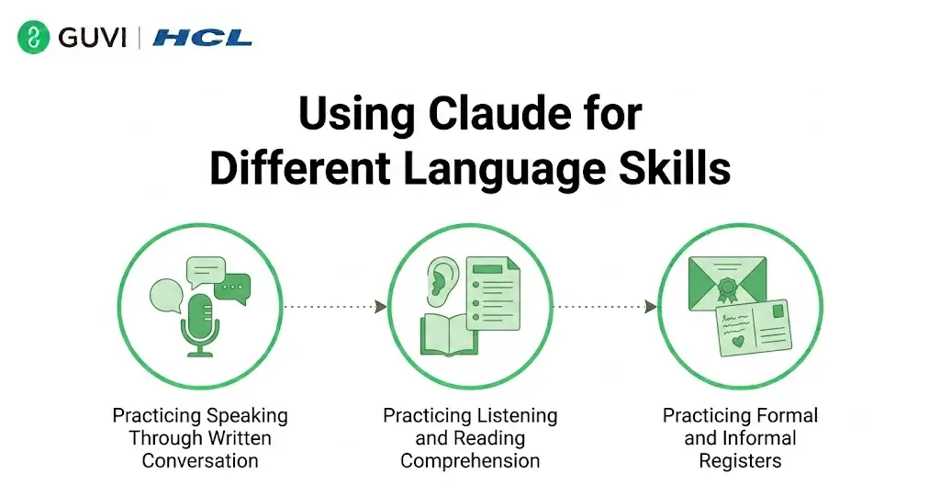
- Practicing Speaking Through Written Conversation
Even though the conversation happens in text, practicing sentence construction and vocabulary recall in real time still builds skills that carry over to speaking, especially for learners still building confidence with basic sentence patterns.
- Practicing Listening and Reading Comprehension
Learners can ask Claude to write short passages or dialogues at their level and then answer comprehension questions about them, which helps build reading and listening skills alongside conversation practice.
- Practicing Formal and Informal Registers
Claude can also help learners understand the difference between formal and casual ways of speaking, which is useful for languages where tone changes significantly based on who you are talking to.
Language researchers have found that repeating the same practice scenario multiple times, rather than always switching to something new, actually speeds up recall of vocabulary and sentence patterns, which is part of why practicing the same conversation with Claude more than once works so well.

Tips for Better Language Practice with Claude
- Set the scenario and your level clearly at the start of the conversation.
- Ask for corrections in batches rather than after every message, so the conversation still feels natural.
- Ask Claude to explain grammar rules in simple terms rather than just giving the correct answer.
- Practice the same scenario more than once to build comfort before moving to a new one.
Common Mistakes to Avoid
- Asking for a correction after every single sentence, which breaks the flow of the conversation.
- Practicing only reading and writing without also trying to speak the language out loud separately.
- Sticking to only one type of scenario instead of practicing a range of everyday situations.
- Treating Claude as a full replacement for real conversation practice with people who speak the language.
Where Claude Cannot Replace Real Practice
Claude does not have the same unpredictability, accent variation, or cultural nuance that comes from talking to real speakers of a language. It also cannot judge pronunciation the way a person listening to you speak out loud can.
For learners working toward fluency, Claude works best as regular practice in between real conversations with people, not as the only source of practice.
Key Takeaways
- Claude works well as a low pressure conversation partner for practicing a new language.
- Setting a clear scenario and skill level makes practice sessions more useful.
- Asking for corrections in batches keeps the conversation natural while still building accuracy.
- It should be used alongside real human conversation practice, not as a full replacement for it.
Conclusion
Claude gives language learners a way to practice conversations without the pressure that often comes with speaking to another person, especially in the early stages of learning. It works well for building vocabulary, sentence structure, and confidence through repeated practice at a learner’s own pace. It still works best alongside real conversations with people, since that is where the unpredictability and nuance of an actual language really comes through.
FAQs
1. Can Claude help me practice speaking a new language?
Yes, practice happens through text conversation, which still builds vocabulary and sentence structure skills that carry over to speaking.
2. Will Claude correct my mistakes automatically?
Not unless asked, so learners usually need to request corrections during or after the conversation.
3. Can I set my own difficulty level for practice?
Yes, telling Claude your current level helps it adjust vocabulary and sentence complexity to match.
4. Is Claude a replacement for talking to a real native speaker?
No, it works best as regular practice alongside real conversations with people who speak the language.
5. Can Claude help with reading and listening skills too?
Yes, it can create short passages or dialogues at your level along with comprehension questions to practice those skills.
Success Stories

About the Author
Vishalini Devarajan
An Aerospace Engineer turned content writer, I focus on making complex concepts easy to understand through well-structured, reader-friendly blogs. Whether it’s a technical topic or a non-technical one, I love creating content that is clear, engaging, and impactful.
View all posts by Vishalini Devarajan
Connect with me @















Did you enjoy this article?