


Roadmap Articles
Angular Roadmap: Best Guide for Beginners in 2026
Embedded Systems Roadmap: Best Guide for Beginners in 2026
TypeScript Roadmap 2026: Complete Beginner to Advanced Guide
C++ Developer Roadmap 2026: Complete Beginner to Advanced Guide


Get In Touch For Details! Request More Information
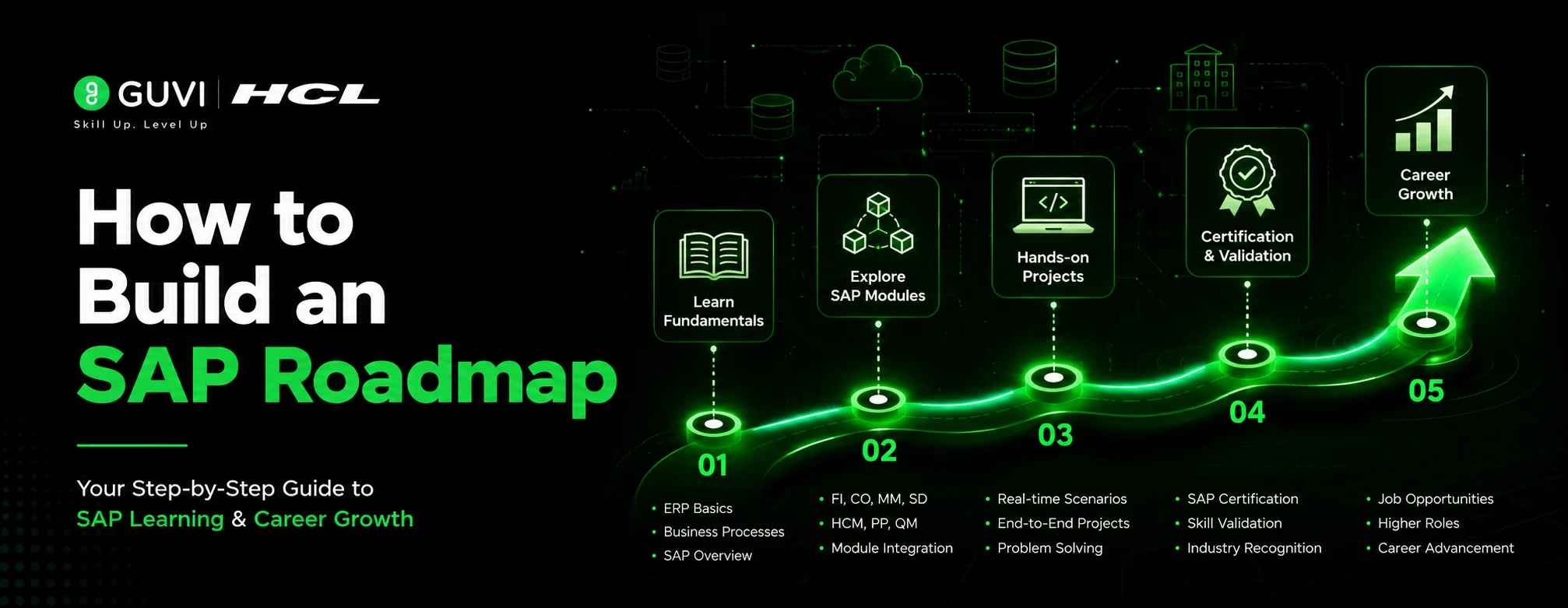
Table of contents
- What Is an SAP Roadmap?
- TL;DR:
- Why an SAP Roadmap Matters in 2026
- Real-World SAP Roadmap Example
- The Challenge
- The Roadmap Decision
- The Phased Approach
- The Outcomes
- The 7 Core Phases of an SAP Roadmap
- Phase 1: Discovery & Current State Assessment
- Phase 2: Strategy & Future Vision
- Phase 3: Architecture & Solution Design
- Phase 4: Business Case & Funding Approval
- Phase 5: Implementation Planning
- Phase 6: Build, Configure & Test
- Phase 7: Go-Live, Stabilization & Hypercare
- SAP S/4HANA Roadmap: What's New in 2026?
- SAP Activate Methodology: Phase-by-Phase Breakdown
- Phase 1: Discover
- Phase 2: Prepare
- Phase 3: Explore
- Phase 4: Realize
- Phase 5: Deploy
- Phase 6: Run
- Industry-Specific SAP Roadmap Considerations
- Manufacturing
- Retail & Consumer Goods
- Utilities & Energy
- Healthcare & Life Sciences
- Financial Services
- SAP Roadmap vs. SAP Implementation Plan
- SAP Roadmap Template: What Should It Include?
- SAP Roadmap Tools and Resources
- Common SAP Roadmap Mistakes to Avoid
- Conclusion
What Is an SAP Roadmap?
An SAP Roadmap is a structured, long-term strategic plan that outlines how an organization will adopt, upgrade, migrate, or expand its SAP ecosystem over time.
It answers three critical questions:
- Where are you now? (Current SAP landscape assessment)
- Where do you want to go? (Target architecture and business goals)
- How will you get there? (Phases, timelines, resources, and milestones)
An SAP Roadmap is not a single document; it is a living plan that evolves with your business, SAP product releases, and regulatory requirements.
TL;DR:
An SAP Roadmap is a step-by-step strategic plan that helps companies migrate from legacy SAP systems, such as ECC, to modern platforms like SAP S/4HANA. In 2026, roadmap planning is critical because SAP ECC support is ending by 2030, pushing organizations to modernize faster.
A complete SAP Roadmap usually follows 7 phases:
- Discovery & Assessment: Audit current SAP systems, integrations, custom code, and data quality
- Strategy & Vision: Choose Greenfield, Brownfield, or Bluefield migration approach
- Architecture & Design: Define target cloud/on-prem architecture, integrations, and security
- Business Case & Funding: Build ROI, TCO, and transformation budget approval
- Implementation Planning: Select partners, governance, testing, and cutover strategy
- Build & Testing: Configure S/4HANA, migrate data, run UAT, and train users
- Go-Live & Hypercare: Launch production system, stabilize operations, and transition to BAU support
Key 2026 SAP trends include:
- AI-powered automation through Joule
- Stronger Clean Core requirements
- Heavy adoption of RISE with SAP
- Expansion of SAP BTP for integrations and extensions
- Industry-specific cloud solutions
Companies with a clear SAP Roadmap reduce migration risk, control costs, improve adoption, and accelerate digital transformation success.
Why an SAP Roadmap Matters in 2026
SAP has officially set 2027 as the end-of-mainstream maintenance deadline for SAP ECC, now extended to 2030 with extended support. This makes roadmap planning more urgent than ever for thousands of companies still running legacy SAP systems.
Without a roadmap, organizations risk:
- Unplanned downtime during rushed migrations
- Cost overruns from poor scoping
- Failed go-lives due to insufficient change management
- Compliance gaps if regulatory-mandated upgrades are skipped
- Loss of competitive advantage from delayed digital transformation
A well-built SAP Roadmap is your single most important tool for de-risking enterprise transformation.
Real-World SAP Roadmap Example
Scenario: Mid-market manufacturing company, 800 employees, running SAP ECC 6.0 since 2009.
The Challenge
A European industrial equipment manufacturer with operations in 4 countries had been running SAP ECC with heavy customization, over 2,400 custom ABAP objects. With SAP’s 2030 deadline approaching and a new CFO demanding better financial reporting, the board mandated an S/4HANA migration.
The Roadmap Decision
After a 10-week Discovery phase, their SAP Readiness Check revealed that 38% of custom objects were either redundant or replaceable by standard S/4HANA functionality.
They chose a Selective Data Transition (Bluefield) approach, migrating open transactions and active master data, while leaving historical data in a decommissioned archive system.
The Phased Approach
| Wave | Scope | Timeline | Rationale |
| Wave 1 | Finance (FI/CO) + Procurement (MM) | Months 1–14 | Highest business priority, cleanest data |
| Wave 2 | Finance (FI/CO) + Procurement (MM) | Months 12–22 | Complex; runs parallel to Wave 1 stabilization |
| Wave 3 | Manufacturing (PP/QM) + Plant Maintenance (PM) | Months 20–30 | Most complex, highest customization |
The Outcomes
- Month-end financial close reduced from 8 days to 3 days
- Custom object count reduced from 2,400 to 610, a 75% reduction
- Total project cost came in at €4.2M, 8% under budget
- Go-live achieved with zero critical incidents during hypercare
The single biggest lesson: The company invested €180,000 in data cleansing before the project started. Their project manager credited this decision with saving at least 3 months of schedule slippage and €400,000 in rework costs.
The 7 Core Phases of an SAP Roadmap
Direct Answer: An SAP Roadmap typically follows 7 phases:
(1) Discovery & Assessment,
(2) Strategy & Vision,
(3) Architecture & Design,
(4) Business Case & Funding,
(5) Implementation Planning,
(6) Build & Test, and
(7) Go-Live & Stabilization. Each phase has defined outputs, owners, and entry/exit criteria.
Phase 1: Discovery & Current State Assessment
Before planning where you’re going, you must deeply understand where you are.
What happens in this phase:
- Inventory your current SAP systems (ECC, BW, CRM, SRM, etc.)
- Identify customizations, interfaces, and third-party integrations
- Assess technical debt and technical risks
- Map current business processes to SAP modules
- Evaluate data quality and master data governance
- Identify regulatory and compliance obligations
Key outputs:
- Current landscape diagram
- Custom code volume analysis
- Interface inventory
- Data quality assessment report
Common mistake to avoid: Skipping or rushing discovery is the #1 cause of SAP project failures. Budget adequate time, typically 6–12 weeks for mid-size enterprises.
Phase 1 Readiness Checklist:
- SAP Readiness Check completed and results reviewed
- Custom code volume and complexity scored
- Interface and integration inventory documented
- Current system landscape diagram created
- Key stakeholders identified and interviewed
- Data quality baseline assessment completed
- Regulatory and compliance obligations catalogued
Phase 2: Strategy & Future Vision
This is where business and IT leadership align on the “North Star” of the transformation.
What happens in this phase:
- Define target architecture (e.g., SAP S/4HANA Private Cloud, Public Cloud, or Hybrid)
- Choose deployment model: Greenfield, Brownfield, or Selective Data Transition (Bluefield)
- Align SAP strategy with enterprise digital transformation goals
- Benchmark against industry peers and best practices
- Engage SAP account team for product roadmap alignment
Greenfield vs. Brownfield vs. Bluefield: What’s the Difference?
| Approach | What It Means | Best For |
| Greenfield | Start fresh, reimplementing SAP from scratch on S/4HANA | Companies wanting a clean slate and a full process redesign |
| Brownfield | In-place conversion, migrate existing ECC to S/4HANA | Companies want speed and continuity |
| Bluefield / Selective Data Transition | Hybrid, selectively migrate data and processes | Companies with complex, heterogeneous landscapes |
Phase 2 Readiness Checklist:
- Deployment model decided: Greenfield / Brownfield / Bluefield
- Cloud strategy defined: RISE / Private Cloud / On-Premise
- Target system landscape approved by IT leadership
- SAP product roadmap reviewed with SAP account team
- Executive sponsor confirmed and committed
- Transformation vision statement approved
Phase 3: Architecture & Solution Design
The technical blueprint of your SAP future.
What happens in this phase:
- Design the target system landscape (SID strategy, clients, transport routes)
- Define integration architecture (SAP BTP, middleware, APIs)
- Plan SAP RISE adoption if applicable
- Design security, authorization, and access control frameworks
- Define reporting and analytics architecture (SAP Analytics Cloud, BW/4HANA)
- Address extensibility strategy (side-by-side vs. in-app extensions)
Key tool in this phase: SAP’s own Business Transformation Center (BTC) and Readiness Check tools help assess custom code compatibility and simplification item relevance before committing to a design.
Phase 3 Readiness Checklist:
- Target architecture document signed off
- Integration architecture designed and approved
- Security and authorization concept drafted
- Clean core extensibility strategy defined
- Reporting and analytics architecture confirmed
- SAP BTP integration points identified
Phase 4: Business Case & Funding Approval
An SAP transformation is a multi-million-dollar investment. You need a bulletproof business case.
What your business case must include:
- Total Cost of Ownership (TCO): License, implementation, infrastructure, training, support
- Return on Investment (ROI): Process efficiency gains, headcount optimization, reporting speed
- Risk Cost of Inaction: Cost of staying on unsupported ECC systems
- Phased investment model: Avoiding one-time capital shock
- Benchmark data: Use SAP’s Value Lifecycle Manager (VLM) or third-party benchmarks
Stat to know: According to SAP benchmarks, organizations that fully migrate to SAP S/4HANA report an average 17% reduction in operational costs and a 2x improvement in finance close cycles.
Phase 4 Readiness Checklist:
- TCO model completed for 5-year horizon
- ROI calculation reviewed by Finance
- The risk cost of inaction is documented
- Funding request submitted and approved
- Implementation partner shortlist created
Phase 5: Implementation Planning
This is where your roadmap becomes a project plan.
Key planning decisions:
- Choose your system integrator (SI) or implementation partner
- Define project governance structure (Steering Committee, Project Board, Workstreams)
- Build your project charter and RACI matrix
- Define your sprint cadence (for agile delivery) or phase gates (for waterfall)
- Plan your testing strategy: Unit → Integration → UAT → Regression → Performance
- Define your cutover strategy and data migration approach
- Build a change management and training plan
SAP Activate Methodology: SAP recommends using its SAP Activate methodology for all S/4HANA implementations, a prescriptive, agile-aligned framework consisting of six phases: Discover → Prepare → Explore → Realize → Deploy → Run.
Phase 5 Readiness Checklist:
- System integrator selected and contracted
- Project governance structure established
- RACI matrix completed and communicated
- Project charter signed by steering committee
- Testing strategy and environments planned
- Change management and training plan drafted
- Cutover strategy and approach documented
Phase 6: Build, Configure & Test
The longest phase, where design becomes reality.
What happens in this phase:
- Configure SAP S/4HANA using Best Practice content or custom configuration
- Develop custom code, reports, forms, and enhancements
- Build and test integrations with third-party systems
- Execute data migration dry runs (typically 3+ rounds)
- Conduct user acceptance testing (UAT) with business key users
- Conduct performance and stress testing
- Train end users and super users
Critical success factor: Establish a Cutover Command Center before go-live. Every hour of unplanned downtime during cutover can cost enterprise organizations $50,000–$500,000+.
Phase 6 Readiness Checklist:
- Configuration complete for all in-scope modules
- Custom development complete and unit tested
- Integration testing completed, all interfaces passing
- Data migration dress rehearsal 1 and 2 complete
- UAT signed off by business key users
- Performance testing completed under load
- End-user training delivered to all user groups
- Cutover dress rehearsal completed
Phase 7: Go-Live, Stabilization & Hypercare
Go-live is not the finish line, it’s the starting line for adoption.
What a successful go-live looks like:
- Phased or Big Bang cutover execution
- Hypercare period (typically 4–8 weeks post go-live)
- Dedicated support team available 24/7 in hypercare
- KPI tracking against baseline measurements
- Rapid incident management and resolution
- Transition to BAU (Business-as-Usual) SAP support team
Phase 7 Readiness Checklist:
- Go / No-Go criteria reviewed and approved by the steering committee
- Hypercare team rostered and on call
- Monitoring dashboards and alerting are configured
- Rollback decision criteria documented
- Post-go-live KPIs baselined and tracked
- Lessons learned session scheduled
Ready to Move from ECC to S/4HANA? Don’t let the 2030 deadline catch you off guard. Learn how to plan, build, and execute a successful SAP S/4HANA implementation, from discovery to go-live. Enroll in HCL GUVI SAP S/4HANA Course.

SAP S/4HANA Roadmap: What’s New in 2026?
Direct Answer: SAP S/4HANA’s 2026 roadmap focuses on five themes: embedded AI via Joule, expanded SAP BTP integration, RISE with SAP cloud adoption acceleration, industry cloud solutions by sector, and enhanced clean core extensibility standards.
Key SAP product roadmap highlights for 2026:
- Joule AI Copilot: Embedded across Finance, HR, Procurement, and Supply Chain, automating repetitive tasks and surfacing insights in natural language
- Clean Core Strategy: SAP is enforcing stricter clean core principles, pushing customizations to BTP side-by-side extensions
- SAP BTP Expansion: SAP Business Technology Platform is becoming the central integration, automation, and extensibility hub for all S/4HANA customers
- Industry Cloud: Pre-built, cloud-native industry solutions for Retail, Manufacturing, Utilities, Healthcare, and more, significantly reducing implementation timelines
- RISE with SAP: The bundled cloud ERP migration program continues to be SAP’s preferred path for ECC customers moving to S/4HANA Cloud
SAP Activate Methodology: Phase-by-Phase Breakdown
SAP Activate is SAP’s official, agile-aligned implementation methodology for S/4HANA. Understanding it is essential for anyone building or executing an SAP Roadmap.
Direct Answer: SAP Activate consists of six phases: Discover, Prepare, Explore, Realize, Deploy, and Run. Each phase has defined inputs, outputs, and quality gate criteria. It replaces the older ASAP methodology and is optimized for cloud and agile delivery.
Phase 1: Discover
Goal: Understand the SAP solution, validate the business case, and align stakeholders.
- Access SAP Best Practice content in the SAP Activate Roadmap Viewer
- Run SAP Readiness Check to identify custom code and simplification impacts
- Complete a fit-to-standard analysis using SAP Best Practice scope items
- Validate technical and functional feasibility
Key output: Approved project charter and scope statement
Phase 2: Prepare
Goal: Set up the project, team, and governance structures.
- Establish project governance (Steering Committee, workstream leads, RACI)
- Set up system environments (Development, Quality, Production)
- Onboard the implementation team and begin change management
Key output: Project infrastructure ready; kickoff complete
Phase 3: Explore
Goal: Validate the solution design using fit-to-standard workshops.
- Run fit-to-standard workshops with business process owners for every in-scope module
- Document configuration decisions and delta design requirements
- Identify and scope custom development needs
- Lock scope, this is your scope freeze gate
Key output: Confirmed solution design document; agreed scope baseline
Phase 4: Realize
Goal: Build, configure, and test the solution.
- Configure the system based on the Explore phase decisions
- Develop custom objects, reports, forms, and integrations
- Execute iterative sprint-based build cycles with continuous testing
- Execute data migration dry runs (minimum 3 rounds)
- Deliver end-user training
Key output: Tested, trained, and data-validated system ready for UAT
Phase 5: Deploy
Goal: Prepare for and execute go-live.
- Complete user acceptance testing (UAT) sign-off
- Execute final cutover rehearsal
- Complete a go / no-go assessment with the steering committee
- Execute production cutover; activate hypercare support
Key output: Live production system; hypercare period begins
Phase 6: Run
Goal: Stabilize operations and transition to business-as-usual.
- Resolve outstanding incidents from hypercare
- Transition to the BAU support team
- Conduct a lessons learned workshop
- Begin continuous improvement and optimization of the backlog
Key output: Stable BAU operations; roadmap updated for next phase
Industry-Specific SAP Roadmap Considerations
An SAP Roadmap is not one-size-fits-all. Strategic priorities, compliance requirements, and module footprints vary significantly by industry.
Manufacturing
- Priority modules: PP (Production Planning), QM (Quality Management), PM (Plant Maintenance), EWM (Extended Warehouse Management)
- Key consideration: IoT integration with SAP Digital Manufacturing is a growing roadmap priority for smart factory initiatives
- Roadmap tip: Manufacturing companies tend to have the highest custom code volumes due to MES integrations. Budget significant time for custom code remediation
Retail & Consumer Goods
- Priority modules: SD (Sales & Distribution), MM (Materials Management), IBP (Integrated Business Planning), CAR (Customer Activity Repository)
- Key consideration: Omnichannel and e-commerce integration with SAP Commerce Cloud is increasingly critical
- Roadmap tip: Seasonal trading peaks create hard go-live blackout windows. Plan your cutover calendar around trading calendars
Utilities & Energy
- Priority modules: IS-U (Industry Solution Utilities), PM, FICO, and SAP S/4HANA Utilities
- Key consideration: The IS-U to S/4HANA Utilities migration path is specialized; not all brownfield conversion tools apply
- Roadmap tip: Utilities projects typically take longer due to extremely high data volumes in billing and metering, and data migration is almost always on the critical path
Healthcare & Life Sciences
- Priority modules: MM, FICO, PM, QM, and GxP compliance configuration
- Key consideration: FDA 21 CFR Part 11, GMP, and GAMP5 validation requirements apply to SAP system validation. This adds 20–30% to testing timelines
- Roadmap tip: Build your validation master plan before the Realize phase begins, not as an afterthought after configuration is complete
Financial Services
- Priority modules: FI, CO, TR (Treasury), FSCM (Financial Supply Chain Management), and regulatory reporting
- Key consideration: IFRS 9, IFRS 17 (insurance), Basel IV (banking), and local GAAP compliance requirements heavily influence FI configuration and reporting design
- Roadmap tip: Financial services organizations typically have the most complex integration landscapes, and integration architecture deserves disproportionate planning investment
SAP Roadmap vs. SAP Implementation Plan
Direct Answer: An SAP Roadmap is a strategic, multi-year vision document that defines what to build and when, while an SAP Implementation Plan is the tactical, project-level document that defines how to build it. The roadmap drives the implementation plan, not the other way around.
| SAP Roadmap | SAP Implementation Plan | |
| Time horizon | 3–5 years | 6–18 months |
| Audience | C-suite, Board, IT Leadership | Project team, workstream leads |
| Level of detail | Strategic, high-level | Tactical, detailed tasks |
| Owned by | CIO / Transformation Lead | SAP Project Manager |
| Updated | Annually or at major milestones | Weekly / Sprint-by-sprint |
SAP Roadmap Template: What Should It Include?
A practical SAP Roadmap document should cover these eight components:
1. Executive Summary: Vision statement, strategic objectives, and top 3 business drivers for SAP transformation
2. Current State Summary: SAP landscape overview, key pain points, and custom code complexity score
3. Target State Architecture: Target SAP product landscape diagram, deployment model decision, and integration architecture overview
4. Transformation Approach: Greenfield / Brownfield / Bluefield decision with rationale, chosen methodology, and system integrator selection criteria
5. Phased Roadmap Timeline: Multi-year Gantt chart or swim-lane timeline with phase-by-phase milestones, deliverables, and critical path
6. Resource & Investment Plan: Headcount (internal + external), budget by phase, and license and infrastructure cost projections
7. Risk Register: Top 10 risks with likelihood/impact matrix and mitigation strategy per risk
8. Governance Model: Steering committee composition, escalation paths, and decision-making RACI
SAP Roadmap Tools and Resources
SAP-provided tools:
- SAP Readiness Check: Free tool to assess ECC-to-S/4HANA conversion readiness
- SAP Business Transformation Center (BTC): Custom code and process impact analysis
- SAP Value Lifecycle Manager (VLM): ROI and business case modeling
- SAP Activate Roadmap Viewer: Interactive methodology guide and accelerator library
- SAP for Me: Customer portal for licenses, support, and product roadmap access
Third-party and complementary tools:
- LeanIX: IT landscape and enterprise architecture management
- Signavio: Business process intelligence and mining
- Celonis: Process mining to identify inefficiencies before SAP transformation
- Tricentis: SAP test automation and risk-based testing
Common SAP Roadmap Mistakes to Avoid
- Skipping the discovery phase: You cannot design a roadmap without knowing your current landscape
- Underestimating data migration complexity: Data is always harder, messier, and more time-consuming than expected
- Ignoring change management: 70% of SAP project failures are people problems, not technical problems
- Over-customizing: Every custom object you build increases upgrade risk and total cost
- No executive sponsorship: SAP transformations without a committed C-level sponsor rarely succeed
- Treating go-live as the end: Post-go-live adoption and optimization drive the real ROI
- Not aligning with SAP’s clean core strategy: Building non-clean-core customizations in 2026 is technical debt before you even go live
Actionable Next Steps
If you are starting your SAP Roadmap journey, here is a prioritized action list:
- Run SAP Readiness Check on your ECC system today (free via SAP for Me)
- Define your 2027/2030 compliance posture: when does your maintenance window close?
- Engage an SAP partner for a 2–4 week discovery and roadmap scoping engagement
- Build your internal business case using SAP’s Value Lifecycle Manager
- Align your roadmap with SAP’s clean core strategy: avoid building technical debt now
Conclusion
An SAP Roadmap is not a luxury; it is the strategic backbone of any successful SAP transformation. Whether you are planning your first SAP implementation, migrating from ECC to S/4HANA, or expanding your SAP footprint to the cloud, a well-structured roadmap de-risks your investment, aligns your organization, and maximizes the value of your SAP ecosystem.
The organizations that succeed in SAP transformations are not the ones with the biggest budgets; they are the ones with the clearest roadmaps.
Your SAP Roadmap Starts Here!
The organizations that succeed in SAP transformations are not the ones with the biggest budgets; they are the ones with the clearest roadmaps. Build the skills to lead yours. Start Your SAP S/4HANA Journey on HCL GUVI.
Success Stories

About the Author
Salini Balasubramaniam
A curious, information-savvy writer loves to turn deep insights into authentic and engaging content that connects. With experience in writing for brands and driving audience engagement, I believe that words can make a powerful difference.
View all posts by Salini Balasubramaniam
Connect with me @







Did you enjoy this article?