


Artificial Intelligence and Machine Learning Articles
Finance Manager to Data Analytics: Career Growth, Salary and Seniority
How to Evaluate LLM Outputs in Production Deployments
AI/ML Skills Gap 2026: Why Companies Can't Find Job-Ready Talent
20 AI/ML Interview Questions Recruiters Can Use Without a Tech Background - Best Guide


Get In Touch For Details! Request More Information
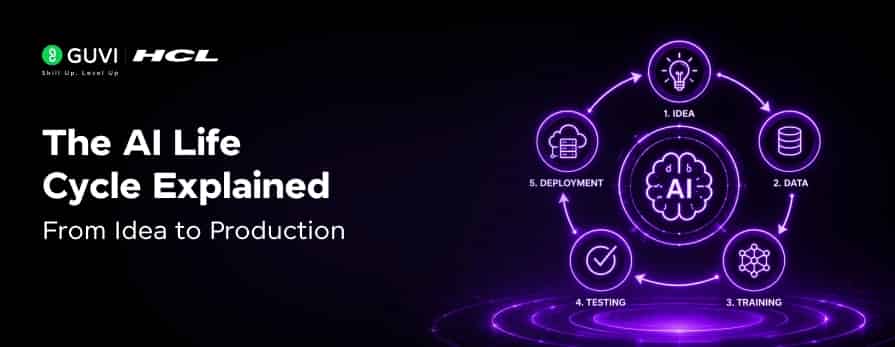
The AI Life Cycle Explained: From Idea to Production
Sep 08, 2026 7 Min Read 832 Views
(Last Updated)
Every AI system you use, like product recommendations, fraud alerts, or chatbots, follows a structured journey: problem definition, data collection, model training, testing, deployment, and ongoing monitoring. This end-to-end process is the AI life cycle, ensuring systems don’t just appear but evolve reliably.
College AI courses often cover only data cleaning, model training, and basic evaluation, skipping real-world essentials like industrial quality assurance, data labeling, ML pipelines, versioning, experiment tracking, and continuous maintenance. Mastering the full cycle turns hobby projects into production-ready systems.
In this article, we will walk through every stage of the AI life cycle in a clear, beginner-friendly way. Whether you are just starting or trying to understand how real AI projects are structured, this guide will give you the complete picture from problem definition all the way through to AI monitoring and maintenance.
Table of contents
- TL;DR
- Why the AI Life Cycle Is Not Linear
- Stage 1: Problem Definition
- Stage 2: Data Collection
- Stage 4: Model Development and Training
- Stage 5: Model Evaluation
- Stage 6: AI Deployment
- Stage 7: AI Monitoring and Maintenance
- The Role of MLOps in the AI Life Cycle
- What is MLOps?
- Market Growth and Production Challenges
- How MLOps Solves It
- Common Mistakes to Avoid
- Wrapping Up
- FAQs
- What is the AI life cycle?
- Why is the AI life cycle not linear?
- What role does MLOps play?
- Why do 85% of ML models fail to reach production?
- How can I avoid common AI project mistakes?
- What job roles can I apply for after completing an AI & ML course?
- What should I look for before enrolling in an AI & ML course?
TL;DR
- AI life cycle: Iterative stages from problem definition to monitoring for reliable systems.
- Non-linear models drift, needing retraining like car maintenance.
- Key stages: Data collection/preprocessing, training/evaluation, deployment, MLOps integration.
- 85% of models fail production due to skipped real-world steps.
- Avoid pitfalls: Define goals early, monitor always, skip POC traps.
- MLOps automates it all for scalable, repeatable AI.
What Is the AI Life Cycle?
The AI life cycle is the complete process of designing, developing, deploying, and maintaining an artificial intelligence system. It includes every stage, from identifying the problem and collecting data to training and evaluating models, deploying them into real-world environments, and continuously monitoring and improving their performance over time. The AI life cycle ensures that AI systems remain accurate, reliable, scalable, and aligned with business or user needs throughout their operation.
Why the AI Life Cycle Is Not Linear
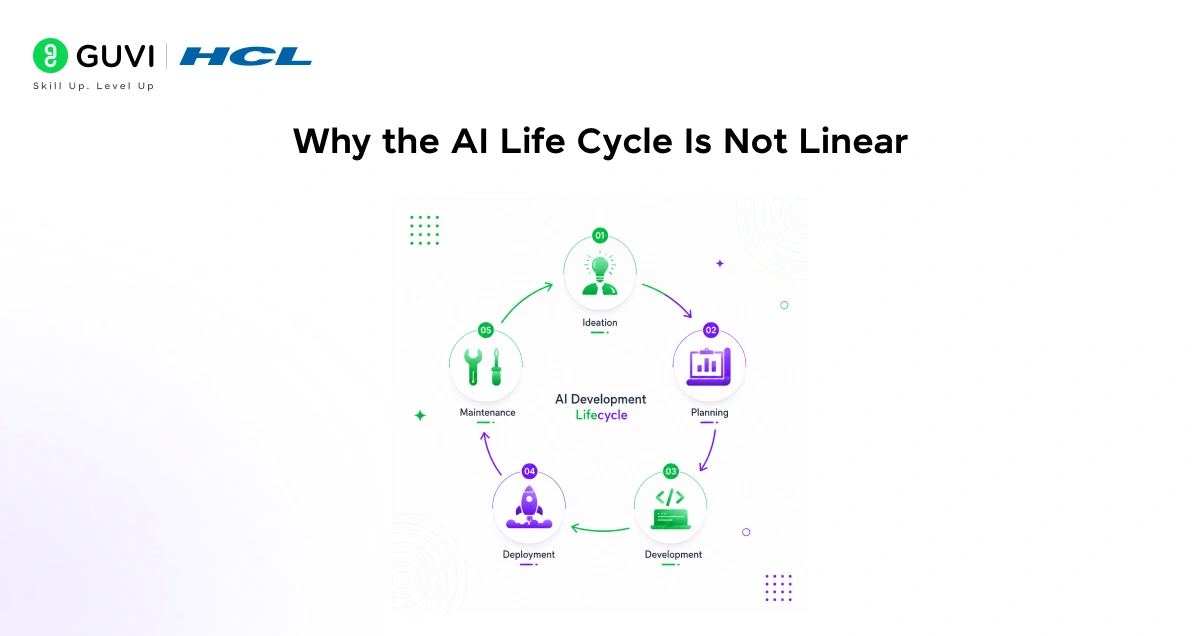
Before getting into the stages, one important thing to understand is that the AI life cycle is not a straight line.
- The AI life cycle is the iterative process of moving from a business problem to an AI solution that solves that problem. Each of the steps in the life cycle is revisited many times throughout the design, development, and deployment phases.
- Unlike traditional software development, which is often linear, the AI life cycle is cyclical. Deployed models must be continuously monitored for performance degradation and retrained with new data to remain effective.
- This structured approach ensures that AI systems are not just experimental code but scalable, reliable, and ethical business solutions that deliver tangible value.
- Think of it like maintaining a car. Buying the car is just the beginning. You need to check the engine regularly, replace parts when they wear out, and adapt to new road conditions. An AI model works the same way. Deployment is not the finish line. It is where the real work begins.
Stage 1: Problem Definition
Every successful AI project starts with a clearly defined problem. This might sound obvious, but skipping this step or rushing through it is one of the most common reasons AI projects fail.
- The first step in the life cycle is identifying the business problem the AI system will solve. Teams define objectives, success metrics, and scope while engaging key stakeholders to align on expectations and compliance requirements.
- A clear understanding of goals ensures the chosen algorithms and datasets are relevant to the problem domain.
- At this stage, you need to answer a few important questions. What exactly are you trying to predict or automate? How will you know if the system is working? What data would you need? Is this even a problem that AI can solve, or would a simpler rule-based approach work just as well?
- Defining measurable success metrics upfront, like a target accuracy, a reduction in error rate, or a business outcome such as reduced churn, gives the entire team a shared definition of what “done” actually means.
- Getting the problem definition wrong is expensive. If you spend three months building a model for the wrong objective, all that work has to be discarded and restarted. Time spent clearly scoping the problem at the beginning is never wasted.
Stage 2: Data Collection

Once the problem is clear, the next stage is gathering the data needed to solve it. Data is the raw material of every AI project. Without enough of the right data, even the most sophisticated model will produce poor results.
- The data gathering and exploration step deals with collecting and evaluating the data required to build the AI solution. Data can come from many sources, including internal databases, third-party APIs, web scraping, surveys, sensors, or publicly available datasets. The key is not just quantity but relevance and quality.
- The AI life cycle is vital because it ensures the development of reliable and accurate AI systems. By following a structured process, developers can create models that are robust, scalable, and capable of adapting to new challenges.
- This life cycle helps mitigate risks, enhance performance, and ensure the ethical use of AI.One practical challenge here is data labeling. For supervised learning tasks, someone has to go through the data and attach the correct labels to each example.
- This process is time-consuming and expensive, but getting it right is critical because the model learns directly from these labels. Errors at the data collection stage compound through every downstream stage of the AI pipeline.
Stage 3: Data Preprocessing
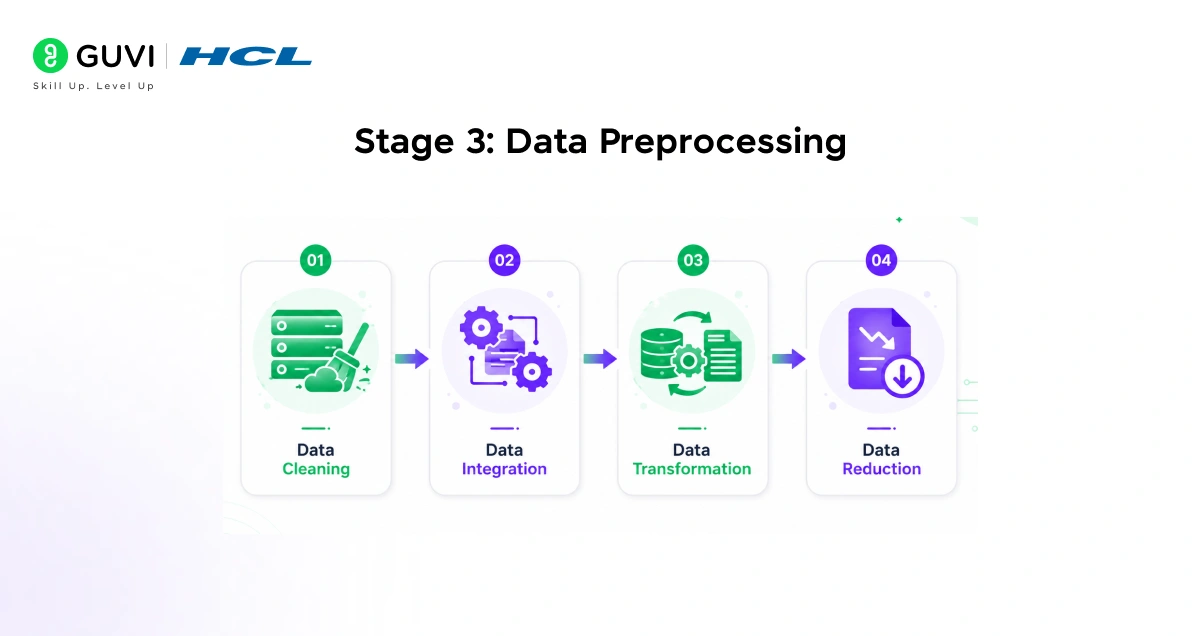
Raw data is rarely ready to feed directly into a model. It is messy, inconsistent, and often incomplete. Data preprocessing is the stage where you clean and prepare the data so the model can actually learn from it effectively.
- Data validation and preprocessing involve removing inconsistencies and standardizing data formats. Feature transformation and engineering involve applying normalization, scaling, or encoding to create new, meaningful features.
- Missing values need to be handled, duplicate records need to be removed, and outliers that could distort the model’s learning need to be identified and addressed. Feature engineering is one of the most impactful parts of this stage.
- It refers to the process of transforming raw data into inputs that capture useful patterns for the model.
- For example, instead of giving a model a raw timestamp, you might extract the day of the week, the hour of the day, and whether it is a holiday, because those derived features often carry more predictive signal than the raw number alone.
- Data cleaning and feature engineering involve removing errors, handling missing values, normalizing formats, and creating informative features. Feature engineering converts raw data into meaningful inputs for models.
- This stage often takes more time than any other in the AI life cycle, and skipping it carefully almost always leads to poor model performance down the line.
Stage 4: Model Development and Training
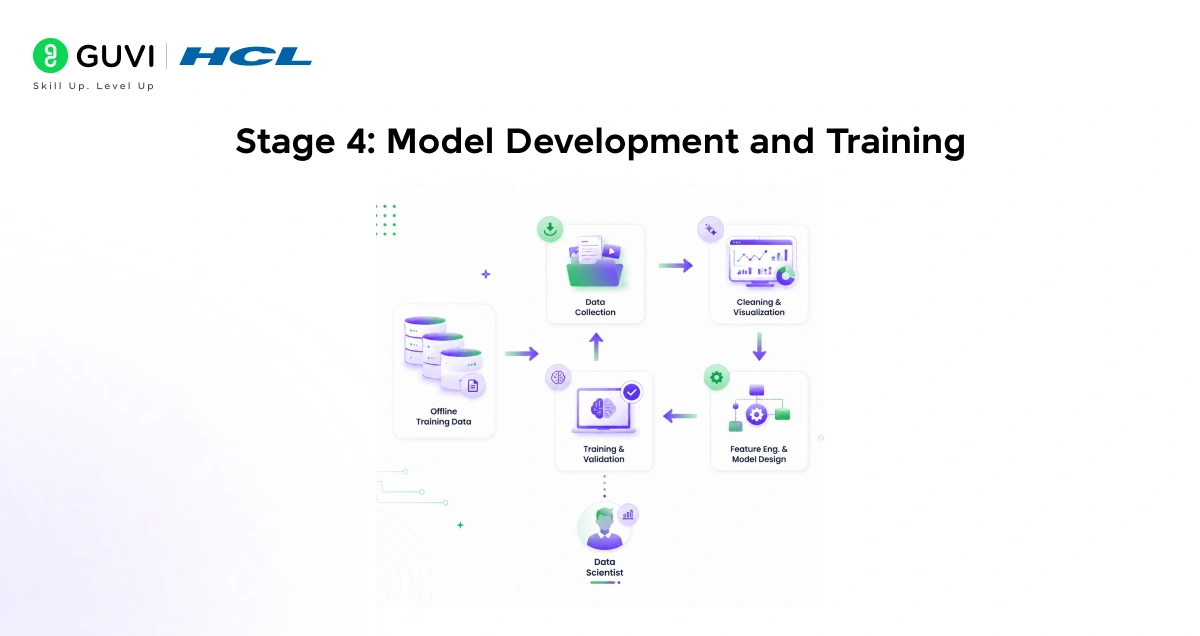
With clean, well-prepared data in hand, the team moves into model development. This is the stage most people picture when they think about AI, though, as you can see, it is just one part of a much bigger process.
- Model selection and architecture design precede the training phase, where algorithms learn from the prepared dataset. Choosing the right algorithm depends on the type of problem you are solving.
- Classification tasks, regression problems, clustering, and natural language processing each have different families of algorithms that tend to work best.
- Iterative training involves running multiple training cycles to improve accuracy while minimizing overfitting. Resource management leverages GPUs and cloud infrastructure for large-scale training.
- Ethical guardrails involve monitoring for bias or skewed data distributions to maintain fairness. The outcome of this phase is a trained model that performs well on the data it has seen, but it still needs to be tested against data it has never seen before.
- Training is inherently experimental. You will typically run many experiments, adjusting hyperparameters, trying different model architectures, and comparing results. Tools like MLflow help teams track these experiments so they can reproduce results and compare different model versions systematically.
Stage 5: Model Evaluation
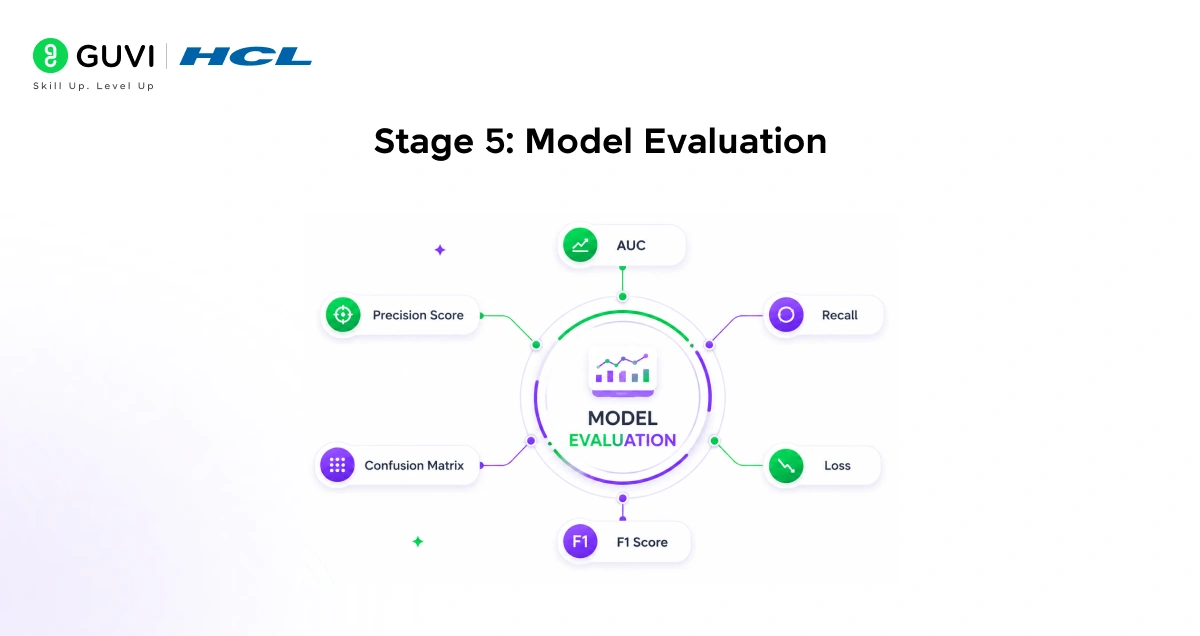
A model that performs well on training data is not necessarily good. The model evaluation stage is where you rigorously test whether the model actually generalizes to new, unseen data and whether it is ready for the real world.
- Model evaluation ensures that the AI performs not only on test datasets but also under real-world conditions. Common evaluation metrics include accuracy, precision, recall, F1 score, and AUC-ROC, depending on the type of problem.
- For a spam filter, you might care more about recall to avoid missing spam. For a medical diagnosis tool, you might prioritize precision to avoid false positives. The right metrics depend entirely on the context and the cost of different types of errors.
- Beyond just accuracy numbers, this stage should also evaluate the model for fairness and bias. A model might achieve high overall accuracy but perform poorly for certain demographic groups if the training data were not representative.
- Teams should define measurable performance metrics and identify risks and mitigation strategies for data or ethical concerns, as well as outline success criteria for deployment and maintenance. Catching bias before deployment is far less costly than dealing with it after the model is already affecting real users.

Stage 6: AI Deployment
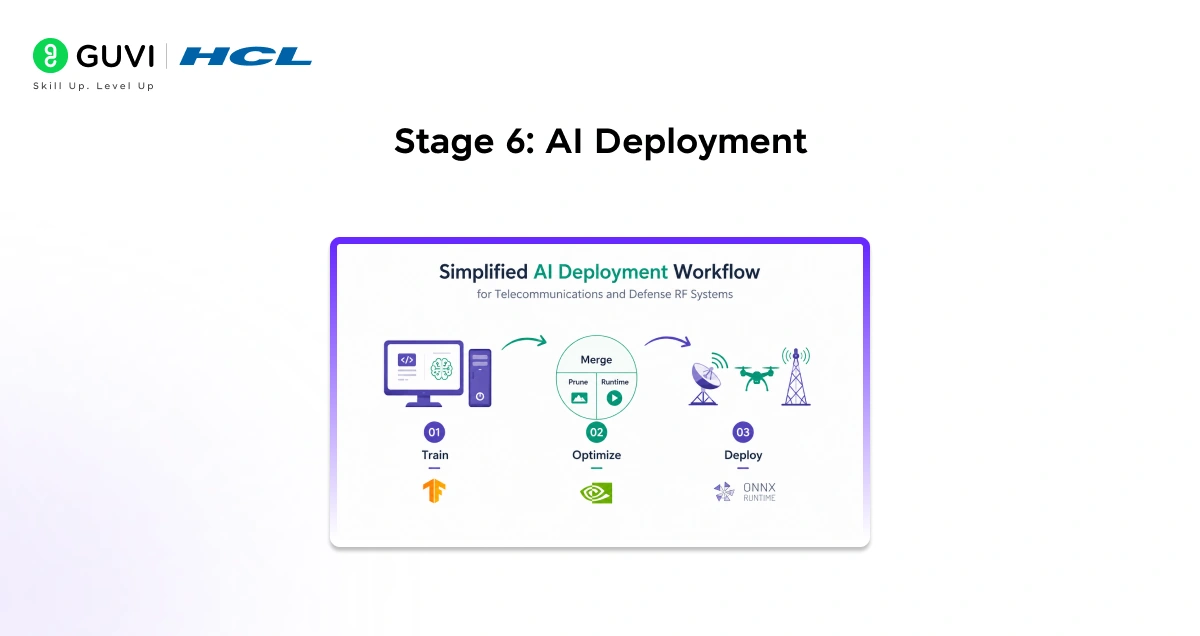
Once a model passes evaluation, it moves into deployment, where it gets integrated into a real product or workflow and starts making predictions on live data. This is the stage where the model finally delivers actual value.
- Deployment can take many forms, such as embedding into apps, connecting via APIs, or integrating into automated workflows. Automated deployment pipelines can streamline model rollout and reduce downtime when retraining or updating models.
- In modern AI pipelines, deployment is rarely done manually. MLOps practices bring software engineering principles to the model deployment process.
- As of 2024, 64.3% of large enterprises have adopted MLOps platforms to optimize the entire machine learning lifecycle, from data ingestion and model training to deployment, monitoring, and retraining. This reflects how seriously organizations now treat the operationalization of AI, not just its development.
- Packaging models for scalable infrastructure, setting up automated pipelines for retraining on fresh data, and embedding governance controls around security, fairness, and explainability protect against drift, compliance breaches, and performance degradation.
- A disciplined deployment approach turns proofs-of-concept into reliable, long-term assets that deliver measurable business value.
Modern enterprises are increasingly adopting MLOps platforms to manage the full AI lifecycle, reflecting a major industry shift from treating machine learning as isolated experimentation to managing it like production software engineering. Organizations now recognize that building a model is only a small part of successful AI deployment; monitoring, versioning, automation, governance, retraining, and infrastructure management are equally critical for long-term value. This growing demand has fueled rapid expansion in the MLOps market, driven by the reality that many AI projects fail when reliable operational processes are missing.
Stage 7: AI Monitoring and Maintenance
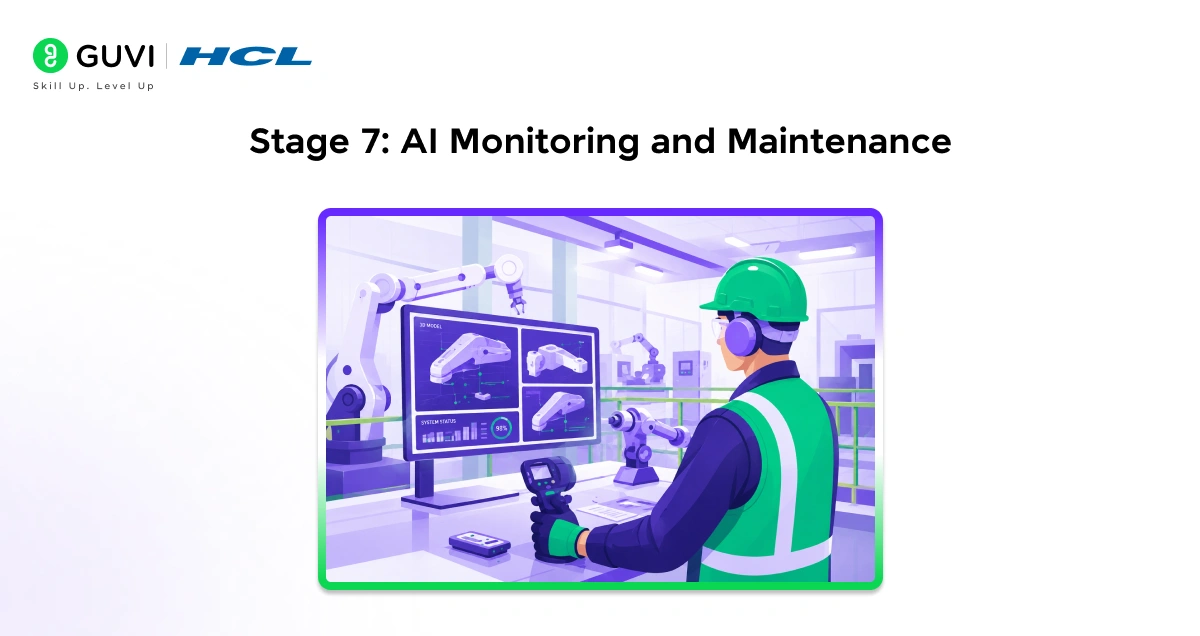
Deploying the model is not the end. In many ways, it is just the beginning of a new responsibility. AI monitoring and maintenance is what keep a deployed model healthy and accurate over time.
- Even an optimally trained model might, over time, suffer from performance degradation due to issues such as model drift. Deployed models, therefore, typically require periodic retraining to maintain adequate performance and adjust to changing circumstances.
- Model drift occurs when the real-world data the model encounters in production begins to differ from the data it was trained on. The world changes, user behavior shifts, and economic conditions evolve, but the model’s knowledge is frozen at the point it was trained unless someone actively updates it.
- Performance monitoring involves regularly checking the model’s accuracy, precision, and other performance metrics to detect any degradation.
- Model retraining involves periodically retraining the model with new data to adapt to changing conditions or trends. Issue resolution involves identifying and fixing any bugs, errors, or unexpected behaviors that arise during the model’s operation.
- A practical example makes this concrete. Imagine you built an AI model to score sales leads. At first, it helped your team close more deals. But a few months later, win rates start dropping.
- If you had a monitoring dashboard, you would see that the model’s predictions were off. Maybe it is now ranking low-quality leads too high. Without monitoring, you might blame the sales team instead of fixing the real issue of model drift.
The Role of MLOps in the AI Life Cycle
1. What is MLOps?
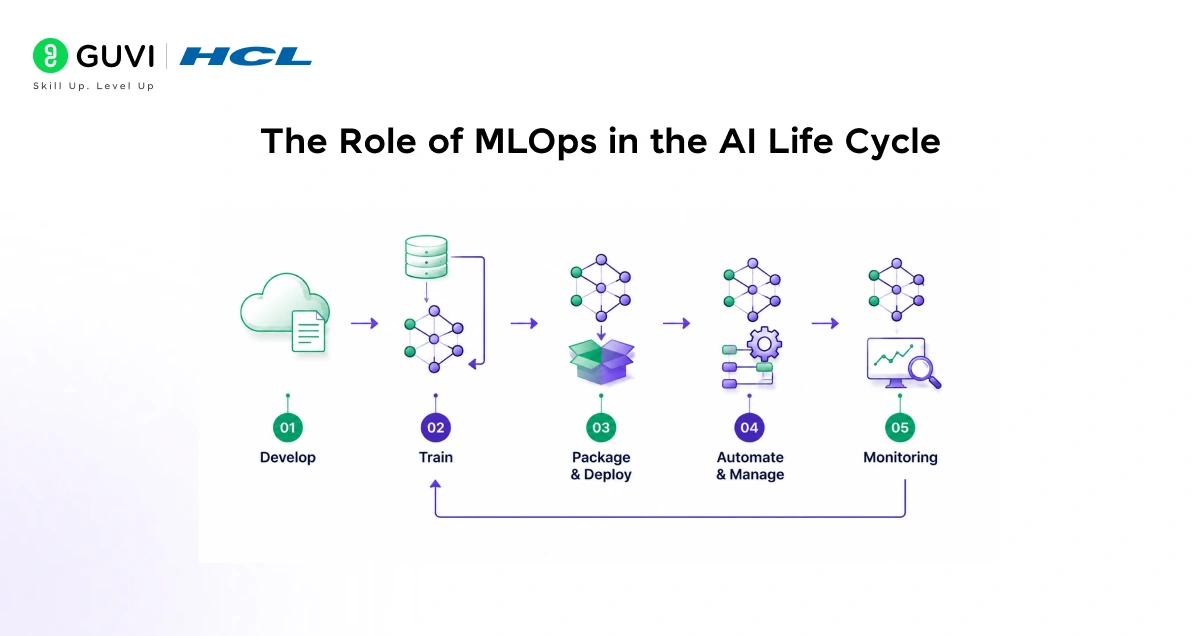
MLOps, or machine learning operations, applies software engineering and DevOps principles to the full AI lifecycle. It blends machine learning with DevOps to automate and scale model management, covering everything from data collection and development to deployment, monitoring, and retraining.
2. Market Growth and Production Challenges
The global MLOps market hit US $1.58 billion in 2024 and should reach US $2.33 billion by 2025, growing at a 35.5% CAGR. Yet, surveys show 85% of ML models fail to reach production, proving that model building is easy, but reliable production deployment is tough. This underscores the need for strong AI lifecycle management.
3. How MLOps Solves It
MLOps automates repetitive pipeline tasks, adds version control for data and models, and builds feedback loops for monitoring and retraining. It turns one-off AI experiments into sustainable, repeatable processes.
Common Mistakes to Avoid
The most costly mistake in AI projects is skipping or rushing the problem definition stage.
- A model built for a vague or incorrect objective will never deliver real value, no matter how technically impressive it is. Take the time to get alignment on what success looks like before writing a single line of code.
- A common failure pattern is the POC trap, where teams build a proof of concept in a sandbox with perfect data.
- When they try to move to deployment, they realize the real-world data is messy or the infrastructure cannot handle the latency requirements. Building with production constraints in mind from the beginning, rather than optimizing only for the demo, saves enormous amounts of rework.
- Ignoring monitoring after deployment is another frequent mistake. A model is deployed and celebrated. Six months later, it starts making bad recommendations because the environment shifted.
- Without monitoring, the company loses money before they realize the model is broken. Setting up monitoring dashboards from day one of deployment, not as an afterthought, is one of the most important practices in maintaining a healthy AI system.
If you’re serious about mastering the complete AI lifecycle from problem definition and data preparation to model training, deployment, and production monitoring, don’t miss the chance to enroll in HCL GUVI’s Artificial Intelligence & Machine Learning Bundle. Enroll now and build production-ready AI systems today!
Wrapping Up
The AI life cycle is the blueprint that takes an idea from a whiteboard conversation all the way to a working, reliable AI system that delivers real value day after day. Each stage builds on the previous one. and skipping any of them creates problems that become harder and more expensive to fix the later they are discovered.
For anyone starting in AI, understanding this full picture is genuinely important. The technical skills of building models are valuable, but the ability to see where your model fits in the broader lifecycle and to think about data quality, deployment pipelines, and long-term monitoring from the very beginning is what makes an AI practitioner truly effective.
The life cycle is not just a project management framework. It is the difference between an AI project that fails quietly and one that keeps working and improving long after it first goes live.
FAQs
1. What is the AI life cycle?
It’s the end-to-end process of building, deploying, and maintaining AI systems, from problem definition and data collection to training, evaluation, deployment, and ongoing monitoring.
2. Why is the AI life cycle not linear?
Unlike traditional software, it’s iterative and cyclical models need constant retraining due to changing data and real-world conditions, like concept drift.
3. What role does MLOps play?
MLOps automates the AI pipeline with DevOps practices, handling version control, deployment, and feedback loops to make models production-ready and scalable.
4. Why do 85% of ML models fail to reach production?
Most projects focus only on model building, ignoring data quality, pipelines, deployment challenges, and maintenance, leading to unreliable systems.
5. How can I avoid common AI project mistakes?
Clearly define problems upfront, build with production in mind (not just POCs), and set up monitoring from deployment day one to catch issues early.
6. What job roles can I apply for after completing an AI & ML course?
You can apply for roles such as AI Engineer, Machine Learning Engineer, Data Scientist, NLP Engineer, Computer Vision Engineer, and AI Developer. To prepare for these roles, consider a project-based AI & ML Programme with career support.
7. What should I look for before enrolling in an AI & ML course?
Look for a structured curriculum, practical projects, experienced mentors, updated AI tools, certification value, and career support. Compare programmes carefully before enrolling in an AI & ML Programme.
Success Stories

About the Author
Vishalini Devarajan
An Aerospace Engineer turned content writer, I focus on making complex concepts easy to understand through well-structured, reader-friendly blogs. Whether it’s a technical topic or a non-technical one, I love creating content that is clear, engaging, and impactful.
View all posts by Vishalini Devarajan
Connect with me @










Did you enjoy this article?