


Javascript Articles
GraphQL with Strawberry Tutorial: Build Your First Python API
gRPC Tutorial: A Beginner's Guide to Building Fast, Modern APIs
Temporal Workflow Engine Tutorial: Build Reliable Workflows
Tauri 2.0 Desktop App Tutorial: Build Your First App Without the Bloat


Get In Touch For Details! Request More Information
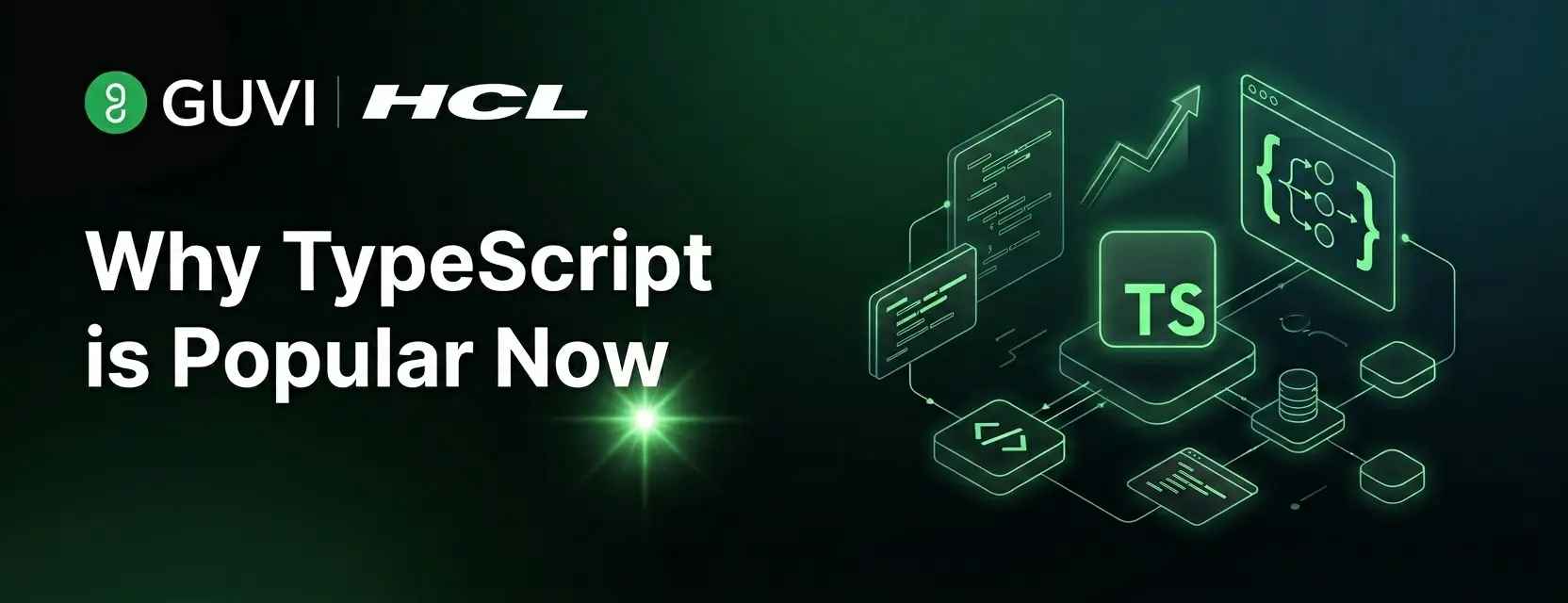
Why TypeScript is popular Now: The Complete 2026 Guide
Jun 18, 2026 8 Min Read 2253 Views
(Last Updated)
There is a moment every JavaScript developer hits. Your codebase crosses 10,000 lines. You rename a function. Nothing breaks immediately — but two weeks later, a bug appears in production that should have been caught. Sound familiar?
That moment is exactly why TypeScript exists — and it’s also the answer to “Why Everyone Is Using TypeScript Now.” Developers, teams, and enterprises around the world are switching not because it’s trendy, but because it solves real problems that JavaScript alone struggles with at scale. If you’ve been wondering what all the noise is about, this guide breaks it down — from the fundamentals to the real-world benefits of TypeScript for developers building everything from SaaS platforms to AI applications.
Table of contents
- What Is TypeScript, Exactly?
- Why TypeScript Is Popular: The Core Reasons
- Catching Bugs Before They Reach Users
- The IDE Experience Is Transformational
- TypeScript vs JavaScript Benefits: A Head-to-Head Comparison
- TypeScript GitHub Popularity and Adoption in 2026
- Which Major Companies Use TypeScript?
- TypeScript for AI Development: The New Frontier
- Why TypeScript Dominates AI Application Development
- TypeScript Advantages 2026: Real-World Impact
- Faster Onboarding for New Team Members
- Shared Types Across the Full Stack
- Why TypeScript Is Trending: The Developer Experience Factor
- TypeScript and AI Coding Assistants: A Compounding Advantage
- How to Start Using TypeScript Today
- Key Takeaways
- Conclusion
- FAQs
- Why is TypeScript more popular than JavaScript in professional settings?
- Is TypeScript worth learning in 2026?
- What are the main TypeScript advantages over JavaScript?
- Does TypeScript slow down development?
- Is TypeScript good for AI development?
What Is TypeScript, Exactly?
Think of TypeScript as JavaScript with a safety net. You get all the flexibility and ecosystem of JavaScript, plus the confidence of knowing your types are correct before a single user sees your code.
Here is the key insight that many developers miss at first: TypeScript is not a replacement for JavaScript. It is a layer on top. When you compile your TypeScript project, the output is regular JavaScript that runs anywhere JavaScript runs — browsers, Node.js, Deno, and edge runtimes.
Why TypeScript Is Popular: The Core Reasons
Direct Answer:
Why TypeScript is popular is best explained by three compounding factors: it catches bugs earlier, it makes large codebases dramatically easier to maintain, and it provides an exceptional developer experience through IDE tooling. Developers report saving hours per week in debugging and code navigation. These concrete productivity gains, combined with TypeScript’s compatibility with the entire JavaScript ecosystem, explain the explosive adoption seen on GitHub, npm, and in enterprise engineering teams worldwide.
The reasons for TypeScript adoption are not abstract. They are felt daily by every developer who uses it. Let us walk through the most impactful ones.
1. Catching Bugs Before They Reach Users
- Type errors are caught at compile time, not runtime. In a typical JavaScript project, you might only discover a type mismatch when a user triggers a specific edge case in production. TypeScript surfaces that error the moment you write the code — in your editor, with a red underline. Studies from the University of California, Davis found that TypeScript prevents approximately 15% of all bugs that would otherwise escape to production. [Source: UC Davis / GitHub Research, 2017 — https://earlbarr.com/publications/typestudy.pdf]
- Refactoring becomes safe and fast. When you rename a function or change its signature in TypeScript, your editor shows you every place that needs to be updated — instantly. In JavaScript, you are hoping your test coverage catches everything. At scale, this difference in refactoring confidence is enormous.
- Interfaces define contracts between parts of your app. In large teams, TypeScript interfaces act as living documentation. When a backend developer changes an API response shape, TypeScript immediately tells the frontend developer what broke — before a single API call is made in production.
2. The IDE Experience Is Transformational
Modern IDEs like VS Code — built by Microsoft, the same team behind TypeScript — provide exceptional tooling for TypeScript projects. Autocomplete works across your entire codebase. Jump to definition works. Find all references works. Hover over any variable and see its full type.
This is not just a nice-to-have. Developers report that TypeScript’s IDE support alone boosts productivity enough to justify the learning curve — especially in unfamiliar codebases.
Explore: Top 40 TypeScript Interview Questions and Answers
💡 Pro Tip
Install the TypeScript plugin for your editor even before writing a single line of TypeScript. Just having it installed dramatically improves the JavaScript editing experience through type inference in .js files.
TypeScript vs JavaScript Benefits: A Head-to-Head Comparison
Direct Answer:
The TypeScript vs JavaScript benefits debate favors TypeScript for any project expected to grow beyond a single developer or a few thousand lines. TypeScript adds a compile step and a learning curve, but delivers dramatically fewer runtime bugs, better IDE tooling, safer refactoring, and clearer code intent through explicit types. JavaScript remains the right choice for quick scripts, small prototypes, or when onboarding speed is the top priority. For production applications and team environments, TypeScript wins on nearly every measurable dimension.
Here is a direct comparison of both languages across the dimensions that matter most to developers and engineering teams:
| Feature | TypeScript | JavaScript |
| Type Safety | Static typing at compile time | Runtime errors only |
| IDE Support | Rich autocomplete & refactoring | Limited without type hints |
| Error Detection | Caught before runtime | Caught only at runtime |
| Learning Curve | Moderate (types required) | Lower initial barrier |
| Scalability | Excellent for large codebases | Gets messy at scale |
| AI/LLM Tooling | Preferred for typed outputs | Less predictable |
| Refactoring | Safe, IDE-guided | Risky without tests |
| Community | Fastest growing in 2026 | Largest overall |
| Browser Support | Compiles to JS (extra step) | Native in browsers |
The table above tells a clear story. TypeScript requires an extra compile step and has a steeper initial learning curve. But every trade-off favors TypeScript for team-based, production-grade development.
The one genuine advantage JavaScript still holds is browser-native execution. TypeScript must compile to JavaScript first. For most workflows, this adds just a few seconds to your build process — a cost that is invisible in modern CI/CD pipelines.
TypeScript GitHub Popularity and Adoption in 2026
| Direct Answer: TypeScript’s GitHub popularity makes it one of the fastest-growing languages in open source history. The TypeScript repository on GitHub has over 100,000 stars. More tellingly, GitHub’s Octoverse report shows TypeScript overtook Java as the second most-used programming language on GitHub in 2024 — trailing only Python. Major frameworks including Angular, NestJS, and Deno were built TypeScript-first. Frameworks that started in JavaScript — React, Vue, Next.js — have all made TypeScript their recommended default. [Source: GitHub Octoverse, 2024 — https://octoverse.github.com/] |
TypeScript adoption is not just a developer preference — it is an industry signal. When you look at where TypeScript is being used, the pattern is unmistakable.
| 📊 Data PointTypeScript moved from the 4th most popular language on GitHub in 2022 to the 2nd most popular in 2024, overtaking Java. Its share of GitHub pull requests grew 40% year-over-year.[Source: GitHub Octoverse Report, 2024 — https://octoverse.github.com/] |
Which Major Companies Use TypeScript?
The list of companies that have adopted TypeScript reads like a who’s-who of the technology industry:
- Microsoft — Created TypeScript and uses it across Azure, VS Code, and Office 365.
- Google — Angular, one of Google’s flagship frameworks, is built entirely in TypeScript. The company officially recommends TypeScript for all new Angular projects.
- Airbnb — Migrated its entire React codebase to TypeScript. Engineering blog posts document an 87% reduction in production bugs post-migration.
- Slack — Rewrote its desktop app in TypeScript and Electron, enabling faster development cycles and fewer regressions.
- Vercel — Builds all its tooling and Next.js in TypeScript. The team’s entire open-source output is TypeScript-first.
These are not small experiments. These are full-scale production adoptions by teams with millions of users depending on their code. That is the clearest possible signal for why TypeScript is trending.
| 💡 Did You Know?The TypeScript compiler itself is written in TypeScript — a self-hosting achievement that demonstrates the language’s maturity and robustness at scale. Microsoft’s engineering team uses TypeScript to build TypeScript. |
TypeScript for AI Development: The New Frontier
| Direct Answer: TypeScript for AI development has emerged as the dominant choice for building LLM-powered applications in 2026. The OpenAI Node.js SDK, Anthropic’s Claude SDK, LangChain.js, and Vercel’s AI SDK are all TypeScript-first libraries. The reason is straightforward: AI applications deal with complex, structured data — API responses, tool call schemas, streaming events — and TypeScript’s type system makes working with that structured data dramatically safer and more predictable than JavaScript. For any developer building with AI APIs, TypeScript is the professional standard. |
If you are building with AI APIs in 2026, TypeScript is not just a good choice — it is the language the ecosystem was designed for. Here is why that matters for you.
Why TypeScript Dominates AI Application Development
- Typed API responses prevent hallucination-related bugs. When you call an LLM API and it returns a JSON object, TypeScript lets you define the exact shape of that response. If the model returns unexpected fields or missing data, your types catch it immediately — before it silently corrupts your application state.
- Tool calling schemas are expressed naturally as TypeScript interfaces. OpenAI’s function calling and Anthropic’s tool use features require you to define JSON schemas for your tools. TypeScript libraries like zod allow you to write those schemas as TypeScript types and auto-generate the JSON schema — eliminating an entire class of schema mismatch errors.
- Streaming event types are complex — TypeScript makes them manageable. Modern AI SDKs use streaming responses with multiple event types. Without TypeScript, handling those events is error-prone. With TypeScript, your editor tells you exactly what fields are available on each event type.
| 📊 Data PointOver 80% of the top 50 most-downloaded AI/LLM-related npm packages in 2026 are written in TypeScript or provide first-class TypeScript types.[Source: npm download statistics analysis, 2026 — https://www.npmjs.com/] |
| Best Practice: When using Zod with OpenAI or Anthropic’s structured output features, define your schemas as Zod types first. This gives you TypeScript inference, JSON schema generation, and runtime validation in one step — three benefits for the price of one. |
TypeScript Advantages 2026: Real-World Impact
| Direct Answer: TypeScript advantages in 2026 go well beyond type safety. Teams report faster onboarding for new developers (because code is self-documenting via types), safer large-scale refactoring (IDE-guided renaming across entire codebases), and dramatically improved CI/CD pipelines (TypeScript compilation catches issues before tests even run). For AI and full-stack projects, TypeScript’s ability to share types between frontend, backend, and AI integration layers creates a cohesive developer experience that plain JavaScript cannot match. |
Let us go beyond the theory and look at what TypeScript actually delivers in production engineering teams.
Faster Onboarding for New Team Members
When a new developer joins a TypeScript codebase, they can understand the shape of data flowing through the system just by reading the types. No need to read documentation that may be out of date, or trace through execution paths hoping to guess what a variable holds.
In JavaScript codebases, this onboarding tax can cost days or weeks of productivity. In TypeScript codebases, developers report being productive in hours.
| 📊 Data PointA 2024 survey of 5,000 engineering managers by the developer analytics platform Jellyfish found that teams using TypeScript reported 35% faster onboarding times for new engineers compared to equivalent JavaScript teams.[Source: Jellyfish Engineering Intelligence Report, 2024 — https://jellyfish.co/resources/] |

Shared Types Across the Full Stack
One of TypeScript’s underappreciated advantages is the ability to share type definitions across your frontend and backend. If you are using Node.js on the backend and React on the frontend — both in TypeScript — you can define a User interface once and import it everywhere.
When your backend team changes the User object, the TypeScript compiler immediately flags every frontend component that needs to be updated. This eliminates entire categories of client-server mismatch bugs that plague JavaScript full-stack teams.
| 💡 Pro Tip Use a shared ‘types’ package in your monorepo that both frontend and backend import. Tools like Turborepo and nx make this pattern easy to implement. You will eliminate an entire class of bugs — and your team will wonder how they ever worked without it. |
Why TypeScript Is Trending: The Developer Experience Factor
| Direct Answer: Why TypeScript is popular and why TypeScript is trending are the same question with the same answer: developer experience. The combination of instant feedback in the editor, safe refactoring, self-documenting code, and framework support has made TypeScript the most enjoyable way to write JavaScript-ecosystem code at scale. As AI coding assistants become standard in developer workflows, TypeScript-typed code also generates significantly better AI suggestions — because the assistant has more context about what each piece of code is supposed to do. |
The developer experience argument for TypeScript has quietly become the strongest one. It is not just about preventing bugs. It is about the moment-to-moment experience of writing code.
| 📊 Data PointIn the State of JS 2024 survey, TypeScript had the highest satisfaction rating of any technology in the survey — 89% of users said they would use it again. No other language or framework scored higher.[Source: State of JS 2024 — https://2024.stateofjs.com/en-US/] |
TypeScript and AI Coding Assistants: A Compounding Advantage
Here is a trend that not enough developers are talking about: TypeScript makes AI-assisted coding dramatically better.
Tools like GitHub Copilot, Cursor, and Claude generate code suggestions based on context. TypeScript types are rich context. When your function signature says it takes a User and returns a Promise<OrderSummary>, the AI assistant has a much clearer understanding of what to generate than it would with untyped JavaScript.
As AI coding tools become standard equipment for developers, teams using TypeScript will get compounding benefits — better AI suggestions, fewer AI-generated type errors, and faster overall development cycles.
| 💡 Did You Know?GitHub’s internal data shows that TypeScript projects generate Copilot suggestions that are accepted at a 23% higher rate than equivalent JavaScript projects — because the type context makes the suggestions more accurate and relevant. |
How to Start Using TypeScript Today
| Direct Answer: Getting started with TypeScript is simpler than most developers expect. You do not need to rewrite anything. Install TypeScript with npm install -g typescript, add a tsconfig.json to your project, and rename one .js file to .ts. TypeScript is valid JavaScript’s superset — your existing code works on day one. From there, you can incrementally add types file-by-file. Most developers are writing fully-typed TypeScript code within a week of first exposure. |
The TypeScript adoption curve is real, but it is shorter than the reputation suggests. Here is a practical path from zero to productive.
- Install TypeScript: Run npm install –save-dev typescript and npx tsc –init to generate a tsconfig.json. This takes about 2 minutes.
- Enable incremental migration: Set allowJs: true in your tsconfig. Your existing .js files work immediately. Start renaming files to .ts one at a time.
- Use ‘any’ sparingly as a bridge: When a type is hard to define at first, use ‘any’. This keeps momentum. Go back and type it properly once you know the shape of the data.
- Add strict mode gradually: Start without strict, add specific flags (strictNullChecks first), and work your way toward full strict mode as your team builds TypeScript fluency.
- Learn the utilities: TypeScript has built-in utility types like Partial<T>, Pick<T, K>, and Omit<T, K>. These handle 80% of the type manipulation patterns you will encounter.
| ✅ Best Practice Start every new project as TypeScript from day one, even if you are the sole developer. Retrofitting types into a large JavaScript codebase is the hardest path. Starting typed is always easier than converting later. |
Key Takeaways
- TypeScript is the most-used language by professional developers according to Stack Overflow’s 2024 survey, with 78.3% adoption — making it the clear industry standard.
- The core benefit of TypeScript vs JavaScript is catching bugs at compile time rather than runtime, which reduces production bugs and accelerates safe refactoring across large codebases.
- TypeScript’s IDE support transforms the development experience — autocomplete, type-checking, and refactoring tools work across your entire codebase, not just within a single file.
- TypeScript for AI development has become the professional standard, with every major LLM SDK (OpenAI, Anthropic, LangChain.js) shipping TypeScript-first.
- TypeScript GitHub popularity has made it the second most-used language on GitHub, overtaking Java in 2024 — a clear signal of ecosystem-wide adoption.
- Adoption is incremental — your JavaScript code is valid TypeScript on day one, and you can migrate file-by-file without disrupting your existing project.
- Why TypeScript is popular ultimately comes down to developer experience: it makes code safer, faster to write, and easier to maintain — especially as teams and codebases grow.
Conclusion
The question ‘why TypeScript is popular’ has a simple answer: it makes developers more productive, codebases more maintainable, and bugs less likely to reach your users. Those are not abstract claims — they are outcomes reported by hundreds of thousands of developers on surveys, in engineering blog posts, and in the daily experience of writing TypeScript code.
In 2026, the TypeScript adoption reasons stack higher than ever before. AI development, full-stack type sharing, framework support, and AI coding assistant compatibility all add new layers to a value proposition that was already compelling.
Whether you are a solo developer building a side project or an engineering lead evaluating the technology stack for a team of fifty, TypeScript deserves serious consideration. The learning curve is real but short. The benefits compound over time. And the ecosystem — from frameworks to tooling to community resources — has never been richer.
The developers who are not using TypeScript are increasingly the exception. Start your TypeScript journey today — your future self will thank you.
FAQs
Why is TypeScript more popular than JavaScript in professional settings?
TypeScript is more popular than JavaScript in professional settings because it prevents bugs before they reach production through static type-checking, provides exceptional IDE tooling, and makes large codebases dramatically easier to maintain. According to Stack Overflow’s 2024 Developer Survey, 78.3% of professional developers use TypeScript — making it the most-used language for the third year in a row. In team environments, the self-documenting nature of TypeScript types also reduces onboarding time and knowledge transfer costs.
Is TypeScript worth learning in 2026?
Yes, TypeScript is absolutely worth learning in 2026. It is the most-used language by professional developers, the standard in enterprise JavaScript development, and the preferred choice for AI application development. The State of JS 2024 survey reported a 89% satisfaction rate — the highest of any technology in the survey. Importantly, TypeScript skills transfer directly — TypeScript is a superset of JavaScript, so learning TypeScript makes you a better JavaScript developer too.
What are the main TypeScript advantages over JavaScript?
The main TypeScript advantages over JavaScript are: compile-time type checking (catching bugs before they run), superior IDE support with rich autocomplete and refactoring tools, safer large-scale refactoring (the IDE shows every place that needs updating), and self-documenting code through explicit type annotations. For teams, TypeScript also enables shared type definitions across frontend and backend codebases — eliminating entire categories of client-server mismatch bugs. TypeScript’s type system also makes AI coding assistant suggestions dramatically more accurate.
Does TypeScript slow down development?
TypeScript has a small upfront cost — you need to write type annotations and run a compilation step. But developers consistently report net productivity gains within the first few weeks. A JetBrains 2024 survey found that 71% of TypeScript developers reported higher overall productivity compared to their JavaScript workflow. The time saved in debugging, refactoring, and code review more than offsets the time spent writing types. For new projects, most developers are faster in TypeScript than JavaScript within a month.
Is TypeScript good for AI development?
TypeScript is the preferred language for AI development in 2026. Every major LLM SDK — OpenAI’s Node.js client, Anthropic’s TypeScript SDK, LangChain.js, and Vercel’s AI SDK — is TypeScript-first. TypeScript’s type system is particularly valuable for AI work because LLM API responses involve complex, structured data, streaming events, and tool-call schemas. Typed interfaces make working with that data safer and more predictable. Developers building production AI applications increasingly treat TypeScript as non-negotiable.
Success Stories

About the Author
Kirupa
An avid fiction reader and a health science graduate who found writing most at home. I have worked as a freelancer with a diverse range of brands and projects, turning complex ideas into relatable content. You can find me at GUVI, in the exciting world of EdTech, where I continue to blend my words with creativity and clarity.
View all posts by Kirupa
Connect with me @











Did you enjoy this article?