


Database Articles
SQL Window Functions: Practical Examples Every Analyst Needs
Microservices vs Monolith: Making the Right Architectural Choice


Get In Touch For Details! Request More Information

Imagine you walk into a library and ask for a book. The librarian can find it using the book title, the ISBN number, or the barcode on the back cover. Each of these works on its own to identify exactly one book. No two books share the same ISBN. No two books have the same barcode. These are like candidate keys in a database.
In database management systems, identifying records correctly is one of the most important jobs. If you cannot uniquely identify a row in a table, your entire database becomes unreliable. Candidate keys solve this problem by giving you reliable, unique ways to find any record.
In this guide, you will learn what candidate key in dbms are, how they work, how they differ from other types of keys, and how to identify them in real database scenarios.
Table of contents
- AI Overview
- Candidate Key in DBMS: Quick Comparison
- What Is a Candidate Key in DBMS?
- The Two Rules Every Candidate Key Must Follow
- Understanding Uniqueness and Minimality With an Example
- Candidate Key vs Super Key
- Candidate Key and Functional Dependency
- Candidate Key vs Primary Key
- Candidate Key vs Alternate Key
- Candidate Key vs Unique Key
- How to Identify Candidate Keys in Any Table
- Step 1: List all the columns.
- Step 2: Check each column for uniqueness.
- Step 3: Check combinations.
- Step 4: Apply minimality.
- Step 5: Collect all minimal unique sets.
- Real-World Example
- Composite Candidate Keys
- Properties of Candidate Keys Summarized
- Common Mistakes to Avoid
- Why Candidate Keys Matter in Database Design
- Conclusion
- FAQs
- Can a table have no candidate key?
- Can a candidate key have null values?
- Is the primary key always the best candidate key?
- Can two different candidate keys share a column?
- How are candidate keys related to indexes in a database?
AI Overview
A candidate key in DBMS is a minimal set of one or more attributes that can uniquely identify every row in a table. It must provide uniqueness without containing unnecessary attributes. A table can have multiple candidate keys, but one is selected as the primary key and the remaining candidate keys are called alternate keys. Candidate keys can be single-column or composite and are closely related to super keys and database normalization.
Candidate Key in DBMS: Quick Comparison
| Key Type | Main Purpose | Can There Be Multiple? | Minimal? |
|---|---|---|---|
| Super Key | Uniquely identifies a row | Yes | Not necessarily |
| Candidate Key | Minimal unique identifier | Yes | Yes |
| Primary Key | Selected candidate key | No | Yes |
| Alternate Key | Candidate key not selected as primary | Yes | Yes |
| Foreign Key | Links one table to another | Yes | Not necessarily |
Key relationship: Every candidate key is a super key, but not every super key is a candidate key. One candidate key can be selected as the primary key, while the others become alternate keys.
What Is a Candidate Key in DBMS?

A candidate key is a column, or a group of columns, in a database table that can uniquely identify every row in that table. The word “candidate” means it is eligible or qualified to be chosen as the primary key.
The Two Rules Every Candidate Key Must Follow
Think of it like a job interview. Several candidates apply for one position. Each candidate is qualified. Only one gets selected for the role. In the same way, a table can have several candidate keys, but only one of them gets selected as the primary key.
Every candidate key must follow two strict rules without any exceptions.
- Uniqueness:
No two rows in the table can have the same value for that key. If two students share the same roll number, that column cannot be a candidate key.
- Irreducibility (also called minimality):
You cannot remove any column from the key and still maintain uniqueness. If a combination of two columns works as a unique identifier, but one column alone also works, then the two-column version is not a candidate key. The single column version is.
Read More: Introduction to Database Keys
Understanding Uniqueness and Minimality With an Example
Look at this simple student table:
| Student_ID | Name | Phone | |
| 101 | [email protected] | Alice | 9876543210 |
| 102 | [email protected] | Bob | 9876543211 |
| 103 | [email protected] | Carol | 9876543212 |
- In this table, Student_ID is unique for every row. No two students share the same ID. So it qualifies for uniqueness.
- Can you remove any column from Student_ID to still keep uniqueness? No, because it is just one column. So it also satisfies minimality.
- Email is also unique for every row. No two students share the same email. It also satisfies minimality since it is a single column.
- Phone is unique here too, assuming each student registers with a different number.
- So this table has three candidate keys: Student_ID, Email, and Phone.
- Now, what about the combination of Student_ID and Email together? That combination is unique, but it is not minimal. Student_ID alone is already enough. So the combination does not qualify as a candidate key. It is a super key, not a candidate key.
Candidate Key vs Super Key
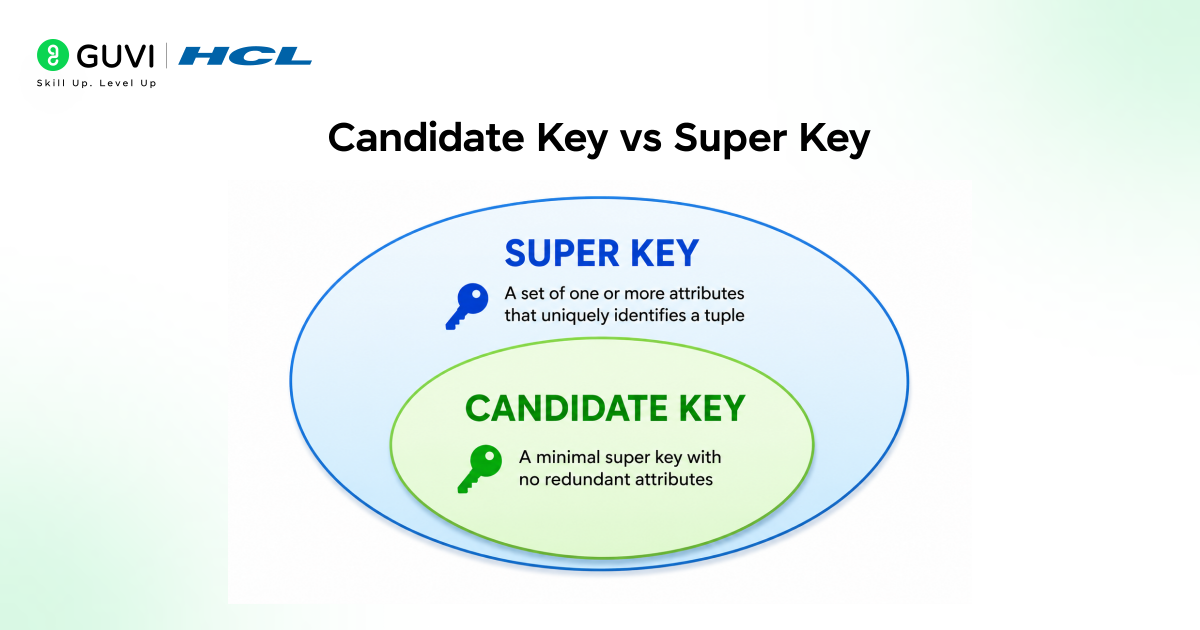
A super key is any set of columns that can uniquely identify a row. A candidate key is a super key with no extra columns in it. Every candidate key is a super key. But not every super key is a candidate key.
Using the student example above, these are all super keys: Student_ID, Email, Phone, (Student_ID + Email), (Student_ID + Phone), (Email + Phone), and (Student_ID + Email + Phone).
But the candidate keys are only: Student_ID, Email, and Phone. The combinations are super keys but not candidate keys because they are not minimal.
Candidate Key and Functional Dependency
Candidate keys are closely related to functional dependencies in relational database theory.
If an attribute or set of attributes can determine all other attributes in a relation, it can be a super key. If that set is also minimal, it is a candidate key.
For example, consider:
Student_ID → Name, Email, Course
If Student_ID determines all the other attributes and no smaller subset can do so, Student_ID is a candidate key.
This concept becomes especially important when finding candidate keys during database normalization.
Candidate Key vs Primary Key
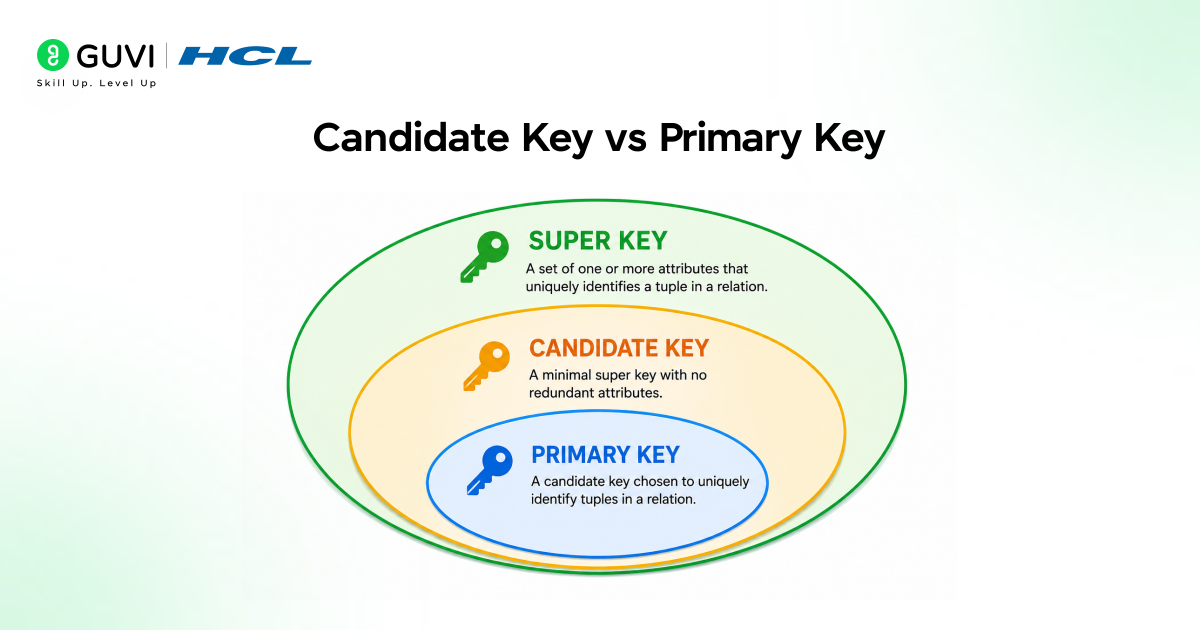
The primary key is the one candidate key that the database designer chooses to be the main identifier for a table. There can only be one primary key per table, but there can be multiple candidate keys.
If a table has Student_ID, Email, and Phone as candidate keys, the designer picks one, say Student_ID, as the primary key. The other two, Email and Phone, do not disappear. They become alternate keys.
The primary key also has one additional rule beyond being a candidate key. It cannot contain null values. A candidate key theoretically allows null in some database systems, but a primary key never allows null.
Candidate Key vs Alternate Key
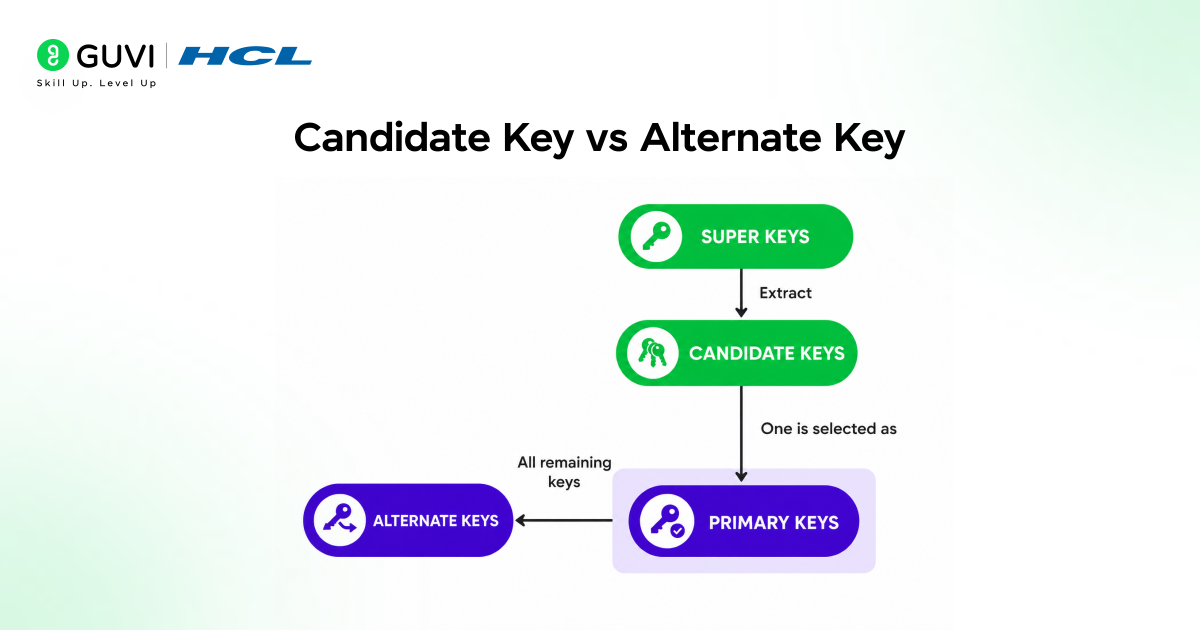
An alternate key is simply a candidate key that was not selected as the primary key. Nothing else changes about it. It is still unique, still minimal, and still a valid way to identify a row. It just was not chosen.
So once you pick Student_ID as the primary key, Email and Phone become alternate keys. They continue to exist and can be used in queries. They just do not carry the “primary” label.
Candidate Key vs Unique Key
A candidate key is a concept from relational database theory: it is a minimal set of attributes that uniquely identifies each tuple.
A UNIQUE constraint, on the other hand, is an SQL feature used to enforce uniqueness on one or more columns. Its behavior regarding NULL values and constraint enforcement can vary between database systems.
So, a column with a UNIQUE constraint may be a candidate key in a particular database design, but the two terms are not interchangeable.
How to Identify Candidate Keys in Any Table
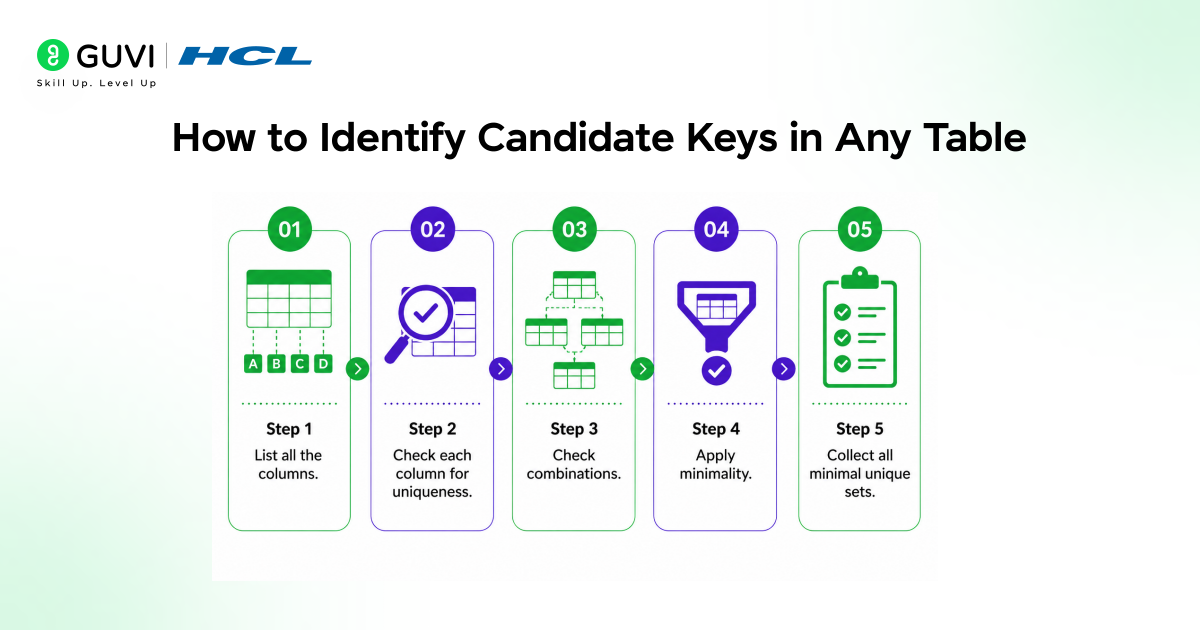
Follow these steps whenever you need to find candidate keys in a table.
Step 1: List all the columns.
Write down every column in the table and think about what each one represents in the real world.
Step 2: Check each column for uniqueness.
Ask yourself whether any two rows could ever have the same value in this column. If yes, it cannot be a candidate key on its own.
Step 3: Check combinations.
If no single column is unique on its own, start combining two columns and check if the combination is unique.
Step 4: Apply minimality.
For every combination you find that is unique, check if you can remove any column and still keep uniqueness. If yes, remove it. Keep trimming until the combination is as small as possible.
Step 5: Collect all minimal unique sets.
Every minimal unique set is a candidate key.
The concept of candidate keys was first formally introduced by Edgar F. Codd in 1970 through his paper “A Relational Model of Data for Large Shared Data Banks”.
This work laid the foundation for primary keys, candidate keys, and database normalization. Nearly every modern database system—from MySQL to PostgreSQL to Oracle—still follows principles defined over 50 years ago.

Real-World Example
- Employee Table:
| Emp_ID | Aadhar_No | Department | Name | |
| E001 | 1234-5678-9012 | [email protected] | HR | Raj |
| E002 | 2345-6789-0123 | [email protected] | IT | Priya |
| E003 | 3456-7890-1234 | [email protected] | Finance | Arjun |
Here, Emp_ID is unique for every employee. Aadhar_No is a government-issued number, unique to every individual. Email is also unique per employee.
Name and Department can repeat across rows, so they cannot be candidate keys.
The candidate keys here are: Emp_ID, Aadhar_No, and Email.
Combinations like (Emp_ID + Aadhar_No) are super keys but not candidate keys because Emp_ID alone already works.
- Order Table
| Order_ID | Product_ID | Customer_ID | Quantity | Date |
| O001 | P01 | C001 | 2 | 2024-01-01 |
| O001 | P02 | C001 | 1 | 2024-01-01 |
| O002 | P01 | C002 | 3 | 2024-01-02 |
In this table, Order_ID alone is not unique. The same order O001 appears in two rows because a single order can contain multiple products.
Product_ID alone is also not unique. P01 appears in two rows.
But the combination of Order_ID and Product_ID is unique. No two rows share the same combination. And you cannot remove either column from this combination because neither alone gives you uniqueness.
So the candidate key here is: (Order_ID, Product_ID). This is called a composite candidate key.
Composite Candidate Keys
When a single column cannot uniquely identify a row, you need two or more columns together. This is called a composite key. When that composite key is also minimal, it becomes a composite candidate key.
Composite candidate keys are very common in junction tables, which are tables that connect two other tables together. For example, a table recording which students are enrolled in which courses might have columns like Student_ID and Course_ID. Neither alone is unique, but together they form the composite candidate key.
A table can technically have only one candidate key, which automatically becomes the primary key with no alternatives.
However, in well-designed real-world databases, most tables include multiple candidate keys. For example, a users table often has a user ID, email address, and phone number—all of which can uniquely identify a record.
Properties of Candidate Keys Summarized
- A candidate key must be unique across all rows in the table at all times, not just at one point in time.
- It must be irreducible, meaning no proper subset of it can also serve as a unique identifier.
- A table must have at least one candidate key. If no column or combination of columns is unique, your table design has a problem.
- A table can have multiple candidate keys. There is no upper limit in theory.
- One candidate key becomes the primary key. The rest become alternate keys.
Common Mistakes to Avoid
- Assuming current uniqueness means permanent uniqueness.
Just because a column has no duplicates right now does not make it a candidate key. Names might be unique today, but two people with the same name might join the organization next year. You need to think about what the column represents, not just what it contains at the moment.
- Forgetting minimality.
Many beginners identify unique combinations but forget to check if they are minimal. Always try removing columns from your combination and see if it still works.
- Using null-prone columns as candidate keys.
If a column might not always have a value, it is a risky choice. A candidate key should ideally be not null for every row.
- Confusing super keys with candidate keys.
Every candidate key is a super key, but not every super key is a candidate key. The difference is minimality.
Why Candidate Keys Matter in Database Design
Candidate keys are not just a theoretical concept. They have direct practical importance.
- They form the basis for choosing your primary key, which drives indexing, query performance, and referential integrity.
- They help you spot design problems early. If you cannot find even one candidate key in a table, your table probably stores data that cannot be uniquely identified, which is a serious design flaw.
- They guide normalization. Many normal forms in database design refer to candidate keys to define rules about how data should be organized.
- They also help during data cleaning. If you know the candidate keys, you can find duplicate rows easily by looking for rows that share the same candidate key value.
If you want to learn more about scanner in Java and its functionalities in the real world, then consider enrolling in HCL GUVI’s Certified Data Science Course which not only gives you theoretical knowledge but also practical knowledge with the help of real-world projects.
Conclusion
A candidate key is one of the foundational ideas in database design. It is a minimal set of columns that can uniquely identify every row in a table. You can have more than one candidate key in a table, but only one becomes the primary key. The others become alternate keys.
To find candidate keys, check each column and each combination of columns for uniqueness, then trim every unique set down to its minimal form. Whatever remains after trimming is a candidate key.
Getting candidate keys right means your database can always find exactly the record it is looking for, no confusion, no duplicates, no ambiguity. That reliability is what makes a well-designed database trustworthy and efficient.
FAQs
1. Can a table have no candidate key?
No. Every valid table must have at least one candidate key. If a table has no unique identifier at all, it violates the basic principles of relational databases. In practice, if no natural candidate key exists, designers create a surrogate key like an auto-incremented ID column.
2. Can a candidate key have null values?
Technically, some database systems allow null in columns that are part of a candidate key if the column is not the primary key. However, it is bad practice. A null value means the identifier is unknown, which defeats the purpose of using it to uniquely identify rows.
3. Is the primary key always the best candidate key?
Not necessarily. The primary key is the chosen candidate key, but the choice depends on factors like stability, simplicity, and size. A shorter, numeric, and non-changing column is usually preferred even if a longer text-based candidate key also exists.
4. Can two different candidate keys share a column?
Yes. For example, if (A, B) and (A, C) are both candidate keys in a table, column A appears in both. This is perfectly valid as long as each combination is unique and minimal on its own.
5. How are candidate keys related to indexes in a database?
When you declare a primary key, the database automatically creates an index on it. Alternate keys can also be indexed to speed up queries that use those columns for searching. Candidate keys are therefore closely tied to query performance and database efficiency.
Success Stories

About the Author
Vishalini Devarajan
An Aerospace Engineer turned content writer, I focus on making complex concepts easy to understand through well-structured, reader-friendly blogs. Whether it’s a technical topic or a non-technical one, I love creating content that is clear, engaging, and impactful.
View all posts by Vishalini Devarajan
Connect with me @
















Did you enjoy this article?