


Artificial Intelligence and Machine Learning Articles
AI/ML Skills Gap 2026: Why Companies Can't Find Job-Ready Talent
20 AI/ML Interview Questions Recruiters Can Use Without a Tech Background - Best Guide
How Industry-Backed AI/ML Bootcamps Are Changing the AI/ML Hiring Pipeline - Best Guide 2026
From IT Support to AI Engineer: A Realistic Career Switch Guide 2026


Get In Touch For Details! Request More Information

Autonomous AI Agents – What They Are & How They Work
Aug 04, 2026 6 Min Read 1025 Views
(Last Updated)
Most software waits.
It waits for a click, a command, or a clearly defined instruction. It does exactly what it is told, nothing more, nothing less. For decades, that has been the fundamental rule of how technology works.
This is where Autonomous AI Agents come into play. Autonomous AI Agents are capable of interpreting a given goal, developing a sequence of actions to achieve this objective, executing these actions, and improving their own methodology without requiring any commands from outside sources.
The paradigm shift from producing “doing tasks” to producing “achieving results” is the reason why Autonomous AI Agents are one of the most significant breakthroughs in artificial intelligence at this time.
In this blog, we will take a look at what Autonomous AI agents are, how they work, their components, types and much more.
Quick Answer:
Autonomous AI Agents are intelligent systems that can independently perform tasks, make decisions, and adapt their actions based on goals and data without constant human intervention.
Table of contents
- What Autonomous AI Agents?
- Major features of Autonomous AI Agents
- How Autonomous AI Agents Work
- Step 1: Goal Input
- Step 2: Planning
- Step 3: Execution
- Step 4: Evaluation
- Step 5: Iteration
- Last Loop: Continuous Improvement
- Components of Autonomous AI Agents
- Perception System
- Reasoning Engine
- Memory Module
- Planning Module
- Action Module
- Types of Autonomous AI Agents
- Reactive Agents
- Model-Based Agents
- Goal-Based Agents
- Utility-Based Agents
- Learning Agents
- Benefits of Autonomous AI Agents
- Increased Efficiency
- Cost Reduction
- Scalability
- Improved Decision-Making
- Continuous Operation
- Challenges of Autonomous AI Agents
- Lack of Transparency
- Data Dependency
- Security Risks
- Ethical Concerns
- Control Issues
- Wrapping it up:
- FAQs
- What are Autonomous AI Agents?
- How are Autonomous AI Agents different from traditional AI?
- Where are Autonomous AI Agents used?
What Autonomous AI Agents?
Autonomous AI Agents are advanced AI systems designed to operate independently. Instead of waiting for step-by-step instructions, they are capable of:
- Understanding the objectives given by users.
- Developing a strategy to attain those goals.
- Performing activities without a constant check.
- Modifying their behavior according to the outcomes and feedback.
Example, if you ask a traditional program to “analyze sales data,” you would need to specify every step. But an autonomous AI agent can:
- Choose the data required.
- Collect and clean the data.
- Analyze trends.
- Generate insights.
- Current findings in a formatted manner.
All these occur with maximum minimal human intervention.
Major features of Autonomous AI Agents
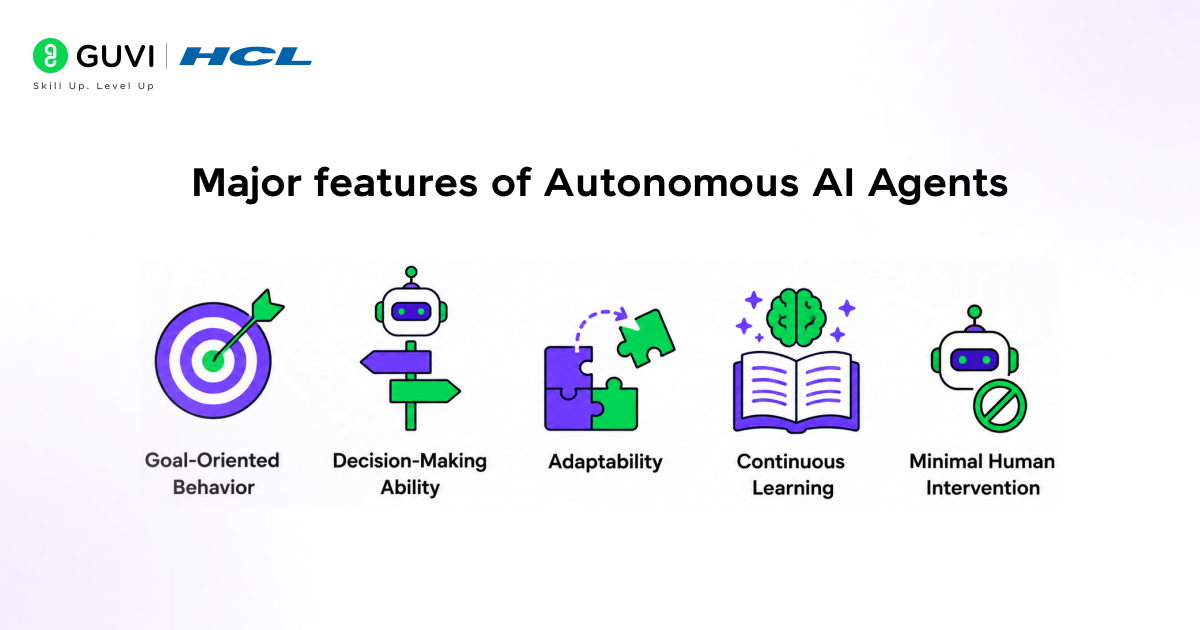
1. Goal-Oriented Behavior: Autonomous AI agents are designed to achieve specific goals rather than just execute commands. Once you define a goal, the agent figures out how to accomplish it step by step.
2. Decision-Making Ability: These agents can weigh the possible options and select the most efficient course of action utilizing data and context.
3. Adaptability: Autonomous AI agents are very adaptable in changing conditions because they can modify their behaviors based on the changes in the environment.
4. Continuous Learning: They can derive out of past experiences and hence their performance increases with time without the need to be reprogrammed continuously.
5. Minimal Human Intervention: These agents do not need constant monitoring and manual input compared to traditional systems.
Also check out: Understanding AI Agent Architecture: How It Works
How Autonomous AI Agents Work
These agents follow a structured loop where they continuously plan, act, evaluate, and improve until they achieve the given goal.
Step 1: Goal Input
It starts with a user giving a specific goal or object to the agent.
- The user gives a high-level instruction instead of detailed steps, such as asking the agent to “create a marketing strategy for a new product.”
- The agent interprets the intent behind the goal using natural language understanding.
- It identifies what success looks like so it can measure whether the task is completed properly.
At this stage the agent is not yet solving the problem but it is knowing what to do.
Step 2: Planning
After grasping the goal, the agent develops a systematic plan towards the goal.
- The agent divides the overall goal into smaller and manageable tasks to ensure that the individual parts are dealt with effectively.
- It arranges these activities in a logical order so that the workflow is effective and worthwhile.
- It determines the tools, data sources, or APIs needed in individual steps.
- It can also rank the tasks according to their importance or the dependencies among tasks.
For example, if the goal is to create a marketing strategy, the agent might plan tasks like researching the target audience, analyzing competitors, identifying suitable marketing channels, and generating campaign ideas.
This is a crucial step as it makes a general objective a specific action plan.
Step 3: Execution
Once the agent plans, it begins to execute the tasks one at a time.
- The agent retrieves the data that is relevant like databases, websites, or APIs.
- It makes use of content generators, analytics, or automation systems to accomplish each task.
- It does things like writing the content, trend analysis, generating reports, or sending outputs.
- It monitors the progress to make sure that everything is done properly.
At this level, the agent is in action towards the goal by transforming plans into actual actions.
Step 4: Evaluation
After the execution of tasks, the agent checks the results to determine whether it is acceptable.
- The agent compares the output with the original goal to see if the objective has been achieved.
- It verifies errors, gaps or places where the output can be refined.
- It may use predefined criteria or feedback signals to measure success.
- It will tell whether the work is done or it requires more polishing.
This is done to make sure that the agent does not merely get through with doing work but also keeps to quality and accuracy.
Step 5: Iteration
If the results are not satisfactory, the agent improves its approach and tries again.
- The agent identifies what went wrong or what could be optimized in the previous attempt.
- It revises its plan or changes some steps to enhance the result.
- It re-runs tasks using superior strategies or with more data.
- This cycle is repeated until the final outcome is achieved.
This form of iteration enables the agent to learn and enhance in the process and thus be more effective with time.
Last Loop: Continuous Improvement
All these steps form a continuous loop:
Goal → Plan → Execute → Evaluate → Improve → Repeat
- The agent continues to repeat these steps until the target is completely met.
- It is able to store insights and learnings even after completion to be utilized in future tasks.
- Over time, the agent becomes faster and more accurate because of this repeated learning process.
Components of Autonomous AI Agents
There are some major components that are used to construct autonomous AI agents to make them functional.
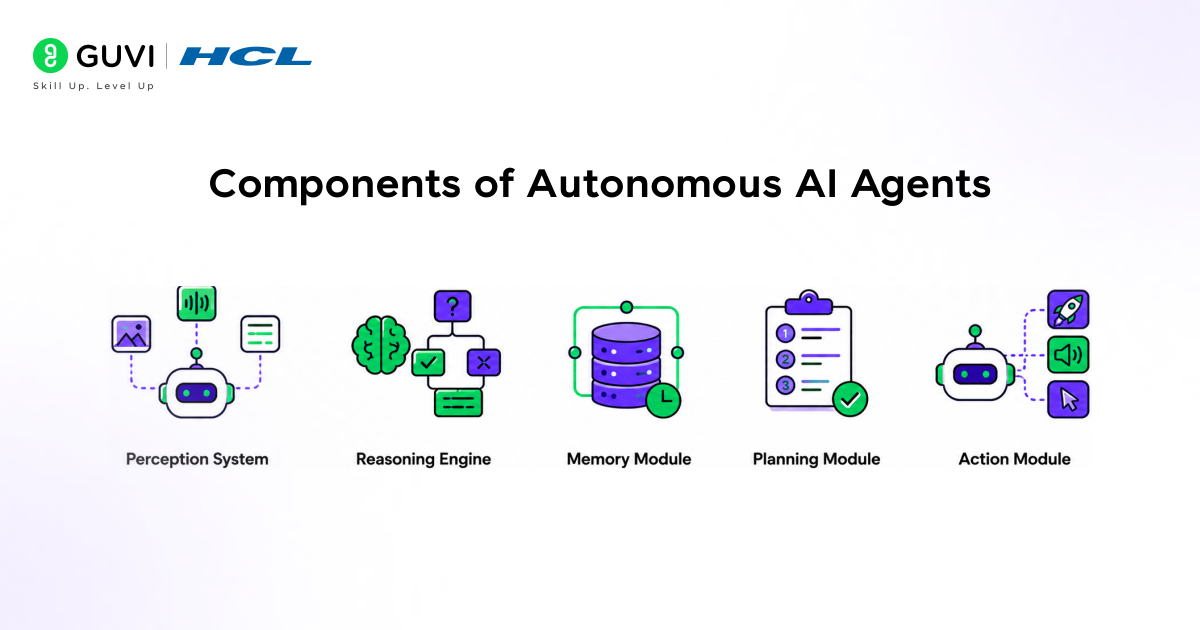
1. Perception System
The perception system enables the agent to receive information about its environment e.g. user inputs, databases or external APIs.
2. Reasoning Engine
The reasoning engine assists the agent in the analysis of information and logical and context-based decisions.
3. Memory Module
The memory module is where past experiences, data and results are stored to enable the agent to learn and improve with time.
4. Planning Module
This module helps the agent create step-by-step strategies to achieve a given goal.
5. Action Module
Action module allows the agent to perform actions, including sending emails, creating content, or executing code.
Also check out: What is AutoGPT? Complete Guide to Building AI Agents (2026)
Types of Autonomous AI Agents
Autonomous AI Agents have various types, and each type deals with a particular type of tasks and circumstances. The main difference between them lies in how they make decisions, how much they rely on past data, and how intelligently they plan their actions.
Let’s break them down in a simple and structured way.
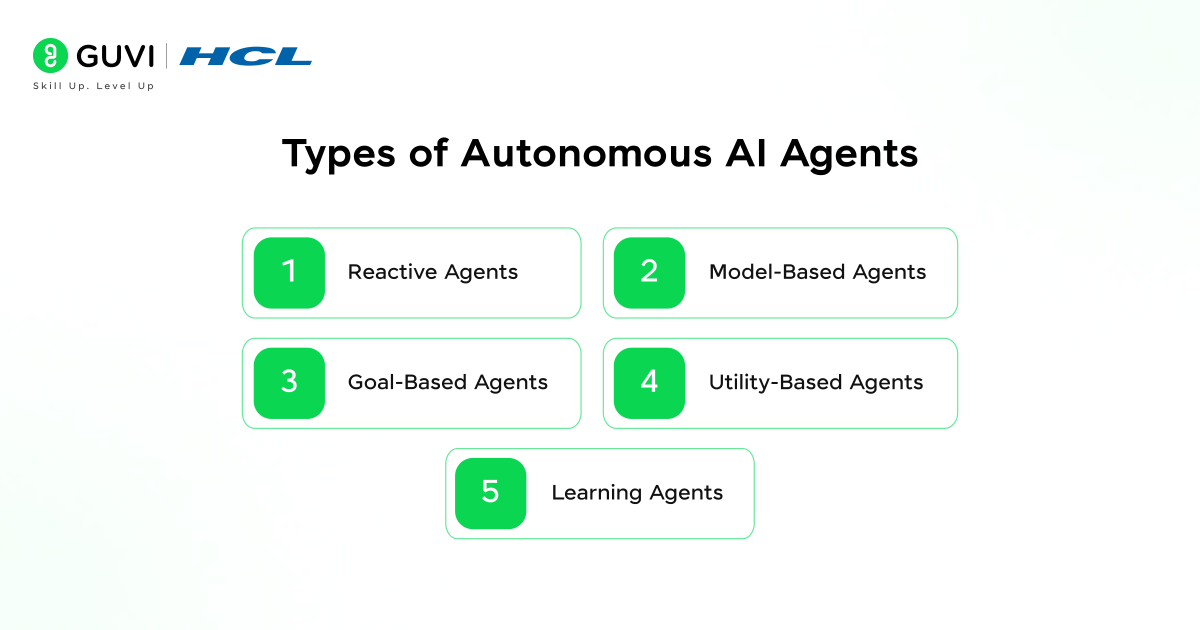
1. Reactive Agents
Reactive agents are the simplest type of autonomous AI agents,because they respond only to what is happening in the present moment.
- These agents cannot store past experiences and therefore they are unable to learn out of past actions.
- They make decisions purely based on current inputs, such as real-time data or immediate conditions.
- They follow pre-determined rules or conditions to determine the next action to take.
- They are very effective in undertaking duties that involve fast responses without a complicated line of reasoning.
For example, a spam filter that detects unwanted emails based on keywords is a reactive agent because it reacts instantly without remembering past emails.

In simple terms, reactive agents are quick and easy, although they have no memory and long-term intelligence.
2. Model-Based Agents
Model-based agents are more advanced because they maintain an internal understanding of their environment.
- These agents remember the previous states; this enables them to know how the environment varies with time.
- Before acting, they rely on this internal model to come up with predictions of what may happen next.
- They can handle situations where not all information is directly visible or available.
- They make better decisions compared to reactive agents because they consider both current input and stored knowledge.
For example, a robot moving around a room recalls the obstacles it has previously met, thus enabling it to move more effectively.
In simple terms, model-based agents think before acting because they understand the environment better.
3. Goal-Based Agents
Goal-based agents, go one step ahead and concentrate on accomplishing a certain goal.
- These agents have a definite objective and they decide on the most appropriate order of actions to achieve the objective.
- They consider the various possible paths and select the one that will result in the desired outcome.
- They have the ability to think several steps ahead rather than respond immediately.
- They are flexible because they can change their strategy if the situation changes.
For example, a navigation system that finds the best route to a destination is a goal-based agent because it plans steps to reach a specific endpoint.
In short, goal-based agents are strategic and goal-oriented since they strive towards a specific goal.
Autonomous AI Agents can break down a complex goal into multiple smaller tasks and execute them without requiring step-by-step human instructions.
Advanced agents can also interact with tools, APIs, and even other AI systems to complete tasks more efficiently, making them far more capable than traditional rule-based automation.
4. Utility-Based Agents
The utility-based agents are even superior since they do not simply strive to accomplish something, but to accomplish it most optimally.
- These agents assign values (or utility) to various possible outcomes.
- They compare various alternatives and select the one that has the greatest benefit or efficiency.
- They consider factors like time, cost, risk, and quality.
- They are best suited in complex circumstances where there are many solutions possible.
For example, a ride-sharing app that selects the fastest and cheapest route is using a utility-based approach.
In simple terms, utility-based agents are able to make smarter decisions because they select the most optimal choice not just any outcome.
5. Learning Agents
The most developed form of autonomous AI agents is learning agents since they improve over time.
- These agents acquire knowledge through historical activities, feedback and results in order to improve their performance.
- They keep on updating their knowledge and adjust to new circumstances.
- They can discover patterns and make superior decisions as they gain experience.
- They reduce errors over time because they learn what works and what doesn’t.
For example, recommendation systems that improve suggestions based on user behavior are learning agents.
Quick note:
Each type of Autonomous AI Agent represents a different level of intelligence:
- Reactive agents focus only on the present.
- Model-based agents understand the environment.
- Goal-based agents plan to achieve objectives.
- Utility-based agents optimize decisions.
- Learning agents continuously improve over time.
Also check out: Claude Opus 4.5 Tutorial: AI Agents and Coding
Benefits of Autonomous AI Agents
Autonomous AI agents offer several advantages that make them highly valuable.
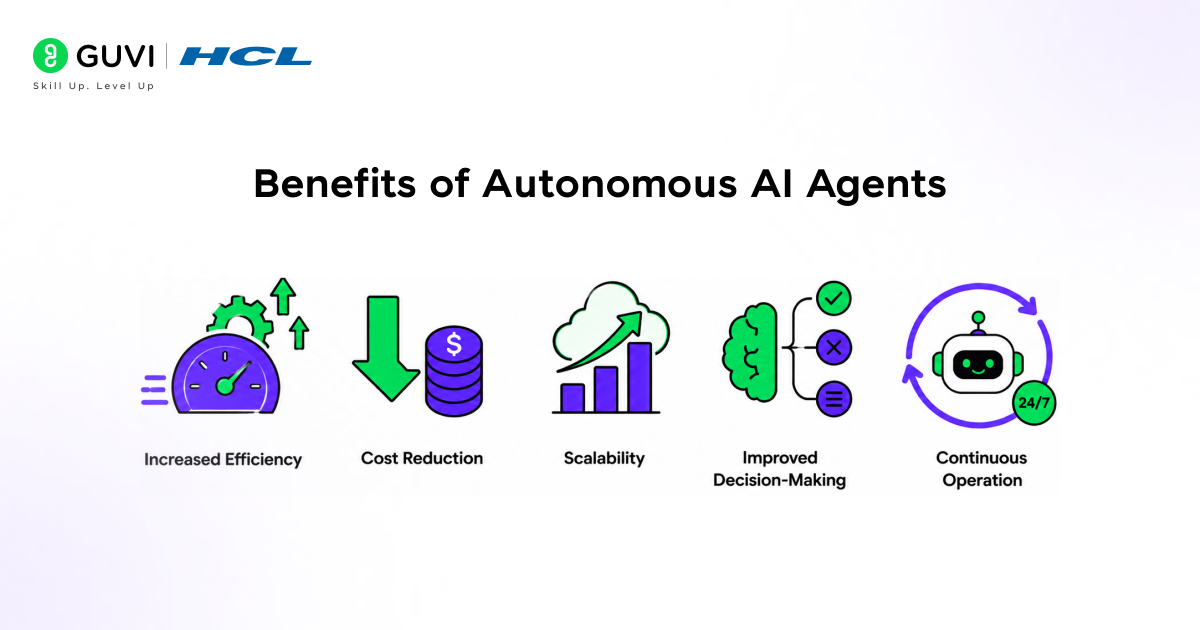
1. Increased Efficiency
These agents are able to work more efficiently by being quicker and more precise than humans, which enhances productivity greatly.
2. Cost Reduction
By automating tasks, businesses can reduce operational costs and minimize the need for manual labor.
3. Scalability
Autonomous AI agents can handle large volumes of work without requiring additional resources.
4. Improved Decision-Making
These agents are able to process big data sets and deliver solutions that assist in taking improved decisions.
5. Continuous Operation
Unlike humans, AI agents are able to work 24/7 without exhaustion.
Challenges of Autonomous AI Agents
Although they are beneficial, Autonomous AI Agents have their challenges.
1. Lack of Transparency
It can be difficult to understand how these agents make decisions, which raises concerns about trust and accountability.
2. Data Dependency
These agents are very dependent on data and inaccurate results can happen when data is of poor quality.
3. Security Risks
Unless secured, autonomous systems can be vulnerable to cyberattacks.
4. Ethical Concerns
There are concerns about job displacement and the ethical use of AI.
5. Control Issues
Giving too much autonomy to AI systems can lead to unpredictable outcomes.
Take your learning beyond theory with HCL GUVI’s AI & Machine Learning Course. Learn Python, build real projects, and master concepts like model routing and multi-model systems.
Wrapping it up:
Autonomous AI Agents are redefining what it means to “use” technology.
Instead of guiding every step, we are beginning to set directions and let intelligent systems handle the execution. This shift is not just about efficiency it is about changing the role of humans from operators to decision-makers.
The real value of these agents lies in their ability to take a goal and turn it into results with minimal intervention. As they continue to improve, they will not just support workflows but reshape them entirely.
In the end, Autonomous AI Agents are not just tools you use they are systems you rely on to get things done.
FAQs
1. What are Autonomous AI Agents?
Autonomous AI Agents are systems that can perform tasks, make decisions, and achieve goals on their own without constant human input.
2. How are Autonomous AI Agents different from traditional AI?
Unlike traditional AI which follows fixed instructions, Autonomous AI agents can plan, act and adapt independently.
3. Where are Autonomous AI Agents used?
They are used in areas like customer support, content creation, healthcare, finance, and automation tools.
Success Stories

About the Author
Vishalini Devarajan
An Aerospace Engineer turned content writer, I focus on making complex concepts easy to understand through well-structured, reader-friendly blogs. Whether it’s a technical topic or a non-technical one, I love creating content that is clear, engaging, and impactful.
View all posts by Vishalini Devarajan
Connect with me @









Did you enjoy this article?